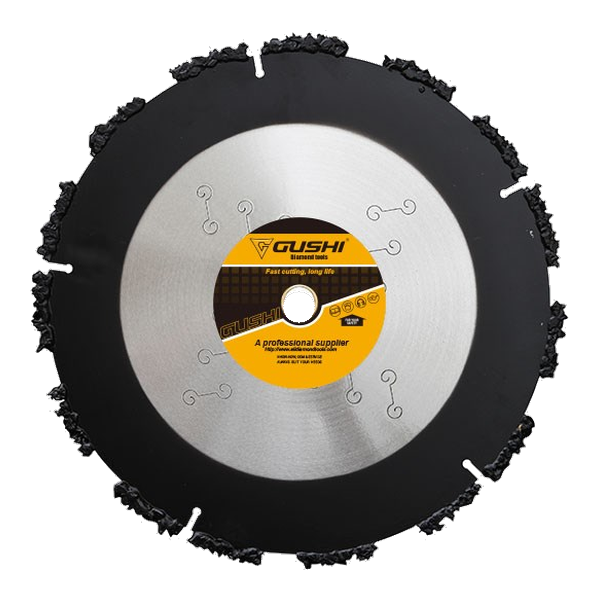
Full Specifications
| Item | HCRDB series fire rescue and root cutter blade |
|---|---|
| Item numbers | 12HCRDB, 14HCRDB, 16HCRDB |
| Diameters | 12, 14 and 16 inch |
| Arbor bore | 16 mm, 22.23 mm or 25.4 mm |
| Tooth size (T x H x W) | 3.2 x 5 x 40 mm |
| Tooth count | 20 or 21 at 12 inch, 24 at 14 inch, 28 at 16 inch |
| Tooth material | Tungsten carbide, 6 to 8 mm pieces |
| Body | Steel, with a noise reduced core |
| Cutting mode | Dry cutting and wet cutting |
| Edge | Symmetric tooth pattern, blade can be reversed on the arbor |
| Applications | Tree roots, roofs, walls, car doors and the metals of automobiles |
| Materials | Light gauge steel, aluminium, bulletproof glass, sheet metal, solid and high density plastic, sheetrock, block, brick, pavers, rubber, branches and stumps |
| Typical users | Forcible entry, extrication, RIT, USAR and demolition crews; concrete, demolition and general commercial contractors |
An Entry Tool, Not a Cutting Tool
In a workshop the sequence is fixed. The material is known, the blade is chosen to suit it, and the only variables left are feed and speed. On a fireground or at a demolition the sequence runs backwards. The crew knows the objective, which is a vent hole, a door, a path through a wall or a root ball out of a trench, and they find out what the material is by putting a blade into it.
That inversion explains nearly every design decision in this blade, and it explains why the specification looks odd beside a masonry blade or a timber blade. A blade tuned for block would have a segmented rim with shallow gullets, and it would load solid in the first metre of rubber or root. A blade tuned for sheet metal would have fine teeth and no clearance for a stringy chip. Neither would survive an hour of not knowing what comes next.
So the blade is deliberately tolerant rather than optimal. It gives up peak performance on every material it touches in exchange for being usable on all of them without a change, which on a roof at three in the morning is the only trade that matters. The crews who buy it are not buying a cutting rate. They are buying the absence of a decision at the door.
One Blade, Three Kinds of Failure
What makes this blade difficult to design is that the materials it is sold for fail in three completely different ways, and each one punishes a different part of the tooth. Get the geometry right for one family and it is wrong for the next, which is why the compromise is visible in the tooth shape.
The first family is hard and brittle: block, brick, pavers, sheetrock and the glass layers of a laminate. These do not cut so much as score and break. Push too hard and the edge chips, the material spalls ahead of the blade and the cut line wanders. The technique is shallow passes and patience, letting the tooth break the surface it has scored.
The second family is soft and gummy: aluminium, solid and high density plastic, rubber, and green root. These smear instead of clearing. The chip welds itself into the space behind the tooth, the blade stops cutting while it is still sharp, and the heat that builds goes into the body rather than into the material. This is the family that punishes a tight rim, and it is the reason the gullets are as large as they are.
The third family is thin and tough: light gauge steel, sheet metal, the skin of a car door, aluminium panel. Here the material does not resist the tooth so much as tear and whip. The sheet grabs, the blade climbs, and the finished edge is a ragged line with burrs on both sides. Thin material also closes on the blade behind the cut, which pinches a thin kerf harder than a thick one.
| Family | Typical material | What goes wrong | What the operator does |
|---|---|---|---|
| Hard and brittle | Block, brick, pavers, sheetrock, glass layers | Edge chips, face spalls ahead of the cut, line wanders | Shallow passes, let the tooth score and break |
| Soft and gummy | Aluminium, plastic, rubber, green root | Loading behind the tooth, blade stops cutting while still sharp | Light pressure, keep the blade moving, clear the loading |
| Thin and tough | Sheet metal, car door skin, light gauge steel | Sheet tears and whips, blade climbs, burred edge | Support the sheet, approach below the work, steady feed |
Why the Teeth Are Long and Few
The published tooth is 3.2 mm thick, 5 mm high and 40 mm long. Those three numbers describe a ripping tooth rather than a sawing tooth: shallow, long and widely spaced, with the clearance behind it doing as much work as the edge itself.
The spacing is worth doing the arithmetic on, because it shows how the series was laid out. At 12 inch the rim is about 957 mm around, and 20 teeth of 40 mm occupy 800 mm of it, leaving roughly 157 mm of gap shared between them, near enough 8 mm per tooth. At 16 inch the rim is about 1277 mm, 28 teeth take 1120 mm, and the leftover gap is again about 157 mm, or about 5.6 mm per tooth. The factory has not made the teeth bigger as the blade grew. It has kept the tooth length fixed and added teeth, which holds the pitch between roughly 45 and 48 mm on all three sizes.
Why only 5 mm of tooth height, when masonry segments run far deeper? Because depth of tooth is wear reserve, and this blade is not bought for wear reserve. A shallow tooth keeps the rim light, keeps the kerf narrow and keeps the pressure per tooth low enough that a brittle face is scored rather than shattered. The price is that the usable depth is short, and the answer to that price is not a taller tooth but the reversible mounting described next.
The 3.2 mm kerf is the other half of the same argument. On a 16 inch blade that is well under one percent of the diameter, so the body is thin enough to be steered by hand and thin enough that the material removed is a slot rather than a groove. It also means the blade has to be used straight: a thin body will not forgive being levered sideways in a cut.
The Reversible Edge
On a symmetric tooth pattern, every tooth presents the same profile to the work whichever way the blade is mounted. Turn the blade over on the arbor and the flank that was trailing becomes the flank that leads. The corner in contact with the material is a corner that has not been in contact before, so a blade that had begun to burnish its way through a roof deck starts cutting again with a fresh edge.
What it buys is a second life from the same 5 mm of tooth height, which is exactly the reserve the shallow tooth gave up. On a blade whose usable depth is deliberately short, doubling the number of usable edges is the difference between one shift and two, and it costs nothing in the factory beyond cutting the pattern symmetrically.
What it does not do is worth stating plainly. Reversing presents an unused edge; it does not create one. A tooth that has lost its carbide, cracked at the braze or been run hot until the carbide went soft is not repaired by turning the blade over, and reversing a damaged blade just puts the damage on the leading side. The check before flipping is a look at every tooth, not a glance at the rim.
The Quiet Core
The body is described as having a noise reduced core, and on a rescue blade that is a working feature rather than a comfort extra. A plain steel disc of this diameter rings at its own resonant frequency once it is up to speed, and the ring sits on top of speech, radio traffic and the sound of the structure itself.
Think about what an operator is listening to while the saw is running. The radio in the pocket, the officer giving instructions, the creak of a roof under load and the change in note when a blade breaks through into a void instead of meeting timber. A blade that drowns all four costs seconds on every cut, and seconds are the currency of the job. The core treatment damps the ring so those signals stay audible.
There is a second effect that matters over a shift rather than a minute. Noise at the ear is cumulative, and the fatigue it produces shows up as heavier hands and worse judgement later in the day, at exactly the point where the work is most dangerous. A quieter blade does not remove the need for hearing protection, and nobody should run a saw without it, but it reduces what the protection has to absorb.
Dry Cutting and Wet Cutting
Both modes are listed for this blade, which is less common than it sounds. Wet cutting on a carbide tipped steel body carries none of the risk it carries on a resin bonded abrasive wheel, where water attacks the bond, and none of the thermal shock problem that a brazed diamond rim can suffer. Water on this blade does two useful things and one that is merely convenient.
The useful pair is dust and heat. Cutting block, brick, pavers and concrete raises silica dust at the cut, and water suppresses it at the source rather than relying on a mask downstream. The same water carries heat out of the tooth, which matters on a long cut where the tooth is spending most of its time in contact with a hard, brittle face that is doing its own work of chipping the edge.
In rescue and roof work there is usually no water. That is not a failure of the blade, it is the nature of the call: nobody is holding a hose on a vertical vent cut, and the blade is expected to run dry for as long as the job takes. Dry cutting is the default, and the design leans on the low tooth pressure and the large gullets to keep the temperature survivable without a coolant.
Sizing the Blade to the Saw
Depth of cut follows the radius, minus whatever the hub and the guard occupy. At 12 inch that is about 150 mm, at 14 inch about 175 mm and at 16 inch about 200 mm, which is geometry rather than a rating. What that means in practice is that a 12 inch blade will go through a roof deck and a wall in one pass, while a 16 inch blade will do the same and still have depth left for a thicker assembly or a cut made at an angle.
The bore is the specification people get wrong. This series is made in 16 mm, 22.23 mm and 25.4 mm, and those are not interchangeable in service. A bushing that sits even slightly loose in the bore lets the blade shift on the arbor, and a blade that shifts rings, chatters and wears its teeth unevenly. Order the bore that matches the saw spindle, and treat an adapter as a temporary measure rather than a specification.
Matching diameter to machine is the last decision and the easiest. Most rescue saws are built around 12 or 14 inch blades, and the saw’s guard and its marked capacity decide the upper limit. Larger cut off saws and demolition saws take 14 or 16 inch. A bigger blade adds mass to accelerate, which is felt on every start, and adds length to the lever if the blade catches, which is felt once and remembered. Go to 16 inch because the work needs the depth, not because it is available.
Roofs and Roots: One Blade, Two Jobs
Ventilation and entry
A roof cut starts with standing on the structure rather than on the surface being cut. Rafters or trusses carry weight; decking and tile do not. Cut from the upwind side so the smoke and the debris leave away from the operator, keep the blade shallow so it does not break through and drop the saw into the space below, and expect the note of the saw to change the instant it clears the deck. A triangular or square opening is easier to work to than a line, and a full depth plunge in one corner is safer than a shallow pass across the whole shape.
Wall and door work is the same blade in a tighter space. A car door is a steel skin over a window run, a side impact beam and a wiring loom, so the blade crosses air gaps and hard spots within the depth of the door; feed by feel, and do not lever when it snags. A laminate glass panel is glass, polymer, glass, polymer, and the blade has to get through both the hard layers and the plastic ones that want to smear.
Roots, branches and stumps
Root cutting is where the blade meets its real abrasive. Soil is a grinding compound, and a root pulled out of the ground carries it in every crevice of the bark. Knock the soil off before the blade goes in, and the tooth will last noticeably longer for the thirty seconds it cost.
Cut where the root enters the ground rather than at mid span. A root under tension from a leaning tree or a lifted slab will spring when it is severed, and a root under compression will pinch the blade. Stumps are cross cut at the highest point within reach, with the same warning about surface grit. And a root ball brings stones: a stone caught between tooth and cut is how a carbide tip is lost, so if the saw starts to ring or jump, stop and look at the rim before going on.
Kickback, Guard and Grip
Every circular blade has a kickback zone and this one is used in a way that finds it more often than most. The zone is the top of the blade, where the teeth are moving towards the operator. When a tooth in that arc bites and the material cannot give, the saw is driven up and back out of the cut, and the operator’s hands go with it.
Rescue work puts the blade there deliberately. A vent cut made from above, a plunge into a door or a cut started in a corner all bring the top of the blade into contact before the bottom, because that is the only angle the structure allows. The mitigation is not to avoid the technique but to control it: bring the blade to full speed before it touches, enter at a shallow angle, keep both hands on the saw with the rear handle held as intended, and stand to the side of the cut line rather than in it.
Two habits carry most of the safety on this blade. The first is the guard: it stays on, and it is set so the exposed arc is only what the cut needs. The second is the post cut check, because a blade that has just been through a car door or a roof with conduit in it may be missing a tooth, and a missing tooth puts double load on the one behind it. Look at the rim before the next cut, not after the next failure.
When the Cut Goes Wrong
Most of what goes wrong with this blade is technique rather than the blade, and almost all of it shows up as one of six symptoms. The causes are worth knowing because the instinctive response is usually the wrong one.
| Symptom | What it usually means | What to do |
|---|---|---|
| Blade stops cutting in rubber, plastic or root while still sharp | The chip has loaded the gullets and the tooth is rubbing rather than cutting | Back out, run the blade free of the cut to throw the chip, then lighten the feed |
| Blue or black burnishing along a steel cut | Too much pressure for the speed, so heat is going into the sheet instead of the chip | Reduce pressure, keep the saw at full speed, let the tooth take a chip |
| Saw climbs out of the cut | Teeth contacting the top arc and biting instead of sliding | Enter from the other side or bring the blade in below the work |
| Cut line wanders in block or brick | Too much depth in one pass, so the blade follows the spall | Shallow scoring pass first, then a second pass to depth |
| Blade rings or chatters | Loose arbor nut, worn flanges, or an adapter bushing that does not fit | Check the flange faces and fit the correct bore |
| One tooth gone, neighbours wearing fast | A stone, a nail or a hard inclusion was hit and the balance of the rim has shifted | Stop, inspect every tooth, and retire the blade if more than one is damaged |
For work where the blade is the wrong tool rather than the technique being wrong, the catalogue has the right one. A TCT ripping saw blade is the blade for clean timber where the cut is the product, and the version with wiper teeth clears the kerf on deep rips. Concrete without the mixed load wants a brazed concrete diamond cutting blade or a dry cutting segmented blade, asphalt wants the aggressive asphalt and concrete blade, and a clean edge in masonry or tile wants a continuous rim blade instead of a ripping tooth.
Private Label and Export Supply
What can be set for a private label order: the diameter and tooth count for each size, the arbor bore, the body print on both faces, the reversible marking, the sleeve or wallet print and the carton print. Where a distributor sells into more than one market, splitting the bores across a single order is normal, since 22.23 mm and 25.4 mm are the two spindle sizes that cover most of the saws in service.
The information that makes a quotation useful is short. Send the saw models you sell for, the bore each one uses, the material mix your market actually cuts, and whether the blade will be sold to fire services or to contractors. A rescue buyer wants the noise reduced core and the reversible marking explained on the packaging. A contractor buyer wants the tooth count and the depth of cut on the front of the sleeve.
For the range around this blade, the same body and tooth technology appears in the hot pressed segmented blade for general masonry, the hand held saw blade for smaller machines, and the carbide grit cup wheels where the same brazed carbide approach is used for grinding rather than cutting. Where a job needs a hole rather than a slot, the concrete core drill bits and the diamond segments for core drills cover it, and for reinforced concrete cut at depth the sintered diamond wire saw is the alternative to any circular blade.
Frequently Asked Questions
- What is a fire rescue and root cutter blade?
- A carbide tipped circular blade for a saw pointed at a surface nobody has opened yet. It is expected to take a roof deck, a wall, a car door, sheet metal, block, brick and a tree root, often in one shift. Teeth are 3.2 by 5 by 40 mm on a noise reduced steel body, and the blade reverses on the arbor.
- What materials will it cut?
- Light gauge steel, aluminium, bulletproof glass, car doors, sheet metal, solid and high density plastic, sheetrock, block, brick, pavers, rubber, tree roots, branches and stumps, dry or wet. It is not a precision blade and it is not built for production cutting of one material all day.
- Can it really cut a car door or bulletproof glass?
- Yes, and technique matters more than the blade. A car door is skin over a window run, an impact beam and wiring, so the blade crosses voids and hard spots inside 90 mm of depth: feed by feel, do not lever. Laminate glass is glass and polymer alternately, so it wants a steady pass rather than pressure.
- What does reversing the blade actually do?
- The tooth pattern is symmetric, so turning the blade over on the arbor puts the opposite flank of every tooth into the work. The trailing edge becomes the leading edge and the blade cuts again on a fresh corner. It restores a dulled edge, not a tooth that has lost carbide or been overheated.
- Why is there so much space between the teeth?
- Because the blade clears stringy material, not dust. Rubber, plastic and root come off in long chips that pack a tight rim solid within a metre. A 40 mm tooth leaves a deep gullet behind it, and pitch stays between roughly 45 and 48 mm at all three diameters, so every tooth has somewhere to throw the chip.
- Will it cut tree roots and stumps?
- Yes, that is half the name. Cut where the root enters the ground, not at mid span, and knock the soil off the bark first because it is grit, not wood, that wears a carbide tooth. A root under tension will spring when severed. Stumps are cross cut at the highest point within reach.
- Should it be used dry or wet?
- Both are listed and the choice belongs to the job. Dry is the default on a roof or in a rescue, where nobody holds a hose. Wet is worth it on block, brick, pavers and concrete, because water suppresses silica dust at the cut and cools the tooth. Steel and carbide take water without harm.
- Which arbor bore do I need?
- The blade is made in 16 mm, 22.23 mm and 25.4 mm. 22.23 mm is the 7/8 inch bore on most petrol rescue saws and hand held cut off machines, 25.4 mm is the 1 inch bore on larger saws, 16 mm suits smaller machines. Order the bore to the saw rather than an adapter to the bore.
- Which diameter should I order, 12, 14 or 16 inch?
- 12 inch reaches about 150 mm deep, 14 inch about 175 mm and 16 inch about 200 mm, which is the radius less what the hub and guard take. A bigger blade also adds mass to accelerate and length to the lever if it catches. Most rescue work is 12 or 14 inch; 16 inch belongs on larger saws and demolition.
- Why does the core need to be noise reduced?
- A plain steel disc rings at its own resonant frequency, loud enough to sit on top of speech and radio traffic. On a fireground the radio and the crew behind the wall are what an operator must still hear, so a damped core is a working feature, not a comfort one. It also cuts fatigue over a shift.
- Will it cut block, brick and pavers?
- Yes. Masonry is hard and brittle, so the tooth has to score and break it rather than push through: keep passes shallow and do not lean on the saw to force depth. A cut that wanders in block is usually a cut taken too deep in one pass. Wet cutting is worth using here for the dust alone.
- Can you supply it under our brand?
- Yes. Body print, bore, tooth count, diameter and carton print are made to order, and the reversible marking can be printed on both faces so a crew can see which way the blade is running after it has been turned. Send the saw models and the material mix your market cuts.