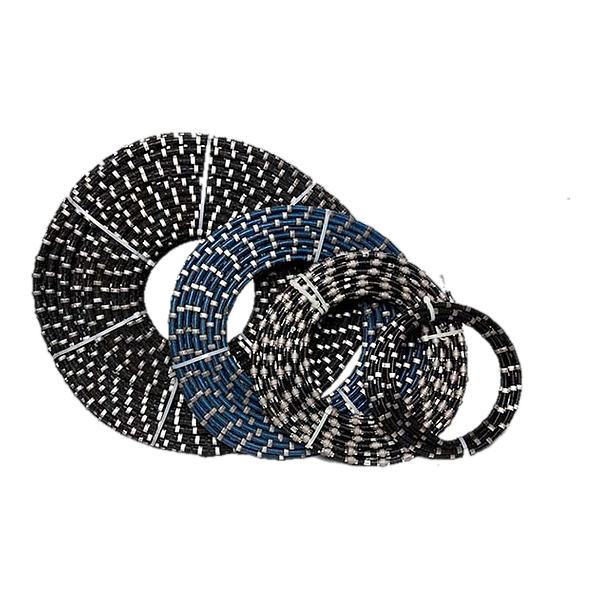
Full Specifications
| Item | HCDWS series sintered diamond wire saw |
|---|---|
| Bead type | Sintered diamond bead, cobalt based bond matrix |
| Bead diameter | 10.5 mm standard; 6.3, 7.2, 8.3, 8.8, 11.0 and 11.5 mm available |
| Beads per metre | 40 standard; 28, 33 and 37 available |
| Bead length | Approx. 5.8 to 6.4 mm working layer, depending on diameter |
| Fixing method | Rubber injection standard; spring, plastic, and rubber with spring available |
| Rope | High tensile steel wire rope, 4.9 mm core rope for 10.5 mm beads |
| Joint | Ferrule crimp with moulded rubber sleeve or spring cover |
| Loop length | Made to order, from 50 m upward |
| Kerf width | Approx. 11 to 12 mm with 10.5 mm beads |
| Cutting materials | Reinforced concrete, hard concrete, granite, marble, steel jacketed structures |
| Machines | Quarry wire saws, stationary and block squaring machines, profile saws, multi-wire machines |
| Cooling | Water flush at both wire entry points; wet cutting as standard |
| Packing | Coil on reel, PVC wrap, export carton; approx. 17 to 19 kg per 50 m |
| Certification | ISO 9001 quality system, CE marking, EN13236 declaration |
| MOQ | 50 metres, mixed builds accepted |
| Lead time | 20 to 30 days after confirmation |
Bead diameter, bead count and fixing are confirmed against your machine model and material before production. Values above describe the standard concrete and granite build.
How a Sintered Diamond Wire Saw Cuts
Cutting happens at the bead, and only at the bead. Each sintered bead is a ring of diamond particles held in a metal bond matrix, pressed and sintered so the diamond sits through the full working layer rather than only on the surface. As the bead grinds, the bond wears back at a controlled rate and fresh diamond is exposed behind it. That balance between bond wear and diamond wear is what makes the tool self sharpening.
The rope’s job is different. It carries the beads, holds them at a fixed spacing, and transmits tension from the drive pulley around the loop. Tension is what converts pulley rotation into cutting force at the bead. Too little tension and the rope bows in the cut, the kerf wanders, and beads wear on one side. Too much and the rope fatigues at the joint.
Water does three things at once: it cools the bead so the bond does not soften, it flushes cement paste or stone slurry out of the kerf so the bead always meets fresh material, and it carries the cuttings away from the machine. On concrete, the paste is the real problem. It sets quickly, packs around the bead, and stops the diamond from touching anything. A wire that suddenly stops cutting is usually a wire that is not being flushed.
Because the loop is flexible, it can be threaded through a 60 mm core hole drilled in a wall and then closed around the section to be removed. This is why wire sawing is used for openings, wall removal and bridge section replacement where a circular saw cannot physically reach. The cut is made from the inside out, in one continuous pass, with no overcut at the corners.
Key Features
1. Sintered beads, not just coated
The diamond runs through the whole working layer of a sintered bead. As the outer layer wears, new diamond is exposed, so the bead keeps cutting at a consistent rate until the layer is used up. That is what makes wire life predictable: the bead does not run out of diamond all at once, it wears down gradually and stays usable until the working layer is spent.
2. Rubber injection fixing holds bead spacing under load
Rubber injection moulds a continuous jacket between and around the beads. The beads cannot creep along the rope, so the 40 per metre spacing you ordered is the spacing you run for the life of the wire. The jacket also keeps slurry out of the rope strands, which is where most wire failures begin.
3. Constant kerf, straight cut
A 10.5 mm bead cuts an 11 to 12 mm kerf from the first metre to the last, because bead diameter changes only slowly as it wears. That means the cut stays straight and the removed section stays dimensionally predictable, which matters when a cut wall is going to be reused or when a quarry block has to meet a size order.
4. Low vibration, low noise, no dust plume
The wire grinds rather than strikes. There is no impact loading and no rotating disc, so vibration transmitted into the surrounding structure is minimal and noise stays well below a circular saw. With water flush there is no airborne dust plume, which is often the deciding factor on occupied buildings and in quarries near housing.
5. Custom loop length, made to your machine
Loops are made to order, from 50 m upward, with the joint moulded at our works. We need the machine model, pulley diameter, and the loop length measured on your machine with the tensioner at mid travel. Getting that measurement right is worth more than any other single detail in the order.
6. Bond matched to material
Concrete and granite do not wear a bead the same way. We match bond hardness, diamond type and bead spacing to the material you are cutting, so the bead neither glazes on hard stone nor dissolves in abrasive concrete. Tell us the material and its condition and the build follows from that.
Choosing the Build
Four things decide the build: what you are cutting, how hard it is, which machine drives it, and what finish the cut needs. The table below gives typical reference builds. It is a starting point for a quote, not a substitute for telling us your job.
| Application | Bead dia. | Beads / m | Fixing | Typical wire speed |
|---|---|---|---|---|
| Normal reinforced concrete | 10.5 mm | 40 | Rubber, or rubber with spring | 22 – 25 m/s |
| Heavily reinforced concrete | 11.0 – 11.5 mm | 40 | Rubber with spring | 18 – 22 m/s |
| Steel jacketed structure | 11.5 mm | 40 | Spring | 12 – 15 m/s |
| Granite quarry, soft to medium | 10.5 – 11.0 mm | 40 | Rubber | 25 – 30 m/s |
| Granite quarry, hard | 11.0 – 11.5 mm | 40 | Rubber | 18 – 22 m/s |
| Marble quarry | 10.5 – 11.0 mm | 33 – 37 | Spring or plastic | 30 – 40 m/s |
| Block squaring, stationary machine | 8.8 – 10.5 mm | 37 | Plastic | 20 – 28 m/s |
| Profiling and shaping | 8.3 – 9.0 mm | 37 | Plastic | 18 – 28 m/s |
| Multi-wire machine | 6.3 – 8.3 mm | 37 | Plastic | 26 – 32 m/s |
Bead Fixing Options
The fixing is the layer between the beads. It looks like a detail and behaves like a specification, because it controls how the beads are held, how the rope is protected and how well the kerf clears.
| Fixing | How it is made | Where it suits | What to know |
|---|---|---|---|
| Rubber injection | Rubber is moulded around and between the beads under pressure | Reinforced concrete, granite quarry, general heavy cutting | Tightest bead grip and best rope protection. Heavier and slightly stiffer in the kerf. |
| Spring | A steel coil sits between beads, holding spacing mechanically | Marble, steel jacketed structures, profiled cuts | Flexes well and clears debris easily. Less sealing against fine slurry. |
| Plastic | A thin hard plastic jacket is extruded over the rope between beads | Block squaring, profiling, multi-wire machines | Lowest profile and tightest kerf. Least shock absorption, so watch feed on start-up. |
| Rubber with spring | Rubber jacket with an internal spring section at the bead gap | Heavily reinforced concrete, mixed concrete and steel | The compromise build when the cut contains both concrete and structural steel. |
Running Parameters
The numbers below are reference starting points collected from common jobs. Treat them as a place to begin, then adjust to what the wire tells you. The wire is the instrument: its sound, its slurry, and the shape of the bead wear are all feedback.
| Material | Wire speed | Typical cutting rate | Typical life |
|---|---|---|---|
| Reinforced concrete, wet | 22 – 25 m/s | 2.0 – 5.0 m²/h | 2 – 6 m²/m |
| Reinforced concrete, dry | 18 – 22 m/s | 1.0 – 2.5 m²/h | 2 – 3 m²/m |
| Reinforced concrete, underwater | 12 – 15 m/s | 1.0 – 2.0 m²/h | 2 – 3 m²/m |
| Steel structure cutting | 12 – 15 m/s | 0.5 – 1.0 m²/h | 0.5 – 1.0 m²/m |
| Granite, soft | 25 – 30 m/s | 8 – 15 m²/h | 20 – 30 m²/m |
| Granite, medium | 22 – 25 m/s | 4 – 8 m²/h | 10 – 20 m²/m |
| Granite, hard | 18 – 22 m/s | 2 – 4 m²/h | 7 – 15 m²/m |
| Marble, soft | 30 – 40 m/s | 12 – 20 m²/h | 35 – 65 m²/m |
Applications
| Sector | Typical work | Why wire sawing |
|---|---|---|
| Building and civil | Door and window openings, lift shafts, stair cores, wall section removal | Reaches through a drilled hole, cuts from inside the structure, leaves a clean square opening with no overcut |
| Infrastructure | Bridge deck and pier section removal, dam and culvert cutting, tunnel breakthrough | Cuts thick reinforced sections in one pass where a blade cannot reach and explosive methods are not allowed |
| Marine and underwater | Pier and quay demolition, pipeline and pile removal | Operates submerged with no dust and no thermal shock to the surrounding concrete |
| Quarrying | Granite and marble block extraction, bench cutting | Produces square blocks with a narrow kerf, so more of the deposit becomes saleable stone |
| Stone processing | Block squaring, slab profiling, shaped and curved cutting | Follows curved and complex profiles that a circular blade cannot produce |
| Steel and composite | Steel jacketed concrete, pipe sections, composite structures | Cuts mixed concrete and steel in a single operation with a spring fixed build |
For straight sawing of slabs, blocks and tiles rather than structural sections, the matching tools are on our marble cutting blade, turbo granite cutting blade and continuous rim diamond saw blade pages. For concrete work with a circular machine, see brazed concrete diamond cutting blade and laser welded diamond blade. Replacement beads and spare parts are listed under wire saw beads.
Jointing, Setup and Tension
A wire saw is only as good as its loop. Most of the failures we are asked about are joint or setup problems, not bead problems. The sequence below is the one that keeps loops running.
- Measure the loop on the machine. Set the tensioner at mid travel, run a measuring rope around the pulleys and through the cut path, and record that length. A loop made to a drawing rather than to the machine is a loop that will not tension correctly.
- Check pulley condition before mounting. Run a finger around each pulley groove. A seized bearing or a grooved, worn pulley will destroy the rope at that point within hours, and it will look like a wire fault when it is not.
- Mount with the joint away from the cut. Start the loop so the joint passes over the pulleys on open rope, and watch it through the first few revolutions. A joint that jumps or clicks needs re-setting before you load it.
- Tension to the machine maker’s figure. Bring tension up gradually while the loop is turning slowly, and stop at the specified value. Over-tensioning shortens rope life at the joint and does not make the wire cut faster.
- Align the pulleys to the cut plane. The wire must enter and leave the kerf in line. Even a small angle error puts a side load on the bead and produces the saddle wear described above.
- Establish water before load. Water must be flowing and visible at both entry points before the wire is fed into the material, not after. Starting dry for even a few seconds glazes the bead surface.
- Feed in slowly for the first cut. Bring the wire into contact and let it establish a groove. Do not force initial penetration; the wire needs a groove to guide it before it will track straight.
Breaking In a New Wire
Break-in is the single step most often skipped and most expensive to skip. A new sintered bead arrives with diamond held deep in the bond and a relatively closed surface. Until the bond wears back, the bead cannot cut efficiently, and if it is pushed hard in that state it glazes instead of sharpening.
- Run the first 30 to 60 minutes at about 70 to 80 percent of your normal wire speed.
- Keep the feed light. The aim is steady contact, not maximum removal rate.
- Cut the material you actually intend to cut. Breaking in on a different stone leaves the bead matched to the wrong wear regime.
- Watch the slurry: it should turn the colour of the material being cut. If it stays clear, the bead is not cutting.
- After break-in, bring speed and feed up in steps over the next hour rather than jumping straight to working values.
Troubleshooting
| Symptom | Most likely cause | What to do |
|---|---|---|
| Wire stops cutting, bead looks polished | Bead glazed: speed too high, feed too light, or water not reaching the kerf | Cut speed about 20 percent, raise feed, confirm flow at both entry points, run 20 to 30 minutes |
| Kerf wanders off line | Uneven bead wear, misaligned pulley, or low tension | Check pulley alignment first, then tension, then turn the wire end for end to even the wear |
| Frequent bead breakage | Seized pulley bearing, kinked rope at the joint, feed too aggressive for rebar density | Spin every pulley by hand, inspect the joint sleeve, reduce feed through rebar |
| Rope breaks at the joint | Loop length wrong so tension runs at the end of travel, or repeated over-tensioning | Re-measure the loop on the machine with the tensioner centred, replace the joint, reset tension |
| Bead worn into a saddle shape | Wire entering the kerf at an angle, or pulley groove worn | Realign pulleys to the cut plane, replace worn pulleys |
| Cut slows down progressively through concrete | Cement paste packing the kerf, water volume too low | Increase water flow, add a second water point, check the slurry is running clear of the cut |
| Rubber jacket torn or missing between beads | Rope running over a damaged pulley or dragging on the cut face | Inspect pulleys and guides, shorten the exposed span, replace the section if rope strands are exposed |
Frequently Asked Questions
- What is a sintered diamond wire saw used for?
- It cuts materials that a circular blade cannot reach or cannot cut safely: reinforced concrete walls, bridge decks, dam and pier sections, foundation piles, and steel jacketed structures, plus granite and marble in quarries, block squaring yards and profiling shops. The wire is a closed loop of steel rope carrying diamond beads, driven by a pulley machine. Because the loop is flexible it can be threaded through a hole drilled in the structure, which is how openings are cut in existing buildings without demolition impact.
- What does 10.5 mm and 40 beads per metre mean?
- 10.5 mm is the outside diameter of a single sintered bead, measured across the diamond working layer. 40 beads per metre is the bead density along the rope. Together they set how much diamond is in contact with the cut at any moment. A 10.5 mm bead at 40 per metre is the standard build for reinforced concrete and granite: enough diamond to keep cutting, enough gap between beads for slurry and water to clear. Fewer beads per metre means larger gaps and faster flushing, which suits softer stone and higher wire speeds.
- Can one wire cut both concrete and granite?
- Not well, and we do not recommend it. Concrete cutting loads the bead with abrasive cement paste and steel rebar impact, so the bond is formulated to wear steadily and release blunt diamond. Granite cutting is a different wear regime: hard quartz grains, high normal force, and a need for a bond that holds diamond longer. A wire run on the wrong material either glazes and stops cutting or wears out far too fast. Tell us the material and hardness when ordering and we match the bond and bead spacing to it.
- What is the difference between rubber, spring and plastic fixed wire?
- The fixing is the layer that holds each bead on the rope. Rubber injection gives the tightest grip and the best protection against slurry ingress, which is why it is standard for concrete and granite quarry work. Spring fixing spaces beads with a steel coil instead of a moulded layer, so it flexes more and clears debris better, suiting marble and profiled cuts. Plastic coating is a harder, thinner jacket used on small diameter wire for squaring and multi-wire machines, where a tight kerf and high bead count matter more than shock absorption.
- What wire speed should I run?
- As a starting point, 22 to 25 m/s for normal reinforced concrete, 18 to 22 m/s for heavily reinforced concrete, and 12 to 15 m/s for steel jacketed structures or underwater work. On granite, 25 to 30 m/s for soft stone falling to 18 to 22 m/s for hard stone; on marble, 30 to 40 m/s. These are reference values, not a specification. The correct speed is the one where the bead keeps a free cutting feel, the slurry runs clear, and the bead does not polish. If the wire stops cutting and starts polishing, reduce speed and increase feed.
- How long should a wire last?
- Life is quoted in square metres of cut per metre of wire, which is the only figure that means anything across different jobs. On reinforced concrete, typical reference life is 2 to 6 m2 per metre of wire; on granite quarry work 7 to 25 m2 per metre depending on hardness; on marble 18 to 65 m2 per metre. Your number will depend on rebar density, water supply, operator feed and how well the wire is broken in. A wire that is run in too fast at the start often loses a third of its life in the first hour.
- Do I need to break in a new wire saw?
- Yes, and it matters more than most operators expect. A new sintered bead has diamond held deep in the bond matrix, so the cutting surface is initially blunt. Run the first 30 to 60 minutes at roughly 70 to 80 percent of your normal wire speed and feed, on the material you intend to cut. This wears back the bond evenly and exposes diamond without overheating the bead. Skip the break-in and the bead glazes, and it may never cut properly again for its whole life.
- How much water does the cut need?
- Enough to fill the kerf and carry the slurry away, at every point where the wire enters the material. On concrete, under-supply is the single most common cause of short bead life: the paste packs around the bead, the diamond cannot reach fresh material, and heat builds until the bond fails. Aim for a visible, steady flow at both entry points, not a drip. For dry or low-water situations, reduce wire speed and feed together, and never run dry at normal speed.
- How is the wire jointed into a loop?
- The rope is joined with a ferrule or crimp, and the joint is then covered with a moulded rubber sleeve or a spring section so it passes over the drive pulleys without catching. Joints are made at our works to your finished loop length, or supplied as open lengths with jointing kits for site assembly. A properly made joint is the weakest point of any wire, so loop length should be measured on the machine, with the tensioner at mid travel, rather than taken from a drawing.
- Why is my wire not cutting or drifting offline?
- If the wire polishes instead of cutting, the bead has glazed: reduce wire speed, increase feed pressure, and check water. If it drifts offline, the cause is usually uneven bead wear on one side, a misaligned pulley, or too little tension; check pulley alignment first, rotate the wire end for end, and re-tension. If bead breakage is frequent, look for a seized pulley bearing, a kinked rope at the joint, or feed that is too aggressive for the rebar density.
- What lengths and diameters can you supply?
- Bead diameters from 6.3 mm to 11.5 mm, with 28, 33, 37 or 40 beads per metre, and loop lengths made to order from 50 m upward. Common builds are 10.5 mm at 40 per metre for concrete and granite, 10.5 to 11 mm at 33 to 37 per metre for marble, and 6.3 to 8.3 mm at 37 per metre for multi-wire machines. Give us the machine model, pulley diameter, loop length and material, and we confirm the build that matches.
- What is the minimum order and can you OEM a wire?
- Standard MOQ is 50 metres, and mixed builds in one order are accepted for distributors and contractors. Typical lead time is 20 to 30 days after confirmation. GUSHI supports OEM and private label: your bead specification, coating colour, printed sleeve, reel labelling and carton design. Exporting since 2004 to more than 20 countries, GUSHI supplies quarry operators, concrete cutting contractors and distributors worldwide.