
Full Specifications
| Item number | Diameter | Segment width | Segment height | Arbor hole |
|---|---|---|---|---|
| 4HCR | 4 in / 105 mm | 1.7 mm | 5 / 7 / 10 mm | 22.23 / 20 mm |
| 4.38HCR | 4 3/8 in / 110 mm | 1.8 mm | 5 / 7 / 10 mm | 22.23 / 20 mm |
| 4.5HCR | 4.5 in / 115 mm | 1.8 mm | 5 / 7 / 10 mm | 22.23 / 20 mm |
| 5HCR | 5 in / 125 mm | 2.0 mm | 5 / 7 / 10 mm | 22.23 / 20 mm |
| 6HCR | 6 in / 150 mm | 2.1 mm | 5 / 7 / 10 mm | 22.23 / 20 mm |
| 7HCR | 7 in / 180 mm | 2.2 mm | 5 / 7 / 10 mm | DM / 22.23 / 20 mm |
| 8HCR | 8 in / 200 mm | 2.4 mm | 5 / 7 / 10 mm | DM / 22.23 / 20 mm |
| 9HCR | 9 in / 230 mm | 2.4 mm | 5 / 7 / 10 mm | DM / 22.23 / 20 mm |
| 10HCR | 10 in / 250 mm | 2.6 mm | 5 / 7 / 10 mm | 25.4 mm |
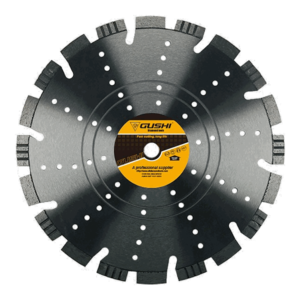
Nine sizes as published for this series. The rim is one continuous diamond band with no slots between teeth. Both cold pressed and hot pressed construction are listed, in three grades named Standard, Premium and Supreme. No speed rating, core thickness or diamond specification is published with this table.
Why a continuous rim runs wet
The defining feature of this blade is the absence of slots. A segmented blade is a ring of separate teeth with wide gullets cut between them; those gullets draw air through the rim and throw the dust clear, which is what lets a segmented blade run dry. A continuous rim has no such openings, so it has no built in way to shed the heat a cut generates. Run it dry and the rim and the bond overheat within a short span, the diamond loses its hold in the matrix, and cutting stops as the rim glazes over.
Water does the work the missing gullets would do. It carries heat away from the rim as the blade turns and flushes the slurry out of the cut, so the diamond keeps exposing fresh cutting points instead of sitting in a hot, packed groove. The listing states wet use for this reason, and it is the single most important operating rule for the blade: wet only, on a saw or grinder with a water feed.
The trade is worth it for the jobs this blade is built for. Where the finish matters and the material is brittle, a clean cut beats a fast one, and the water that the rim needs is already part of a tile saw or a bridge saw setup. The same limitation is what keeps this blade out of dry masonry work, which belongs to the segmented dry blade in the same range.
One practical note on water: the aim is a steady flow across the rim, not a flood. Enough coolant to keep the edge cool and the slurry moving is the whole requirement. A continuous rim that is kept wet holds its cut quality long after a dry blade would have glazed, which is the reason the rim exists in the first place.
Chip free cutting on brittle material
A segmented blade strikes the workpiece with a series of discrete teeth, and each impact is a small shock at the cut edge. On a soft or coarse material that is fine, but on a brittle face such as tile, porcelain or glass the shock can spall a chip out of the edge. A continuous rim presents a smooth, unbroken edge to the material, so it slices rather than hammers. The cut face stays clean with no chipping along the line, which is the property the listing names when it calls the blade chip free.
This is why the blade is the right choice wherever the edge is seen. Tile and ceramic that will show in a finished wall, porcelain that has to meet another piece with a clean joint, and glass where any spall is a reject, all want the smooth rim rather than a toothed one. The source describes the blade as giving the smoothest, chip free cuts, and that claim rests entirely on the continuous rim: there is no tooth to break the surface.
Chip free does not mean slow. The continuous rim keeps a wide, even contact with the material, and because it runs wet the diamond stays cool and cutting. The result is a steady, clean pass rather than a fast, rough one. For a fabricator the difference shows up as less edge polishing after the cut and fewer rejected pieces from chipped corners.
The clean edge also matters for the cut width. A continuous rim tracks a narrow, even kerf, so the blade follows the marked line without the wander a coarse tooth pattern can introduce. On delicate materials that straight, clean line is often the point of using this blade at all.
Cold pressed or hot pressed
Two construction methods are listed for this range, and the difference is in how the rim is formed and sintered. Cold pressed rims are shaped from the diamond and metal powder mix and then sintered in a furnace. Hot pressed rims are sintered under heat and pressure in a single step, which gives a denser, more tightly bonded rim with the diamond held more firmly in the matrix.
The practical reading is straightforward. Hot pressed costs more to make and holds up longer in service, so it is the choice where the blade is in steady or daily use and the extra life pays for itself. Cold pressed is the lower cost route and the right call for a job lot or a price led order where the blade will not see heavy continuous duty. Both are offered because the buyer, not the factory, knows which side of that line the order falls on.
What does not change between the two is the size, the width, the height menu or the arbor. The construction is a property of the rim bond, set at order time alongside the grade, and it does not alter the cutting geometry in the table above. A buyer specifying cold pressed or hot pressed is choosing a bond density, not a different blade shape.
Three grades: Standard, Premium, Supreme
The listing offers three grades, and they are the buyer’s main lever on cost against life. A grade sets how much diamond and cobalt sits in the band. Standard is the working grade for normal duty. Premium adds more to the rim for longer service in steady use. Supreme is the longest running option where the blade stays in the machine and downtime costs more than the rim.
Per the manufacturer’s grade rating, Premium is set at twice the service life of Standard, and Supreme at four times. That rating is the maker’s stated figure for Premium and Supreme against Standard within this one product line, not a measured figure against an outside brand, and it is the basis for choosing a grade rather than a guarantee of a field result. The size, width, height menu and arbor stay the same across the three; only the rim fill differs.
Because only the fill changes, a distributor can stock one width set per size and offer the grade as an option at the counter, rather than holding three physically different blades. For a first order the simple rule is to match the grade to the run length: a short or intermittent job does not need Supreme, and a blade on a production line should not be specified down to Standard. The grade is the one column in this specification that is bought, not measured.
What it cuts: marble, tile, ceramic, porcelain, granite, glass
The listing names six materials and a method: marble, tile, ceramic, porcelain, granite and glass, all cut wet. Those are the brittle and hard materials where a clean, chip free edge is the point, and where a coarse dry blade would spall the surface instead of slicing it. The source also describes the blade as an extended performance rim for hard materials such as tile, porcelain, granite, ceramic and glass, which lines up with the six named in the listing.
Marble and granite are the stone side of the list: hard, and easy to chip if the edge is not smooth, so the continuous rim is the right tool for a clean cut on a wet saw. Tile, ceramic and porcelain are the everyday tile shop work, where the finished edge is what the customer sees. Glass is the most demanding of the six because any chip is a reject, and the smooth rim is what keeps the cut clean.
What it is not listed for matters as much. Dry masonry such as block, concrete, pavers and brick is the job of a segmented dry blade, not this one, because this rim cannot run without water. Staying inside the six named materials is what keeps the blade cutting the way the table implies, and reaching for the dry segmented blade on masonry is the correct split of the range.
Nine sizes, one height menu
The width column is a steady climb from 1.7 mm at 105 mm to 2.6 mm at 250 mm, and it moves in small steps rather than jumps. The 105, 110 and 115 mm sizes sit at 1.7, 1.8 and 1.8 mm; 125 and 150 step to 2.0 and 2.1; 180 to 230 sit at 2.2 and 2.4; and 250 reaches 2.6. Wider rims carry more diamond, so the larger blades are also the heavier cutting members, which is what a bigger wet saw expects.
The height menu is the same at every size: 5, 7 or 10 mm. That is worth noting, because it means a buyer can standardise the rim depth across the whole range and switch diameter without switching segment height. The 5 mm is the light duty option, 7 mm the general choice, 10 mm the longest running, and the choice is open at every diameter in the table.
The arbor splits the range into the machine groups. From 105 to 150 mm the bore is 22.23 or 20 mm, the spindles of hand held wet saws and grinders. At 180, 200 and 230 mm the listing adds DM alongside 22.23 and 20 mm, where DM is a code the table does not expand, so it has to be confirmed against the saw. The 250 mm is 25.4 mm only, the one inch spindle of the larger wet saws.
Private Label and Export Supply
The range is supplied under the GUSHI mark or made to order under a buyer’s own. What can be set is the core printing on both faces, the item numbering, the bore within each size group, the segment height where a size offers three options, and the sleeve or carton print. Construction and grade are chosen per order, so a private label run can be specified cold pressed Standard or hot pressed Supreme without changing the tooling.
For the rest of the cutting range, the dry masonry and site work belongs to the segmented blade, while the continuous rim here covers the wet, chip free jobs on tile, stone and glass. Both are part of one diamond saw blade family built for different cutting conditions rather than for the same one.
Frequently Asked Questions
- What is a continuous rim diamond saw blade?
- A blade whose cutting edge is one unbroken band of diamond bearing material, with no slots or teeth cut into it. The smooth rim slices the workpiece instead of striking it with separate teeth, which is what lets it leave a clean, chip free edge on brittle materials such as tile and glass. By contrast a segmented blade is a ring of separate teeth with open slots between them; that design is built for dry cutting and a coarser finish, not for a clean edge.
- Why does a continuous rim blade have to run wet?
- Because the rim has no slots, it has no way to vent the heat a cut generates on its own. A segmented blade uses the open gullets between its teeth to draw air through the rim and throw dust clear; a continuous rim has neither relief, so without water the rim and the bond overheat, the diamond loses its hold and cutting stops. Water does the job the missing gullets would: it carries heat away from the rim and flushes the slurry out of the cut. The listing states wet use for this reason.
- What materials will it cut?
- The listing names marble, tile, ceramic, porcelain, granite and glass, cut wet. Those are the brittle and hard materials where a clean, chip free edge is the point, and where a coarse dry blade would spall the surface. It is not listed for dry masonry such as block, concrete, pavers or brick, which are the job of a segmented dry blade; for those a continuous rim is the wrong tool because it cannot run dry.
- Cold pressed or hot pressed, and which to choose?
- Both constructions are listed for this range. Cold pressed segments are formed from the powder mix and then sintered in a furnace; hot pressed segments are sintered under heat and pressure in one step, giving a denser, more tightly bonded rim. Hot pressed costs more and runs longer, so it suits steady or daily use; cold pressed is the lower cost route for a job lot or a price led order. The size, width, height menu and arbor are the same for both.
- What do Standard, Premium and Supreme mean, and how do they differ?
- They are the three grades this listing offers for the rim fill. The grade sets how much diamond and cobalt sits in the band, which is the cost against service life lever on a blade like this. Per the manufacturer’s grade rating, Premium is set at twice the service life of Standard, and Supreme at four times. The size, width, height menu and arbor stay the same across the three; only the rim fill changes, so a distributor can hold one width set per size and offer the grade as an option.
- Which arbor bore do I need?
- The 105 to 150 mm sizes are listed at 22.23 or 20 mm, the spindles of hand held wet saws and grinders. The 180, 200 and 230 mm sizes add a third entry, DM, alongside 22.23 and 20 mm, where DM is a code the table does not expand, so confirm it against the saw before ordering. The 250 mm size is listed at 25.4 mm only. Measure the spindle rather than assume it.