
Full Specifications
| Item | HCMSB series combo diamond blade |
|---|---|
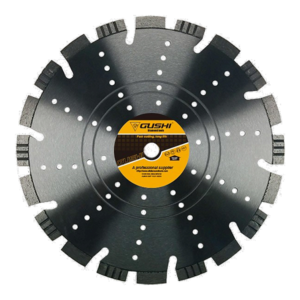
| Construction | Laser welded segmented rim on a steel core |
| Segment pattern | Alternating turbo segments and flat segments |
| Drop segments | Full-kerf shoulder at every gullet for undercut protection |
| Diameters | 250, 300, 350, 400, 450, 500, 550 and 600 mm |
| Segment width (kerf) | 2.5 mm at 250 mm, rising to 4.5 mm at 600 mm |
| Segment height | 10 mm |
| Weld | Laser welded |
| Arbor | 22.23 or 25.4 mm; reducing bushings to order |
| Cutting mode | Wet or dry |
| Materials | Cured hard concrete, hard paver, hard brick, refractory brick, stone, block, rebar |
| Machine types | Walk-behind saw, masonry saw, high-cycle saw, large angle grinder at 250 mm |
| Speed basis | 80 metres per second at the rim |
| Packing | Individual sleeve, then export carton |
| Standards | Made under ISO 9001; finished blades carry the CE mark |
Alternating Turbo and Flat Segments
The rim is built from two segment shapes set one after the other around the circumference. A turbo segment carries shallow channels pressed into its cutting face; a flat segment has a plain face. The pair repeats the whole way round, and that arrangement is what lets one rim work across concrete, block and paver.
What the turbo segment does
The channels in a turbo segment give the slurry somewhere to go. Water reaches the cut and the fines leave it, so the bond wears back and fresh diamond keeps coming up. On cured concrete, which is hard and closes on the blade, that clearing is what keeps the segment cutting instead of polishing over.
What the flat segment does
A flat segment presents a full face to the stone. It steadies the rim between the channeled segments, holds the line in a straight cut, and on brick and block it leaves a squarer corner at the exit. The flat segments also stiffen the rim, so the blade keeps its shape in a deep cut.
Why the two are paired
Run only turbo segments and the rim cuts freely but can wander in a wide slot; run only flat segments and the rim steadies but clears poorly in concrete. Set them alternately and each covers the other’s weakness. The blade clears like a turbo rim and holds a line like a flat one, which is why it can cover three materials on one machine.
Drop Segments and Undercut Protection
Undercut retires most segmented blades before the diamond is spent, so it is worth understanding. The drop segments on this blade exist for no other reason.
What undercut is
A segment is wider than the steel core it is welded to, so the kerf it cuts is wider than the core that follows it. In a clean cut the core runs free in that gap. In abrasive block, or in concrete that relaxes behind the segment, the wall of the cut can slump inward and close on the core, and the steel then grinds against the stone on its sides.
That grinding wears a groove into the core just behind the segment. The groove narrows the core, the core loses stiffness, and the blade starts to steer. Once the groove is deep the blade is finished, even though the segment still has diamond left on it.
How the drop segment shields the core
A drop segment is a shoulder of segment material that drops down at the gullet, so the full kerf width is held open right where the core would otherwise meet the wall. The shoulder takes the rub the core would have taken. The core stays at full width, keeps its stiffness, and the blade holds its line for the rest of its working life.
Where it pays for itself
The saving shows up in abrasive material and in steel. Hard brick, refractory brick, block and reinforced concrete put the core under load that a plain segmented rim passes straight to the steel. The drop segments are the difference between a blade that finishes the contract and one that is scrapped at half its segment.
Laser Welding and Cutting Rebar
The segments are laser welded to the core, not brazed and not sintered onto it. The weld is a full metallurgical joint, and it changes what the blade can be asked to do.
Why the weld matters at steel
Cutting rebar means the diamond meets steel, and steel is the hardest thing a diamond blade sees. The segment heats fast at that contact, and a brazed joint can soften and let go under the heat and the side load. A laser weld holds at the temperature the segment reaches in steel, so the blade can be run through reinforced concrete and mesh without the segment lifting.
Running dry without losing the segment
Laser welding is also why the blade is rated for dry work at these diameters. A dry cut heats the rim and the core, and the weld has to carry that heat without creeping. The drop segments help here as well, because they keep the core off the wall and stop the local hot spot that a rubbing core creates.
What it does not change
A laser weld does not make the segment immune to heat, and it does not let the blade be forced through steel. Rebar wants a steady feed and, where the saw allows, water. The weld keeps the segment attached while the segment does the cutting; it does not cut for you.
Size Chart: Diameter, Segment Width, Arbor and Speed
| Item | Diameter | Segment width | Segment height | Arbor | Max rpm |
|---|---|---|---|---|---|
| 10HCMSB | 10 in / 250 mm | 2.5 mm | 10 mm | 22.23 / 25.4 mm | 6,110 |
| 12HCMSB | 12 in / 300 mm | 3.2 mm | 10 mm | 22.23 / 25.4 mm | 5,090 |
| 14HCMSB | 14 in / 350 mm | 3.2 mm | 10 mm | 22.23 / 25.4 mm | 4,365 |
| 16HCMSB | 16 in / 400 mm | 3.6 mm | 10 mm | 22.23 / 25.4 mm | 3,820 |
| 18HCMSB | 18 in / 450 mm | 3.8 mm | 10 mm | 22.23 / 25.4 mm | 3,390 |
| 20HCMSB | 20 in / 500 mm | 3.8 mm | 10 mm | 22.23 / 25.4 mm | 3,050 |
| 22HCMSB | 22 in / 550 mm | 4.0 mm | 10 mm | 22.23 / 25.4 mm | 2,780 |
| 24HCMSB | 24 in / 600 mm | 4.5 mm | 10 mm | 22.23 / 25.4 mm | 2,550 |
Segment width widens with diameter because a larger disc needs a stiffer rim to hold its line, and above 300 mm the blade is on a saw rather than in a hand. Segment height is 10 mm across the range.
Segment Height and Working Life
This blade is built on a 10 mm segment. That is deeper than the 8 mm rim common on general blades, and the extra depth is aimed at the material it is sold into: abrasive concrete, block and brick consume segment height sooner than dense stone does, so the taller segment buys metres of cut rather than a longer catalogue number.
The usable band is about 8.5 mm above the steel. Past that the blade is cutting with a steel edge, it stops cutting and heats up, and the weld is at risk. Ten millimetres suits a blade that has to survive a mixed schedule; a trim grade would be shorter and a longer-life grade taller, both arranged to order with the factory.
Maximum rpm and Saw Match
These are large blades, and from 300 mm up they belong on a saw rather than in a hand. The limit comes from peripheral speed, and the rating is 80 metres per second at the rim, so the limit falls as the blade grows.
| Diameter (mm) | 250 | 300 | 350 | 400 | 450 | 500 | 550 | 600 |
|---|---|---|---|---|---|---|---|---|
| Max rpm | 6,110 | 5,090 | 4,365 | 3,820 | 3,390 | 3,050 | 2,780 | 2,550 |
The numbers are arithmetic from that 80 m per second figure, and they are a limit rather than a target. A walk-behind saw and a masonry saw both run inside these figures at their working diameter. Check the spindle speed of the machine against the marking on the blade before the first cut, and never fit a blade larger than the machine was built for.
Wet Cutting and Dry Cutting
Running wet
Water is the default on concrete and block. It keeps the bond from softening, holds the dust down, and on a walk-behind saw the built-in feed does the work. Three to five litres a minute at the point where the segment enters the cut is enough at these diameters, and the slurry should leave milky rather than thick.
Running dry
Dry work is possible because the blade is laser welded and the drop segments protect the core, and on a paver or a small block job it saves the set-up. Keep the passes shallow, let the blade run free between them, and stop if the cut starts to steer. Dry cutting on concrete or refractory brick puts respirable silica in the air, so it wants extraction or a mask rated for it.
The dust point
Cured concrete, refractory brick and block all carry crystalline silica. Water or extraction is not a nicety on these materials; it is the difference between a job and an exposure. The blade is rated for dry work, but the material decides whether dry is sensible.
Arbor, Bushing and Mounting
The arbor on this range is 22.23 or 25.4 mm. 22.23 mm is 7/8 inch, the common bore on walk-behind saws and large grinders; 25.4 mm is one inch, used on masonry saws and some high-cycle saws. Reducing bushings take the bore down for a machine with a smaller spindle.
The bushing has to be pressed
A loose bushing on a 350 mm blade is worse than on a small one, because any play at the centre is multiplied at the rim. A few tenths of a millimetre at the bore becomes visible swing at the edge, the blade cuts a curve and one side of the segment does the work. Fit a pressed bushing and check that it does not drop out.
Flanges and the first cut
Both flanges have to be clean, flat and large enough to support the disc. On a saw, check that the blade runs true before the first cut; a blade that wobbles from the start is a mounting fault rather than a blade fault, and running it will dish the core.
Matching the Blade to the Material
The blade is one specification, so what is left to choose is mode and feed. The table is the short version of how those get assigned.
| Material | Mode | What to expect |
|---|---|---|
| Cured hard concrete | Wet preferred | Hard and closing. Full water, steady feed, and the drop segments keep the core clear of the wall |
| Reinforced concrete and rebar | Wet where possible | Diamond meets steel. Ease the feed at the bar and let the laser-welded segment cut, not the operator |
| Hard paver | Either | Abrasive and dense. Expect steady segment wear and a clean edge with a moderate feed |
| Hard brick | Either | Abrasive. The undercut risk is real here, and the drop segments are the reason the core lasts |
| Refractory brick | Dry with extraction | Very abrasive and dusty. Extraction matters as much as the blade |
| Block and masonry | Either | Fast cutting. Watch the feed where the block is reinforced |
| Stone | Wet preferred | Cuts readily. The rim barely works, so life is long |
One pattern runs across the table. Hard dense material wants water and a steady feed, because the diamond does the work and heat is the enemy. Abrasive material consumes segment height before it dulls the diamond, so the taller 10 mm segment is what carries the blade through concrete and block. In both cases the drop segments protect the same thing: the steel core behind the cut.
One Blade Across a Mixed Schedule
The reason a contractor reaches for a combo blade is a schedule that changes material before it changes machine. A day might run cured concrete in the morning, block in the afternoon and pavers at the end. Changing blades for each is downtime, and stocking three part numbers for one saw ties up money on the shelf.
The arithmetic of one SKU
Three blades covering concrete, block and paver, one per size, is three part numbers to buy, stock and re-order. A combo blade covers the same three duties on one number. The blade costs more per piece than a single-purpose rim, but it removes two changeovers a day and two lines from the shelf, and for a contractor running one or two saws that is the figure that matters.
Where a single-purpose blade still wins
If the work is one material all day, every day, a dedicated rim cuts it with less compromise. A shop that only cuts cured concrete will get more metres from a concrete-specific bond. The combo is for the mixed day, not for the single-material factory, and saying so is more useful than claiming it does everything.
What to tell us
Tell us the mix of materials, the machine and the diameters you run, and we will confirm the bond and the segment height that fits the schedule rather than the catalogue.
Troubleshooting
| Symptom | Usual cause | What to do |
|---|---|---|
| Segments look polished and stop cutting | Glaze: feed too light, or the material is softer than the bond was made for | Open the segment on an abrasive block for 20 to 30 seconds, then keep the feed up |
| Groove worn into the core behind the segment | Undercut: the wall is closing on the steel, or feed is too heavy | Ease the feed, check the drop segments are not worn past, and step-cut a deep slot |
| Cut wanders from the first metre | Loose bushing or dirt on a flange | Clean both flanges, fit a pressed bushing, check spindle runout |
| Blade wobbles as soon as it runs | Bushing not seated, or a burr on the flange | Refit the bushing, dress the flange face, re-check before cutting |
| Segment lifts from the core | Cutting past the segment so the weld runs on stone, or sustained heat at steel | Replace at about 1.5 mm of segment. This is a wear limit, not a repairable fault |
| Blue or straw colour on the core | Overheated from dry cutting with too deep a pass | Water, or shallow passes with a free run between them. A blue core has lost tension |
| Cut closes and grips the blade | Deep cut in a material that relaxes | Step cut, put a wedge behind the cut, and keep the saw square to the line |
Frequently Asked Questions
- What is a combo diamond blade?
- A combo diamond blade is a segmented blade built to cut several materials on one machine. This one alternates turbo segments, which carry shallow channels to clear slurry, with flat segments that steady the rim, and it sets a drop segment at every gullet to protect the core. Eight diameters run from 250 mm to 600 mm on a 10 mm segment, and the blade cuts cured concrete, paver, brick, block, stone and rebar, wet or dry.
- What do the alternating turbo and flat segments do?
- The two segment shapes cover each other. A turbo segment has shallow channels pressed into its face, so water reaches the cut and the fines leave it, which keeps the bond wearing back in hard, closing concrete. A flat segment presents a full face, steadies the rim between the channeled segments and holds the line in a straight cut. Set alternately, the rim clears like a turbo blade and holds a line like a flat one, which is why one blade can cover concrete, block and pavers.
- What are drop segments and what is undercut?
- A segment is wider than the steel core it is welded to, so the core runs in a gap inside the kerf. In abrasive block, or in concrete that relaxes behind the cut, the wall can slump inward and close on the core, and the steel grinds a groove into itself just behind the segment. That is undercut, and it retires a blade while the segment still has diamond. A drop segment is a shoulder that drops down at the gullet, holds the full kerf open and takes the rub the core would have taken.
- Can it cut rebar and reinforced concrete?
- Yes. The segments are laser welded to the core, so the joint holds at the temperature the segment reaches when the diamond meets steel. Cutting rebar is the hardest duty a diamond blade sees, and a brazed joint can soften and let go under that heat and side load. Run reinforced concrete and mesh with a steady feed, and use water where the saw allows it. The weld keeps the segment attached; it does not let the blade be forced through steel.
- What does laser welded mean and why does it matter?
- Laser welding fuses the segment to the core with a full metallurgical joint rather than a braze or a sintered bond. The weld carries heat and side load without creeping, which is why this blade can be rated for dry work at these diameters and can cut rebar. A dry cut heats both rim and core, and the weld has to hold through it. Laser welding does not make the segment immune to heat, so shallow passes and, where possible, water still apply.
- What diameters are available and what machine do they fit?
- Eight sizes cover 10 in / 250 mm, 12 in / 300 mm, 14 in / 350 mm, 16 in / 400 mm, 18 in / 450 mm, 20 in / 500 mm, 22 in / 550 mm and 24 in / 600 mm. The 250 mm suits a large angle grinder or a small saw; from 300 mm up the blade belongs on a walk-behind saw, a masonry saw or a high-cycle saw. Match the blade to the machine the way the machine was built: never fit a blade larger than the saw was made for.
- What segment height is used and how long does it last?
- The blade is built on a 10 mm segment, deeper than the 8 mm rim common on general blades, because abrasive concrete, block and brick consume segment height quickly. The usable band is about 8.5 mm above the steel; past that the blade cuts with a steel edge, stops cutting and heats up. Life is quoted in linear metres, and it moves with feed and material more than with anything else. Tell us the material mix and we will confirm the height that fits.
- What arbor do I need and can you supply a bushing?
- The range is supplied in 22.23 mm or 25.4 mm. 22.23 mm is 7/8 inch, the common bore on walk-behind saws and large grinders; 25.4 mm is one inch, used on masonry saws and some high-cycle saws. Reducing bushings take the bore down for a machine with a smaller spindle, and on a blade this size the bushing must be a press fit. A loose bushing on a 350 mm blade turns a few tenths of a millimetre of play into visible swing at the rim.
- What is the maximum rpm for each diameter?
- The limit comes from peripheral speed, and the rating is 80 metres per second at the rim, so it falls as the blade grows. That gives about 6,110 rpm at 250 mm, 5,090 at 300 mm, 4,365 at 350 mm, 3,820 at 400 mm, 3,390 at 450 mm, 3,050 at 500 mm, 2,780 at 550 mm and 2,550 at 600 mm. These are arithmetic from the 80 m per second figure and they are a limit, not a target. Check the machine against the marking on the blade before the first cut.
- Can the blade cut both wet and dry?
- Yes, it is rated for both. Water keeps the bond from softening, holds the dust down and is the default on concrete and block; on a walk-behind saw the built-in feed does the work. Dry work is possible because the blade is laser welded and the drop segments protect the core, and on a paver or a small block job it saves the set-up. Cured concrete, refractory brick and block carry crystalline silica, so dry cutting on them wants extraction or a proper mask.
- Why is my cut wandering or the core wearing at the slots?
- A groove worn into the core just behind the segment is undercut, and it usually means the wall of the cut is closing on the steel. On this blade the drop segments hold the kerf open, so a groove points first at feed that is too heavy for the material, or at a wall that is collapsing behind the cut. A cut that wanders from the first metre is more often a mounting fault: a loose bushing or dirt on a flange. Check the mounting before blaming the blade.
- What is the minimum order and can you print my brand?
- Minimum order is 100 pieces per size, and mixed sizes in one order are accepted so a distributor can carry the 250 to 600 mm range without committing to a container of one line. Lead time is 20 to 30 days after artwork and specification are confirmed. We print your logo and grade on the label, supply the blade in your own sleeve or carton, and hold the bond, the segment pattern and the drop segment from order to order so a re-order behaves like the first.