What Is a Turbo Diamond Saw Blade?
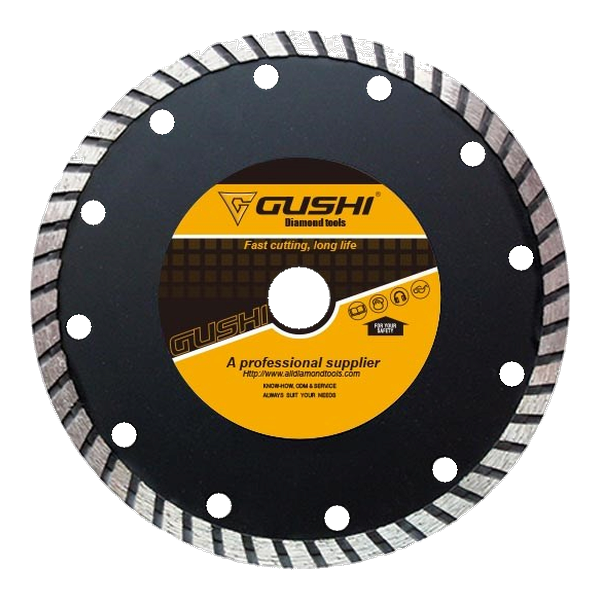
A turbo diamond saw blade is a diamond cutting blade with a continuous serrated rim. It sits between a segmented blade and a continuous-rim blade: it keeps the continuous cutting edge of a continuous-rim blade, but adds a serrated or wavy profile that improves airflow and debris evacuation.
A typical turbo blade has three main parts:
-
Heat-treated steel core — provides rigidity and resistance to distortion.
-
Diamond segment/rim — contains industrial diamond particles held in a metal bond matrix.
-
Welded joint — laser-welded or high-frequency welded connection between the rim and the core.
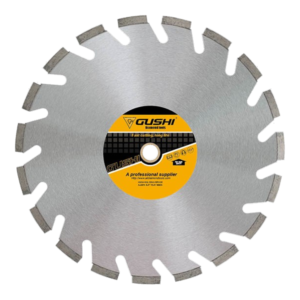
The “turbo” profile—serrated, wavy, or grid-like—is the key visual difference from a segmented blade, which has wide gullets between separate segments, and a continuous-rim blade, which has a completely smooth cutting edge.
Where the Turbo Blade Fits: A Quantitative Comparison
Choosing a diamond blade is essentially a trade-off between cutting speed and cut quality. The turbo blade is valuable because it does not maximize either extreme; instead, it provides a practical engineering compromise.
| Comparison | Segmented Blade | Turbo Blade | Continuous-Rim Blade |
|---|---|---|---|
| Rim design | Separate segments with wide gullets | Continuous serrated/wavy rim | Fully smooth continuous rim |
| Cutting speed | Fastest | Medium-fast (about 70% of segmented) | Slowest |
| Cut finish | Rougher; more chipping | Good; significantly less chipping than segmented | Best; near chip-free |
| Heat dissipation | Excellent — gullets evacuate debris and allow airflow | Good — serrations balance airflow and continuous grinding | Poorer — heat concentrates at the rim |
| Wet/dry use | Wet or dry | Wet or dry; most flexible | Mainly wet cutting |
| Best materials | Reinforced concrete, asphalt, thick masonry | Mixed materials, concrete pavers, granite, hard stone, roof tiles, concrete where a visible edge matters | Porcelain tile, natural stone, fine finishing |
| Typical trade-off | Cut edge may need finishing; chipping may be acceptable | Not “first” in any single metric, but highest overall efficiency | Slow; not suitable for heavy concrete cutting |
Industry positioning: A common industry summary describes the turbo blade as delivering “70% of segmented speed with 80% of continuous-rim finish.” Its “one blade for many materials” capability can reduce unplanned downtime from blade-material mismatch by up to 40%. Wet cutting can extend blade life by 3–5 times compared with dry cutting, and this advantage also applies to turbo blades because their serrated rim is designed to assist heat dissipation in dry conditions.
What Materials Is a Turbo Diamond Saw Blade Best For?
The versatility of a turbo blade is not marketing language. It comes from a serrated rim that can both grind and evacuate debris. The following material groups are the core application range for turbo blades.
Tier 1: Mixed materials and visible-edge cutting
Concrete pavers—especially pavers with exposed aggregate or repaired surfaces—landscape mixed masonry, and outdoor paving where the customer will see the cut edge are the strongest use cases for a turbo blade. Segmented blades chip these materials noticeably, while continuous-rim blades are too slow and wear too quickly in abrasive aggregate. The turbo blade fills this gap.
Tier 2: Hard stone and structural cutting requiring a moderate finish
Granite, hard natural stone, roof tiles, and concrete cutting where the edge needs to remain relatively clean are all suitable for turbo blades. They deliver a “good” cut finish at an acceptable speed.
Tier 3: General masonry and emergency tile compatibility
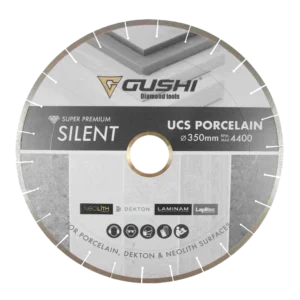
Turbo blades can be used on brick, concrete block, and some tiles. However, for porcelain and vitrified tile, a continuous-rim blade remains irreplaceable. Turbo blades still carry some chipping risk on extremely brittle porcelain materials.
Clear boundary: where a turbo blade is not the best choice
Turbo blades are not suitable for heavy reinforced-concrete demolition or large-scale asphalt grooving. These applications require the wide gullets of a segmented blade to rapidly clear large amounts of debris and withstand high feed pressure. With a continuous serrated rim, a turbo blade becomes a speed bottleneck and a heat-risk point in these conditions.
How to Choose the Right Turbo Diamond Saw Blade Specifications
Diameter and arbor: match the machine first
The rule for turbo blade diameter is simple: cutting depth determines diameter; working space constrains diameter.
-
Small diameters (105–180 mm) — angle grinders, hand-held saws, and tile saws; overhead cutting, tight spaces, and shallow grooves.
-
Medium diameters (200–230 mm) — the main range for general masonry and paving cutting.
-
Large diameters (250–350 mm and above) — table saws, power cutters, and applications requiring greater cutting depth.
The arbor bore must exactly match the machine spindle. Common arbor sizes include 20 mm, 22.23 mm (7/8″), and 25.4 mm (1″). An oversized arbor causes off-center rotation, vibration, uneven wear, and potentially serious safety hazards. An undersized arbor simply will not fit.
Maximum RPM: a hard safety limit
Every turbo diamond saw blade is marked with a maximum RPM. This is not a recommendation; it is a safety limit. The blade’s rated speed must be equal to or greater than the no-load speed of the power tool.
-
Mounting a low-RPM blade on a high-RPM machine can cause centrifugal force to throw segments or rim fragments.
-
Mounting a high-RPM blade on a low-RPM machine drastically reduces cutting efficiency and causes heat buildup, shortening blade life far below expectation.
Rim height and bond hardness
Rim height determines the blade’s life reserve and suitable cutting depth. Taller rims suit thick concrete and heavy-duty cutting; lower rims suit thin pavers and precision work.
Bond hardness should match the material:
-
Hard, dense materials such as high-strength concrete and granite require a softer bond so that worn metal exposes fresh diamond particles.
-
Soft, abrasive materials such as block and mortar require a harder bond to prevent diamonds from being released before the bond has worn sufficiently.
How Manufacturing Quality Determines Turbo Blade Performance
Quality differences in turbo blades are largely determined by two stages: rim manufacturing and the rim-to-core joint.
Hot-pressed sintering
Hot-pressed sintering is the core process for forming diamond rims. Diamond particles are mixed with metal powders—typically copper, cobalt, nickel, and iron—cold-pressed in a mold, then sintered under high temperature and pressure. Typical sintering temperatures are around 720°C–880°C. This process densifies the metal matrix and mechanically holds the diamonds.
Sintering temperature is one of the most important variables affecting sharpness, life, and weldability:
-
Too low — the bond is not fully dense, diamond retention is insufficient, and the rim wears prematurely.
-
Too high — diamonds may graphitize, causing a sharp drop in cutting performance.
Laser welding
Laser welding is the mainstream process for joining the rim to the steel core, and its quality directly affects safety. Laser welding creates a metallurgical bond at the interface using high energy density. Weld strength is typically required to reach 600 N/mm² or above, and each rim should be tested for weld strength before leaving the factory.
Compared with high-frequency welding, laser welding produces a narrower heat-affected zone and less hardness loss in the steel core. For turbo blades that must withstand high RPM and impact loads, this is a meaningful advantage.
Practical quality signals for buyers
-
The weld between rim and core is continuous and uniform.
-
The steel core is flat and free from warping after heat treatment.
-
The diamond surface is properly exposed, not buried under an excessively thick metal layer.
-
The product has traceable weld-strength test records.
Dry Cutting vs. Wet Cutting: A Dual-Mode Strategy
Turbo blades are designed for wet or dry use, but the cost of each mode is not the same.
Wet cutting is the reliable way to extend life
At the same RPM, water cooling can lower blade temperature by roughly 22°C, allowing blade life to reach 3–5 times that of dry cutting. For blades above 400 mm, wet cutting is mandatory. Even for small and medium diameters below 300 mm, wet cutting is superior in most metrics.
Wet cutting also significantly reduces exposure to respirable crystalline silica dust. This is important for meeting occupational health limits such as an 8-hour time-weighted average of 0.05 mg/m³.
Dry cutting is possible, but requires discipline
Turbo blades can work dry because their serrated rim provides better airflow and heat dissipation than a continuous-rim blade. However, dry cutting requires controlled feed pressure:
-
Excessive push force causes heat spikes, premature diamond loss, and steel-core annealing.
-
In dry conditions, use a “multiple shallow passes with intermittent cooling” strategy.
-
Inspect rim wear, chipping, and vibration every 50 operating hours.
-
Keeping the serration channels clean can extend blade life by up to 25%.
Safety Standards and Compliance
Turbo diamond saw blades are superabrasive cutting tools. In the EU and regions that adopt related standards, their design, manufacture, and marking are governed by the EN 13236 series. This standard covers safety requirements for diamond and cBN superabrasive products, including maximum working speed, connection and clamping requirements, and hazard-reduction and verification test procedures.
When selecting a supplier, confirm that the product is designed and marked in accordance with applicable safety standards. This is a basic part of risk management.
Operational safety basics include:
-
Wear eye, face, hearing, and respiratory protection.
-
After mounting, run the blade for one minute and confirm there is no abnormal vibration or noise.
-
Never operate without the machine guard in place.
-
The cutting-direction arrow must match the machine rotation direction.
-
Do not put the tool down until the blade has completely stopped.
FAQ
Q1: Can a turbo diamond saw blade cut reinforced concrete?
Yes, but it is not optimal. The continuous serrated rim grinds rebar less efficiently than the wide-gullet design of a segmented blade, and debris evacuation is limited. For structural cutting with dense rebar, a segmented blade remains the safer and more efficient choice.
Q2: Is a turbo blade the same as a “turbo segmented blade”?
No. A standard turbo blade has a continuous serrated rim with no wide segment gaps. A “turbo segmented blade” usually refers to a blade with separate segments whose surfaces carry a turbo pattern; its debris-evacuation logic is closer to a segmented blade. The two have materially different cutting characteristics. When buying, judge by rim design—continuous vs. segmented—not just by the word “turbo.”
Q3: Can one turbo blade cut both concrete and tile?
Technically yes, but it is not recommended as the primary tile-cutting tool. Porcelain and vitrified tile are extremely brittle and require the smooth rim of a continuous-rim blade to suppress chipping. A turbo blade is cleaner than a segmented blade on tile, but its chipping risk is still significantly higher than that of a continuous-rim blade. For occasional tile work, a turbo blade can serve as a temporary substitute; for volume tile work, use a dedicated continuous-rim blade.
Q4: The blade sparks or turns blue during dry cutting—can I keep using it?
A blue or purple temper color on the steel core indicates that local temperature has exceeded the steel’s tempering range. The core’s hardness and rigidity have already suffered irreversible loss. Continued use increases the risk of core distortion, rim detachment, and blade breakage. Stop using it immediately, check whether feed pressure is too high or debris channels are clogged, and switch to wet cutting or intermittent cutting.
Q5: How can I judge the quality of a turbo diamond saw blade?
If cutting tests are not possible, check four things first:
-
Weld quality — continuous and uniform, with no porosity or lack of fusion.
-
Steel core — flat, free from warping and rust.
-
Diamond exposure — diamonds should be exposed at the working surface, not completely buried in metal.
-
Documentation — weld-strength test standards such as 600 N/mm² and a declaration of conformity with applicable safety standards such as EN 13236.