Full Specifications
| Item number | Diameter | Segment width | Segment height | Arbor hole |
|---|---|---|---|---|
| 4HCCB | 4 in / 100 mm | 6.4 / 9.5 mm | 10 mm | 22.23 mm |
| 4.5HCCB | 4.5 in / 115 mm | 6.4 / 9.5 mm | 10 mm | 22.23 mm |
| 5HCCB | 5 in / 125 mm | 6.4 / 9.5 mm | 10 mm | 22.23 mm |
| 6HCCB | 6 in / 150 mm | 6.4 / 9.5 mm | 10 mm | 22.23 mm |
| 7HCCB | 7 in / 180 mm | 6.4 / 9.5 mm | 10 mm | 22.23 mm |
| 8HCCB | 8 in / 200 mm | 6.4 / 9.5 mm | 10 mm | 22.23 mm |
| 9HCCB | 9 in / 230 mm | 6.4 / 9.5 mm | 10 mm | 22.23 mm |
Seven sizes as published for this series. Segment width is 6.4 mm at the narrow top and 9.5 mm at the wide base, segment height is 10 mm and the arbor is 22.23 mm at every size; only the diameter changes from 100 to 230 mm. No speed rating, core thickness, diamond concentration or bond hardness is published with this table.
The job is chasing and repairing cracks
A crack chaser follows the line of a crack and opens it to a clean, even profile so a repair compound can be laid in and bonded. The listing describes this blade as a tool to chase, widen and repair concrete cracks, and to clean out the crack before the damage spreads. That early cleaning is the point: left alone, a fine crack keeps taking water and load until it widens into a fault across the slab, so the blade is there to stop deterioration and widespread cracking by removing the loose edge first.
The work is named in the listing as concrete, stone, brick, asphalt and granite. Those are the masonry and stone surfaces where a crack opens and where a repair joint is called for, from a floor slab to a brick wall to a granite counter. The blade is a tuck point and crack chasing tool for those surfaces, not a blade for metal or wood, and not a large road blade for cross cutting a flat span. Its size range, 100 to 230 mm, is the range that fits the grinders and small saws a repair crew actually carries, not a walk behind road saw.
Cleaning a crack and repairing it are two steps of one pass. The V segment routes the crack to a V shape, the shape a repair joint is filled to, and the cut clears the dirt and loose stone that would otherwise sit between the new compound and the old material. The listing adds that the blade cuts smoothly without chipping or breaking the stone while cutting, which matters on a brick or stone face where a ragged edge is the failure of the repair. A clean V channel is what lets the joint hold.
The V segment does the cleaning
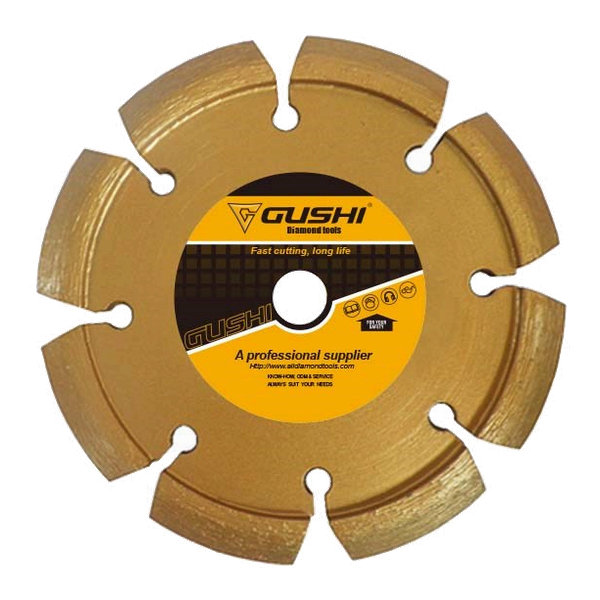
The listing calls the blade a beveled V crack chaser with segmented V segments, and the V shape is the whole reason it works on a crack. A flat segment would skim the surface and leave the crack mouth clogged; a V segment drops into the crack, follows it along its line and lifts out the loose material as it goes. The narrow top, 6.4 mm in the table, keeps the cut tight at the surface, while the wide base, 9.5 mm, opens the channel below so the repair has something to grip. That profile is what makes the blade efficient at cleaning rather than just scoring the top.
Segmented V segments also mean the rim is not one continuous band but a set of separate V teeth with gaps between them. The gaps give the cut a way to shed the dust and grit it throws up, so the blade keeps advancing along the crack instead of loading against a bed of ground out debris. On a brick or stone face that clearance is what keeps the cut smooth and keeps the stone from chipping at the edge, the result the listing names as cutting without chip or breaking.
The V profile is fixed across every size. The table gives 6.4 / 9.5 mm for the segment width at all seven diameters and 10 mm for the segment height at all seven, so a buyer gets the same V geometry on a 4 inch grinder blade and on a 9 inch saw blade. What changes is only the diameter of the steel core the segment sits on, not the shape of the segment that does the work. That consistency is useful when one site runs several grinder and saw sizes but wants the same crack channel out of each.
Dry or wet, on a grinder or saw
The listing states the blade runs dry or wet with angle grinders, circular saws and tuck pointers. The choice is the tool and the site, not the blade. On a wall or a small floor crack a dry grinder is the quick way to open the joint, and the segmented V rim clears its own dust well enough for a short run. On a longer repair, or where the dust must be controlled, a wet saw keeps the cut cool and the slurry moving, and the same V segment behaves the same way under water.
The machines named are all small to mid size. Angle grinders take the 100 to 180 mm sizes for hand held crack work, circular saws and tuck pointers take the larger 200 and 230 mm sizes for a steadier pass along a longer line. None of the diameters here is a road saw blade, and none needs a threaded spindle; the listing describes the mount as non-threaded on a 22.23 mm arbor, the standard fit for these grinders and saws. Pick the diameter to the machine, and the machine to the length and position of the crack.
Dry and wet both suit the V segment because the gaps between the segments are what matter for cooling and clearance, and those gaps are there in either mode. Wet cutting simply adds a coolant flow on top of the rim’s own debris clearance. The material stays concrete, stone, brick, asphalt or granite either way; the blade does not change its cut because the feed changed.
Seven sizes, three fixed columns
The diameter column runs 100, 115, 125, 150, 180, 200 and 230 mm, the seven sizes from 4 to 9 inch. That is the only column in the table that changes from row to row. The item numbers 4HCCB through 9HCCB mark each diameter, and the diameters are what a buyer matches to the grinder or saw on site. Everything else in the table is the same line repeated seven times.
The segment width column reads 6.4 / 9.5 mm on every row: 6.4 mm at the narrow top of the V and 9.5 mm at the wide base. The segment height column reads 10 mm on every row. The arbor column reads 22.23 mm on every row. So a buyer choosing between the seven sizes is choosing only the diameter; the rim, the height and the bore are already decided by the series. That is a simple buy, because there is no second variable to weigh once the machine is known.
The non-threaded 22.23 mm arbor is the reason the sizes stay this small. A 22.23 mm bore fits the grinders and small saws these diameters mount on, and it does not change because the diameter does not cross into road saw territory. The blade is built as a crack chasing and tuck pointing tool across its whole range, so the fixed arbor, fixed V segment and fixed 10 mm height are the constants, and the diameter is the one dial the table turns.
Private Label and Export Supply
The range is supplied under the GUSHI mark or made to order under a buyer’s own label. What can be set is the printing on the core, the item numbering and the carton or sleeve print for the export carton. The seven sizes, the V segment geometry and the 22.23 mm bore stay as listed, because the table publishes them as fixed at every diameter; there is no second bore or second segment height in the source to choose between.
For the rest of the cutting range, the crack and tuck point work belongs to this V crack chaser, the wide slab and road work to the asphalt and concrete blades, and the brittle tile and glass work to the continuous rim. The family splits by the shape of the cut and the material, and this blade is the one shaped to follow a crack line. The seven diameters cover the grinder and small saw sizes a repair crew runs, and the fixed rim means the same channel comes out of each.
Frequently Asked Questions
- What is a V crack chaser blade used for?
- It is used to chase, widen and repair cracks and to clean out cracks in concrete, stone, brick and similar materials. The V-shaped segment opens the crack to a clean profile so the repair joint can be filled. The listing states the blade helps prevent deterioration and widespread cracking by removing the loose material along the crack line first.
- Which materials can the V crack chaser cut?
- The listing names concrete, stone, brick, asphalt and granite for crack cleaning and repair. The blade is a tuck point and crack chasing tool for those masonry and stone surfaces. It is not a blade for metal or wood, and the V segment is shaped to follow a crack line rather than to cross cut a flat slab the way a large road blade does.
- Can the V crack chaser be used dry and wet?
- Yes. The listing states the blade runs dry or wet with angle grinders, circular saws and tuck pointers. Choose the mode to suit the tool and the site; the V segment works in both. Dry use suits a grinder on a wall or floor crack; wet use on a saw keeps the dust down on a longer repair run.
- What diameters are available?
- Seven sizes from 4 inch (100 mm) to 9 inch (230 mm): 100, 115, 125, 150, 180, 200 and 230 mm. Every size shares the same segment width, segment height and arbor, so the diameter is the only variable in the table. Pick the size to the grinder or saw in hand rather than to a change in the rim geometry.
- What is the segment height and arbor of the V crack chaser?
- Segment height is 10 mm and the arbor hole is 22.23 mm at every listed size. The V segment is 6.4 mm at the narrow top and 9.5 mm at the wide base, the figures that give the segment its V profile. These numbers do not change across the seven diameters, which is why the table reads as one fixed rim at seven diameters.
- Is this a threaded or non-threaded crack chaser?
- The listing describes it as a non-threaded crack chaser with segmented V segments. It mounts on a 22.23 mm arbor with angle grinders, circular saws and tuck pointers rather than on a threaded spindle. The non-threaded mount is the standard fit for the grinders and small saws these diameters are run on.
- Why a V-shaped segment for crack chasing?
- The V shape lets the blade clean and rout the crack to a V profile, which is the shape a repair joint is filled to. By chasing and widening the crack along its line, the blade removes loose material so the repair bonds instead of sitting on a dirty edge. A flat segment would skim the surface; the V follows the crack down.