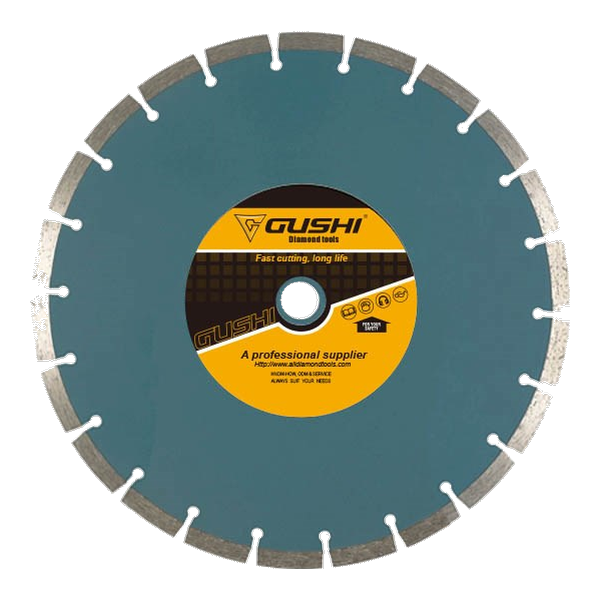
Full Specifications
| Item number | Diameter | Segment width | Segment height | Arbor hole |
|---|---|---|---|---|
| 4HCGPB | 4 in / 100 mm | 1.6 mm | 8 / 10 mm | 16 / 20 / 22.23 mm |
| 4.5HCGPB | 4.5 in / 115 mm | 2.0 mm | 8 / 10 mm | 16 / 20 / 22.23 mm |
| 5HCGPB | 5 in / 125 mm | 2.0 mm | 8 / 10 mm | 20 / 22.23 mm |
| 6HCGPB | 6 in / 150 mm | 2.0 mm | 8 / 10 mm | 20 / 22.23 mm |
| 7HCGPB | 7 in / 180 mm | 2.2 mm | 8 / 10 mm | 22.23 / 25.4 mm |
| 8HCGPB | 8 in / 200 mm | 2.4 mm | 8 / 10 mm | 22.23 / 25.4 mm |
| 9HCGPB | 9 in / 230 mm | 2.6 mm | 8 / 10 mm | 22.23 / 25.4 mm |
| 10HCGPB | 10 in / 250 mm | 2.6 mm | 10 / 12 mm | 22.23 / 25.4 mm |
| 12HCGPB | 12 in / 300 mm | 3.0 mm | 10 / 12 mm | 22.23 / 25.4 mm |
| 14HCGPB | 14 in / 350 mm | 3.2 mm | 10 / 12 mm | 22.23 / 25.4 mm |
| 16HCGPB | 16 in / 400 mm | 3.6 mm | 10 / 12 mm | 22.23 / 25.4 mm |
| 18HCGPB | 18 in / 450 mm | 4.0 mm | 10 / 12 mm | 22.23 / 25.4 mm |
| 20HCGPB | 20 in / 500 mm | 4.2 mm | 10 / 12 mm | 22.23 / 25.4 mm |
| 24HCGPB | 24 in / 600 mm | 4.5 mm | 10 / 12 mm | 22.23 / 25.4 mm |
| 28HCGPB | 28 in / 700 mm | 5.0 mm | 10 / 12 mm | 22.23 / 25.4 mm |
| 32HCGPB | 32 in / 800 mm | 5.5 mm | 10 / 12 mm | 22.23 / 25.4 mm |
| Rim | Segmented |
|---|---|
| Materials | Tiles, bricks, blocks, concrete building materials |
| Stated benefit | High cutting speed |
| Other sizes | More specifications and styles available on request |
What General Purpose Commits To
The words on the listing are short: designed for cutting tiles, bricks, blocks and concrete building materials, with high cutting speed. There is no claim about finish, no claim about life on any particular material, and no claim about being the best at anything. That is not modesty, it is an accurate description of what a blade like this is for.
A general purpose blade is bought by people whose next cut is a different material from the last one. A builder opening a doorway meets block, then brick, then a concrete lintel, then a floor tile at the threshold, and the saw stays in the same hands all day. Changing the blade four times is not going to happen, so the blade that wins is the one that handles all four competently and does not need to come off.
Once you accept that, the design decisions make sense. The segment is open and the bond wears readily, because that is what keeps a blade cutting through changeable material without glazing on any of it. The price of that readiness is paid where the blade meets something that rewards a specialist: a hard dense material that wants a tougher bond, or a glazed tile where the edge itself is the deliverable. A general purpose blade gives up a little at both ends to hold the middle.
So the honest question for a buyer is not which blade is fastest in a given material. It is how much of the day the blade can stay on the arbour. Everything else on this page is detail against that.
The Break at 250 mm
Sixteen rows, and the segment height column changes exactly once. Every size from 100 to 230 mm offers 8 or 10 mm. Every size from 250 to 800 mm offers 10 or 12 mm. Nothing else about the column varies: no third option, no further steps as the diameter climbs.
The interesting part is where the change happens. Between 230 and 250 mm is the smallest step in the whole table, a 20 mm difference in diameter, and yet the segment menu changes completely across it. That is not a diameter effect, because 20 mm of diameter does not change how much diamond a segment needs. It is a machine effect. Up to 230 mm the blade is on a hand held tool, mostly an angle grinder, where the blade is a consumable bought by price and where a shallow segment is entirely rational. At 250 mm the blade is on a bench or table saw, in a workshop or on a site where the machine is set up and the blade has to last.
Read the other way, the column also tells you that the factory does not regard segment height as a tuning parameter. On a blade where you could plausibly offer 8, 10 and 12 mm at every size, it offers two, and it offers the deeper pair only where the machine justifies it. If you want a 12 mm segment on a 230 mm blade, that is a conversation with the factory rather than a line in the catalogue.
Width from 1.6 to 5.5 mm
The width column runs 1.6, 2.0, 2.0, 2.0, 2.2, 2.4, 2.6, 2.6, 3.0, 3.2, 3.6, 4.0, 4.2, 4.5, 5.0, 5.5. Two things stand out in that sequence, and both are about how the growth is distributed rather than how big it gets.
The first is that the diameter grows eightfold across the range while the width grows about three and a half times. So the kerf is not scaling with the blade. It is tracking something else, and that something is the depth of cut and the slurry that has to come back out of it. A 100 mm blade cuts 50 mm deep at most and the kerf only has to clear a shallow slot. An 800 mm blade cuts 400 mm deep and the slurry has four times as far to travel, in a slot that is only 5.5 mm wide. The width is sized to keep that slot from packing, not to keep pace with the diameter.
The second is where the increments sit. Below 300 mm the width steps in tenths of a millimetre, 2.0 to 2.2 to 2.4 to 2.6. Above 400 mm the steps become 0.4 and then 0.5 mm: 3.6, 4.0, 4.2, 4.5, 5.0, 5.5. The big blades are not being refined, they are being built stoutly, because at that size the core is reaching a long way from the flange and the rim has to resist wandering in a deep cut. A 0.1 mm change at 150 mm is a design choice; a 0.5 mm change at 700 mm is structure.
Three Bore Groups
The arbor column splits the sixteen sizes into three groups, and the boundaries are at 150 and 180 mm. The 100 and 115 mm sizes take 16, 20 or 22.23 mm. The 125 and 150 mm take 20 or 22.23 mm. Everything from 180 to 800 mm takes 22.23 or 25.4 mm.
This matters to a stockist more than to a site, because the bore is what a customer checks when they are standing at the counter with a machine in the van. A blade that fits everything except the spindle is a return. The three groups correspond to the three kinds of machine the sizes go on, and the 16 mm option appearing only at the bottom is the giveaway: that bore belongs to small wet cutters and compact saws.
For an export order, the practical consequence is that a size mix has to specify the bore group by group rather than once for the whole line. A distributor taking 100 to 800 mm in one shipment is really taking three product groups that happen to share an item prefix, and the 25.4 mm end of the range is the one to confirm first, because that is where a mismatch is expensive and where a customer is least likely to accept a bushing.
The One Thin Size at the Bottom
The 4 inch is 1.6 mm and every other size in the family is 2.0 mm or wider. That single outlier is worth a paragraph, because it is the only place in the table where the family admits to a different kind of work.
A 1.6 mm kerf on a 100 mm blade is a trim kerf. It is the width that lets a small blade cut tile and thin section without displacing so much material that the edge breaks up, and it is what a 4 inch blade is usually bought for. From 115 mm the width goes to 2.0 mm and stays there for three consecutive sizes, which is the family settling into masonry work: 2.0 mm is enough to clear slurry from a block or a brick cut and narrow enough to keep a small saw pulling.
The point for a buyer is that the 4 inch is the size to pick if the work is trim and tile, and the 4.5 inch is the size to pick if the work is masonry. They are one item number apart and they are not the same blade in use. Ordering the 4 inch for block work because it is cheaper gives up kerf clearance that the block cut needs.
What High Cutting Speed Costs
High cutting speed is the one performance claim in the listing, and it is worth unpacking rather than repeating. Speed in a diamond blade comes from three things: an open segment that lets slurry out instead of recirculating it, a bond that wears back at the rate the diamond dulls so a fresh edge is always present, and a rim that stays in the cut instead of wandering. All three are design choices, and all three have a cost attached.
The open segment costs edge quality. A segmented rim cuts by grinding in interrupted passes, and the interruptions are what make it fast through brick and block. They are also what chips a glaze. The bond that wears readily costs life in hard dense material, where the same readiness becomes rapid wear. And a rim tuned to stay in the cut is tuned for a feed rate, which means it rewards a steady hand and punishes leaning on the machine.
None of that is a fault. It is the trade the blade is built on, and it is the right trade for the buyer described on this page, who needs the saw to keep working through whatever the next cut is. But it does explain the two complaints that come back on blades like this one: that it chipped a tile, and that it wore out quickly in hard concrete. Both are the same trade being called in.
What It Cuts, and What It Does Not
The listed materials are tiles, bricks, blocks and concrete building materials. That is a wider list than it looks, because concrete building materials covers a lot of what goes into a structure: lintels, sills, kerbs, paving, precast units, and the poured stuff itself.
What is not on the list matters just as much. Steel is not there, and a diamond segment grinding steel will glaze, because the bond is formulated to wear against stone and abrasive masonry rather than against ductile metal. Asphalt is not there either: asphalt is soft and sticky and it packs a segmented rim solid, which is why road work uses a blade with a different bond and a different segment. Glass is not there, and glass wants a thin continuous rim and a light hand rather than an open segment.
Reinforced concrete sits in the honest middle. The concrete is in the list; the reinforcement is not mentioned either way. In light reinforcement a segmented blade will go through the steel and carry on, with the segment taking some wear it was not designed for. In heavy reinforcement the same blade will glaze and stop cutting while the segment still looks unworn. Where the steel is the job rather than an obstacle, this is the wrong blade and the fair thing is to say so before the order.
Depth and Step Cuts
Depth of cut is geometry before it is anything else: the blade reaches its radius and no further. On this range that means a 100 mm blade reaches 50 mm, a 250 mm reaches 125 mm, a 400 mm reaches 200 mm and an 800 mm reaches 400 mm. Those figures are the radius of each size, nothing more, and they are worth stating because the diameter in the item number is the only dimension most buyers look at.
The usable depth is always less than the radius. The flange that clamps the blade sits on the arbor side, the guard sits over the top, and on a hand held saw the body of the machine meets the work before the blade has buried itself. That is why a 350 mm saw is not a way of cutting 175 mm deep kerfs but a way of cutting somewhere well short of that in comfort.
Where the cut is deeper than the blade can take in one pass, the answer is steps, not force. Two passes at half depth remove the same material and load the segment less than one buried pass, because a segment that is fully buried cannot take air or water in at the slot and its slurry has nowhere to go. On the larger sizes the step cut is normal practice rather than a compromise, and the deeper segment heights from 250 mm up are what make it practical: there is enough wear reserve on the blade to spend a pass on each level.
Keeping One Blade on the Machine
The commercial case for a family like this is not in the cutting, it is in the stopping. Every blade change is a machine stopped, an operator walking to the van, a flange undone and retightened, and a blade put down somewhere it will be found again with a chipped segment. On a day of mixed work that overhead is larger than the difference in cutting performance between a good general blade and a specialist one.
That is the argument a distributor should make to a trade account, and it is also the argument for the shape of the range. Sixteen sizes covering 100 to 800 mm means one line can serve a hand held saw, a bench saw and a floor saw without three separate product families and three separate stock decisions. For the buyer, it means one item number to remember and one spare to keep.
What it does not mean is that the specialist blades are redundant. The right pattern is one general blade doing the bulk of the work on each machine, and one specialist size kept for the work that actually pays for it: a tile blade where the edge is judged, a hard material bond where the material is dense and unforgiving, an asphalt bond where the road is the job. The general blade covers the rest, and the rest is most of the day.
What to Send With an Enquiry
Four answers turn this range into a quotation quickly, and the fourth is the one that gets left off.
The machine, and the spindle it takes, measured rather than assumed, because the bore groups change twice across the range. The materials in the mix, named rather than described as general building work, since the mix is what decides whether a general purpose bond is right or whether one specialist size should be added to the order. The maximum depth needed in one pass, which decides the diameter and whether the work will be done in steps.
And the volume by size rather than a total. A trade account buying this family does not buy sixteen sizes evenly; it buys a few sizes in quantity and the rest as singles, and a quotation built on a size mix is a quotation the buyer can actually check against their own stock. Add the segment height where the size offers both options, and say whether water is available at the machine, since that governs how the blade should be run rather than how it is made.
Private Label and Export Supply
The range is supplied under the GUSHI mark or made to order under a buyer’s own. What can be set is the core printing on both faces, the item numbering, the bore specified per size group, the segment height where a size offers two options, and the sleeve or carton print. The diameters and the width at each are fixed by the table, so a private label programme is placed as a size mix rather than as one blade in sixteen lengths.
Because the bore changes at 150 and 180 mm and the segment height changes at 250 mm, a mixed order has three natural groups inside it, and a first order that ignores them tends to come back with the wrong bores at the bottom of the range. That is the detail worth getting right on the first shipment rather than the second.
For the rest of the cutting range, the dry cutting segmented blade and the hot pressed segmented blade cover general masonry in the smaller sizes, the split turbo blade and the masonry turbo blade cover brick and block where a different rim is wanted, the concrete and asphalt blade covers road work where this bond would pack, the brazed concrete blade covers the budget end of the same jobs, the thin rim tile blade covers the work where the edge is the deliverable, and the T segment grinding cup wheels cover the grinding that follows a cut.
Frequently Asked Questions
- What is a general purpose diamond blade?
- A segmented blade intended to cover a wide span of building materials rather than one of them: tiles, bricks, blocks and concrete. The listing describes it as designed for cutting those materials with high cutting speed. It is the blade that stays on the machine because the next cut is a different material, so it is judged on range and consistency rather than on a single-job record.
- What sizes are available?
- Sixteen: 100, 115, 125, 150, 180, 200, 230, 250, 300, 350, 400, 450, 500, 600, 700 and 800 mm, which is 4, 4.5, 5, 6, 7, 8, 9, 10, 12, 14, 16, 18, 20, 24, 28 and 32 inch. Item numbers run from 4HCGPB to 32HCGPB.
- What materials will it cut?
- The listing gives tiles, bricks, blocks and concrete building materials. That covers the bulk of masonry and concrete work on a building site. Steel, asphalt and glass are not in the list, and each of those wants a blade built for it rather than this one pushed harder.
- Will it cut reinforced concrete?
- Concrete building materials are listed and reinforcement is not mentioned either way. A segmented diamond segment will cut through rebar in light reinforcement, and it will glaze if it spends a lot of time in steel, because the bond is set for stone rather than for steel. Where the steel is heavy, order a blade specified for reinforced concrete.
- Should it be cut wet or dry?
- The published specification for this blade gives no dry or wet rating, so it should be confirmed for the size you intend to order rather than assumed. Water is worth having wherever it is available, on dust grounds alone on brick, block and concrete. Where the machine has no water, keep the passes shallow and the feed steady.
- Why does the segment height change at 250 mm?
- Because that is where the family crosses from hand tool to bench tool. Every size up to 230 mm offers 8 or 10 mm; every size from 250 mm up offers 10 or 12 mm. It is the only place in the table where the height menu changes, and it changes between two sizes that are only 20 mm apart, which is the smallest step in the range.
- Which arbor bore do I need?
- The 100 and 115 mm sizes are listed at 16, 20 or 22.23 mm. The 125 and 150 mm are listed at 20 or 22.23 mm. Every size from 180 mm to 800 mm is listed at 22.23 or 25.4 mm. Measure the spindle before ordering rather than assuming, because the bore decides whether the blade sits true.
- Will it leave a clean edge on tile?
- It will cut tile, and it is not the blade to choose when the edge is the point. A segmented rim of 1.6 to 2.2 mm in this class is built for speed through masonry, and speed through masonry is achieved with an open segment and a bond that wears readily. Where glaze must stay intact, a thin rim tile blade is the right tool.
- Why is the 4 inch the only 1.6 mm one?
- Because the 4 inch is the one size in this family that belongs to small-tool work. From 115 mm the width goes to 2.0 mm and stays there through 125 and 150 mm, then steps up in tenths of a millimetre. A 1.6 mm kerf on a 100 mm blade is a tile and trim kerf; 2.0 mm is a masonry kerf.
- How deep will each size cut?
- The ceiling is the radius, so a 100 mm blade reaches 50 mm, a 350 mm reaches 175 mm and an 800 mm reaches 400 mm. Real depth is less than that, because the flange and the guard sit in the way, and any cut deeper than two thirds of the usable depth is normally done in steps rather than one pass.
- Can one blade really cover a whole site?
- For the materials in the list, largely yes, which is the point of the design. What it will not do is match a specialist blade on finish or on the hardest material, because those are the two things a general purpose bond gives up in exchange for range. Keep one specialist size for the work that pays for it.
- Can you supply these under our brand?
- Yes. Core printing on both faces, item numbering, the bore per size, segment height and the sleeve or carton print are made to order. Because the range runs from 100 to 800 mm in one item family, a distributor order is normally placed as a size mix that covers hand held work and bench saw work from one line.