Full Specifications
| Item | MTDB series masonry turbo diamond blade |
|---|---|
| Construction | Laser welded turbo segmented rim on a steel core |
| Segment type | Turbo segment with shallow relief ridges, separated by open gullets |
| Diameters | 350, 400, 450, 500, 550, 600, 650, 700, 750, 800 and 900 mm |
| Segment width (kerf) | 3.2 mm at 350 mm, rising to 4.5 mm from 600 mm upward |
| Segment height | 8, 10, 12 or 15 mm; 750 mm and above from 10 mm |
| Weld | Laser welded |
| Arbor | 25.4 mm |
| Cutting mode | Wet on a floor saw; dry only where saw and dust controls allow |
| Materials | Medium to hard concrete with moderate reinforcement, hard concrete, paver, clay paver, hard brick, block, field stone |
| Machine types | High speed saw, masonry table saw, walk-behind concrete saw up to 13 HP |
| Speed basis | 80 metres per second at the rim |
| Packing | Individual sleeve, then export carton |
| Standards | Made under ISO 9001; finished blades carry the CE mark |
The Turbo Rim on a Large Diameter
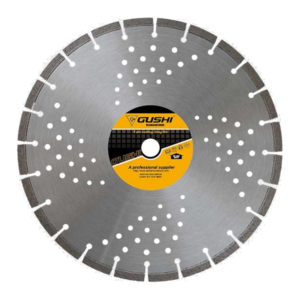
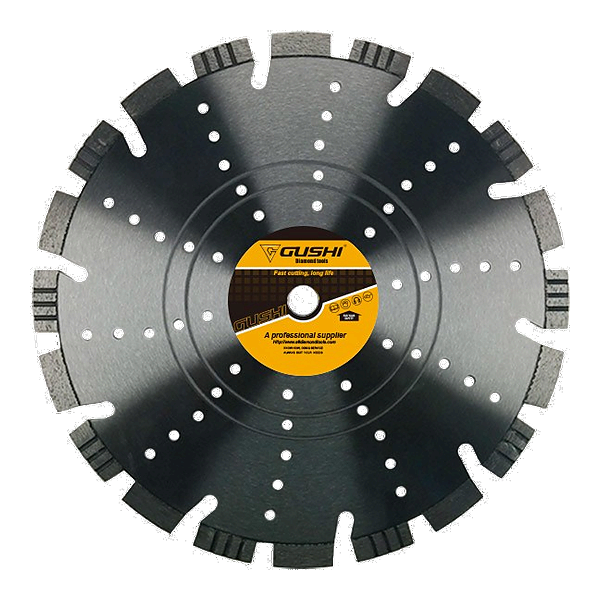
The rim is a ring of turbo segments, each a block of diamond bond with shallow ridges pressed across its face, and each pair separated by an open gullet that runs to the edge of the core. On a 900 mm blade that arrangement is the difference between a rim that keeps cutting and one that polishes itself shut halfway down a slab.
Why the arc length changes the job
A 350 mm blade puts roughly 550 mm of rim into the stone on a full depth pass; a 900 mm blade about twice that, and the rim stays in contact for a long unbroken stretch. Slurry has to leave that arc and water has to reach its far end, and on a rim with no relief neither happens. The fines pack between segment and wall, the bond cannot wear back, and sharp diamond sits behind blunt metal.
The ridges break that up. They give water a channel into the cut and slurry a channel out, and leave the edges of the bond exposed so the metal wears and fresh diamond comes up. The gullets do the same at a coarser scale.
What a working rim looks like
A rim that is cutting shows an even, slightly rounded wear face with grit standing proud. A glazed rim shows a bright polished face and a cut that slows while the blade heats. The two call for opposite responses, which is why the troubleshooting table starts there.
Depth of Cut: the Number That Decides the Saw
Depth of cut is not printed on the blade. It is half the diameter minus the flange radius, so the saw decides it and the blade only sets the ceiling. A blade buried to the flange is at its limit, and the flange on a walk-behind saw is a substantial disc.
| Diameter | Radius | Typical single pass | How to go deeper |
|---|---|---|---|
| 350 mm / 14 in | 175 mm | about 120 mm | Two passes, first at 60 mm |
| 400 mm / 16 in | 200 mm | about 145 mm | Two passes |
| 450 mm / 18 in | 225 mm | about 165 mm | Two passes |
| 600 mm / 24 in | 300 mm | about 240 mm | Two or three passes |
| 700 mm / 28 in | 350 mm | about 285 mm | Three passes |
| 900 mm / 36 in | 450 mm | about 380 mm | Three passes, stepped evenly |
The figures assume a flange radius of 55 to 70 mm. Measure your own flange before quoting a depth, because 10 mm of flange radius is 10 mm of cut lost on every pass. Arbor height is the second limit: on many saws the blade cannot reach the depth its diameter suggests, and forcing the handle past that point lifts the rear wheels and puts the blade out of square.
Size Chart: Diameter, Kerf, Height, Arbor and Speed
Eleven sizes share one arbor and one bond family, so a contractor can step up a diameter without changing anything else in the kit. Segment width rises with the diameter; segment height is a separate order decision.
| Item | Diameter | Segment width | Segment height | Arbor | Max rpm |
|---|---|---|---|---|---|
| MTDB350 | 14 in / 350 mm | 3.2 mm | 8 / 10 / 12 / 15 mm | 25.4 mm | 4,365 |
| MTDB400 | 16 in / 400 mm | 3.5 mm | 8 / 10 / 12 / 15 mm | 25.4 mm | 3,820 |
| MTDB450 | 18 in / 450 mm | 4.0 mm | 8 / 10 / 12 / 15 mm | 25.4 mm | 3,395 |
| MTDB500 | 20 in / 500 mm | 4.0 mm | 8 / 10 / 12 / 15 mm | 25.4 mm | 3,055 |
| MTDB550 | 22 in / 550 mm | 4.0 mm | 8 / 10 / 12 / 15 mm | 25.4 mm | 2,780 |
| MTDB600 | 24 in / 600 mm | 4.5 mm | 8 / 10 / 12 / 15 mm | 25.4 mm | 2,545 |
| MTDB650 | 26 in / 650 mm | 4.5 mm | 8 / 10 / 12 / 15 mm | 25.4 mm | 2,350 |
| MTDB700 | 28 in / 700 mm | 4.5 mm | 8 / 10 / 12 / 15 mm | 25.4 mm | 2,180 |
| MTDB750 | 30 in / 750 mm | 4.5 mm | 10 / 12 / 15 mm | 25.4 mm | 2,035 |
| MTDB800 | 32 in / 800 mm | 4.5 mm | 10 / 12 / 15 mm | 25.4 mm | 1,910 |
| MTDB900 | 36 in / 900 mm | 4.5 mm | 10 / 12 / 15 mm | 25.4 mm | 1,700 |
Maximum rpm is calculated from 80 metres per second at the rim. The marking on the blade governs and the two are kept identical at production.
Kerf Width and Horsepower
Cutting is a volume problem. Every second the saw turns a rectangle of concrete into dust and slurry, and its area is kerf width times depth of cut times feed. Horsepower has to cover that volume, which is why segment width climbs with the diameter.
The 13 HP ceiling
This range is built for walk-behind saws up to 13 HP, about 9.7 kW. At that power a 450 mm blade with a 4.0 mm kerf cutting 165 mm deep will pull at a steady walk on ordinary concrete. The same engine on a 900 mm blade with a 4.5 mm kerf cutting 380 mm deep is at the top of its range and wants a slower feed or a shallower pass. That is not a fault in the blade; it is the arithmetic of a bigger rectangle.
Two consequences follow. Do not fit a blade larger than the saw was built for and expect the same feed; the saw does not gain power when the blade grows. When a job needs a deep cut on a modest saw, step cutting beats a bigger disc.
Where the kerf volume goes
A 4.5 mm kerf at 380 mm deep cuts about 1.7 square metres of slot per metre of travel. That figure decides how many metres a segment delivers, and it explains why segment height in millimetres is a poor way to quote life on a big blade. Ask for metres of slot instead.
Maximum rpm and Saw Match
Every diameter has a speed above which the rim is travelling past what the bond and the core can stand, and the ceiling comes from peripheral speed. A diamond blade is rated at 80 metres per second at the rim, so rpm falls as the circumference grows: 4,365 rpm at 350 mm, 1,700 rpm at 900 mm.
Floor saws are geared to sit inside those figures, which is why a saw built for a 900 mm blade turns slowly and one built for a 350 mm blade quickly. When the match is wrong the failure is not a blade that wears out; it is a rim that lets go. Never fit a blade larger than the machine was made for, and never run one above the rpm printed on it.
High speed saws sit near the top of the range for the smaller diameters, and a 350 mm blade on a 4,300 rpm saw is close to its ceiling. Check the two numbers against each other before the first cut.
Segment Height: 8, 10, 12 or 15 mm
The range is offered in four heights, and the choice is about the material rather than the diameter. Segment height is the diamond-bearing depth above the steel core; once it is gone the blade cuts with a steel edge, the cut slows and the core loses tension.
When a taller segment pays
Abrasive material eats height. Clay paver, soft brick, block with a high sand content and some asphalt mixes wear the bond fast, because the material grinds the metal away before the diamond dulls. There a 15 mm segment is the economical choice: the blade stays on the saw for more metres and the operator changes discs less often.
When a shorter segment is right
Hard dense concrete wears the bond slowly and dulls the diamond, so the limit there is glazing rather than height. An 8 or 10 mm segment is ample, and the money goes into the bond and the diamond instead of metal that will never be used. From 750 mm up the range starts at 10 mm, because the kerf area per metre is large enough that a thin segment goes quickly.
If a customer asks which height to stock, the honest answer needs their material mix and weekly metres.
Water on a Floor Saw
On a blade this size water is not optional. It keeps the bond from softening, stops the diamond overheating, flushes slurry out of the cut and holds the silica dust down. Cured concrete carries crystalline silica, and on a 900 mm blade cutting a 380 mm slot the dust volume is substantial, so water is a health control too.
How much water
A 350 mm blade is comfortable on three to five litres a minute delivered where the rim enters the stone. As the diameter grows the arc grows with it, so the flow has to rise: a 600 mm blade wants roughly twice that, and a 900 mm blade a steady supply well above it, with the slurry leaving the cut thin and milky. If it comes out as paste, the flow is too low and the rim is recirculating its own fines.
Delivery point matters as much as volume. Water sprayed over the guard cools the guard; water aimed where the segment enters the cut does the work. On most floor saws that means checking the nozzle angle and clearing swarf from the port before the job.
Running dry
Some jobs run dry: a small paver cut, a quick chase, a site with no supply and proper extraction. The laser weld tolerates the heat and the turbo rim clears itself. What the blade will not survive is repeated dry passes at full depth, because the core heats, loses tension and dishes. If a job must run dry, keep the passes shallow and let the blade run free between them.
Arbor, Flange and Mounting
The arbor is 25.4 mm, one inch, the spindle standard on floor saws, masonry saws and high-cycle saws. There is no 22.23 mm option, and that is deliberate. On a 900 mm blade the torque at the spindle and the side load at the rim are large, and a bushing stepping a one inch bore down is a thin-walled part carrying both. It can creep, and a few tenths of a millimetre of play becomes visible swing at the rim.
Flange size grows with the blade
The flange holds the core flat, and its diameter has to grow with the disc. A small flange on a large blade lets the core flex between flange edge and rim; a flexing core cuts a curve, loads one side of every segment and wears the rim into a taper. Both faces must be clean, flat and free of burrs.
Tighten firmly and evenly, and do not hang off the spanner: over-tightening distorts the flange and puts a permanent dish in the core. On a used saw, check spindle runout before blaming the blade.
Mounting checks before the first cut
Three checks take a minute. Spin the blade by hand with the saw off and watch the rim against a fixed point; a wobble means the mounting is wrong or the core is bent. Check the rotation arrow. Check that no part of the rim is worn past the weld, because an unevenly worn rim runs out of true from the first metre.
Step Cutting a Deep Slot
When the slot is deeper than one pass, the cut is made in steps. The first pass goes to about a third of the final depth, the second to two thirds, and the last to full depth. Each pass removes material the next does not have to fight, and the blade spends less time buried to the flange.
Two things make it work. The saw has to run against a guide or a marked line on every pass, because a second pass a few millimetres off loads one side of the rim for its whole length. And the cut should be wedged so the walls do not close on the blade between passes; concrete that relaxes after cutting can grip a blade within minutes.
Depth per pass is roughly a third of the single pass figure in the table above. A 900 mm blade at 380 mm single pass steps 120, 250 and 380 mm; a 450 mm blade goes in two passes of 80 and 165 mm.
Matching the Blade to the Material
| Material | Water | Segment height | Notes |
|---|---|---|---|
| Medium to hard concrete, moderate rebar | Yes, full flow | 10 or 12 mm | Steady feed; the weld carries the heat where diamond meets steel |
| Hard dense concrete, high strength | Yes, full flow | 8 or 10 mm | Bond wears slowly here; watch for glazing rather than height loss |
| Hard concrete slab, deep section | Yes, full flow | 12 or 15 mm | Step cut; the arc is long and the slurry volume high |
| Paver and clay paver | Yes, or dry with extraction | 12 or 15 mm | Abrasive; height disappears before the diamond dulls |
| Hard brick and block | Yes, or dry with extraction | 12 or 15 mm | Abrasive and dusty; water is the cheaper control |
| Field stone and rubble | Yes | 10 or 12 mm | Uneven load; keep the feed light |
One pattern runs across the table. Hard dense material wants water, a steady feed and a bond that holds diamond, because the diamond does the work and heat is the enemy. Abrasive material consumes height before it dulls the diamond, so the taller segment pays. Both want relief that keeps the cut clear.
Blade Care Between Jobs
A blade this size is an investment and easy to ruin in storage. Stand it on edge, not flat, and hang it if there is a rack. A 900 mm disc stored flat takes a set from its own weight, and a core with a set will not run true however carefully it is mounted.
Clean the slurry off the core and the flange faces before the blade goes back in the van; it sets hard, and a lump on a flange face is exactly the dirt that tilts a blade. Check the rim for cracks at the gullets each time the blade comes off. A crack that starts at a gullet grows, and a cracked blade is scrap.
Keep the segment height recorded. At 2 mm the weld is close to running on stone, which is where a segment can lift. Retire the blade at about 1.5 mm.
Troubleshooting
| Symptom | Usual cause | What to do |
|---|---|---|
| Rim looks polished, cut slows, blade gets hot | Glaze: feed too light, or the bond is harder than the material needs | Open the rim on an abrasive block for 20 to 30 seconds, then keep the feed up |
| Feed drops and the saw labours | Kerf too wide for the horsepower, or too deep a pass | Step cut, or move to a narrower kerf suited to the saw |
| Cut drifts from the first metre | Bushing with play, dirty flange, or spindle runout | Clean both flanges, check runout, refit before cutting again |
| Blade wobbles as soon as it runs | Burr or dirt on a flange face, or a core with a set from storage | Dress the flange, check the core on a flat plate |
| Core turns blue or straw | Overheated from dry passes at full depth | Water, or shallow passes with a free run between. A blue core has lost tension |
| Slot grips the blade partway down | Material relaxing behind the cut, or a single full depth pass | Step cut and wedge the slot; never leave a deep pass unattended |
| Uneven segment wear around the rim | Blade out of square to the line, or one side of the flange dirty | Square the saw to the guide, clean the flange, check the rim after a metre |
Frequently Asked Questions
- What is a masonry turbo diamond blade?
- It is a large segmented blade whose rim is built from turbo segments, blocks of diamond bond with shallow ridges pressed into the cutting face. The ridges keep water reaching the cut and fines leaving it, which matters on big diameters because the rim stays in the stone for a long arc every revolution. This range runs 350 to 900 mm on a 25.4 mm arbor, for floor saws up to 13 HP.
- What sizes are available and what saw does each fit?
- Eleven sizes run 14 in / 350 mm to 36 in / 900 mm in 50 mm steps: 350, 400, 450, 500, 550, 600, 650, 700, 750, 800 and 900 mm. The 350 and 400 mm suit a high speed saw or a masonry table saw. From 450 mm up the blade belongs on a walk-behind saw, and past 600 mm it wants a saw rated for the diameter and the water supply.
- How deep will each diameter cut?
- Depth of cut is half the diameter minus the flange radius, so the saw decides it. With a typical flange a 350 mm blade cuts about 120 mm, a 450 mm about 165 mm, a 600 mm about 240 mm and a 900 mm about 380 mm. Anything deeper needs step cutting, and the arbor height sets a ceiling no blade can pass.
- Why is the arbor 25.4 mm only?
- 25.4 mm is one inch, the spindle standard on floor saws, masonry saws and high-cycle saws, which is what this range is built for. On a 900 mm blade the torque at the spindle and the side load at the rim are large enough that a thin-walled reducing bushing can creep and let the blade swing. If your saw runs a 22.23 mm spindle, buy a blade built on that bore.
- What segment height should I choose?
- The range comes in 8, 10, 12 and 15 mm, and 750 mm and above start at 10 mm. Abrasive material such as clay paver and soft brick consumes height quickly, so a taller segment buys metres of cut. Hard dense concrete wears the segment slowly but dulls the diamond, so a shorter segment is no penalty there. Tell us the material mix and weekly metres and we will confirm the height.
- What kerf width do the different diameters use?
- Segment width steps up with diameter: 3.2 mm at 350 mm, 3.5 mm at 400 mm, 4.0 mm from 450 to 550 mm and 4.5 mm from 600 to 900 mm. The kerf is the load the saw pulls, so the width is matched to the horsepower behind each diameter. A 4.5 mm kerf on a machine sized for 3.2 mm will stall the saw and glaze the rim.
- What is the maximum rpm for each diameter?
- The rating is 80 metres per second at the rim, so the limit falls as the blade grows: about 4,365 rpm at 350 mm, 3,820 at 400 mm, 3,395 at 450 mm, 3,055 at 500 mm, 2,545 at 600 mm, 2,180 at 700 mm, 1,910 at 800 mm and 1,700 at 900 mm. They are a ceiling, not a setting, and the number moulded on the blade governs.
- Can it cut reinforced concrete?
- Yes, it is built for medium to hard concrete with moderate steel reinforcement. Laser welding fuses the segment to the core with a full metallurgical joint, so the bond line holds at the temperature the segment reaches when diamond meets steel. Keep the feed steady and water on the cut, and expect the segment to wear at the steel. Heavy mesh or dense bar wants a blade specified for that duty.
- Does the blade need water?
- On a floor saw yes, and the volume rises with the diameter. A 350 mm blade is comfortable on three to five litres a minute at the point where the rim enters the stone; a 900 mm blade wants a steady flow well above that, because the arc in the cut is longer and the slurry has further to travel. Water keeps the bond from softening and holds the silica dust down.
- What does the turbo segment do in a big diameter?
- It keeps the cut alive. A rim with no relief polishes itself shut on hard, closing concrete, because the fines have nowhere to go and the bond cannot wear back to expose diamond. The ridges give the slurry a path and leave the bond edges exposed, so the rim keeps cutting through a long pass. On a 900 mm blade that pass can be a metre of continuous contact.
- Why is my cut drifting or the blade binding?
- A cut that drifts from the first metre is usually mounting: a bushing with play, dirt or a burr on a flange, or a spindle with runout. Binding that starts partway through is usually a deep slot closing on the blade, which is what step cutting prevents. A core showing blue or straw colour has been overheated and has lost tension; no adjustment will bring the line back.
- What is the minimum order and can you print my brand?
- Minimum order is 50 pieces per size, and mixed sizes in one order are accepted so a distributor can hold the 350 to 900 mm range without committing to a container of one line. Lead time is 20 to 30 days after artwork and specification are confirmed. We print your logo and grade, supply your sleeve or carton, and hold the bond and segment height from order to order.