Full Specifications
| Item number | Diameter | Segment width | Segment height | Arbor hole |
|---|---|---|---|---|
| 4HSCTB | 4 in / 100 mm | 2.4 / 2.6 / 2.8 mm | 8 / 10 mm | 20.0 / 22.23 mm |
| 4-3/8HSCTB | 4 3/8 in / 110 mm | 2.4 / 2.6 / 2.8 mm | 8 / 10 mm | 20.0 / 22.23 mm |
| 4.5HSCTB | 4.5 in / 115 mm | 2.6 / 2.8 mm | 8 / 10 mm | 20.0 / 22.23 mm |
| 5HSCTB | 5 in / 125 mm | 2.8 mm | 8 / 10 mm | 20.0 / 22.23 mm |
| 6HSCTB | 6 in / 150 mm | 2.8 / 3.0 mm | 8 / 10 mm | 20.0 / 22.23 mm |
| 7HSCTB | 7 in / 180 mm | 2.8 / 3.0 mm | 8 / 10 mm | 20.0 / 22.23 mm |
| 8HSCTB | 8 in / 200 mm | 3.0 / 3.2 mm | 8 / 10 mm | 20.0 / 22.23 mm |
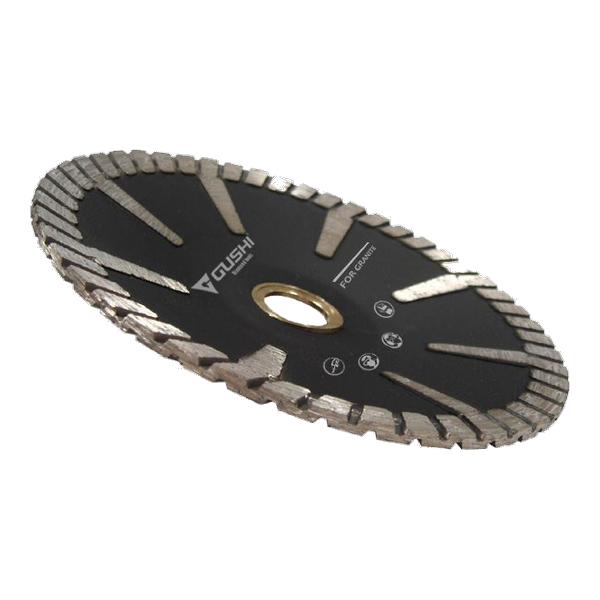
Seven sizes as published for this series. The rim is a concave, dished profile with a turbo segmented edge, listed for dry and wet use. Segment height is 8 or 10 mm at every size and arbor is 20.0 or 22.23 mm across the range. No speed rating, core thickness, diamond concentration or bond hardness is published with this table.
Curved cutting is the job
The defining feature of this blade is the dished profile. Where a flat rim blade presents a straight edge to the work, a concave blade presents a curved one, and a curved edge follows a radius. That is why the listing names radius and curved line work on slab and countertops as the work this shape is built for. Cutting a circle, a sink opening or a curved profile in stone is exactly the cut a flat blade cannot make in one pass, and it is the reason the blade exists.
On a countertop the cut is usually a hole or a curve, not a straight rip. A dished rim lets the blade sweep that line while keeping the cut width even, so the opening comes out clean enough to drop a basin into without a second tool. The curve does the path setting; the turbo edge does the cutting. Keeping those two jobs separate is what makes the blade practical for fabrication rather than only for rough site work.
The small diameters matter here. The range runs 100 to 200 mm, the sizes a fabricator runs on a hand held saw or a grinder, not the large blades a bridge saw carries for straight slab cuts. Those are the tools that actually make sink and curve cuts on a bench, so the size menu matches the job rather than the machine hall.
One practical point: a concave blade cuts the path it is shaped for, so the radius you can cut is set by the dish, not by pushing the blade harder. Working within the profile is what keeps the cut true, and it is the difference between a curve that fits and one that has to be reworked.
The turbo rim gives it bite in hard stone
The dished profile sets the path; the turbo segmented edge does the cutting. A turbo rim is a ring of small, alternating segments with open gullets between them, and that pattern keeps a cutting point engaged as the blade turns instead of letting the rim skate across a hard face. On granite and other hard stone that engagement is what moves the cut forward, where a plain rim would only scribe the surface.
The gullets do a second job: they give the rim a way to shed heat and dust, which is what makes dry use possible on this blade. The listing covers dry and wet use, and the open turbo edge is the reason dry cutting does not simply glaze the rim. On a grinder with no water feed the blade still clears the cut; on a saw with a water feed it runs cooler and keeps the slurry moving.
Turbo and concave are independent choices that happen to suit each other here. The turbo edge handles the material; the concave profile handles the path. Putting the two on one blade is what makes a single tool able to cut a curve in hard stone, rather than needing a flat turbo blade for the stone and a separate curved blade for the shape.
The segmented form also means the blade is a rim of separate teeth, not a continuous band. That is the opposite of a continuous rim blade, and it is why this blade is listed for hard stone and granite rather than for the brittle tile and glass work where a smooth rim is the right call. The two blades split the range by material and by finish, not by accident.
Protection on both arbor faces
The listing states the arbor carries protection on both the in and out faces. That reinforcement sits around the mount, where the blade meets the flange and where the curved cut places side load on the core. Holding that central area true is what keeps the blade running straight through repeated mounting and through the lateral force a radius cut introduces, which a straight cut does not.
This is a structural part of the blade next to the bore, not a coating on the cutting edge. The protection is there to keep the mount stable, so the dished profile cuts the radius it is shaped for instead of wandering as the core flexes. For a blade whose whole point is a precise curve, a stable centre is the condition that makes the curve accurate.
The arbor itself is 20.0 or 22.23 mm across the range, the spindles of the hand held saws and grinders these sizes run on. The both-side protection is built around that bore, so the blade seats the same way on either face and the reinforcement does not depend on which side faces out.
What it cuts: hard stone, granite, hard material
The listing names hard stone, granite and hard material, and names the turbo concave blade for harder stones. Those are the materials where the segmented turbo edge keeps biting instead of polishing the surface, which is the job this blade is listed for. Granite is the everyday hard stone in fabrication, and the turbo rim is the edge that cuts it without skating.
What it is not listed for is just as clear. The brittle tile, ceramic and glass work belongs to a continuous rim blade, whose smooth edge leaves a chip free finish that a segmented turbo rim is not built to match. This blade is the hard stone and granite tool in the range, and staying inside that split is what keeps the cut quality the table implies.
Dry or wet use widens where the blade can work. Dry cutting takes it to site and to a grinder without a water feed; wet cutting keeps it on a saw where slurry and edge quality matter. The material stays hard stone and granite either way; only the cooling changes.
Seven sizes, one height menu
The width column is a steady climb with diameter. It reads 2.4 mm at 100 and 110 mm, 2.6 mm at 115 mm, 2.8 mm from 125 to 180 mm, and 3.0 to 3.2 mm at 200 mm. Wider rims carry more diamond, so the larger blades are also the heavier cutting members, which is what a bigger hand held saw expects from its blade.
The height menu is the same at every size: 8 or 10 mm. That is worth noting, because it means a buyer can standardise the rim depth across the whole range and switch diameter without switching segment height. The 8 mm is the lighter option, 10 mm the longer running, and the choice is open at every diameter in the table.
The arbor stays at 20.0 or 22.23 mm across all seven sizes, so the blade fits the same spindles from the smallest to the largest in the range. Pick the diameter for the cut and the tool, the width and height from the menu, and the bore from the spindle, and the rest of the geometry is fixed by the size.
Private Label and Export Supply
The range is supplied under the GUSHI mark or made to order under a buyer’s own. What can be set is the core printing on both faces, the item numbering, the bore within each size, the segment height where a size offers two options, and the sleeve or carton print. The seven sizes and the concave turbo profile stay as the product; the printing and the bore choice are where a private label run is specified.
For the rest of the cutting range, the straight hard stone and site work belongs to the flat segmented blade, the brittle tile and glass work to the continuous rim, and the curved hard stone and countertop work to this concave turbo blade. The three are one diamond saw blade family split by cut shape and material rather than by separate product lines.
Frequently Asked Questions
- What is a concave diamond saw blade, and what is it for?
- A concave blade carries its cutting edge on a dished, curved profile rather than a flat one. That curve lets the rim follow a radius, so the blade cuts circles, sink openings and curved lines on a slab or countertop in a single pass instead of in a series of straight bites. The listing names radius and curved line work on slab and countertops as the job this shape is built for, which is the work a flat rim blade does poorly.
- Will it cut dry, or does it need water?
- The listing covers both dry and wet use for this blade. Dry cutting is practical on site and on a grinder; wet cutting is the choice on a saw with a water feed where slurry control and edge quality matter. Because the rim is a turbo segmented edge with open gullets between the segments, it can shed heat and dust in dry work, which is what makes dry use possible on this blade.
- What materials will it cut?
- The listing states hard stone, granite and hard material, and names the turbo concave blade for harder stones. Those are the materials where the segmented turbo edge keeps biting instead of polishing the surface. It is listed for dry or wet work on stone rather than for the soft or brittle tile and glass jobs that belong to a continuous rim blade; stay within the hard stone and granite range the table implies.
- What does the both-side protection do?
- The arbor carries protection on both the in and out faces, as the listing states. That reinforcement sits around the mount where the blade meets the flange, so the central area holds its shape through repeated mounting and through the side loads a curved cut places on the core. It is a part of the blade’s structure next to the bore, not a coating on the cutting edge.
- How do I read the segment width and arbor in the table?
- Segment width climbs with diameter: 2.4 mm at 100 and 110 mm, 2.6 mm at 115 mm, 2.8 mm from 125 to 180 mm, and 3.0 to 3.2 mm at 200 mm. Wider rims carry more diamond, so the larger blades are also the heavier cutting members. Segment height is 8 or 10 mm at every size, the buyer’s choice of rim depth. The arbor is 20.0 or 22.23 mm across the whole range, the spindles of hand held saws and grinders.
- Why a turbo rim on a concave blade?
- The turbo rim is a segmented edge with a small, alternating tooth pattern that keeps a cutting point engaged as the blade turns, which gives it bite in hard stone and granite where a plain rim would skate. On a concave blade that bite is what lets the curved profile cut a radius in hard material rather than just scribe it. The turbo edge and the dished profile do different jobs: one sets the cut path, the other does the cutting.