Full Specifications
| Item number | Diameter | Segment width | Segment height | Arbor hole |
|---|---|---|---|---|
| HHSB230 | 9 in / 230 mm | 2.6 mm | 10 mm | 25.4 mm |
| HHSB300 | 12 in / 300 mm | 3.2 mm | 10 mm | 25.4 mm |
| HHSB350 | 14 in / 350 mm | 3.2 mm | 10 mm | 25.4 mm |
| HHSB400 | 16 in / 400 mm | 3.5 mm | 10 mm | 25.4 mm |
| HHSB450 | 18 in / 450 mm | 4.0 mm | 10 mm | 25.4 mm |
Five sizes as published for this series. Segment height is 10 mm and the arbor is 25.4 mm at every size; the segment width is the one column that changes, from 2.6 mm at 230 mm to 4.0 mm at 450 mm. No speed rating, diamond concentration or bond hardness is published with this table.
The job is cutting masonry and stone on site
The hand held saw blade cuts concrete, brick, block, masonry and stone with a hand-held power saw or a masonry saw. The listing names those five materials and those two machines, and the diameters run 230 to 450 mm, the range for saws that a crew carries and runs on a wall, a floor or a slab rather than for a small angle grinder. That is the whole point of the series: a blade sized above the grinder range for the bigger, slower passes a masonry or hand-held saw makes.
Concrete, brick, block and masonry are the building materials where a joint, a opening or a damaged section has to be cut cleanly, and stone is the natural stone face the same saw meets. The blade is a masonry and stone cutting tool for those surfaces, not a blade for metal or wood. Because the diameters are 230 mm and up, the blade is built for the saws that sit in that size band and for the cuts that need a steady, guided pass rather than a free hand grind.
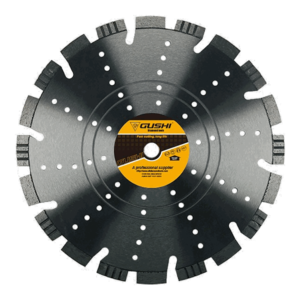
The cut has to stay cool and keep advancing, and that is where the core of the blade matters as much as the rim. The listing points to the holes in the core as the feature that helps cooling and fast cutting, so the blade is designed for heat control on the longer runs these saws make. The rim does the cutting; the core is what keeps the blade from overheating while it does.
The holes in the core help cooling
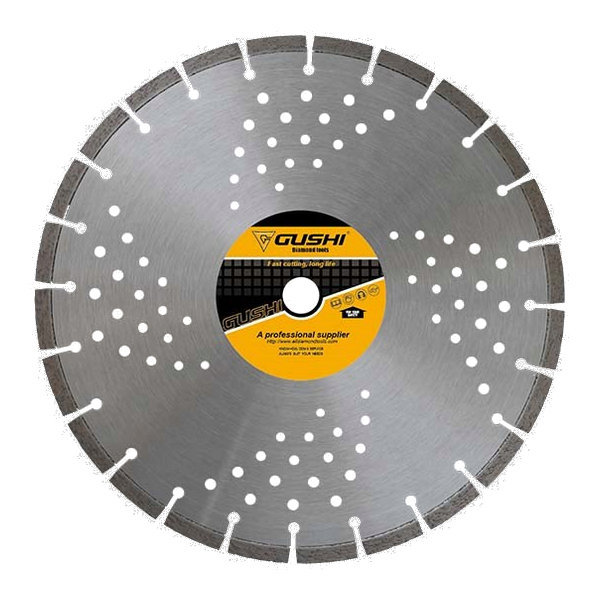
The listing states that holes in the core help cooling and fast cutting. The steel core of this blade carries a pattern of holes, and those holes are what let air move through the blade as it spins and as it cuts. On a hand-held or masonry saw the cut is a longer, more loaded pass than a quick grinder nick, so heat builds in the core; the holes give that heat a way out and keep the blade cooler through the run.
Cooling is what lets the cut keep moving. A blade that holds its temperature keeps its rim engaged instead of yielding to heat, and the listing ties that directly to fast cutting. The holes are part of the blade’s build, not an add on, and they sit in the steel core rather than in the rim, because the core is the part that loads up with heat while the saw drives the cut. The feature is named in the listing as the reason the blade cuts cool and fast.
The holes also lighten the core, which matters on a hand-held saw where the spinning mass is felt at the handle. A lighter, vented core runs steadier in the operator’s hands and keeps the cut on line. The listing does not give a weight or a hole count, so those are not stated here; what is stated is that the core holes help cooling and fast cutting, and that is the function they serve on this blade.
The segment width grows with the diameter
This series is the one where the segment width is not fixed. The table sets the segment width to the diameter: 2.6 mm at 230 mm, 3.2 mm at 300 and 350 mm, 3.5 mm at 400 mm and 4.0 mm at 450 mm. A larger blade takes a wider, deeper cut, so the rim needs a wider segment to carry the cut on the bigger diameters, and the table reflects that directly rather than holding one width across the range.
What stays fixed is the rest of the rim. The segment height is 10 mm at every size, and the arbor is 25.4 mm at every size. So a buyer choosing between the five diameters is choosing the diameter and, with it, the matching segment width; the height and the bore are already decided by the series. The segment width is the one dial the table turns with the diameter, and the height and arbor are the constants.
The 25.4 mm arbor is the reason the sizes sit where they do. A 25.4 mm bore fits the hand-held power saws and masonry saws these diameters mount on, and it does not change because the diameter stays in the saw range and never crosses into a different spindle. The blade is built as a masonry and stone cutting tool across its whole range, so the fixed 25.4 mm arbor and fixed 10 mm height are the constants, and the diameter and the segment width move together.
Hand-held power saws and masonry saws
The listing names the hand-held power saw and the masonry saw as the machines for this blade, and the 25.4 mm arbor fits those saws. The diameters from 230 to 450 mm are the sizes those machines carry, so the series is built for the saws that cut concrete, brick, block, masonry and stone on site rather than for a grinder in the hand. Pick the diameter to the saw, and the saw to the cut.
The sizes span the saw band neatly. The 230 and 300 mm sizes sit at the smaller end of the hand-held saw range for lighter, more frequent cuts; the 350, 400 and 450 mm sizes are the heavier masonry saw diameters for longer, deeper passes on a slab or a wall. None of the five is a grinder blade, and none needs the small 22.23 mm bore that the grinder blades use; the 25.4 mm arbor is the fit for the saws named in the listing.
Because the machine is a guided saw rather than a free grinder, the cut is steadier and the blade runs at a more even load, which is exactly the condition the core holes are there to support. The listing’s note that the core holes help cooling and fast cutting fits a saw that holds the blade in a frame and drives a long, straight pass. The blade and the machine are matched by the arbor and the diameter together.
Five sizes, two fixed columns
The diameter column runs 230, 300, 350, 400 and 450 mm, the five sizes from 9 to 18 inch. Two columns do not change from row to row: the segment height reads 10 mm on every row, and the arbor reads 25.4 mm on every row. The item numbers HHSB230 through HHSB450 mark each diameter, and the diameters are what a buyer matches to the saw on site.
The segment width column is the one that moves. It reads 2.6 mm at 230 mm, 3.2 mm at 300 and 350 mm, 3.5 mm at 400 mm and 4.0 mm at 450 mm. So a buyer choosing between the five sizes is really choosing the diameter and the matching segment width together, because the two are tied in the table. The height and the bore stay put, which keeps the buy simple once the machine is known.
The 25.4 mm arbor is the constant that keeps the sizes in one family. Because the arbor never changes, every one of the five mounts the same way on the hand-held power saw or masonry saw, and only the diameter and the rim width differ. That is why the table reads as one blade at five diameters with a width that scales, rather than as five unrelated blades.
Private Label and Export Supply
The range is supplied under the GUSHI mark or made to order under a buyer’s own label. What can be set is the printing on the core, the item numbering and the carton or sleeve print for the export carton. The five diameters, the 10 mm segment height and the 25.4 mm bore stay as listed, because the table publishes them as fixed at every diameter; the segment width that scales with the diameter also stays as listed, since the table sets each width to its diameter.
For the rest of the cutting range, the hand-held and masonry saw work belongs to this blade, the grinder and small saw groove work to the tuck point and crack blades, and the brittle tile and glass work to the continuous rim. The family splits by the machine and the material, and this blade is the one sized above the grinder range for the saws that cut concrete, brick, block, masonry and stone on site. The five diameters cover the hand-held and masonry saw band, and the fixed arbor means the same mount runs through all of them.
Frequently Asked Questions
- What is a hand held saw blade used for?
- It is used to cut concrete, brick, block, masonry and stone with a hand-held power saw or a masonry saw. The listing names those five materials for the blade and the two machines as the hand-held power saw and the masonry saw. The diameters run 230 to 450 mm, the range for those saws rather than for small angle grinders.
- Which materials can the hand held saw blade cut?
- The listing names concrete, brick, block, masonry and stone. The blade is a masonry and stone cutting tool for those surfaces on site, run on a hand-held power saw or a masonry saw. It is not a blade for metal or wood, and it is sized above the grinder range, so it is for the larger saws these diameters mount on.
- What are the holes in the core for?
- The listing states that holes in the core help cooling and fast cutting. The steel core carries a pattern of holes that let air and heat move through the blade as it runs, keeping the cut cooler on the longer passes these hand-held and masonry saws make. The holes are part of the blade’s build, not an add on.
- What diameters are available?
- Five sizes from 9 inch (230 mm) to 18 inch (450 mm): 230, 300, 350, 400 and 450 mm. Every size shares the same segment height and arbor, so the diameter is the main variable in the table. Pick the size to the hand-held power saw or masonry saw in hand.
- What is the segment width, height and arbor of the hand held saw blade?
- Segment height is 10 mm and the arbor hole is 25.4 mm at every listed size. The segment width is the figure that changes: 2.6 mm at 230 mm, 3.2 mm at 300 and 350 mm, 3.5 mm at 400 mm and 4.0 mm at 450 mm. The width tracks the diameter while the height and the bore stay fixed.
- Which machines run this hand held saw blade?
- The listing names the hand-held power saw and the masonry saw. The 25.4 mm arbor fits those saws, and the diameters from 230 to 450 mm are the sizes those machines carry. These are larger than the grinder blades, so the range is built for the saws that cut concrete, brick, block, masonry and stone on site.
- Why does the segment get wider as the blade gets bigger?
- The table sets the segment width to grow with the diameter: from 2.6 mm at 230 mm to 4.0 mm at 450 mm. A larger blade takes a wider, deeper cut, so the wider segment carries the rim on the bigger diameters. The segment height stays 10 mm and the arbor stays 25.4 mm at every size, so only the width tracks the diameter.