Full Specifications
| Item number | Diameter | Segment width | Segment height | Arbor hole |
|---|---|---|---|---|
| 12HCASB | 12 in / 300 mm | 3 mm | 10 / 12 mm | 22.23 / 25.4 mm |
| 14HCASB | 14 in / 350 mm | 3.2 mm | 10 / 12 mm | 22.23 / 25.4 mm |
| 16HCASB | 16 in / 400 mm | 3.6 mm | 10 / 12 mm | 22.23 / 25.4 mm |
| 18HCASB | 18 in / 450 mm | 3.8 mm | 10 / 12 mm | 22.23 / 25.4 mm |
| 20HCASB | 20 in / 500 mm | 4 mm | 10 / 12 mm | 22.23 / 25.4 mm |
| 24HCASB | 24 in / 600 mm | 4.5 mm | 10 / 12 mm | 22.23 / 25.4 mm |
| 28HCASB | 28 in / 700 mm | 4.5 mm | 10 / 12 mm | 22.23 / 25.4 mm |
| 30HCASB | 30 in / 750 mm | 4.5 mm | 10 / 12 mm | 22.23 / 25.4 mm |
| 32HCASB | 32 in / 800 mm | 4.5 mm | 10 / 12 mm | 22.23 / 25.4 mm |
| 36HCASB | 36 in / 900 mm | 4.5 to 6.0 mm | 10 / 12 mm | 22.23 / 25.4 mm |
| 40HCASB | 40 in / 1000 mm | 5.5 to 6.5 mm | 10 / 12 mm | 22.23 / 25.4 mm |
| 44HCASB | 44 in / 1100 mm | 5.5 to 6.5 mm | 10 / 12 mm | 22.23 / 25.4 mm |
| 48HCASB | 48 in / 1200 mm | 5.5 to 7.0 mm | 10 / 12 mm | 22.23 / 25.4 mm |
Thirteen sizes as published for this series. Segment height is 10 or 12 mm and arbor is 22.23 or 25.4 mm at every size; only the rim width changes, and only above 800 mm does it become a range. No speed rating, core thickness, diamond concentration or bond hardness is published with this table.
The job is asphalt and green concrete
The blade is built around two demanding road materials: asphalt, and green concrete, the fresh pour that has not fully cured. The listing also names cured and reinforced concrete, so the range covers the full set of slab and pavement cuts a road crew meets. Those are abrasive, gritty jobs where a hard, polished rim would skate; the listing answers them with a soft bonded turbo segment that keeps cutting into the material.
The diameters tell you where the blade lives. The range runs 300 to 1200 mm, the sizes that fit walk behind cut off saws and other floor and road machines, not the small blades a hand grinder spins. That is the equipment that actually opens a road, cuts a control joint or trims a fresh slab, so the size menu matches the machine hall rather than the toolbox.
Green concrete is the harder of the two to cut well, because the aggregate is loose in a soft matrix and the cut loads up fast. A rim that clears its own debris is what keeps a green concrete cut moving, which is the specific problem the U-shaped slots are there to solve. Asphalt adds its own grit and tack, and the same open rim handles it. The blade is one tool for the abrasive road set, not a general stone blade.
Soft bond and U-slots keep the cut moving
The listing specifies a soft bonded turbo segment. A softer bond is the choice for aggressive cutting of abrasive material, because the matrix wears back to keep fresh diamond at the edge instead of letting a worn flat face glide over the work. On asphalt and green concrete, where the cut is full of grit, that exposure is what keeps the blade biting rather than polishing, and it is the reason this rim is described as aggressive.
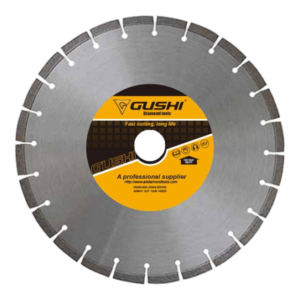
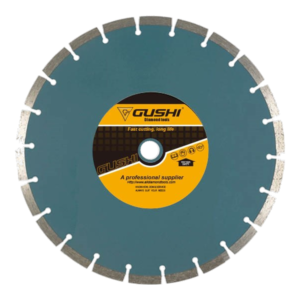
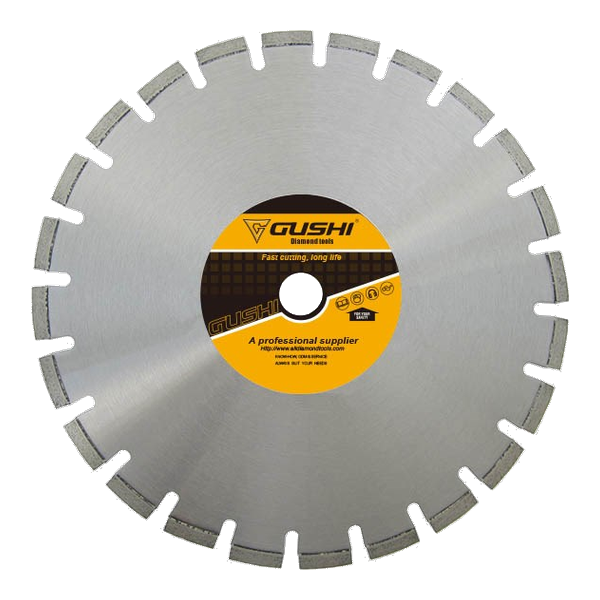
The U-shaped slots do the second half of the job. They sit between the segments and their work is to move debris out of the cut so the cutting edge stays in contact with the material. In abrasive road work the slot is what stops the blade loading up on ground asphalt or concrete and stalling; the slot shape is part of why the listing calls this an aggressive cutting blade rather than a plain segmented one.
Turbo and slot are the same idea from two sides: the turbo segment keeps a point engaged as the blade turns, and the U-slot keeps that point clear. Together they are what let a large diameter blade hold its feed rate in material that would clog a closed rim. The rim is a ring of separate teeth with open gullets, which is the opposite of a continuous rim blade and the reason this tool is listed for road material rather than for the brittle tile and glass work a smooth rim is built for.
Laser welded, with an optional protection tooth
The listing states laser welded segments with grade A diamond. Laser welding fuses each segment to the steel core so the joint holds through the impact and heat of road cutting, which is why this method is used on blades this large rather than a brazed joint that can let go under load. Grade A is the diamond grade named in the listing, the crystal quality behind the cutting edge; the table gives segment height as 10 or 12 mm at every size, the buyer’s choice of how much rim depth to start with.
For added wear resistance at the rim, the listing offers a version with protection teeth. The protection sits at the segment edge where the abrasive road material wears the fastest, so the rim holds its width longer under continuous asphalt and concrete work. It is an option rather than a fitted feature on every size in the table, so it is worth naming when ordering the larger diameters where rim wear costs the most.
The arbor is 22.23 or 25.4 mm across the whole range, the bores of the saws these diameters mount on. The laser weld and the optional protection are both about keeping the rim intact under road loads; the bore is simply the spindle the blade seats on, unchanged from the smallest to the largest size.
What it cuts: asphalt, green and cured concrete
The listing is written around asphalt, green concrete and cured and reinforced concrete. Those are the materials where the soft bonded turbo rim keeps biting instead of polishing the surface, which is the job this blade is built for. Asphalt and green concrete are the everyday road cuts; cured and reinforced concrete extend it to the harder slab and pavement work a cut off saw meets on site.
What it is not built for is the brittle, fine finish work. Tile, ceramic and glass belong to a continuous rim blade, whose smooth edge leaves the chip free finish a segmented turbo rim is not shaped to match. This blade is the abrasive road tool in the range, and staying inside that split is what keeps the cut quality the table implies; for a different material a different bond and segment shape apply.
Dry or wet use widens where the blade can work. Wet cutting on a saw with a water feed keeps the slurry moving and the rim cool, which is the common way these diameters are run. Dry cutting is possible where no water is available, and the open turbo gullets give the rim a way to shed heat and dust so the cut keeps advancing. The material stays asphalt and concrete either way.
Thirteen sizes, two fixed columns
The width column behaves in two parts. Below 900 mm it is one fixed figure per size, climbing 3 mm at 300 mm, 3.2 at 350, 3.6 at 400, 3.8 at 450 and 4 mm at 500, then holding at 4.5 mm across 600, 700, 750 and 800 mm. At 900 mm the table switches to a range, 4.5 to 6.0 mm, and the top sizes widen it further: 5.5 to 6.5 mm at 1000 and 1100 mm, and 5.5 to 7.0 mm at 1200 mm. So the smallest nine sizes ship one width, and the largest four let the buyer pick the rim mass for the job.
The height column is the same at every size: 10 or 12 mm. That is worth noting, because it means a buyer can standardise the rim depth across the whole range and switch diameter without switching segment height. The 10 mm is the lighter start, 12 mm the longer running, and the choice is open at all thirteen sizes in the table.
The arbor stays at 22.23 or 25.4 mm across all thirteen sizes, so the blade fits the same spindles from the smallest to the largest in the range. Pick the diameter for the saw and the cut, the width from the menu on the larger sizes, the height from 10 or 12 mm, and the bore from the spindle, and the rest of the geometry is fixed by the size.
Private Label and Export Supply
The range is supplied under the GUSHI mark or made to order under a buyer’s own. What can be set is the core printing on both faces, the item numbering, the bore within each size, the segment height where a size offers two options, and the sleeve or carton print. The thirteen sizes and the soft bonded turbo rim stay as the product; the printing and the bore choice are where a private label run is specified.
For the rest of the cutting range, the abrasive road and slab work belongs to this asphalt and green concrete blade, the hard stone and granite work to the laser welded and turbo stone blades, and the brittle tile and glass work to the continuous rim. The family splits by material and by finish, and this blade is the abrasive road member of it.
Frequently Asked Questions
- What is an asphalt and green concrete blade for?
- This blade is built for asphalt and for green concrete, the fresh, not yet fully cured pour, and the listing also names cured and reinforced concrete. Those are abrasive and often gritty jobs where a soft bonded turbo rim keeps cutting instead of polishing the surface. It is a road and slab blade in the 300 to 1200 mm range, the diameters that fit walk behind and other cut off saws rather than a hand grinder.
- Can it cut dry, or does it need water?
- The listing covers both dry and wet use. On a road saw with a water feed, wet cutting keeps the slurry moving and the rim cool, which is the common way these diameters are run. Dry cutting is possible where no water is available, and the open turbo gullets give the rim a way to shed heat and dust so the cut keeps moving. Pick the mode to the machine and the site, not to the blade.
- What do the U-shaped slots do?
- The rim carries U-shaped slots between the segments. Their job is to move debris out of the cut so the cutting edge stays in contact with the material instead of riding on a bed of ground up asphalt or concrete. In abrasive work the slot is what lets the blade keep advancing rather than loading up, and the slot shape is part of why the listing describes this as an aggressive cutting blade.
- What are the protection teeth for?
- The listing offers a version with protection teeth, an optional build for added wear resistance at the rim. The protection sits at the segment edge where the abrasive road material wears the fastest, so the rim holds its width longer under continuous asphalt and concrete work. It is offered as an option rather than fitted to every size in the table, so confirm it when ordering the larger diameters.
- How do I read the segment width and arbor in the table?
- Below 900 mm the width is one fixed figure per size, climbing 3 mm at 300 mm to 4.5 mm by 600 mm and holding at 4.5 mm across 600, 700, 750 and 800 mm. At 900 mm the table switches to a range, 4.5 to 6.0 mm, widening to 5.5 to 6.5 mm at 1000 and 1100 mm and 5.5 to 7.0 mm at 1200 mm, so the largest four sizes let the buyer pick rim mass. Segment height is 10 or 12 mm at every size and arbor is 22.23 or 25.4 mm across the whole range.
- Why laser welded segments with grade A diamond?
- The listing states laser welded segments with grade A diamond. Laser welding fuses each segment to the steel core so the joint holds through the impact and heat of road cutting, which is why this method is used on blades this large rather than a brazed joint. Grade A is the diamond grade named in the listing; the table gives segment height as 10 or 12 mm at every size, the buyer’s choice of rim depth.