Full Specifications
| Item | HST series split turbo diamond blade |
|---|---|
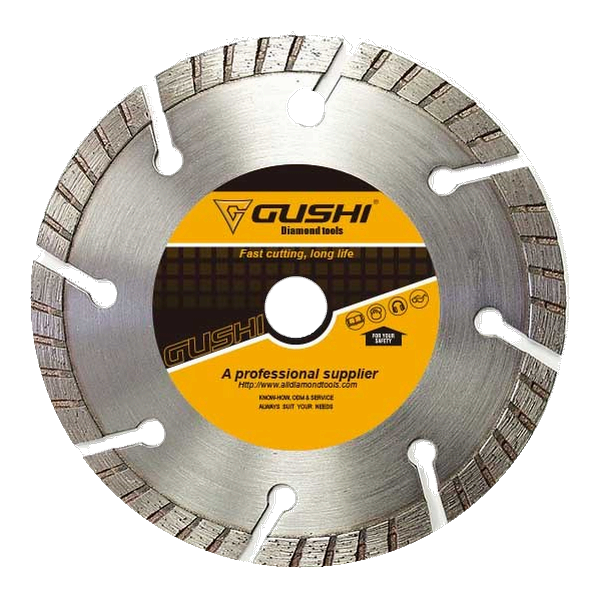
| Construction | Separate turbo segments set on a steel core, one gullet between each pair |
| Segment face | Shallow corrugations pressed across the cutting face |
| Diameters | 100, 115, 125, 150, 180, 200, 230, 250, 300 and 350 mm |
| Inch sizes | 4, 4.5, 5, 6, 7, 8, 9, 10, 12 and 14 in |
| Segment width (kerf) | 1.8 mm at 100 mm, 2.0 mm at 115 to 150 mm, 2.2 mm at 180 mm, 2.4 mm at 200 mm, 2.6 mm at 230 mm, 3.0 mm at 250 and 300 mm, 3.2 mm at 350 mm |
| Segment height | 5, 7, 8 or 10 mm, specified per order |
| Joint | Silver brazed on the smaller sizes, laser welded from 180 mm up |
| Arbor | 16, 20, 22.23 or 25.4 mm by size; reducing bushings to order |
| Core | Steel plate with silent holes between arbor and rim |
| Cutting mode | Wet or dry |
| Materials | Masonry, concrete, hard paver, brick, block, refractory material, stone |
| Machine types | Angle grinder at 100 to 125 mm, masonry saw, walk-behind saw |
| Speed basis | 80 metres per second at the rim |
| Packing | Individual sleeve, then export carton |
| Standards | Made under ISO 9001; finished blades carry the CE mark |
What a Split Turbo Rim Actually Is
Three rim types get confused in catalogues, and the difference is worth stating plainly because it decides what a blade can be asked to do.
A continuous rim
A continuous rim is one unbroken band of diamond bond around the edge. There is no gap anywhere on the circumference, so the blade meets stone with a smooth edge all the way round. That is what a tile or marble blade needs, and it is also why a continuous rim clears poorly in a deep, abrasive cut: the slurry has nowhere to go except back past the blade.
A turbo rim
A turbo rim is still continuous, but shallow channels are pressed into its face. Those channels move water to the cutting edge and give the fines a path out. The rim stays in one piece, which keeps it stiff and quiet in a shallow cut.
A split turbo rim
This blade goes one step further: the rim is not one piece at all. It is a series of turbo blocks, each pressed with the same shallow corrugations and each cut clear of its neighbour by a gullet that runs the full segment depth. The blocks are separate pieces of tool steel with diamond in them, held by the core and not by each other. Everything this blade does well follows from that separation.
If your work is tile, marble or a finished stone edge, the continuous rim is the right rim. This blade is built for masonry, concrete, brick and block, where the cut is deep and the material is abrasive.
What the Gullet Does, Three Jobs at Once
A gullet is easy to read as empty space. It is not empty; it is doing three separate jobs, and a rim that loses any one of them stops behaving like this one.
It carries the slurry out
Cutting concrete and masonry produces a slurry of stone flour, water and worn bond. It has to leave the kerf or the segment starts rubbing in its own debris. A continuous rim relies on the flow of water pushing it out. A gullet gives it a straight path: the material enters the gap ahead of a block and is carried round and out on the next revolution. On a dry cut there is no water flow at all, and the gullet is the only clearing mechanism the blade has.
It lets each block move on its own
A segment heats as it cuts, and hot steel grows. In a continuous rim the whole band grows together and has nowhere to go, so it buckles slightly out of plane, and a buckled rim cuts a wider, hotter, wanderier kerf that gets worse as it goes. Split the rim into blocks and each one grows into the gap beside it. The rim stays flat and the blade holds its line in a long cut.
It gives every block a free leading edge
The front of a block, where it first touches stone, is the part that actually cuts. On a continuous rim there is exactly one leading edge, always in the same place on the circumference, so wear concentrates there. On a split rim every block has its own, and the load is shared round the whole circumference, which is why these segments wear flat instead of hollowing at one point.
Segment Count, Diameter and Rim Speed
The blocks stay roughly the same length as the blade grows, so the count goes up with diameter. A 100 mm blade carries about eight blocks, a 230 mm about eighteen, a 350 mm about twenty-six. That number is not cosmetic: it sets how often a leading edge arrives at the kerf.
The arithmetic worth knowing
Every block passes the cut once per revolution. Multiply the count by the rpm and you have the number of cutting events per minute. A 350 mm blade at 4,365 rpm with twenty-six blocks puts over 113,000 leading edges into the kerf every minute; a 100 mm blade at 15,280 rpm with eight blocks is in the same order, about 122,000. Both deliver comparable cutting frequency at very different rim speeds.
Short blocks cut softer
A short block has less unsupported face hanging out from the core, so it flexes less when it meets a hard aggregate and it does not snatch. That matters in brick and in concrete with flint in it, where a long segment will catch and kick. It is the reason a split rim is the usual build on a hand-held grinder.
Silent Holes in the Core
The cut-outs you can see in the steel between the arbor and the rim are not there to save weight, although they do. They are there because a thin steel disc rings.
Where the noise comes from
A blade is a disc clamped at its centre and free at its edge, which is the geometry of a drum head. It has resonant modes, and a running blade excites them: the rim is pushed sideways several thousand times a minute by the cut, and at certain speeds the disc responds like a struck cymbal. Most of the shriek of a dry cut is the plate, not the diamond. It is also vibration, and a vibrating rim cuts wider and runs hotter.
What the holes do to it
Cutting openings in the plate breaks up the mode shape. The disc can no longer ring as one continuous surface, because the paths that carry the vibration are interrupted. The result is a blade that runs quieter and, more to the point, a rim that sits still in the cut. The effect is strongest on the thin, large-diameter blades most prone to ringing.
The two side benefits
The holes let air move across both faces of the core as the blade turns, which pulls heat out of the plate rather than letting it build at the rim. They also take mass off the blade, and on a 350 mm blade on a hand-fed saw, less mass at the rim means less gyroscopic resistance when the operator steers.
If noise is the deciding factor on a site, see our silent diamond cutting blade, which takes the same idea further with a sandwich core.
Silver Brazed or Laser Welded
The same rim is supplied on two different joints, and choosing between them is a matter of diameter and duty rather than of price.
Silver brazing
Brazing joins the segment to the core with a silver-based filler that wets both surfaces and sets as a thin, tough layer. It is the traditional joint on small blades and is entirely sound on a 100 mm or 125 mm grinder blade, where the segment is small and the load is light. It is also the cheaper of the two, which is why it holds its place at the small end of the range.
Laser welding
Laser welding melts a narrow zone of segment and core together, so the joint is metallurgical rather than adhesive. That matters as soon as the blade gets big: a big blade runs hot and carries side load, and a brazed joint softens before a weld does. From 180 mm up we fit the laser joint as standard, and on any blade headed for dry cutting or reinforced material regardless of size.
How to read the marking
A laser welded blade is marked as such on the flange, and the marking is not decorative: it tells the user the blade may be run dry and may be used on reinforced concrete. A brazed blade is not rated for either.
Size Chart
Ten sizes, all built on the same split turbo rim. Width grows with diameter so the block keeps its proportions, and the arbor follows what the machine expects at that size.
| Item | Diameter | Segment width | Segment height | Arbor |
|---|---|---|---|---|
| 4HST | 4 in / 100 mm | 1.8 mm | 5 / 7 / 8 / 10 mm | 16 / 20 / 22.23 mm |
| 4.5HST | 4.5 in / 115 mm | 2.0 mm | 5 / 7 / 8 / 10 mm | 16 / 20 / 22.23 mm |
| 5HST | 5 in / 125 mm | 2.0 mm | 5 / 7 / 8 / 10 mm | 20 / 22.23 mm |
| 6HST | 6 in / 150 mm | 2.0 mm | 5 / 7 / 8 / 10 mm | 20 / 22.23 mm |
| 7HST | 7 in / 180 mm | 2.2 mm | 5 / 7 / 8 / 10 mm | 22.23 / 25.4 mm |
| 8HST | 8 in / 200 mm | 2.4 mm | 5 / 7 / 8 / 10 mm | 22.23 / 25.4 mm |
| 9HST | 9 in / 230 mm | 2.6 mm | 5 / 7 / 8 / 10 mm | 22.23 / 25.4 mm |
| 10HST | 10 in / 250 mm | 3.0 mm | 5 / 7 / 8 / 10 mm | 22.23 / 25.4 mm |
| 12HST | 12 in / 300 mm | 3.0 mm | 5 / 7 / 8 / 10 mm | 22.23 / 25.4 mm |
| 14HST | 14 in / 350 mm | 3.2 mm | 5 / 7 / 8 / 10 mm | 22.23 / 25.4 mm |
Choosing Segment Height
Four heights are offered, and the choice changes how long the blade lasts and how much it costs, so it is worth two minutes of thought.
| Height | Where it fits | Notes |
|---|---|---|
| 5 mm | 100 to 125 mm grinder blades | The standard build. Light, quick to spin up, enough for repair work and small openings. |
| 7 mm | 100 to 180 mm, long-life option | Same rim, more usable diamond. The sensible choice where the blade is used daily. |
| 8 mm | 180 to 300 mm | The general rim on masonry and walk-behind saws. Balances life against the cost of a heavier blade. |
| 10 mm | 230 to 350 mm, volume cutting | For block, brick and abrasive concrete where the rim is consumed fast and a blade change costs time. |
Usable height is the segment height less about 1.5 mm, because the blade stops cutting once the steel core reaches the stone. Past that point the rim is grinding rather than cutting and the blade heats quickly. Order the height by how abrasive the work is.
Maximum rpm by Diameter
The rating is 80 metres per second at the rim, which is the figure the range is built and marked against. Peripheral speed is proportional to diameter, so the permitted rpm falls as the blade grows.
| Diameter | Maximum rpm | Typical machine |
|---|---|---|
| 100 mm / 4 in | 15,280 | Angle grinder |
| 115 mm / 4.5 in | 13,290 | Angle grinder |
| 125 mm / 5 in | 12,220 | Angle grinder |
| 150 mm / 6 in | 10,190 | Angle grinder, small saw |
| 180 mm / 7 in | 8,490 | Large grinder, masonry saw |
| 200 mm / 8 in | 7,640 | Masonry saw |
| 230 mm / 9 in | 6,640 | Large grinder, masonry saw |
| 250 mm / 10 in | 6,110 | Masonry saw, small walk-behind |
| 300 mm / 12 in | 5,090 | Walk-behind saw |
| 350 mm / 14 in | 4,365 | Walk-behind saw |
These figures are arithmetic from the 80 m per second basis, not a target. The marking on the blade is the authority, and the machine must not be able to spin the blade above that marking.
Wet and Dry
The blade is rated for both, and the choice is about dust and heat more than about the rim. Wet cutting is the default on concrete, block and stone wherever a hose is practical. Water carries heat out of the segment, keeps the bond from softening, and holds the silica dust in the slurry instead of in the air. On a walk-behind saw the built-in feed does the work and there is no reason to run dry.
Dry cutting is where a split turbo rim earns its place. The gullets clear the kerf without a water flow, and on a grinder doing a repair or an opening in a wall, running dry saves the set-up. The limits are heat and dust: keep the passes shallow, let the blade cool between them, and expect the rim to wear sooner than it would wet.
Masonry, concrete, brick, block and stone all contain crystalline silica. A dry cut on any of them needs extraction at the blade or a proper respirator.
Arbor and Bushing
Bores are supplied in 16, 20, 22.23 and 25.4 mm. 22.23 mm is 7/8 inch and is what most angle grinders and walk-behind saws take; 25.4 mm is one inch and appears on masonry saws; 16 mm and 20 mm turn up on smaller grinders and on some European machines.
A reducing bushing takes a 22.23 mm bore down to 20 mm or 16 mm for a machine with a smaller spindle. On a blade up to 125 mm a slip-fit bushing is tolerable. Above 180 mm it is not: a few tenths of a millimetre of play at the bore becomes visible swing at the rim, and swing in a 350 mm blade shows up as a wide kerf and a vibration you can feel through the saw. Specify the machine and we will fit the bushing to it.
Check the flange faces before mounting. A burr or a chip of dried slurry under a flange tilts the blade, and a tilted blade wears the segment unevenly.
Matching the Blade to the Material
| Material | Suitability | Notes |
|---|---|---|
| Concrete, cured | Good | Wet for preference. Keep the feed steady; the gullets carry the slurry out. |
| Reinforced concrete | Laser welded only | Specify the welded joint and expect slower feed through the bar. |
| Hard paver | Good | Dry is common here. Shallow passes keep the rim cool. |
| Brick and block | Good | The usual work for this rim. Abrasive, so order the deeper segment. |
| Refractory material | Good | Very abrasive. Expect short rim life and plan for it. |
| Sandstone, limestone | Good | Soft and abrasive. Wet cutting clears the fines best. |
| Granite, engineered quartz | Not recommended | Hard and dense, needs a rim built for stone rather than masonry. |
| Tile, marble, porcelain | Not recommended | A continuous rim leaves the clean edge these materials need. |
For hard stone see the turbo granite cutting blade; for large diameters the masonry turbo diamond blade; for mixed site work the general purpose diamond saw blade.
Troubleshooting
| Symptom | Usual cause | What to do |
|---|---|---|
| Blade stops cutting, segment looks polished | Bond glazed on hard, dense material or a light feed | Dress in an abrasive block or soft brick at light feed until the face opens up |
| Cut wanders in a straight line | Worn flange, loose bushing, or a blade run above its rpm | Check the flange faces and the bushing fit before blaming the rim |
| Rim wears on one side only | Blade tilted by a burr or slurry under the flange | Clean the flanges, remount, and check the blade runs true by hand |
| Excessive noise and vibration | Blade run above its rated rpm, or a core with no silent holes | Check the machine speed against the marking; confirm the core is the slotted type |
| Segment gone before the rim is worn | Joint overloaded, usually by forcing or by side load | Check the joint rating for the material; do not steer a blade in the cut |
Frequently Asked Questions
- What is a split turbo diamond blade?
- It is a segmented blade whose rim is a row of short turbo blocks rather than one continuous ring. Each block carries shallow corrugations pressed into its face and is separated from the next by a deep gullet. Ten sizes run from 100 mm to 350 mm, segment width from 1.8 mm to 3.2 mm, and the blade cuts masonry, concrete, brick, block and stone on grinders, masonry saws and walk-behind saws.
- What does the split actually do?
- The gap between two segments is a working part of the rim, not a gap left over from manufacture. It carries slurry and water out of the cut, it lets each block grow and shrink on its own as it heats and cools, and it gives every block a free leading edge. A continuous rim has none of these, which is why a split rim holds its cut in abrasive material and a continuous rim suits tile and stone instead.
- How many segments are on the rim?
- It scales with diameter so the blocks stay a similar length. A 100 mm blade carries about eight blocks, a 230 mm blade about eighteen, and a 350 mm blade about twenty-six. The count matters because each block passes the cut once per revolution, so a 350 mm blade at 4,365 rpm sends something over 100,000 leading edges past the kerf every minute. Short blocks cut softer and steer less than long ones.
- What are the silent holes in the core?
- They are the cut-outs you can see around the steel between the arbor and the rim. A thin steel disc rings because it behaves like a drum head: it has a resonant mode that a running blade excites, and that is most of the noise a dry cut makes. Cutting holes in the plate breaks that mode up and drops the ringing. The holes also let air move across the core, which runs cooler, and they take mass off the blade.
- Is it silver brazed or laser welded?
- Both are supplied, and the choice follows diameter and duty. Silver brazing gives a sound joint on the smaller sizes and is the usual build on 100 mm to 125 mm blades for grinders. Laser welding fuses segment to core metallurgically and is what we fit from 180 mm upward, and on any blade that will be run dry or on reinforced material. Tell us the machine and the material and we will fix the joint.
- What segment height should I order?
- Four heights are offered: 5, 7, 8 and 10 mm. On a 100 mm grinder blade the 5 mm rim is normal and the 7 mm is the long-life option. From 180 mm up the 8 mm and 10 mm rims are the ones that pay, because a walk-behind saw is usually bought to cut volume and the deeper rim saves a blade change. Abrasive block and brick consume height fastest, so ask for the deeper rim on that work.
- What arbor sizes are available?
- The range covers 16 mm, 20 mm, 22.23 mm and 25.4 mm. 22.23 mm is 7/8 inch and is the common bore on angle grinders and walk-behind saws; 25.4 mm is one inch for masonry saws; 16 mm and 20 mm appear on smaller grinders and on some European machines. Reducing bushings are supplied to order, and on a blade above 180 mm the bushing has to be a press fit rather than a loose slip.
- What is the maximum rpm for each size?
- The rating is 80 metres per second at the rim, so the figure falls as the blade grows: about 15,280 rpm at 100 mm, 13,290 at 115 mm, 12,220 at 125 mm, 10,190 at 150 mm, 8,490 at 180 mm, 7,640 at 200 mm, 6,640 at 230 mm, 6,110 at 250 mm, 5,090 at 300 mm and 4,365 at 350 mm. These are arithmetic from the 80 m per second basis and they are a ceiling. Check the machine against the marking on the blade before the first cut.
- Can it cut concrete and reinforced concrete?
- Yes on plain concrete, hard paver, brick, block, refractory material and stone. On reinforced concrete the answer depends on the joint: use a laser welded blade, keep the feed steady and let the segment meet the bar rather than forcing it. Steel is the hardest thing a diamond rim can be asked to cut, and a brazed joint on a small blade is not the right tool for it. Tell us if rebar is in the mix.
- Wet or dry, and does it matter here?
- Both are rated. Water carries heat away, holds the dust down and keeps the bond from softening, and on concrete and block it is the default wherever a hose is practical. Dry cutting works because the gullets clear the cut without a water flow, and on a grinder doing a small repair it saves the set-up. Masonry, concrete and stone all carry crystalline silica, so a dry cut wants extraction or a proper mask.
- Why does the blade stop cutting and go shiny?
- The bond has stopped wearing back, so the diamond is buried and the rim is polishing the material instead of cutting it. It happens on hard, dense material, on a blade held too lightly, or when the segment has glazed. Dress it by cutting a few passes in an abrasive block or a soft brick at a light feed. If the segment has lost its height and the steel is showing, dressing will not bring it back; the rim is spent.
- Can you supply this blade under our brand?
- Yes. The rim pattern, segment height, arbor, flange printing, sleeve and carton are all made to order, and the minimum for a private label run is 100 pieces per size. We print the blade marking to the rpm and size you specify, so the marking and the drawing have to be fixed before the run starts. Send the artwork and the machine list and we will quote against both.