Product Overview
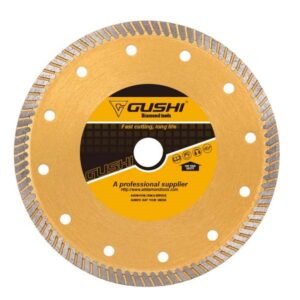
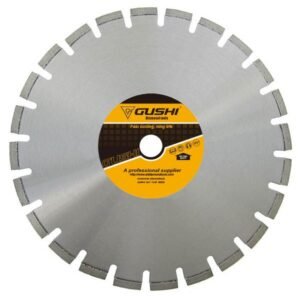
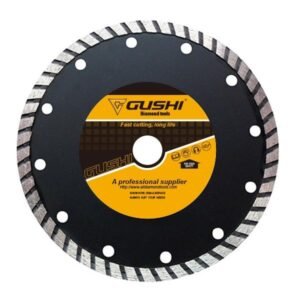
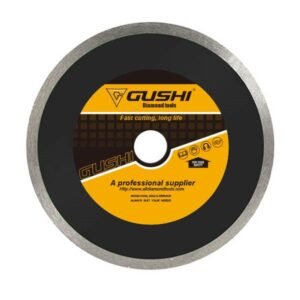
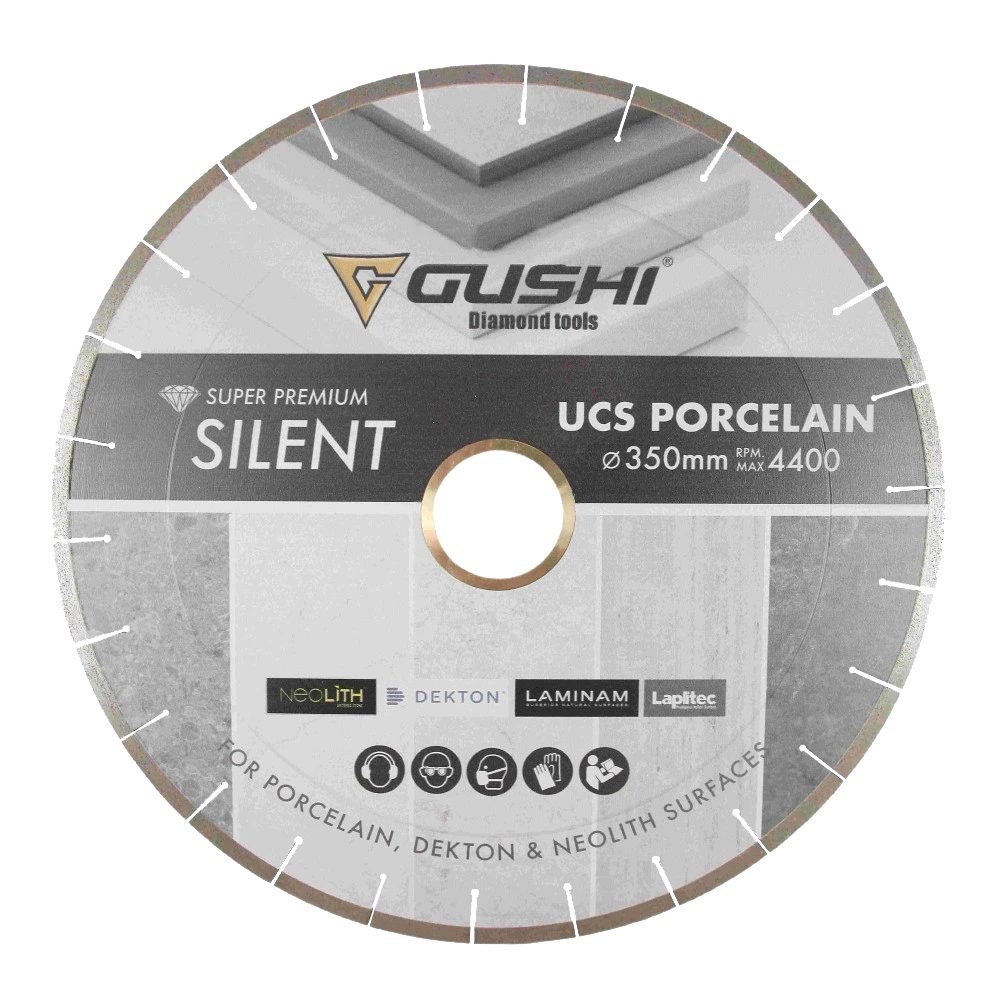
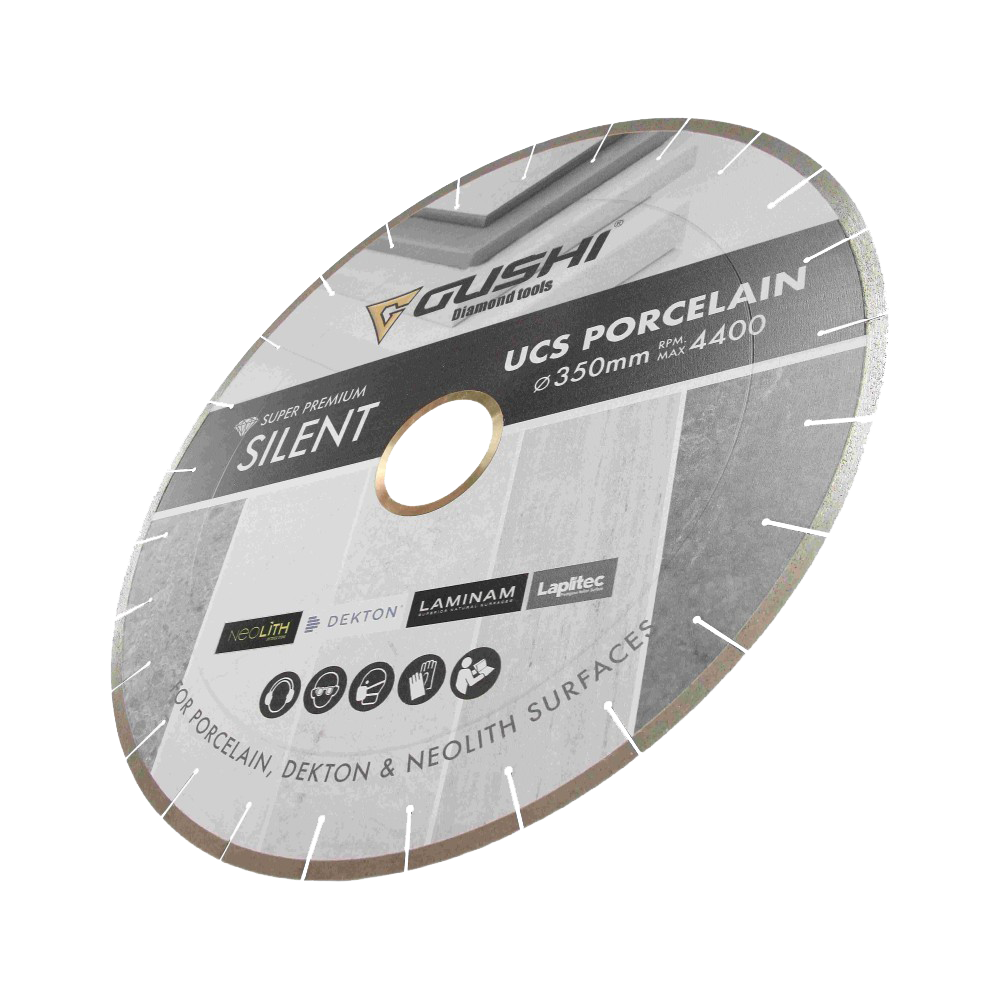
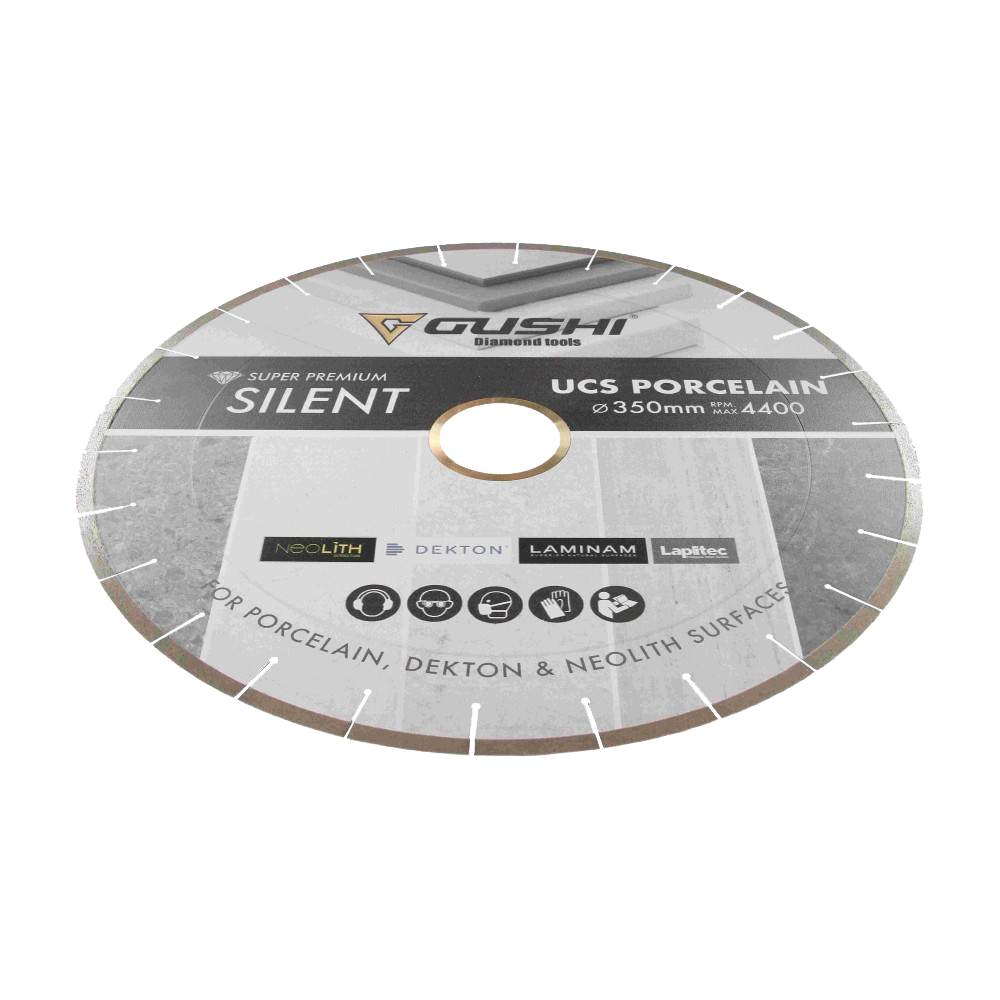
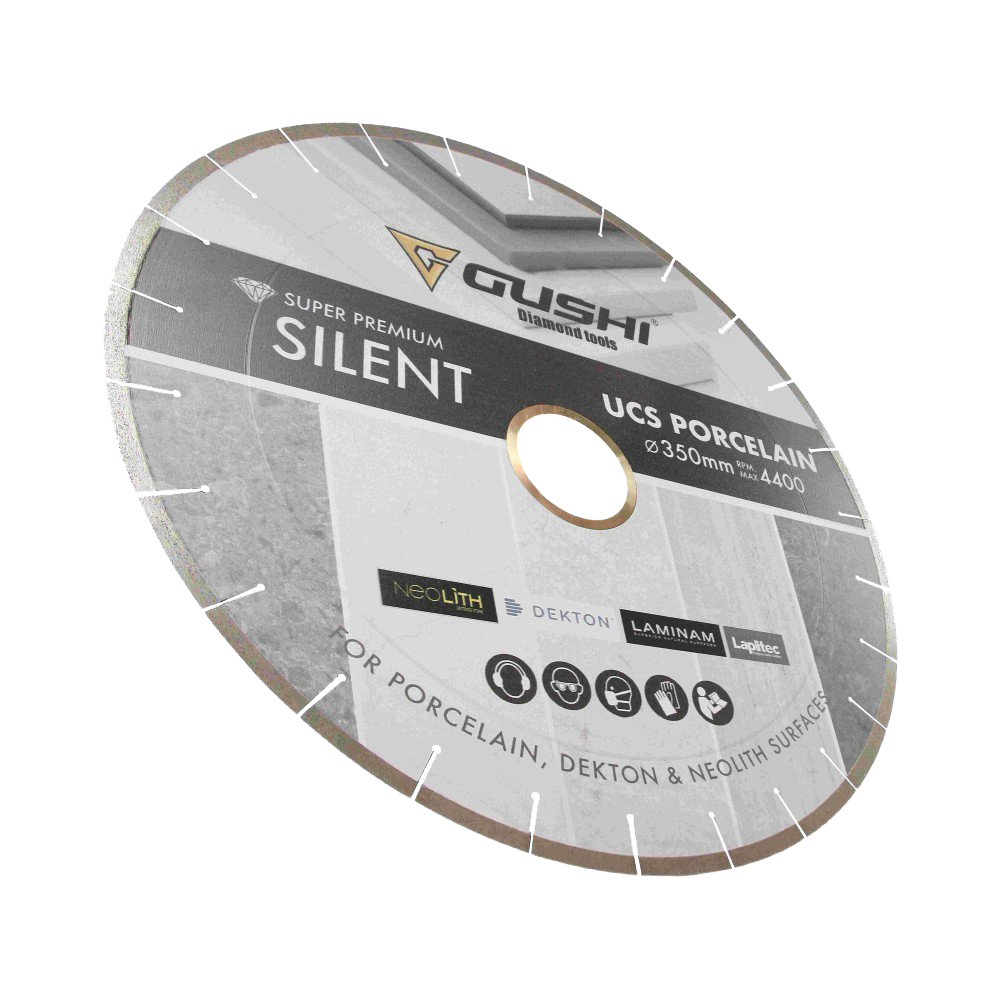
The GUSHI Silent Diamond Cutting Blade is a laser-welded silent-core diamond saw blade built with a sandwich steel-copper-steel body that cuts operational noise by 10–15 dB and reduces blade vibration by 30–50% versus standard solid-core blades. Manufactured by Huzhou Gu’s Imp. & Exp. Co., Ltd. — a diamond tool specialist founded in 2004 and ISO 9001, CE, EN13236 and RoHS certified — the blade delivers chip-free cuts on granite, quartzite, marble, engineered stone, concrete and masonry. With a production capacity of 100,000 sets per month, GUSHI exports diamond blades to 20+ countries including the USA, Germany, UK, Australia and Brazil. The silent core design meets EN13236 noise-compliance requirements for urban, hospital and school job sites.
The blade fills the premium tier of the diamond saw blade market, where noise is a regulatory, contractual or quality requirement rather than a convenience. Stone fabrication shops use it on bridge saws to eliminate core chatter on hard substrate; urban concrete contractors rely on it to stay inside municipal decibel limits; and renovation crews working in occupied hospitals, schools and airports depend on its low-noise profile during curfew hours.
GUSHI is one of only 23 Chinese manufacturers that won the anti-dumping case for diamond blades exported to the USA, holding a 6.2% tariff rate. This compliance heritage, combined with in-house laser welding and per-lot destructive cross-section QC, makes the silent-core blade a dependable specification for distributors and OEM partners serving regulated markets.
Full Specifications
| Parameter | Specification |
|---|---|
| Product Name | GUSHI Roycel Silent Diamond Cutting Blade |
| Model Number | GSDB-SC Series |
| Blade Type | Silent-core (sandwich) diamond saw blade |
| Diameter Range | 105 mm (4″) – 800 mm (32″) |
| Arbor / Bore | 20 / 22.23 / 25.4 / 50 / 60 mm |
| Segment Height | 8 / 10 / 12 / 15 / 20 mm |
| Segment Thickness | 1.2 – 5.8 mm (scaled by diameter) |
| Segment Length | 34 – 40 mm |
| Core Construction | Sandwich — 1075 steel + copper damping layer + 1075 steel |
| Damping Layer Thickness | 0.3 – 0.6 mm |
| Total Core Thickness | 2.3 – 3.6 mm (20–30% thicker than solid) |
| Diamond Type | Synthetic industrial diamond, premium grit |
| Bond | Cobalt-enriched metal bond, substrate-matched |
| Segment Attachment | Laser-welded (≥12″); silver-brazed option |
| Noise Reduction | 10 – 15 dB vs. solid-core blade |
| Vibration Reduction | 30 – 50% lateral vibration at full RPM |
| Max RPM | 5,600 – 13,300 (by diameter) |
| Cutting Mode | Wet and dry (water cooling recommended) |
| Applications | Granite, quartzite, marble, engineered stone, concrete, masonry, asphalt |
| Machines | Bridge saw, table saw, masonry/floor saw, angle grinder, handheld saw |
| Certifications | ISO 9001, CE, EN13236, RoHS, SGS |
| Safety Standard | EN13236 (diamond tool safety) |
| Core Finish | Natural steel, no color coding |
| Packaging | Foam-insert box / blister card / printed center label |
| HS Code | 8202.39 |
| MOQ | 500 pieces |
| Lead Time | 25 – 30 days |
| Port of Loading | Shanghai / Ningbo, China |
How the Silent Diamond Cutting Blade Works
The Sandwich Silent-Core Construction
Every diamond blade has a steel core — the body the segments are welded onto. A standard solid core is a single homogeneous layer of 1075 high-carbon spring steel that transmits cutting vibration directly to the rim, acting like an acoustic transmitter. The silent core replaces this with a sandwich: two 1075 spring-steel layers (1.0–1.5 mm each) diffusion-bonded around a 0.3–0.6 mm copper, aluminum or polymer damping layer. Vibration energy generated at the cutting face is absorbed at the interface and dissipated as low-grade heat instead of radiating as noise or chatter.
Laser-Welded Diamond Segments
The synthetic diamond segments are laser-welded to the core with a minimum 1.5 mm penetration, creating a heat-free joint that will not soften under the high rim speeds of bridge and floor saws (up to 80 m/s). Substrate-matched bond formulas pair softer metal bonds with hard, less-abrasive stone and harder bonds with abrasive concrete, balancing cut speed against segment wear. Segment heights of 8–20 mm let operators choose between fast initial bite and long re-tip intervals.
Wet vs. Dry Cutting Physics
Water cooling carries away the frictional heat that would otherwise soften the bond and stress the damping layer. In wet operation the blade sustains continuous production runs with minimal core warp. In dry operation the same sandwich core tolerates intermittent use, but the operator should pause every 30–60 seconds so the core can shed heat. This dual-mode capability lets the blade serve both stationary bridge saws and portable on-site saws.
Key Features Explained
10–15 dB Noise Reduction
The damped core lowers measured sound pressure by 10–15 dB versus an equivalent solid-core blade. Because decibels are logarithmic, a 10 dB drop is perceived as about half the loudness — moving a typical 100+ dB stone-cutting environment into the 85–95 dB band and helping sites meet EN13236 and local ordinance limits.
30–50% Vibration Damping
Lateral rim vibration drops 30–50% at full RPM. Less flex means less blade chatter, which translates directly into cleaner, chip-free edges on brittle materials like quartz and engineered stone, and reduces operator fatigue across long shifts.
Chip-Free Edge Quality
By eliminating the high-frequency ringing of a solid core, the silent blade produces a smooth cut face with minimal micro-chipping. This is critical for countertop fabrication where the exposed edge is the finished product.
Substrate-Matched Bond Matrix
GUSHI tunes the cobalt-enriched bond to the target substrate per SKU — softer bonds for granite and quartzite, harder bonds for abrasive cured concrete and asphalt. Correct bond selection preserves cut speed while maximizing segment life.
EN13236 Noise Compliance
Each blade is manufactured and tested to the EN13236 diamond-tool safety standard, the benchmark for noise and safety compliance in EU construction. QC includes destructive cross-section of the segment weld and core, with documentation available for EU-market SKUs.
Selection / Diameter Guide
Choose diameter and arbor to match your machine and substrate. Larger diameters and 50/60 mm arbors suit stationary bridge and floor saws; smaller 20/22.23 mm arbors fit angle grinders and handheld saws.
| Diameter | Arbor (mm) | Machine | Best For |
|---|---|---|---|
| 105 – 230 mm (4″–9″) | 20 / 22.23 | Angle grinder, handheld saw | On-site granite/marble trim, tile & vent cuts |
| 300 mm (12″) | 25.4 / 50 / 60 | Table saw, masonry saw | General stone & concrete cutting |
| 350 – 450 mm (14″–18″) | 50 / 60 | Bridge saw | Countertop & slab fabrication |
| 500 – 600 mm (20″–24″) | 50 / 60 | Bridge saw, floor saw | Slab cutting, road & flat sawing |
| 700 – 800 mm (28″–32″) | 60 | Industrial bridge saw | Large slab & block cutting |
Applications & Suitable Materials
Where the Silent Core Blade Is the Right Choice
| Application | Why the Silent Core Wins |
|---|---|
| Stone fabrication (granite, quartzite) | Less chatter on hard substrate → cleaner edge quality |
| Engineered stone countertops (quartz, Dekton) | Vibration-sensitive resin matrix, chip-free requirement |
| Hospital / school renovation | Noise restriction during occupied hours |
| Urban concrete cutting | Municipal decibel-limit compliance |
| Airport overnight maintenance | Curfew dB limits at perimeter |
| EU-market construction | EN13236 regulatory noise compliance |
Suitable Materials
| Material | Bond Recommendation | Cutting Mode |
|---|---|---|
| Granite, quartzite | Softer bond, sharp grit | Wet preferred |
| Marble, limestone | Soft bond | Wet / dry |
| Engineered stone (quartz, Dekton) | Soft–medium bond | Wet |
| Cured / reinforced concrete | Hard bond, abrasive-resistant | Wet / dry |
| Masonry, brick, block | Medium–hard bond | Wet / dry |
| Asphalt | Soft bond, high diamond concentration | Wet / dry |
Silent Core vs. Standard Solid Core Blade
Both constructions use the same diamond segments; the difference is the core. The table below compares the GUSHI silent-core blade with a conventional solid-core diamond blade at equivalent diameter and segment specification.
| Dimension | Silent Core (GUSHI) | Standard Solid Core |
|---|---|---|
| Core construction | Sandwich steel-copper-steel | Single-layer 1075 steel |
| Noise level | 85–95 dB (10–15 dB lower) | 100–110+ dB |
| Vibration | 30–50% less lateral flex | Significant ringing & chatter |
| Edge / finish quality | Chip-free, superior | Standard finish |
| Operator fatigue | Low | High |
| EN13236 compliance | Documented for EU/silent sites | Not noise-optimized |
| Wet / dry use | Both (water recommended) | Both |
| Blade lifespan | +20–40% (even wear) | Baseline |
| Best for | Stone shops, urban, regulated sites | Open outdoor general work |
| Initial cost | +$50–150 at same diameter | Lower (baseline) |
| Long-term value | Lower cost/linear-meter | Higher per-meter |
Bottom line: Choose the silent-core blade whenever noise is a regulatory, contractual or quality requirement — stone fabrication, urban concrete, hospitals, schools, airports and EU construction. For open outdoor jobs with no noise constraint, a standard solid-core blade remains the lower-cost option.
How to Use: Step-by-Step Guide
- Confirm the blade arbor (20/22.23, 25.4, 50 or 60 mm) matches your saw spindle before mounting.
- Visually inspect the core and segments for cracks, missing diamond or loose welds; do not use a damaged blade.
- Mount the blade with the correct flange and tighten to the manufacturer’s torque specification; ensure rotation arrow matches spin direction.
- Verify your machine’s maximum RPM exceeds the blade’s rated RPM for its diameter (e.g., 300 mm ≈ 6,500 RPM max).
- For wet cutting, connect a continuous water supply to the cutting zone before starting — cooling protects the damping layer.
- Run the saw free (no load) for 10–15 seconds to confirm smooth, quiet rotation and no wobble.
- Begin the cut with light feed pressure; let the diamond segments cut rather than forcing the blade through the material.
- Maintain a steady, even feed rate to avoid segment loading and overheating.
- If dry cutting, pause every 30–60 seconds to let the core shed heat; never force a hot blade.
- After cutting, spin the blade briefly to fling off slurry, then wipe the core and segments clean.
- Store the blade flat in its protective box — never lean it against a wall where the core can warp.
- Periodically check segment height; re-tip or replace when segments reach the wear limit to protect the core.
For more guidance, see our related guides on Diamond Polishing Pads, Diamond Core Drill Bits, and Diamond Cup Grinding Wheels.
Frequently Asked Questions
What is a silent diamond cutting blade and how does it work?
A silent diamond cutting blade uses a sandwich “silent core” — two 1075 spring-steel layers bonded around a 0.3–0.6 mm copper (or polymer/aluminum) damping layer. During cutting, vibration energy that would normally ring through a solid steel core is absorbed at the damping interface and dissipated as low-grade heat. The result is 10–15 dB lower noise and 30–50% less lateral blade vibration at full RPM, producing cleaner cuts with less operator fatigue.
How much noise reduction can I expect from a silent core blade?
A GUSHI silent-core blade measures 10–15 dB quieter than an equivalent solid-core blade at the same diameter and RPM. Because the decibel scale is logarithmic, a 10 dB drop is perceived as roughly half the loudness. Standard blades often exceed 100 dB cutting dense stone; the silent core typically brings the work environment down to the 85–95 dB range, helping sites stay inside EN13236 and municipal noise limits.
Can the silent diamond blade be used wet and dry?
Yes. The blade supports both wet and dry cutting. Wet cutting is recommended for bridge-saw and continuous-production work because water cools the core and protects the internal damping layer from heat. For dry cutting on handheld saws, use intermittent feed and allow cool-down breaks every 30–60 seconds to prevent overheating of the bond and core.
What materials can a silent diamond cutting blade cut?
The blade cuts hard and abrasive materials including granite, quartzite, marble, engineered stone (quartz and Dekton), cured concrete, reinforced concrete, masonry, brick, block and asphalt. Substrate-matched bond formulas are selected per order — softer bonds for hard, less abrasive stone and harder bonds for abrasive concrete — to balance cut speed and segment life.
What diameters are available for the GUSHI silent core blade?
Diameters range from 105 mm (4″) to 800 mm (32″). Smaller 105–230 mm blades use 20/22.23 mm arbors for angle grinders and handheld saws; 300–800 mm blades use 25.4, 50 or 60 mm arbors for table saws, bridge saws and floor saws. Segment height options are 8, 10, 12, 15 and 20 mm, with segment thickness scaled 1.2–5.8 mm by diameter.
How long does a silent core blade last compared with a standard blade?
Because the damped core reduces vibration stress on each diamond segment, segment wear is more even and total service life typically extends 20–40% over a comparable solid-core blade in the same application. Actual lifespan depends on substrate hardness, feed pressure and cooling; on granite bridge-saw runs, a 15 mm segment blade commonly delivers 800–2,000 linear meters before re-tipping.
What is the OEM minimum order quantity and lead time?
OEM and private-label MOQ is 500 pieces per specification. Standard production lead time is 25–30 days after artwork and sample confirmation. Custom branding (laser marking, silk screen or printed stickers), packaging and substrate-matched bond formulas are available. Samples are supplied at cost price with the buyer paying shipping. Payment via L/C, T/T, Western Union or PayPal. Port of loading: Shanghai or Ningbo.
Is the silent diamond blade certified for international markets?
Yes. GUSHI silent-core blades are manufactured under ISO 9001:2015 quality management, carry CE marking and RoHS compliance, and are tested to the EN13236 diamond-tool safety standard — the same standard that governs noise and safety compliance in EU construction. Each production lot is QC-checked with destructive segment and core cross-sections, and SGS inspection is available on request.
OEM & Wholesale Information
| Parameter | Specification |
|---|---|
| Minimum Order Quantity | 500 pieces per specification |
| Production Lead Time | 25 – 30 days after sample & artwork confirmation |
| Custom Branding | Laser marking, silk screen, printed stickers |
| Custom Packaging | Foam-insert box, blister card, printed center label |
| Custom Specifications | Diameter, segment height, bond, arbor per RFQ |
| Sample Policy | Available at cost price; buyer pays shipping |
| Payment Terms | L/C, T/T, Western Union, PayPal |
| Port of Loading | Shanghai or Ningbo, China |
| QC Documentation | Destructive cross-section per lot, SGS on request |
| Production Capacity | 100,000 diamond-tool sets / month |
Huzhou Gu’s Imp. & Exp. Co., Ltd. (GUSHI Tools / Roycel) has manufactured and exported diamond tools since 2004, serving 20+ countries across North America, Europe, South America, Australia and Africa. As one of 23 Chinese companies that won the US anti-dumping case for diamond blades (6.2% tariff rate), GUSHI combines compliant export experience with ISO 9001, CE, EN13236 and RoHS certified production. Many distributor partners have collaborated with GUSHI for over 10 years.
Explore our complete diamond-tool range: Diamond Polishing Pads, Diamond Core Drill Bits, and Diamond Cup Grinding Wheels.