Full Specifications
| Item number | Diameter | Segment width | Segment height | Arbor hole |
|---|---|---|---|---|
| 4HHPJ | 4 in / 100 mm | 1.6 mm | 8 / 10 mm | 16 / 20 / 22.23 mm |
| 4.5HHPJ | 4.5 in / 115 mm | 1.6 mm | 8 / 10 mm | 16 / 20 / 22.23 mm |
| 5HHPJ | 5 in / 125 mm | 1.8 mm | 8 / 10 mm | 20 / 22.23 mm |
| 6HHPJ | 6 in / 150 mm | 1.8 mm | 8 / 10 mm | 20 / 22.23 mm |
| 7HHPJ | 7 in / 180 mm | 2.0 mm | 8 / 10 mm | 22.23 / 25.4 mm |
| 8HHPJ | 8 in / 200 mm | 2.2 mm | 8 / 10 mm | 22.23 / 25.4 mm |
| 9HHPJ | 9 in / 230 mm | 2.2 mm | 8 / 10 mm | 22.23 / 25.4 mm |
| 10HHPJ | 10 in / 250 mm | 2.2 mm | 8 / 10 mm | 22.23 / 25.4 mm |
| 12HHPJ | 12 in / 300 mm | 3.0 mm | 8 / 10 mm | 22.23 / 25.4 mm |
| 14HHPJ | 14 in / 350 mm | 3.0 mm | 8 / 10 mm | 22.23 / 25.4 mm |
| Core | J-slot |
|---|---|
| Materials | Tile and ceramic |
| Cutting | Wet or dry, wet use strongly recommended |
| Stated benefits | Precise cuts, less chipping, stable, quieter, cooler rim |
| Other sizes | More specifications and styles available on request |
Why a Thin Rim Cuts Cleaner
The first thing a tiler looks at is not the speed of the cut. It is the edge: the top face where the blade entered, the bottom face where it left, and whether the glaze is still continuous along both. A blade that cuts in half the time and lifts a chip of glaze on every second tile has not done the job, it has created a callback. That is why the rim on this blade is as thin as it is.
Chipping is a force problem rather than a diamond problem. Two forces act on the tile. The first is pressure at the rim, and it comes from the operator pushing: the blade has to be pushed hard enough to advance, and that push is transmitted straight into the material either side of the cut. The second is the displacement of the kerf itself. Every millimetre of width is material that has to go somewhere, and in a vitrified tile it goes sideways into the body of the tile and lifts the glaze at the edge.
A thin rim reduces both at once. A 1.6 to 2.2 mm kerf displaces less material than a 3.0 mm masonry kerf, so the tile is disturbed less, and because there is less material to remove the blade needs less push to advance, so the operator’s force drops as well. The two effects compound: less kerf means less push, and less push means less chipping.
The price of thin is paid in stiffness. A thin rim has very little steel behind it, so it deflects easily, heats quickly and cannot be leaned on. Everything else in the design exists to keep a thin rim running true and cool, which is why the core is slotted the way it is.
What the J Does
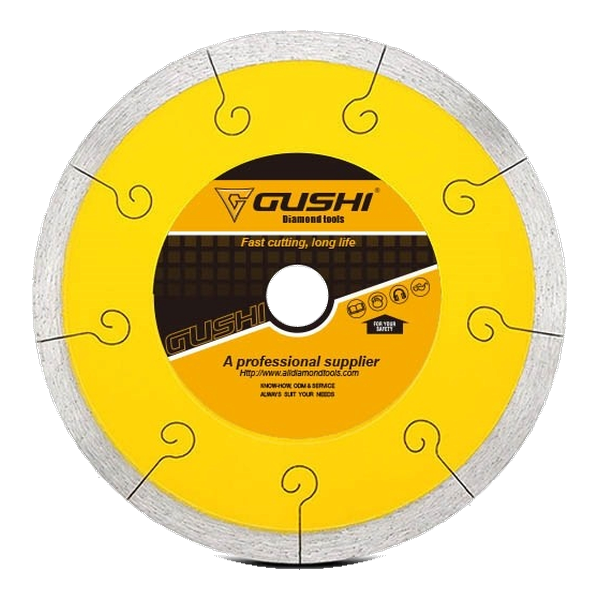
The slot on this core runs in from the rim and then curls at its inner end, so the root of each slot is a hook instead of a plain rounded stop. It is a small change in shape and it answers four separate problems that a thin plate has.
The first is stiffness. A slot removes steel from a disc that is held in tension, and the root of the slot is where that loss concentrates. A blunt-ended slot puts the whole stress of the opening at one small radius; a curled root spreads it along a longer path, and a longer path means the plate can carry a longer slot before it starts to run out of flat. Length is exactly what a thin rim needs, because the slot is the only route by which coolant reaches the rim. The curl buys the length without the penalty.
The second is noise. A disc rings at the frequency set by the spacing of its interruptions, and a rim broken by slots of equal length can find one frequency and hold it, which is the shriek a tile blade makes in a bathroom. The curl changes the effective length of each interruption, so the rim does not settle on a single note. The listing states reduced cutting noise and the hooked root is the mechanism behind that claim.
The third is cooling and the fourth is chip clearance. The curl holds a pocket of air or water, carries it round with the blade and releases it at the rim, which keeps flow moving past the diamond instead of letting it stall in a straight slot. On a wet saw the same pocket keeps slurry travelling so it does not set in the slot. Both matter more here than on a masonry blade, because a thin rim has no thermal mass to absorb a mistake.
The Bore Column Is a Machine Map
Read the arbor column from top to bottom and it changes twice. The 100 and 115 mm sizes are listed at 16, 20 or 22.23 mm. The 125 and 150 mm drop the 16 mm and offer 20 or 22.23 mm. From 180 mm to 350 mm the 20 mm is gone as well, and every size offers 22.23 or 25.4 mm. Three bore menus across ten sizes, and the boundaries sit at 150 and 180 mm.
That is not an accident of tooling. The bore follows the spindle, and the spindle follows the class of machine. A 16 mm spindle belongs to the small wet tile saw and the compact rail cutter, which is where a 100 or 115 mm blade goes. From 180 mm up, the blade is on an angle grinder or a bench saw, and those are built around 22.23 and 25.4 mm. So the bore column is really a machine column in disguise, and it is more reliable than asking a buyer what saw they have.
The practical rule that follows is simple: pick the size you need, then pick the bore that matches the spindle, and do not bridge the gap with a bushing if you can order the right bore. A bushing is a second interface between blade and machine, and on a thin rim at speed that interface is where runout appears, which then appears as chipping on the tile rather than as a wobble you can see.
From 1.6 to 3.0 mm, and Where Thin Stops
The width column climbs in four steps: 1.6 mm at 100 and 115 mm, 1.8 mm at 125 and 150 mm, 2.0 mm at 180 mm, 2.2 mm across 200, 230 and 250 mm, and then a jump to 3.0 mm at 300 and 350 mm.
Two things are worth pulling out of that. The first is the plateau: three consecutive sizes, 200 to 250 mm, all at 2.2 mm. That is the same signal as on any other blade family, which is that width is set by what the cut needs rather than by the diameter. Once the rim is wide enough to clear slurry and stiff enough to stay in the cut, a bigger diameter does not need a wider rim.
The second is the jump at 300 mm, and it is bigger than it looks. Going from 2.2 to 3.0 mm is a third more kerf at a stroke. It marks the point where the blade has left the thin rim class and become a general purpose masonry blade in the same family: same core, same slot pattern, same item numbering, but a rim that removes what a masonry blade removes. If the job is 600 by 600 porcelain, the sizes that belong to that job are further down the table. If the buyer wants a 350 mm because the saw takes one, they should know they are buying a different animal.
Eight or Ten Millimetres, on Every Size
Every one of the ten sizes carries a segment 8 or 10 mm high, from the 100 mm blade to the 350 mm one. On a masonry blade that column would be about depth of cut. Here it is not, because on tile work the tile sets the depth: a 10 mm floor tile is a 10 mm cut whatever the blade is. What the height represents on this blade is pure wear reserve.
That makes the arithmetic on the large sizes worth doing. The rim of a 100 mm blade is roughly 300 mm around. The rim of a 350 mm blade is roughly 1,100 mm, which is between three and four times as long, for the same 8 or 10 mm of diamond and a rim nearly twice as wide. Put plainly, the big sizes take far more work per millimetre of segment than the small ones, so the same nominal life buys fewer metres of tile on the 350 than on the 100.
The choice between 8 and 10 mm is then a straight commercial one. Eight is the cheaper blade and it is not a compromise at the small end, where the rim is short and the blade is doing light work. Ten is the blade for anyone cutting all day, or for a hire fleet where a blade comes back and has to go out again. Note also that both options exist on every size, so a buyer can take the 100 to 150 mm shallow and the larger sizes deep in the same order.
Wet, Strongly Recommended
Of everything in the listing, one phrase carries the most weight: wet or dry, with wet use strongly recommended. It is the only place the source qualifies its own claim, and the reason is that a thin rim has almost nothing to absorb heat with.
The first job water does is dust. Cutting tile and porcelain dry puts fine silica-bearing dust into the air, and most tile work happens indoors, in a room somebody will be living in. Water at the cut is the practical answer, and on a wet tile saw it is already there.
The second job is the one that decides blade life. A 1.6 mm rim is a sliver of steel with diamond on its edge, and at cutting speed it heats fast. When the bond gets hot it softens, and a softened bond smears over the diamond instead of wearing back to expose it. The rim then goes shiny, the blade rides on the glaze instead of biting into it, and the operator pushes harder to make it cut, which produces more heat and more chipping. Water breaks that loop at the first step.
Dry cutting is allowed and it is sometimes the only option: a quick cut on a small blade, outdoors, where a hose is not going to happen. What dry asks in return is a lighter hand and shorter runs, letting the rim come back down in temperature instead of holding it at the limit. The failure mode when that discipline slips is always the same shiny rim, and it appears long before the segment is worn out.
Ceramic, Porcelain, and the Glaze Line
Ceramic is a family rather than a material, and the blade has to work across it because a tiler buys one blade and meets all of it in a week. At one end there is glazed wall tile, soft and porous, which cuts easily and chips mainly because the glaze is glass. At the other end there is fully vitrified porcelain, dense, hard and unforgiving, where the same rim has to cut without polishing itself shut.
The glaze line is where the failure shows. Glaze is a thin glass layer fired onto the body, and glass is brittle in the way that matters here: it does not deform, it flakes. Any bending load applied at the edge of the cut will lift a chip, and the two sources of that load are a blade that is riding rather than cutting, and a tile that is not supported right at the point where the blade exits. A chipped exit edge is very often a support problem that got blamed on the blade.
On the hard end of the family, the constraint moves to the bond. Porcelain is hard enough that it does not wear the bond back on its own, so a bond that is right for soft wall tile will polish on porcelain and stop cutting. That is why the hard end of the market is served by blades with their own bond, such as the super thin blade for Dekton and porcelain. Pushing this blade harder on porcelain does not turn it into that blade.
Blade to Saw, Three Groups
The table divides into three groups, and each group is a different kind of machine with a different kind of hand.
The 100 to 150 mm sizes are the small wet tile saw and rail cutter group. These machines hold the blade on a guided carriage, water is usually plumbed, and the operator’s job is to feed at a steady rate rather than to steer. This is where a thin rim is at its best, because the machine supplies the alignment the rim cannot supply itself. It is also where the 16 mm bore lives, so check the spindle before ordering.
The 180 to 230 mm sizes are the angle grinder group, and it is the least forgiving of the three. The blade is hand held, alignment comes from the operator’s wrist, and water is often absent. A 2.0 to 2.2 mm rim on a freehand grinder will cut cleanly if it is fed lightly and kept moving, and it will chip if it is leaned on or held still in one spot. Long straight cuts in porcelain are better done on a saw than freehand, whatever the rim.
The 250 to 350 mm sizes are the bench and table saw group, where the tile is on a sliding table and water is normally available. At this size the rim is 2.2 to 3.0 mm, so the cut is a general purpose one: fine for a lot of tile, and the right tool for thicker stone-look product and for mitres where the kerf is hidden in the joint.
Reading a Chipped Edge
A chipped edge is a diagnosis waiting to be made, because the pattern of the chip says what caused it. Four causes cover most of it.
Chips at the exit edge only, with the entry edge clean, point at support. As the blade leaves the tile there is nothing behind the glaze to hold it, and the last few millimetres spall. A sacrificial board under the tile, or a cut stopped and finished from the other side, solves more of these than a new blade does.
Random chips scattered along the cut, with no pattern, usually mean the blade is not running true. That comes from a worn or dirty flange, a bushing that does not fit the spindle, or a blade that has been dropped. On a thin rim even a small amount of runout shows up as a chipped edge rather than as a visible wobble, which is why the bore should be ordered to the machine rather than adapted.
The fourth cause is the material itself. Some porcelain and most fully vitrified large-format product will chip at the glaze with any blade that removes a wide kerf, because the body is dense enough to transmit the displacement straight to the surface. If a thin rim blade is chipping on that material, the answer is a narrower kerf and a lighter feed, not more pressure.
What to Send With an Enquiry
Five answers fix a tile blade order, and the first two are the ones that get left out.
The machine and its spindle: what the saw or grinder is, and the bore it takes, measured rather than assumed, because the 16 mm option exists only at the bottom of this range. The material: wall tile, floor tile, porcelain, or a mix, and whether it is large format, since that decides whether a thin rim is enough or whether the job needs a bond built for vitrified product.
Then the cut: wet or dry, and whether water is plumbed at the machine, because a blade that will be run dry should be fed differently from one on a wet saw. Then the volume by size rather than a total, since a tiling account is nearly always a mix with the 100 to 150 mm sizes carrying the volume. And finally the segment height, 8 or 10 mm, which is a cost and life decision the buyer should make knowingly rather than by default.
Add the destination and the packaging requirement, and an enquiry becomes a quotation without a second round. Where a distributor is buying for several markets, say which bores are needed in which sizes, because the 16 mm and the 25.4 mm ends of this table serve different trades and are usually stocked in different quantities.
Private Label and Export Supply
The range is supplied under the GUSHI mark or made to order under a buyer’s own. What can be set for a private label order is the rim printing on both faces, the item numbering, the bore specified per size, the segment height per size, and the sleeve or carton print. The ten diameters and the width at each are fixed by the table, so a programme is placed as a size mix rather than as a single blade in ten lengths.
The usual split is between the small sizes that carry the volume in a tiling account and the larger ones that a hire shop or a stone fabricator buys in singles. Because the bore changes at 150 and 180 mm, a mixed order has to specify the bore for each group rather than once for the lot, and that is the detail most often missed on a first order.
For the rest of the range, the super thin turbo blade covers fast dry cutting in tile where a segmented rim is wanted, the continuous rim blade covers clean cutting in the same materials with a different rim, the marble blade and the granite turbo blade cover the stone side, the TCT thin kerf blade covers the timber and composite work on the same bench, and the hard ceramic drill bits cover the holes that a blade cannot make.
Frequently Asked Questions
- What is a J-slot diamond blade?
- A blade whose slots run in from the rim and then curl at the inner end, so the root of each slot is a hook rather than a plain rounded stop. On a thin rim blade the slot has to be long enough to cool the rim without taking so much steel out that the plate goes soft, and the curl is how the two are reconciled.
- What sizes are available?
- Ten: 100, 115, 125, 150, 180, 200, 230, 250, 300 and 350 mm, which is 4, 4.5, 5, 6, 7, 8, 9, 10, 12 and 14 inch. Segment width runs from 1.6 mm at the two smallest sizes to 3.0 mm at 300 and 350 mm, and every size carries an 8 or 10 mm segment.
- Should it be used wet or dry?
- The listing gives wet or dry and adds that wet use is strongly recommended. A thin rim has very little steel behind the diamond, so it heats quickly and the bond can smear if it runs dry under load. Water also keeps silica dust out of the air, which matters on indoor tile work. Dry is workable for short cuts with a light hand.
- What does the J-slot actually do?
- Four things according to the listing: precision, stability, lower cutting noise and cooling. Mechanically the curled root spreads the stress of the slot over a longer path than a blunt stop, so the plate can carry a long slot and stay flat; slots of unequal effective length stop the rim ringing on one frequency; and the curl carries air or water round to the rim.
- Will it cut porcelain tile?
- It is listed for tile and ceramic, and porcelain is the dense hard end of that family. Porcelain is where the bond is most likely to polish rather than cut, so keep the rim wet and the feed light. If the blade starts to ride on the surface instead of biting, that is a bond question rather than a technique question.
- Why is the rim so thin?
- Because the kerf is the damage. Every millimetre of kerf is material displaced out of the tile, and that displacement is what lifts glaze at the cut edge. A 1.6 mm rim removes less, disturbs less and lets the operator use a lighter push, which is the real reason it chips less than a general masonry blade.
- Which arbor bore do I order?
- It depends on the size. The 100 and 115 mm are listed at 16, 20 or 22.23 mm, the 125 and 150 mm at 20 or 22.23 mm, and every size from 180 mm up at 22.23 or 25.4 mm. Check the spindle on your saw against the table before ordering, since the bore is what decides whether the blade sits true.
- Why is the 300 and 350 mm segment 3.0 mm wide?
- Because at that size the blade has left the thin rim class. Width climbs from 1.6 mm at 100 mm to 2.2 mm across 200, 230 and 250 mm, then jumps to 3.0 mm at 300 and 350 mm. A 3.0 mm rim is a general masonry kerf, on a blade that shares the family name and the J-slot core.
- Is 8 mm or 10 mm segment height better?
- Ten is the longer lived blade, eight is the cheaper one, and both are offered on every size. On tile work the segment height is not about depth of cut, because the tile sets the depth. It is pure wear reserve, so the choice is between first cost and how often the blade comes off the machine.
- Can it cut glass or glass tile?
- Glass is not in the listed applications, which are tile and ceramic. Glass and glass mosaic want a rim built for them and a very light feed, and the tool for the job is usually a different blade rather than this one pushed gently. Holes in glass and ceramic are drilled, not cut, which is a separate tool again.
- Why has my blade stopped cutting?
- Most often the bond has glazed: the rim looks polished, the diamond is still there and the blade rides on the tile instead of biting. That comes from running dry under load, or from a bond that is too hard for the material. Dressing the rim on an abrasive block and using water usually brings it back before the segment is worn out.
- Can you supply these under our brand?
- Yes. Rim printing on both faces, item numbering, the bore per size, segment height and the sleeve or carton print are made to order. A tiling account usually takes the 100 to 150 mm sizes in volume with a smaller count of the larger diameters, so an order is placed as a size mix rather than as one blade.