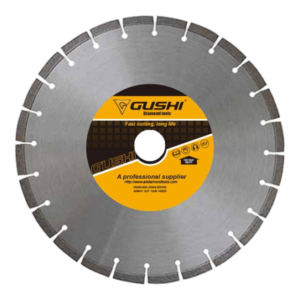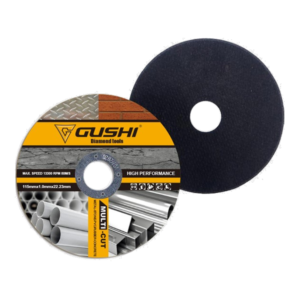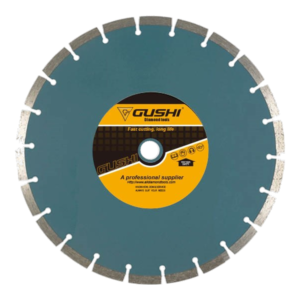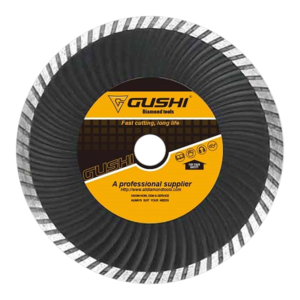
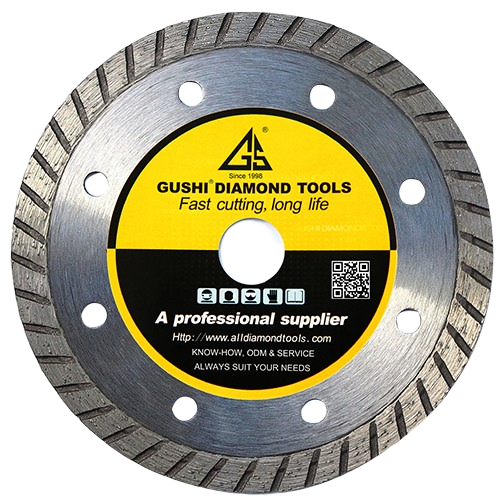
The blade is intended for the part of stone work where the cut is fast but the edge still matters. Granite fabricators use it to cut sink openings, edge strips and backsplashes, where a segmented blade cuts quickly but leaves chips that need extra polishing, and where a full continuous rim cuts cleanly but too slowly to be economic. The narrow turbo rim sits between those two extremes: the interrupted rim throws coolant and dust out of the cut, the closed band keeps the cut line supported, and the result is a cut that is roughly as fast as segmented and roughly as clean as continuous.
Segment height is offered as 7 mm or 10 mm on the grinder and mid sizes, and 8 mm or 10 mm on the 300 and 350 mm bridge saw sizes. That is a real commercial choice rather than a cosmetic one: 7 mm is the low cost per cut option for 20 mm slab and thin tile, while 10 mm carries about 40 percent more diamond and pays for itself wherever a blade change stops a bridge saw. Kerf width scales with diameter from 2.1 mm at 105 mm up to 3.6 mm at 300 and 350 mm, which keeps the cut narrow and the motor load low on lower horsepower saws.
The blade runs wet or dry. Wet cutting with water is the recommended mode on granite because it controls both heat and respirable crystalline silica, and it is mandatory in most workshops for health reasons. Dry cutting is permitted for short site trims and for materials where water staining is a problem, provided the blade is given cooling passes. The steel core is alloy steel rather than mild steel, so it resists the dishing that shows up when a blade is overheated on one side.
Full Specifications
Blade parameters
| Parameter | Specification |
|---|---|
| Product type | Turbo rim diamond cutting blade, narrow turbo teeth |
| Manufacturing process | Hot pressed sintered segment on alloy steel core |
| Diameter range | 105 mm to 350 mm (4 inch to 14 inch), 11 sizes |
| Segment height | 7 mm or 10 mm (105 to 250 mm); 8 mm or 10 mm (300, 350 mm) |
| Segment width (kerf) | 2.1 mm at 105 mm; 2.2 mm at 110 and 115 mm; 2.4 mm at 125 mm; 2.6 mm at 150 to 200 mm; 2.8 mm at 230 mm; 3.0 mm at 250 mm; 3.6 mm at 300 and 350 mm |
| Arbor bore | 22.23 mm with 20 mm reducing ring (105 to 150 mm); 25.4 mm (250 to 350 mm); DM / 22.23 / 20 as listed for 180 to 230 mm |
| Core material | Alloy steel, hardened and tensioned |
| Abrasive | Synthetic diamond, hot pressed metal bond |
| Bond hardness | Soft to medium, released for hard dense stone |
| Cutting mode | Wet or dry; wet recommended on granite |
| Rim speed reference | 80 m per second class; see RPM table below |
| Cooling | Laser cut cooling holes in the core |
| Flange marking | Brand, diameter, maximum RPM, safety pictograms |
| Standard | Conforms to EN13236; manufactured under ISO 9001; CE marked |
| Applications | Granite, hard stone, engineered quartz, sintered slab, porcelain, concrete, brick |
| Machines | Angle grinder, tile saw, masonry saw, bridge saw, block cutter |
| Packing | Colour sleeve, double blister or carton, neutral or branded |
| MOQ | 50 pieces per size, mixed sizes accepted |
| Lead time | 25 to 30 days for production, shorter for stock sizes |
Size table, all eleven diameters
| Item | Diameter (inch) | Diameter (mm) | Segment width (mm) | Segment height (mm) | Arbor (mm) |
|---|---|---|---|---|---|
| 4HT | 4 | 105 | 2.1 | 7 / 10 | 22.23 / 20 |
| 4.38HT | 4 3/8 | 110 | 2.2 | 7 / 10 | 22.23 / 20 |
| 4.5HT | 4.5 | 115 | 2.2 | 7 / 10 | 22.23 / 20 |
| 5HT | 5 | 125 | 2.4 | 7 / 10 | 22.23 / 20 |
| 6HT | 6 | 150 | 2.6 | 7 / 10 | 22.23 / 20 |
| 7HT | 7 | 180 | 2.6 | 7 / 10 | DM / 22.23 / 20 |
| 8HT | 8 | 200 | 2.6 | 7 / 10 | DM / 22.23 / 20 |
| 9HT | 9 | 230 | 2.8 | 7 / 10 | DM / 22.23 / 20 |
| 10HT | 10 | 250 | 3.0 | 7 / 10 | 25.4 |
| 12HT | 12 | 300 | 3.6 | 8 / 10 | 25.4 |
| 14HT | 14 | 350 | 3.6 | 8 / 10 | 25.4 |
Maximum RPM by Diameter
A diamond blade is not limited by diameter but by rim speed, the speed at which the diamond edge travels through the stone. This class of blade is built around 80 metres per second. Holding that rim speed constant means the maximum safe spindle speed falls as the blade gets larger, which is why a 350 mm blade is destroyed at the speed a 115 mm blade considers normal. The table below is arithmetic derived from 80 m per second rather than a factory marking: use it to check whether your machine is in range, not as a substitute for the plate rating.
| Diameter (mm) | Diameter (inch) | Computed max RPM at 80 m/s | Typical machine |
|---|---|---|---|
| 105 | 4 | 14,550 | Angle grinder, tile saw |
| 110 | 4 3/8 | 13,880 | Angle grinder, tile saw |
| 115 | 4.5 | 13,280 | Angle grinder |
| 125 | 5 | 12,215 | Angle grinder |
| 150 | 6 | 10,190 | Angle grinder, small tile saw |
| 180 | 7 | 8,490 | Masonry saw, circular saw |
| 200 | 8 | 7,640 | Masonry saw, small bridge saw |
| 230 | 9 | 6,640 | Masonry saw, circular saw |
| 250 | 10 | 6,110 | Bridge saw, masonry saw |
| 300 | 12 | 5,090 | Bridge saw, block cutter |
| 350 | 14 | 4,370 | Bridge saw, block cutter |
Two rules override the arithmetic. First, the marking on the blade governs: hot pressed blades are individually marked with a maximum RPM at the flange, and the marked figure is the one that applies to that blade. Second, the machine rating governs: if a bridge saw’s spindle is rated lower than the blade’s marking, the spindle wins. Running a blade overspeed is the single most common cause of a core failure, and a core failure at 3,000 rpm throws fragments rather than dust.
How the Turbo Rim Cuts Granite
The cutting action
Diamond does not cut by sharpness. Each diamond particle in the segment is a tiny hard crystal embedded in a metal matrix, and it removes stone by scratching at a depth of a few microns per pass. As the diamonds at the surface wear flat or are pulled out, the matrix has to wear back to expose the next layer, and that is the whole trick of blade design. A bond that is too hard holds the diamonds after they have gone blunt, and the segment polishes instead of cutting. A bond that is too soft releases diamonds before they have done any work, and the segment wears away without cutting stone. On granite the correct bond is on the soft side, because granite is hard enough to blunt diamond quickly and the matrix needs to keep shedding.
Why the rim is slit rather than open
A segmented blade has wide gullets between separate segments. Those gullets are excellent at clearing slurry and at letting air reach the cut, which is why segmented blades dominate concrete and asphalt cutting. But every time a gullet passes the work, the cut is interrupted, and an interrupted cut on brittle polished granite produces a chip at the exit edge. The turbo rim solves this by keeping the diamond band continuous and putting the clearance in as a narrow angled slit instead. There is still enough open area to move coolant and dust, but the rim is never fully out of the cut, so the edge is supported and the chip stays small.
Heat, and why water matters more than people think
Cutting granite generates heat at the contact point, and heat does three damaging things at once: it softens the braze that holds the segment to the core, it can warp or dish the steel core, and it changes the way the bond wears so the blade glazes. Water removes that heat and also suppresses the respirable crystalline silica dust that makes dry cutting granite a genuine health hazard. The cooling holes in this blade’s core help air and water reach the rim on dry cuts, but they do not replace water. If a job must be cut dry, use short passes and let the blade run free between them rather than holding a single long cut.
Key Features Explained
1. Narrow turbo segments for speed without chipping
The turbo teeth are cut narrow and angled, so the effective cutting face stays small and the pressure per diamond stays high. On a lower horsepower grinder that matters: a wide segment on a 900 W motor simply stalls, while a 2.2 mm turbo segment at 115 mm keeps the motor in its power band and the cut moving. The angled slit also throws the slurry sideways out of the cut rather than packing it under the blade, which is why a turbo rim stays freer in deep cuts than a full continuous rim of the same width.
2. 7 mm or 10 mm segment height as a cost decision
Segment height is the diamond inventory in the blade. Moving from 7 mm to 10 mm adds roughly 40 percent more segment volume, and on a hot pressed blade that translates fairly directly into life. For a fabricator cutting 20 mm slab on a grinder, 7 mm is the economical choice because the blade will be worn out by other causes before the diamond runs out. For a bridge saw cutting 30 mm and 40 mm edges on granite, the machine hour costs more than the blade, so 10 mm wins on cost per metre even at a higher unit price.
3. Kerf scaled to diameter
The kerf widens from 2.1 mm at 105 mm to 3.6 mm at 300 and 350 mm. Narrow kerf means less stone turned into dust, less motor load and less slurry, which is why the small sizes stay thin. The large sizes need the extra width because a 350 mm blade cutting 40 mm granite has to carry slurry a long way out of the cut, and a kerf that is too tight there produces binding, heat and a wandering cut.
4. Cooling holes and a tensioned alloy core
The laser cut holes in the core are not decoration. They let air move across the core on dry cuts, they break up the harmonic ring that a plain steel disc produces at speed, and they reduce weight at the rim so the blade spins up faster and loads the spindle less. The core itself is alloy steel, hardened and tensioned, so it resists dishing when one side of the blade runs hotter than the other, which is the usual failure path on a grinder used by hand.
5. Wet or dry, on the same blade
Hot pressing produces a dense segment that tolerates dry running for short periods, which is what makes this blade usable on site where a wet saw is not practical. The blade does not need a different specification for dry work; it needs the operator to respect the duty cycle. As a working rule, a dry pass of 20 to 30 seconds followed by an equal free-running interval keeps the segment below the temperature where the bond behaviour changes.
Selection Guide: Matching the Blade to the Stone
Choose the diameter by machine, not by preference
The blade has to fit inside the machine’s guard and within its rated speed. A 115 mm grinder will not accept a 180 mm blade safely no matter how convenient the larger size looks, and a 350 mm bridge saw gains nothing from a smaller blade beyond a shallower cut. Pick the machine first, then the diameter that fits it, then the segment height that matches the workload.
Match the bond to the stone
| Stone class | Examples | Bond direction | Segment height |
|---|---|---|---|
| Hard, dense granite | Absolute black, black galaxy, fine grained granite | Softest available | 10 mm |
| Medium granite | Standard grey and pink granite, most countertop stone | Soft to medium | 7 or 10 mm |
| Abrasive stone | Sandstone, limestone, some quartzite | Harder, to resist matrix wear | 7 mm |
| Engineered quartz | Quartz surfacing with resin binder | Soft, resin dulls hard bonds | 10 mm |
| Sintered stone | Dekton type compact sintered slab | Soft, wet only | 10 mm |
| Porcelain slab | Large format and thin porcelain | Soft, wet only | 10 mm |
If the blade glazes on the stone you are cutting, the bond is too hard for that stone and no amount of extra push will fix it properly. If the segment wears away visibly within a few metres and the blade still cuts, the bond is too soft and a harder specification is cheaper in the long run. Both are specification conversations with the factory, not operator problems.
Pick the segment height by job value
A quick way to decide: if the blade is on a hand held grinder, choose 7 mm, because grinder blades are usually lost to damage or to a worn flange before the diamond is exhausted. If the blade is on a bridge saw or a block cutter, choose 10 mm, because the machine is the expensive resource and every blade change is lost production. For a distributor stocking both, the 7 mm sells to trade counters and the 10 mm sells to fabrication shops.
Choose the cutting mode by material and site
Wet cutting for granite, always, when water is available and silica exposure is a consideration. Dry cutting only for short trims, for materials that stain with water, or where the machine cannot be fed with water. Sintered stone and porcelain slab should be cut wet without exception: these materials are glass-like, they crack rather than chip, and the thermal shock of a dry cut on a cold slab is a real breakage risk.
Applications and Materials
Where this blade is used
| Application | How the blade is used |
|---|---|
| Countertop sink cut-outs | Plunge cut with a grinder or bridge saw, then corner relief before the waste drops |
| Countertop edge strips | Rip cutting 20 to 40 mm granite, wet, with the finish cut left 1 to 2 mm oversize |
| Slab cutting on a bridge saw | 300 or 350 mm blade, 10 mm segment, water fed through the saw |
| Backsplash and upstand | Small diameter on a grinder, dry trim acceptable with cooling passes |
| Tile and slab trimming on site | 105 to 125 mm on a tile saw or grinder, wet preferred |
| Vanity and fireplace surrounds | Mix of straight cuts and mitres, edge finished afterwards |
| Monument and headstone work | Medium granite, wet, 10 mm segment for life |
| Paving and hard landscaping | Granite setts and pavers, dry or wet depending on site rules |
| Concrete and brick trimming | Occasional use; a segmented blade is more efficient for sustained concrete |
| Stair treads and risers | Straight cuts with edge polishing after, wet to protect the finish |
Materials: what it cuts well and what it does not
| Material | Suitability |
|---|---|
| Granite, all grades | Primary use, best match |
| Basalt and dense volcanic stone | Good, use 10 mm segment and soft bond |
| Quartzite | Good, wet cutting recommended |
| Engineered quartz | Good, expect shorter life because the material is abrasive |
| Sintered stone, Dekton type | Acceptable, wet only, 10 mm segment, slab must be fully supported |
| Porcelain slab and hard tile | Acceptable, wet only |
| Marble and soft stone | Works, but a narrower kerf blade gives a cleaner edge |
| Concrete and brick | Works for occasional cutting, segmented blade is better for volume |
| Reinforced concrete | Not recommended, use a laser welded segmented blade |
| Asphalt | Not recommended, wrong bond and wrong rim |
| Steel, cast iron, aluminium | Do not use, diamond will not cut metal and the core is at risk |
How to Use the Blade Correctly
- Check the bore and the rating before mounting. Confirm the arbor matches the spindle, fit the reducing ring if the spindle is 20 mm, and confirm the machine’s rated speed is at or below the blade’s marked maximum RPM.
- Inspect the blade. Look for a bent flange, a cracked core, missing segment sections or a segment that has started to lift. A blade that rings dull when tapped should not go on a machine.
- Mount with clean flanges. Wipe both flanges, fit the blade with the rotation arrow matching the machine, and tighten to the machine’s specified torque rather than by feel. A dirty or worn flange is the most common cause of a blade running out of true.
- Support the slab on both sides of the cut. On slab work, pack under both halves so the cut does not close on the blade. A closing cut pinches the blade, and a pinched blade either stalls the motor or cracks the slab.
- Set the water where it lands on the segment. Water aimed at the core does very little. Direct the flow so it enters the cut at the leading edge of the segment, and check the flow rate rather than just the presence of water.
- Start the cut at low load. Let the blade reach full speed before touching the stone, then enter the material slowly for the first 10 mm so the rim establishes a groove. Plunge cutting straight in is how sink cut-outs get chipped corners.
- Keep a steady feed. Feed fast enough that the blade sounds like it is cutting and the segment throws grit, and slow enough that the motor does not labour. A blade that is pushed too slowly glazes; a blade that is pushed too hard overheats and can stall.
- Use relief cuts on long or closed shapes. For a sink cut-out, cut the long sides first, then the short sides, then relieve the corners with a small diameter blade before the waste drops. This stops the waste piece from pinching the blade on the final cut.
- Let the blade run free after a deep cut. Two or three seconds at full speed with no load throws the slurry out of the rim and cools the segment before the next pass.
- Cut oversize where the edge will be finished. Leave 1 to 2 mm for a router bit or a polishing sequence rather than trying to cut to a finished edge with a turbo rim.
- Store it flat and dry. Hang or stand blades on edge in a dry place. A blade left damp against a steel surface will rust at the flange, and rust under the flange is what makes a blade run out of true later.
- Retire it on time. When the segment is down to about 1 mm above the core, stop using it. A segment worn to the core will not cut, and on a high speed machine it can delaminate.
Troubleshooting Common Cutting Faults
Most granite cutting problems are specification or technique rather than a defective blade. This table maps the symptom to the cause and the fix.
| Symptom | Likely cause | Fix |
|---|---|---|
| Blade stops cutting, rim looks polished and shiny | Glazing: bond too hard, feed too light, or dry running with no load | Dress in sandstone or block for a few passes, increase feed, use water, and specify a softer bond if it recurs |
| Segment wears away very fast, blade still cuts | Bond too soft for an abrasive stone, or heavy water flow washing the matrix | Specify a harder bond, reduce water to the minimum that controls dust and heat |
| Visible chipping on the exit edge | Turbo rim limit reached on polished granite, or feed too fast at exit | Slow the exit, cut oversize and finish, or use a continuous rim for the finishing pass |
| Blade wanders off line | Worn or dirty flange, bent core, or a cut that is closing on the blade | Clean or replace flanges, retire the core, add support and relief cuts |
| Burning smell and blue discolouration on the core | Overheating from dry cutting or blocked water flow | Restore water flow, reduce pass length, retire the blade if the core has warped |
| Excessive vibration and noise | Core tension lost, flange not seated, or blade overspeed | Check speed against the RPM table, reseat the flange, retire a core that no longer rings true |
| Segment section missing | Overheat softened the braze, or mechanical impact on a jammed cut | Stop using immediately, review water flow and feed, never lever a jammed blade |
| Cut curves away at the bottom of a deep cut | Kerf too narrow for the depth, or slurry packing under the blade | Use a wider kerf size, increase water, take two passes rather than one deep pass |
| Slab cracks at the end of the cut | Unsupported waste piece dropping or pinching | Support both halves, use relief cuts, finish from the ends inward |
| Blade cuts slowly from new | Bond too hard for the stone, or machine underpowered for the diameter | Match bond to stone, drop one diameter size, or move to a higher output machine |
Frequently Asked Questions
- What is a turbo granite cutting blade and how does it differ from a segmented blade?
- A turbo rim blade carries a continuous band of diamond segments slit at an angle into narrow teeth, so the rim stays closed enough to cut smoothly but open enough to throw dust and heat out. A segmented blade has wide deep gullets between separate segments. On granite the turbo rim cuts faster than a plain continuous rim and chips far less than a segmented blade, which is why granite fabricators use it for visible edges. The trade-off is that a turbo rim cannot clear heavy slurry as well as a segmented blade in deep wet block cutting.
- What materials can the GUSHI turbo granite blade cut?
- Granite and other hard dense stone: fine grained and black granites, basalt, quartzite, engineered quartz, sintered stone such as Dekton, and hard porcelain slab. It also cuts marble, concrete pavers, brick and roof tile, though on soft marble a narrower kerf and softer bond give a cleaner edge. It is not intended for reinforced concrete, asphalt, cast iron or steel, where a segmented or laser welded blade with a different bond is the correct tool.
- Should I cut granite wet or dry with this blade?
- Both are possible because the blade is hot pressed and rated for dry use, but wet cutting is strongly preferred on granite. Water removes the heat that causes glazing and stops respirable silica dust at the source, which is a legal requirement in most workshops. Dry cutting is acceptable for short site trims: run passes of 20 to 30 seconds, lift the blade, let it idle for the same time, then continue. Never dry cut sintered stone or quartz indoors without extraction.
- What diameters are available in this turbo granite blade range?
- Eleven diameters from 105 mm to 350 mm: 105, 110, 115, 125, 150, 180, 200, 230, 250, 300 and 350 mm, or 4, 4 3/8, 4.5, 5, 6, 7, 8, 9, 10, 12 and 14 inch. The 105 to 150 mm sizes are grinder and tile saw sizes for edge work and sinks. The 180 to 250 mm sizes suit masonry saws and small bridge saws. The 300 and 350 mm sizes are bridge saw and block cutter sizes for slab work.
- Should I choose 7 mm or 10 mm segment height?
- Segment height is diamond reserve, not cutting depth. The 7 mm version suits low horsepower machines and fabricators who want the lowest cost per cut in 20 mm slab and thin tile. The 10 mm version carries roughly 40 percent more diamond and is better for 30 to 40 mm countertop edges, high horsepower bridge saws, and anywhere a blade change costs more than the blade. All 105 to 250 mm sizes come in both heights; 300 and 350 mm come in 8 and 10 mm.
- Which arbor bore fits my machine?
- The 105 to 150 mm sizes are listed with a 22.23 mm bore plus a 20 mm reducing ring, covering the standard 7/8 inch grinder spindle and the 20 mm spindles on many European tile saws. The 250, 300 and 350 mm sizes use a 25.4 mm bore for bridge saw and block cutter shafts. The 180, 200 and 230 mm rows carry the code DM / 22.23 / 20 in the factory table, and DM is not defined on the source page, so confirm that bore geometry with the factory before ordering those three sizes.
- What is the maximum safe RPM for each diameter?
- This class of blade is built around 80 metres per second rim speed. At that speed the arithmetic maximum is 14,550 rpm at 105 mm, 13,280 at 115 mm, 12,215 at 125 mm, 10,190 at 150 mm, 8,490 at 180 mm, 7,640 at 200 mm, 6,640 at 230 mm, 6,110 at 250 mm, 5,090 at 300 mm and 4,370 at 350 mm. These figures are calculated, not printed by the factory: the marking on the blade and the rating plate of your machine govern, and the lower of the two is the limit.
- Why does my granite blade stop cutting and go shiny on the rim?
- That is glazing. The diamond tips polish flat instead of fracturing, usually because the bond is too hard for the stone, the feed pressure is too light, or the blade runs dry at speed with no load. Fix it by cutting a few passes in an abrasive material such as sandstone, concrete block or a dressing brick to open the matrix again, then increase feed and use water. If glazing returns within a few metres on the same stone, switch to a softer bond rather than pressing harder.
- How long does the blade last and what is the cost per metre?
- On 20 mm granite with water cooling, a 350 mm blade in 10 mm segment height typically cuts 400 to 700 linear metres before the segment is consumed; the 115 to 125 mm sizes used on grinders deliver proportionally less because the diamond reserve is smaller. Cost per metre is the useful number: blade price divided by metres cut. A blade that costs twice as much but cuts three times as long lowers cost per metre by about a third.
- Will this turbo blade chip polished granite edges?
- Less than a segmented blade, but a turbo rim is not chip-free in the way a fine continuous rim is. The narrow angled teeth interrupt the cut just enough to clear slurry, and that interruption produces a small uniform edge chip of roughly 0.1 to 0.3 mm on polished granite. For a visible countertop edge, cut 1 to 2 mm oversize and finish with a router bit or a polishing pad set; for hidden cuts the as-cut finish is usually acceptable.
- Can it cut engineered quartz, Dekton and porcelain slabs?
- Yes, with adjustments. Engineered quartz is abrasive and dulls a hard bond quickly, so use a softer bond and expect shorter life than on natural granite. Sintered stone such as Dekton and large format porcelain are dense and glass-like: use the 10 mm segment height, run wet, keep the feed steady rather than fast, and support the slab on both sides of the cut because these materials crack rather than chip.
- What is the minimum order quantity and can I get OEM branding?
- Standard MOQ is 50 pieces per size for stock specifications, and mixed diameter orders are accepted from distributors. OEM and private label are available: custom laser marking, printed flange labels, colour boxes, and bespoke diameter, segment height, bond hardness and arbor combinations. Typical production lead time is 25 to 30 days from confirmation, faster for stock sizes. Huzhou Gu’s Imp. & Exp. Co., Ltd. has manufactured diamond tools since 2004 and exports to more than 20 countries.