-
Full Specifications
Item MCD series multi-purpose cutting disc Type Type 41 flat and Type 42 depressed centre Bond Phenolic resin, cured, with filler Grain Aluminium oxide, silicon carbide, or a blend of the two Grit 30, 36, 46 or 60 Reinforcement Two layers of fibreglass mesh as standard, three layers to order for 230 mm Diameters 100, 115, 125, 180 and 230 mm Inch sizes 4, 4.5, 5, 7 and 9 in Thickness 1.0 mm at 100 to 125 mm, 1.2 mm general purpose, 1.6 mm at 180 mm, 2.0 and 2.5 mm at 230 mm Arbor 16 mm on 100 mm, 22.23 mm on 115 mm and above Rim speed 80 m/s maximum Blotter Printed paper blotter both sides, iron-free print Shelf life Three years from the production date on the blotter Marking Dimensions, maximum rpm, grain, safety pictograms, production date Standard ISO 9001 quality system, CE marked Minimum order 500 pieces per size for private label Grain, grit, thickness and mesh layers are fixed per size before a production run. The disc marking is printed from the same drawing, so a change to any of them is a new drawing.
Where One Disc Actually Pays
The general-purpose wheel is an old idea and it keeps being bought for a reason that has nothing to do with cutting performance. It is bought by people whose day is fragmented.
The fitter on a service call
A fitter arrives with a bag and a grinder. In three hours he may cut a seized mild steel bracket, a stainless handrail, a cast iron pipe, PVC conduit and a row of floor tiles where the new duct goes in. Four dedicated wheels means four changeovers and four discs half-consumed. One disc that is merely acceptable on all five finishes the job with none.
Where it stops paying
A fabricator cutting 10 mm mild steel plate eight hours a day should not be on a general-purpose wheel. A tiler cutting porcelain all week should not either. The moment the material mix collapses to one material, the dedicated wheel wins on cost per cut, and continuing to buy general-purpose is paying a premium for flexibility nobody uses. Ask what fraction of the day is actually mixed. If it is under about a third, the general disc is the expensive choice.
The Thin Kerf and What It Buys
Thickness is the one number on a cutting disc that changes everything at once: how fast it cuts, how much heat goes into the workpiece, how straight the cut runs, and how much material ends up as dust.
The arithmetic
Take a 20 mm deep cut in mild steel. A 2.5 mm wheel removes about 50 cubic millimetres of steel for every centimetre of travel. A 1.0 mm wheel removes about 20. The grinder has the same motor in both cases, so on the thin disc that motor is spending its power on 40 per cent of the material and putting the rest into rotational speed and a cooler cut. The operator feels it as less push, and the workpiece feels it as less blueing around the cut.
Straightness
A narrow kerf gives the disc less room to wander. On a tube cut at an angle, the difference between a 1.0 mm and a 2.5 mm disc is visible at the joint: the thin disc leaves a face that closes up square, the thick one leaves a face that needs dressing. On stainless trim work that is the difference between a weld-ready edge and a file.
Waste
Every millimetre of kerf is material turned into dust. On a 100 mm stainless bar cut to length, 1.5 mm of kerf over 200 cuts is 300 mm of bar, or about 2.4 kg of stainless, and that argument survives even when labour is cheap.
What thinness costs
A 1.0 mm disc has less lateral stiffness. It will not tolerate being levered sideways to widen a cut, and it will crack if the operator uses the face of the disc to grind. It is also more fragile in transport and in a toolbox. That is why 1.2 mm is the volume thickness: it keeps most of the kerf advantage and survives being handled by someone in a hurry.
Rule for the counter staff: 1.0 mm for sheet, tube, stainless trim and tile where the cut is a finishing operation. 1.2 mm for everything else on a grinder. 1.6 mm upwards once the disc is big enough that a thin one would chatter.Resin Bond and Fibreglass Mesh
A cutting disc is a composite, and the two things that keep it in one piece at 12,000 rpm are the resin that holds the grain and the mesh that holds the disc.
The bond
Phenolic resin is pressed and cured around the abrasive grain. Its job is to hold each grain long enough for it to cut, then release it so fresh grain is exposed. A hard bond holds too long and the disc glazes; a soft bond releases too fast and the disc wears out in the middle of a job. The filler in the mix sets where a given disc sits on that scale, and it is why two discs of the same dimensions can behave completely differently on the same material.
The mesh
Two layers of fibreglass mesh are laminated inside the disc, one near each face, and they carry the tensile load. Resin alone would burst well below the marked speed; the mesh is what makes 80 metres per second possible on a 1 mm section. On 230 mm discs where the rim speed at fixed spindle rpm is highest, a third layer is available to order, and it is worth it on any disc that will be used on a chop saw rather than a grinder.
Why the blotter matters
The paper blotter is not packing. It spreads the clamping load from the flange into the disc so stress is not concentrated in a ring at the bore, and it gives friction so the disc does not slip. Mounting with a torn blotter is a common cause of failure at the bore.
Choosing the Grain
Three options, and the choice is made per order. Most buyers take the blend because it is what a general-purpose disc is for; the two single-grain options exist because a blend is a compromise by definition.
Aluminium oxide
Tough, blocky grain that fractures gradually. It is the right choice for steel, stainless steel and cast iron, where the material is ductile and the grain needs to survive impact rather than stay sharp. A brown or blue-brown disc is usually aluminium oxide.
Silicon carbide
Harder and sharper, and it fractures into new edges rather than dulling. It suits stone, concrete, tile, cast iron and non-ferrous work, where the material is brittle and the cut is more about scratching than shearing. A green or black disc is usually silicon carbide. It is the better grain for masonry and tile, and the worse one for mild steel.
The blend
Most multi-purpose discs mix the two, sometimes with a small addition of a third grain. The result cuts steel without glazing as fast as pure silicon carbide would, and cuts tile without polishing as badly as pure aluminium oxide would. It is a genuine compromise and it is why the disc is acceptable everywhere and optimal nowhere. If a buyer knows that 80 per cent of his volume is stainless, we will quote a blend weighted to aluminium oxide rather than the standard mix.
Grit
30 and 36 grit cut fast with a rougher edge and suit thick section. 46 grit is the general-purpose choice. 60 grit gives a cleaner edge on thin trim but cuts slower and loads more easily on soft material.
What the Word General-Purpose Costs
These are real, they show up on the job, and a supplier who does not mention them is selling to someone who will find out later.
Iron transfer on stainless
Cut mild steel, then cut stainless with the same disc, and free iron particles from the first cut embed in the second. They rust. The result is a line of brown speckles along a cut edge that was supposed to be clean, and on architectural stainless it is a rework. The fix is a disc reserved for stainless, or a dress on a dressing block long enough to strip the contaminated layer before the disc touches the stainless.
Loading on aluminium
Aluminium is soft and ductile. It smears and packs into the grain instead of clearing, the disc stops cutting and starts rubbing, and once it is loaded it will not recover on its own. Use a coarse grain, a light feed and a lubricant, and dress the loading out early. A wax stick on the cut line is the cheapest fix and the one most crews skip.
Chipping on tile
A general disc will cut tile, and it will chip the glaze on the exit side. On a floor tile that is hidden under a skirting; on a wall tile it is a reject. For visible tile work a continuous rim diamond blade is the right tool and this disc is not, which is a limitation worth stating plainly.
Size and Thickness Chart
Diameter Inch Thickness Arbor Max rpm Typical use 100 mm 4 in 1.0 mm 16 mm 15,280 Compact grinder, sheet, trim, tight access 115 mm 4.5 in 1.0 mm 22.23 mm 13,290 Thin sheet, tube, stainless trim 115 mm 4.5 in 1.2 mm 22.23 mm 13,290 Volume general purpose on a grinder 125 mm 5 in 1.0 mm 22.23 mm 12,220 Sheet and trim, deeper reach 125 mm 5 in 1.2 mm 22.23 mm 12,220 Mixed material on a 125 grinder 180 mm 7 in 1.6 mm 22.23 mm 8,490 Large grinder, section and rebar 230 mm 9 in 2.0 mm 22.23 mm 6,640 Chop saw, masonry, general site cuts 230 mm 9 in 2.5 mm 22.23 mm 6,640 Chop saw, heavy section, stiffer wheel Other thicknesses and bores are made to order. The rpm figures are calculated from the 80 m/s basis and are a ceiling, not a working target.
Maximum Speed and the Machine
The rim speed limit is what the mesh and bond were tested at, and it does not move with the machine. What moves is the spindle speed needed to reach it, which is why a small disc and a large disc have very different rpm markings.
At 80 metres per second the arithmetic gives 15,280 rpm at 100 mm, 13,290 at 115 mm, 12,220 at 125 mm, 8,490 at 180 mm and 6,640 at 230 mm. Every angle grinder carries its no-load spindle speed on the plate; every disc carries its maximum on the blotter. The rule is one line: the machine’s speed must not exceed the disc’s marking.
Oversize discs on undersize machines
Fitting a 125 mm disc to a 115 mm grinder does not make the grinder a 125 mm machine. The disc will run at the 115 mm machine’s spindle speed, which is higher than the 125 mm disc was rated for, and the rim speed goes over the limit. Guards also stop covering the disc. This is one of the most common causes of a burst in the field and it is entirely avoidable.
Chop saws
A fixed chop saw feeds the head into a held workpiece, so the disc sees a steady load and no side pressure. That is the kindest duty a resin disc can have, and it is where a third mesh layer earns its cost.
Storage and Shelf Life
This is the part of resin bonded abrasives that gets ignored until a disc fails, and it is worth two minutes on a store shelf.
Moisture
Phenolic resin absorbs water from the air. A damp disc looks and feels normal, cuts normally, and has less burst strength than it was tested at. The mechanism is that water plasticises the resin and weakens the bond between resin and mesh. A disc that has spent a wet season in an unheated container, or a winter in a shed, should be treated as suspect regardless of its date.
The three-year rule
We print a production date on the blotter and rate shelf life at three years in a dry store. Past that the margin has gone: use the disc on non-critical work with a guard, or scrap it. A disc costs a few tenths of a dollar, a burst disc at 12,000 rpm does not.
A field test that costs nothing: hang a disc on a finger and tap it with a fingernail. A sound disc rings clear. A dull thud means a crack, a delamination or a damp disc, and it goes in the bin.Burst, Guard and Hand Position
A resin bonded disc is strong in compression across its faces and weak against a bending load applied to its rim. Almost everything that goes wrong follows from that one sentence.
Side pressure
Levering the disc sideways to widen a cut, or using the flat face to grind, puts a bending load on a section that was never designed for it. The disc cracks from the rim inward and lets go. If a cut is tight, relieve it with a second pass rather than by levering. If the job needs grinding, use a grinding disc.
The guard
The guard catches the pieces and covers the wheel path. It gets removed because it fouls an awkward cut, and that is the cut where a burst happens. Rotate it, do not remove it.
Hands
Two hands on the grinder, body out of the plane of rotation, because that is the plane a burst disc travels in. Eye protection and a face shield on overhead work.
Dust
Cutting concrete, stone and tile with an abrasive disc makes fine crystalline silica dust, and it is the respirable fraction that matters. Water suppression or extraction at the cut, and a proper respirator where neither is practical. Cutting painted or coated steel also releases whatever the coating contains.
Matching the Disc to the Material
Material Grain Grit Thickness Note Mild steel sheet and tube Aluminium oxide or blend 46 1.0 – 1.2 mm Best case for a thin disc, fast and square Stainless steel Aluminium oxide 46 1.0 mm Reserve the disc, avoid iron transfer, no chlorine lubricant Cast iron Silicon carbide or blend 36 1.6 mm Graphite in the iron loads the grain, keep the feed up Aluminium Silicon carbide, coarse 30 – 36 1.2 mm Wax the cut, light feed, dress the loading out early Copper, brass, bronze Silicon carbide 36 1.2 mm Softer than steel, loads rather than glazes Concrete and stone Silicon carbide 30 – 36 2.0 mm Wear is fast, dust control is the real issue Tile and porcelain Silicon carbide 46 – 60 1.0 mm Chips on exit, a diamond continuous rim is the better tool PVC and plastic conduit Any 46 1.0 mm Cut slow, plastic melts and re-welds behind the kerf Rebar and section Aluminium oxide 36 1.6 – 2.5 mm Thicker disc resists pinching in a deep cut Troubleshooting
The disc stops cutting but is barely worn
It has glazed or loaded. Glazing is a hard, shiny, grey face where the bond has stopped releasing grain; loading is material packed into the grain. Glazing comes from too light a feed on hard material, loading from soft material. Both clear with a dress on an abrasive block or a soft brick at a light feed, and both come back if the feed is not changed.
The cut wanders
Usually side pressure rather than a bent disc. A thin disc follows the hand, so a cut that curves means the operator is steering. Check the flange for a burr and the blotter for a tear first, then check technique. A disc that has been stored leaning on one edge can also run out of true, which shows as a rhythmic wobble, not a wander.
The disc wears out fast
Too soft a bond for the material, or too much pressure on a disc that was shedding grain ahead of its own pace. On concrete and stone with an abrasive disc, fast wear is normal and expected: the disc is being consumed by design. On steel, a disc that vanishes in a few cuts is either the wrong bond or being pushed hard enough to overheat.
It smells hot and the workpiece is blue
Too much pressure, too fine a grit, or a disc too thick for the motor. Heat goes into the workpiece because the disc is rubbing rather than cutting. Reduce pressure, use a coarser grit, or move to a thinner disc so the motor is removing less material per revolution.
Private Label and Export Supply
The blotter is the visible face of this product in a shop, and it is the part buyers customise first. We print blotters in one or two colours to your artwork, with your dimensions, your maximum rpm, your grain designation and your safety pictograms. Sleeve print and carton print follow the same artwork.
What has to be fixed before the run
Grain, grit, thickness and mesh layers are set per size and per drawing. The disc marking is printed from that drawing, so any change after the run starts is a new run. Send the size list, the material mix your market cuts and the rpm marking you want, and we will propose grain and grit per size rather than quoting one blend across the range.
Order shape
Minimum is 500 pieces per size for private label, and mixed size pallets are quoted as one order. A range built around 115 mm and 125 mm suits a European and Middle East grinder market; a range built around 100 mm and 230 mm suits a contractor market where chop saws do the volume. Tell us which machines your customers actually run and we will build the size split around them.
Related products
For stone and concrete where a resin disc wears too fast, the diamond range is the right starting point: our general purpose diamond saw blade covers mixed masonry work, the masonry turbo diamond blade is built for block and brick, and the split turbo diamond blade handles concrete and hard paver. For granite and engineered stone, the turbo granite cutting blade and the turbo rim blade with protect teeth are the two we quote most often alongside this disc.
Frequently Asked Questions
- What is a multi-purpose cutting disc?
- It is a thin resin bonded abrasive wheel intended to cut more than one family of material on the same disc. The grain is aluminium oxide, silicon carbide or a blend, held in cured phenolic resin and reinforced with fibreglass mesh. One disc will cut steel, stainless steel, cast iron, aluminium, copper, brass, masonry, concrete, stone, tile and PVC. Diameters run 100 to 230 mm and thickness 1.0 to 2.5 mm.
- Where does one disc actually save money?
- Not in cut speed, in the number of stoppages. A maintenance fitter or a pipe crew spends a day moving between mild steel, stainless, cast iron, PVC and tile. Carrying four dedicated wheels means four changeovers and four part-used discs rattling in the box. One disc that is acceptable on all five removes those changeovers. If a site cuts only one material all day, a dedicated wheel will outlast it and the arithmetic goes the other way.
- Why is a 1.0 mm disc easier to cut with?
- Because the motor is removing far less material. A 2.5 mm wheel in a 20 mm deep cut lifts about 50 cubic mm of steel per centimetre of travel; a 1.0 mm wheel lifts about 20. On the same grinder that difference is felt as less pressure, less heat in the workpiece and a straighter cut, and it leaves a narrower gap to fill. The trade is stiffness: a very thin disc deflects if it is levered sideways.
- What thickness should I order for each size?
- 1.0 mm for 100, 115 and 125 mm discs used on thin sheet, tube, stainless trim and tile, where speed and a clean edge matter. 1.2 mm is the general-purpose grinder thickness and the one we ship most. 1.6 mm for 180 mm, 2.0 mm for 230 mm, and 2.5 mm for 230 mm where the operator wants a stiffer wheel for heavy section. Below 1.0 mm the disc becomes fragile in transport and in the hand.
- Does the grain type matter on a general-purpose disc?
- Yes, and it is the main lever on how the disc behaves on one material or another. Aluminium oxide is tough and suits steel, stainless and cast iron. Silicon carbide is harder and sharper and suits stone, concrete, tile and cast iron. A blend sits between the two and is what most general-purpose discs use, which is why they are acceptable everywhere and best nowhere.
- What goes wrong when I cut stainless with a disc that has cut mild steel?
- You transfer iron. Free iron particles from the mild steel embed in the stainless cut face, and they rust, leaving a line of brown spots along an otherwise clean edge. On visible stainless work that is a rework. The fix is a disc reserved for stainless, or a thorough dress on a dressing block before the disc touches the stainless. It is the clearest example of what the word general-purpose costs.
- Can it cut aluminium?
- It will cut aluminium, and it will also load. Aluminium is soft and ductile, so it smears and packs into the grain instead of clearing, and the disc stops cutting while it is still half worn. Use a coarser grain, a harder bond, a light feed, and a wax or fluid lubricant on the cut. Never let a loaded disc run hot in the cut; clear the loading with a dress before it glazes.
- What is the maximum speed for each diameter?
- The rating is 80 metres per second at the rim on our standard line, so the figure falls as the disc grows: 15,280 rpm at 100 mm, 13,290 at 115 mm, 12,220 at 125 mm, 8,490 at 180 mm and 6,640 at 230 mm. These are arithmetic from the 80 m per second basis and they are a ceiling, not a target. Check the machine spindle speed against the marking on the disc before the first cut, and never run a disc over its marked speed.
- Do these discs expire?
- Yes. Phenolic resin takes up moisture from the air, and a damp disc loses burst strength while looking perfectly normal. Shelf life is three years from the production date printed on the blotter, in a dry store between about 5 and 30 degrees Celsius, flat, away from the floor and away from solvent fumes. A disc that has been in an unheated container through a wet season should be treated as suspect.
- Why did the disc break?
- Almost always one of four things: side pressure, which is levering the disc rather than cutting with it; a disc run over its marked speed; a disc that has absorbed moisture; or a disc mounted without the blotter and flanges, so the clamping load concentrates at the bore. A resin wheel is strong in compression and weak against a bending load, which is why the guard and the two-hand grip are not optional.
- Can it be used on a bench grinder or a chop saw?
- The 230 mm sizes are made for fixed chop saws and cut-off machines running at the machine’s rated spindle speed, with the guard in place. Small discs are for angle grinders. Do not fit a disc on a machine whose spindle speed exceeds the disc marking even if the bore fits, and do not fit a 100 mm disc to a 115 mm machine to use up stock: the disc will run at a rim speed it was never rated for.
- Can you supply these under our brand?
- Yes. Blotter print in one or two colours, sleeve print, carton print and the disc marking are made to order. Grain, grit, thickness and reinforcement layers are fixed per size before the run. Minimum is 500 pieces per size for a private label order, and mixed size pallets are quoted as one order. Send the artwork, the machine list and the material mix your market cuts.
Cutting Tools
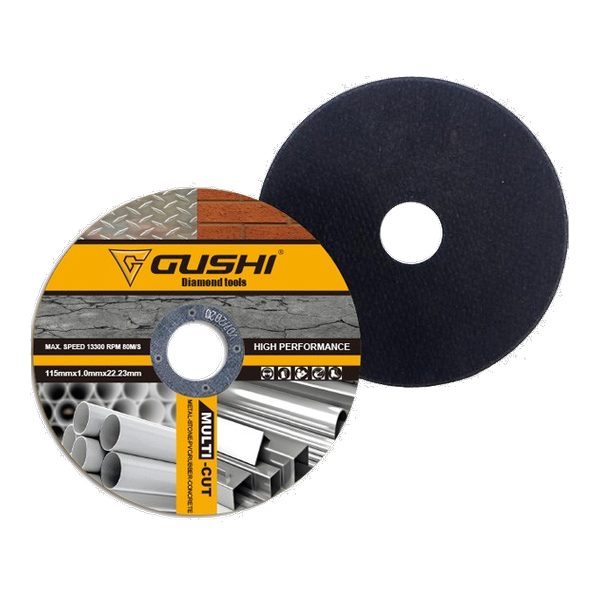
Multi-Purpose Cutting Disc
Multi-purpose cutting wheel is tried and proven to perform in a wide range of industrial and construction applications. This innovative disc is designed to be everything to everybody and can be used to cut many different materials such as: Steel, Stainles Steel, Cast Iron, Aluminium, Copper, Brass, Bronze, Masonry, Concrete, Stone, Tiles, PVC
Related products
-
Cutting Tools
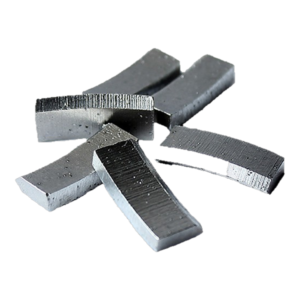
Diamond Segment for Core Drill Bits
-
Cutting Tools
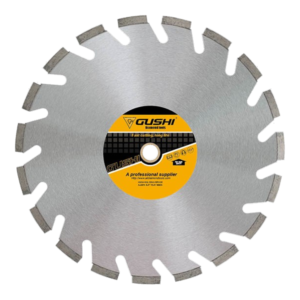
Hard Materials Diamond Saw Blade
-
Cutting Tools
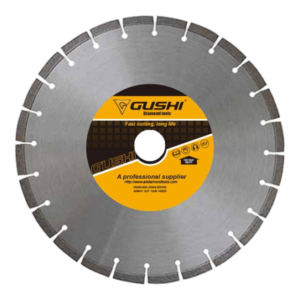
Laser Welded Diamond Blade
-
Cutting Tools
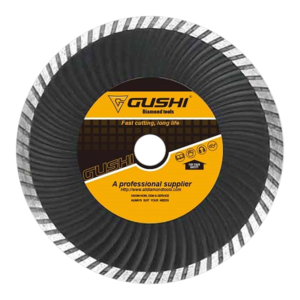
Narrow-Turbo Wave Diamond Blade