Full Specifications
| Item number | Diameter | Segment width | Segment height | Arbor hole |
|---|---|---|---|---|
| GSHMB250 | 10 in / 250 mm | 2.6 mm | 8 / 10 mm | 25.4 mm |
| GSHMB300 | 12 in / 300 mm | 3.0 mm | 8 / 10 / 12 mm | 25.4 mm |
| GSHMB350 | 14 in / 350 mm | 3.2 mm | 8 / 10 / 12 mm | 25.4 mm |
| GSHMB400 | 16 in / 400 mm | 3.5 mm | 10 / 12 mm | 25.4 mm |
| GSHMB450 | 18 in / 450 mm | 4.0 mm | 10 / 12 mm | 25.4 mm |
| GSHMB500 | 20 in / 500 mm | 4.0 mm | 10 / 12 mm | 25.4 mm |
| Rim | Segmented, slant slot |
|---|---|
| Core | Slant slot, for debris clearance and cooling |
| Materials | Hard brick, pavers, refractory, masonry, block |
| Cutting | Dry or wet |
| Positioning | Mid-range, high performance at a competitive price |
| Other sizes | More specifications and styles available on request |
What “Hard Materials” Actually Means Here
The phrase covers three things on this page: hard brick, pavers and refractory. They are not the same material, but they share the property that decides how a diamond blade behaves in them. They are dense. A concrete block is full of air; a clay paver and a firebrick are not. In block, the diamond opens a pore and the powder has somewhere to fall. In a paver there is no pore, so the powder has to leave through a kerf 2.6 to 4.0 mm wide, past a segment that is filling the slot it just made.
The second thing that follows from density is heat. Diamond does not cut by being sharp in the way a knife is sharp. It cuts by being harder than the material and scraping it away grain by grain, and that process makes heat at a very small point of contact. In a porous material some of that heat goes into air and into the pore structure. In a dense material it goes into the segment, the core and the workpiece, and in refractory it stays there, because refractory is made to resist the passage of heat.
The third consequence is on the bond, the metal powder that holds each diamond in place. The bond has to wear at the same rate the diamond dulls, so a fresh diamond is always being exposed. If the material is abrasive, the bond wears quickly and the blade stays sharp and dies young. If the material is hard but not abrasive, the bond wears slowly, the diamonds polish instead of cutting, and the segment glazes. Dense hard material sits on the second side of that line, which is why the geometry of this blade is doing as much work as the diamond.
The Slant Slot, Read as a Scoop
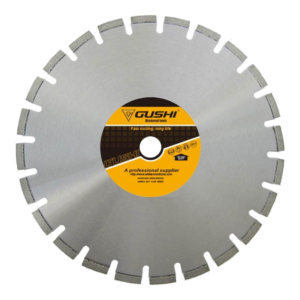
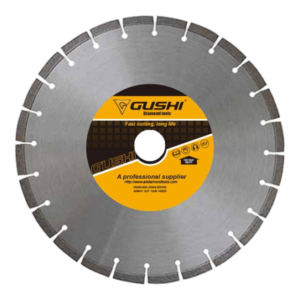
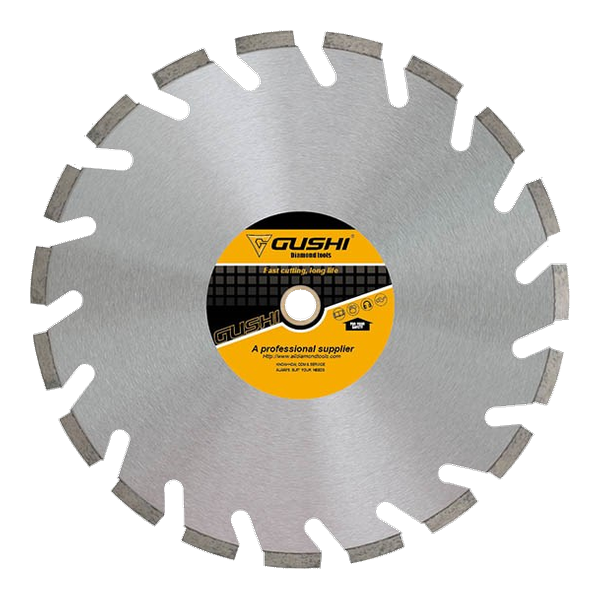
Look at the blade and the first thing to notice is that the slots are not radial. A conventional segmented blade has slots cut straight in towards the centre, and each slot is an open channel pointing at the arbor. This blade has its slots cut at an angle to the radius, in the segment and in the core, so the wall of each slot is a ramp rather than a step.
That change does three things. The first is transport. In a radial slot, debris leaves because the blade is spinning and the slurry is thrown outward against a wall that is parallel to the direction of travel. In a slanted slot, the trailing wall faces partly outward, so as the plate turns it scoops, the way a paddle wheel scoops water. The source describes the geometry as designed to clear debris out of the cut, and the angle is the reason it can: the slot is pushing, not just opening.
The second is airflow. A slanted slot works as a crude fan. As the plate turns, each slot traps a pocket of air, carries it round and releases it, and the result is a small pressure difference across the kerf that keeps air moving where a radial slot would leave it still. On a dry cut that is the only cooling the segment gets. The source calls this circulating air and water to keep the blade cool, and the slant is what makes the circulation possible.
The third is the one buyers rarely think about. Because the slots are angled, the root of one slot is not in line with the root of the next, so the ligament of steel between two slots is longer than it would be on a radial pattern with the same open area. A crack travelling around the rim, which is how a scored core eventually fails, has to turn a corner at every slot instead of running straight through a line of them. The same open area, distributed at an angle, leaves a stiffer rim.
The Cooling Circuit, and Where It Breaks
There are two separate heat problems in a diamond blade, and the source treats them separately: the segment, where the design is intended to reduce heat, and the core, which the slots are meant to keep cool. They fail differently and they are read differently.
Heat at the segment is a bond problem. The bond is a sintered metal matrix, and like any metal it softens as it gets hotter. When it softens, two things can happen. The diamond can be pulled out of its socket before it has done its work, which is a blade that wears quickly and looks like it has been sandblasted. Or the bond can smear and seal over the diamonds, which is glazing: the segment goes shiny, the blade stops cutting, and the operator pushes harder, which makes more heat.
Heat at the core is a tension problem. A circular saw blade is not a flat disc; it is a disc held in tension by the manufacturing process, and that tension is what keeps it running true at speed. Take the core past the temperature where the steel starts to change colour and the tension goes with it. The blade then runs out of flat, the kerf wanders, and a wandering kerf pinches the blade and loads one side of the segment. A blue band on the core near the rim is the visible sign, and by the time it is there the blade is a wall ornament.
The circuit that prevents both is short: slot, kerf, segment face, out with the slurry. It breaks in predictable places. Burying the segment in the cut, so the slot is below the surface and cannot take in air, is the most common. A slot packed with set slurry is the second. Running dry at a feed rate the blade cannot support is the third. In all three the segment is the part that reports the damage first.
Eight, Ten or Twelve Millimetres
Segment height is the wear reserve. It is the depth of diamond-bearing material on the rim, and it is the number that decides how long the blade works before it is finished. In this range the factory offers three heights, but not on every size: 8 or 10 mm on the 250, 8, 10 or 12 mm on the 300 and 350, and 10 or 12 mm on everything from 400 mm up.
Read that menu backwards and it tells you something. The shallow option is withdrawn above 14 inch. An 8 mm segment on a 500 mm blade would carry the same diamond depth as an 8 mm segment on a 250 mm blade, while the rim it sits on is twice as long and the work it is asked to do per revolution is twice as much. The blade would be worn out sooner in the life of the job, and the buyer would be changing a large blade rather than a small one, which is the expensive kind of blade change. The factory does not list it because it does not make sense.
Where the choice is real, it is a straight trade between first cost and life. Twelve millimetres against eight is half again as much diamond layer in the same segment, so it is half again as much cutting before the blade is retired, in exchange for a higher unit price. For a contractor buying a blade per job, the shallow one is rational. For anyone buying blades by the box for a season, or for a rental fleet where a dull blade comes back and a fresh one goes out, the deeper segment is the cheaper blade per metre cut, because the cost of the change sits in the labour and the downtime rather than in the segment.
Why the Width Stops at 4.0 mm
The width column climbs from 2.6 mm at 250 mm to 4.0 mm at 450 mm, and then it does something worth a second look: the 500 mm is also 4.0 mm. Two sizes with a 50 mm difference in diameter cut the same kerf. That is not an omission in the table, it is the design telling you what the top of the range is for.
Segment width is not a quality grade. It is the kerf, which is the volume of material removed per unit of depth, and it is paid for three times: in the power the saw has to deliver, in the dust the operator has to breathe, and in the material destroyed that did not need to be. So the width is set by what the cut needs, and the cut needs two things. It needs room to carry slurry out of a deep slot, and it needs a rim stiff enough not to wander. Both of those are satisfied at 4.0 mm by the time the blade reaches 18 inch. Going wider at 20 inch would remove more material without making the cut any straighter or any cleaner.
At the small end the logic runs the other way. The 250 mm blade is on a hand held cut off saw with a limited motor, and a 2.6 mm kerf is what keeps that motor inside its working range in a dense material. Put a 4.0 mm rim on it and the saw labours, the operator leans, the segment heats and the blade glazes. The width ladder is really a ladder of machines, and it is worth choosing the diameter your saw was built for rather than the largest one that fits under the guard.
One Bore, Six Sizes
Every size in this range is listed at 25.4 mm, the one inch arbor. There is no 22.23 mm option in the table, and that single fact says what kind of product this is: a family of saw blades, not a family of grinder discs.
It also has a practical consequence at the counter. A distributor who is used to stocking 115 and 125 mm grinder discs, which are commonly on a 22.23 mm spindle, will not find this range continuous with that shelf. The smallest blade here is 250 mm, which is a cut off saw or a masonry saw size, and the bore follows the machines those blades go on. If a customer turns up with a saw that needs a different bore, the answer is to ask, not to assume a bushing will be in the box. Order the bore to the spindle, because a bushing is a second interface between the blade and the machine, and every interface is a place where runout can appear.
Dry or Wet, and What Water Costs
The listing gives dry or wet without a separate rating for either, so the choice belongs to the job. What water does is three things at once, and only one of them is cooling.
It suppresses dust. Cutting silica-bearing masonry and refractory dry puts fine dust into the air where everyone on the site breathes it, and water at the cut is the simple answer. It flushes the kerf, which is the part that matters most for blade life: water carries the slurry out through the slots instead of letting it pack in behind the segment, and a packed slot is a blade that has lost its cooling circuit. And it takes heat off the segment directly, which is what allows an operator to keep a feed rate up in a dense material without glazing.
Dry cutting has its own logic. A hand held saw on a roof or a short run in a firebox is not going to be plumbed, and water on a live electrical job or on a surface that must stay dry is not an option. What dry asks in return is discipline: shallower passes, a steady feed rather than pressure, and pauses that let the segment come back down in temperature. The blade will do it. The failure mode when it goes wrong is always the same one, a shiny segment that has stopped cutting, and it is caused by pushing, not by the absence of water.
Brick, Paver and Firebrick in One Blade
Three materials are named for this blade, and they pull the bond in different directions. Fired clay brick is hard and moderately abrasive. A concrete paver is dense and often silica rich, which makes it strongly abrasive, so it wears the bond away and keeps the diamonds exposed without much help. Refractory is abrasive in the same way and adds a problem of its own: it insulates, so the heat of the cut does not leave through the workpiece.
One bond has to cover all three, and that is the design compromise the blade is built around. Set the bond hard enough to survive the paver and it will glaze on hard brick, because nothing is wearing the matrix back fast enough to expose new diamond. Set it soft enough to stay open on brick and it will wash away in paver, leaving diamond sitting proud with nothing holding it. A blade sold as a hard materials blade is set in the middle of that span, which is why it holds up across a mixed masonry account and why it is not the record holder in any single one of them.
Both failure modes are diagnosable on the bench, and neither is cured by the operator. A segment that is glassy and will not scratch steel is glazed, and the material that caused it is the hard, low-abrasive one. A segment that is worn back with diamond still visible is being washed, and the material that caused it is the abrasive one. In the first case, dress the rim on something abrasive and slow the feed. In the second, the answer is a harder bond, which is a different blade rather than a different technique.
What Mid-Range Buys, Stated Plainly
The listing describes this blade as a mid-range product combining high performance with a competitive price. That is the manufacturer’s own positioning, and it is worth taking literally rather than treating it as modesty, because a buyer who understands where a blade sits buys the right one twice instead of the wrong one three times.
What mid-range means in practice is that the diamond grade and the bond are set for a full working life at a normal feed rate, not for a record life at the edge of what the segment can survive. What you get for that is a consistent segment, a core that runs true, six sizes on one bore, dry or wet use, and the slot geometry that this material needs. What you do not get is the top diamond grade, which is what a contractor needs when the blade is asked to survive reinforced concrete or to run all day in abrasive paver without a change.
The premium is wasted in specific places. A rental fleet cutting occasional brick and paver wants a blade that comes back and goes out again; it does not want to pay for a segment that outlives the machine. A masonry contractor working a mixed account wants a blade that does all three materials competently rather than one material brilliantly. The premium earns its money in the opposite case: contract sawing where a blade change stops a crew, or a plant cutting refractory on a schedule, where the cost of the stoppage is larger than the cost of the blade by an order of magnitude. In that case the answer is not this blade pushed harder. It is a blade specified for that one material.
What to Send With an Enquiry
Six answers settle almost every order in this range. First, the machine: make and model, and the maximum diameter marked on the guard. That fixes the size far more reliably than a preference does. Second, the material, named specifically: hard brick, concrete paver, refractory, or a mix, because a mix is the case this blade is designed for and a single material is the case where a specialist bond wins. Third, the depth of cut needed per pass, which decides whether the diameter is enough or whether the work has to be stepped. Fourth, dry or wet, and whether water is available at the cut.
Fifth, the bore on the saw spindle, checked rather than assumed, since every size here is on 25.4 mm. Sixth, the quantity per size rather than a total, because a mixed order is normal and the sizes are not interchangeable: a buyer who takes twenty blades as four sizes of five is in a different position from one who takes twenty of the 300 mm. Add the segment height you want where the size offers a choice, and say what the blades are going into, whether that is your own stock, a rental fleet or a contract sawing outfit. Those six answers plus the destination port turn an enquiry into a quotation without a second round of questions.
Private Label and Export Supply
The range is supplied under the GUSHI mark or made to order under a buyer’s own brand. What can be set for a private label order is the core printing on both faces, the item numbering that goes with it, the segment height per size where the table offers a choice, the bore, and the sleeve or carton print. The diameters themselves are fixed by the six sizes, so a private label programme is placed as a set of sizes rather than as one blade in six lengths.
Where a distributor sells into more than one trade, the split is usually between the hand held sizes and the bench sizes: 250 and 300 mm for cut off saws on site, 350 to 500 mm for masonry bench saws and larger cut off machines. Ordering both ends of the range in one shipment is normal, and it is the reason the segment height menu matters, since the 250 mm can be had shallow where price decides and the 400 mm and up cannot.
For the rest of the cutting range, the dry cutting segmented blade and the hot pressed segmented blade cover general masonry in the smaller diameters, the split turbo blade and the masonry turbo blade cover quicker cutting in brick and block where a continuous rim is wanted, the concrete and asphalt blade covers the road work this bond is not set for, the brazed concrete blade covers the budget end of the same jobs, and the T segment grinding cup wheels cover the grinding that usually follows a cut in refractory.
Frequently Asked Questions
- What is a hard materials diamond blade?
- A segmented diamond blade built for dense, low porosity material rather than for general masonry. In this range that means hard brick, pavers and refractory work. A dense material gives the swarf nowhere to go and holds heat at the cut, so the segment and the core are shaped around clearing debris and keeping the blade cool.
- What sizes are available?
- Six: 250, 300, 350, 400, 450 and 500 mm, which is 10, 12, 14, 16, 18 and 20 inch. Item numbers run GSHMB250 to GSHMB500. Segment width goes from 2.6 mm at 250 mm to 4.0 mm at 450 and 500 mm, and every size takes a 25.4 mm arbor.
- What does slant slot mean?
- The slots between segments are cut at an angle to the radius instead of straight in towards the centre. As the blade turns, the angled wall of each slot works as a scoop and pushes slurry outward, and the slot also carries air or water towards the segment. A radial slot only gives debris an edge to be dragged against.
- What materials will it cut?
- The listed applications are dense hard materials: hard brick, pavers and refractory work, and masonry and block. It is a segmented masonry blade, so it also handles the general block and brick work a masonry contractor does. It is not listed for metal, and steel wants a blade built for steel.
- Will it cut reinforced concrete?
- That is not in the listed applications, and the bond is set for dense masonry and refractory rather than for grinding steel. If the work involves rebar, order a concrete blade specified for reinforced concrete rather than expecting a hard materials blade to do both jobs, because the two bonds want opposite things.
- Dry or wet cutting?
- The listing gives dry or wet, with no separate rating for either. Water suppresses dust and flushes slurry out of the kerf, which is worth having on refractory and on silica bearing masonry. A short run on a hand held saw is normally cut dry. Either way the slot has to stay open so the segment keeps getting air.
- Which arbor bore do I need?
- All six sizes in this range are listed at 25.4 mm, the one inch bore. There is no 22.23 mm version in the table, so check the spindle on your saw before ordering and ask about a bushing or a different bore if the machine needs one. Order the bore to the machine rather than an adapter to the bore.
- Which segment height should I order?
- The 250 mm is listed at 8 or 10 mm, the 300 and 350 mm at 8, 10 or 12 mm, and everything from 400 mm up at 10 or 12 mm. Height is the wear reserve, so 12 mm is the longer lived blade. The shallow option is offered where the blade is small and price sensitive.
- Why is the 10 inch segment narrower?
- Because the machine behind it is smaller. Segment width is the kerf, and the kerf is the volume of material the saw has to remove per unit of depth. A 250 mm blade sits on a hand held saw with limited power, so a 2.6 mm kerf keeps the motor inside its working range. Width climbs with the size of the saw, not with the hardness of the material.
- Will it fit a 4.5 or 5 inch angle grinder?
- No. The smallest size is 250 mm, which is 10 inch, and every size in the range is on a 25.4 mm bore. This is a saw blade family for cut off saws and masonry saws, not a grinder disc. A 115 or 125 mm grinder needs a blade built for that spindle and that guard.
- What is refractory and why is it hard on a blade?
- Refractory is the heat resistant brick and castable lining used in kilns, furnaces and fireboxes. It is abrasive like brick, and it also insulates, which means heat generated at the cut has less chance to travel away into the material. That combination is why refractory work rewards a blade with an open slot and a bond that keeps opening.
- Can you supply these under our brand?
- Yes. Core printing on both faces, item numbering, segment height per size, bore and carton print are made to order. A distributor order is normally placed as a set of sizes rather than one blade, since a masonry account buys the 250 and 300 mm for hand held work and the larger sizes for bench saws.