Full Specifications
| Item number | Diameter | Segment width | Segment height | Arbor hole |
|---|---|---|---|---|
| 4HCTP | 4 in / 100 mm | 6.4 mm | 8 / 10 mm | 22.23 mm |
| 4.5HCTP | 4.5 in / 115 mm | 6.4 mm | 8 / 10 mm | 22.23 mm |
| 5HCTP | 5 in / 125 mm | 6.4 mm | 8 / 10 mm | 22.23 mm |
| 6HCTP | 6 in / 150 mm | 6.4 mm | 8 / 10 mm | 22.23 mm |
| 7HCTP | 7 in / 180 mm | 6.4 mm | 8 / 10 mm | 22.23 mm |
| 8HCTP | 8 in / 200 mm | 6.4 mm | 8 / 10 mm | 22.23 mm |
| 9HCTP | 9 in / 230 mm | 6.4 mm | 8 / 10 mm | 22.23 mm |
Seven sizes as published for this series. Segment width is 6.4 mm, segment height is 8 or 10 mm and the arbor is 22.23 mm at every size; only the diameter changes from 100 to 230 mm. The listing also gives the overall blade thickness as 6 to 8 mm. No speed rating, diamond concentration or bond hardness is published with this table.
The job is raking out and repointing mortar joints
A tuck point blade makes the groove and repairs the mortar joint in a concrete, stone or brick masonry wall. The listing describes this blade as a tool for fast, efficient removal of mortar joints in brick, block and stone, and for repair and resurfacing of almost any type of concrete and masonry. That is the whole point of tuck pointing: cut the old, failed mortar out of the joint, then fill it again so the wall or floor reads as sound and weather tight.
The work runs on exterior building surfaces and interior floors and walls. The listing names concrete, brick, block and masonry as the application, and the description adds stone, so the blade is the one for the masonry and stone faces where a joint opens and where a repair is called for. It is not a blade for metal or wood, and it is not a large road blade for cross cutting a flat span; it is sized for the grinders and small saws a repointing crew carries, not a walk behind road saw.
Removing the mortar and refilling the joint are two steps of one pass. The wide segment rakes the old mortar out to a clean channel, and the cut clears the dust and loose debris that would otherwise sit between the new mortar and the old brick or stone. The listing adds that the blade cuts smoothly with water while it works, which matters on a brick or stone face where a ragged joint is the failure of the repair. A clean channel is what lets the new mortar bond.
The wide segment does the raking
The listing gives the segment width as 6.4 mm, and that width is what sets the groove the blade cuts into the mortar joint. A tuck point blade is not a thin cutting disc; its segment is wide so it clears the old mortar in one pass and leaves a channel the new mortar is raked into and refilled into. The 6.4 mm figure is the published groove width for this series, the number a buyer matches to the joint being repointed.
Segment height is 8 or 10 mm at every size, and the arbor is 22.23 mm at every size. The height is the diamond bearing depth of the segment, the part that does the cutting and that wears as the blade is used. Because the segment width, the segment height and the arbor are fixed across all seven diameters, a buyer gets the same groove and the same mount on a 4 inch grinder blade and on a 9 inch saw blade. What changes is only the diameter of the steel core the segment sits on, not the shape of the segment that does the work.
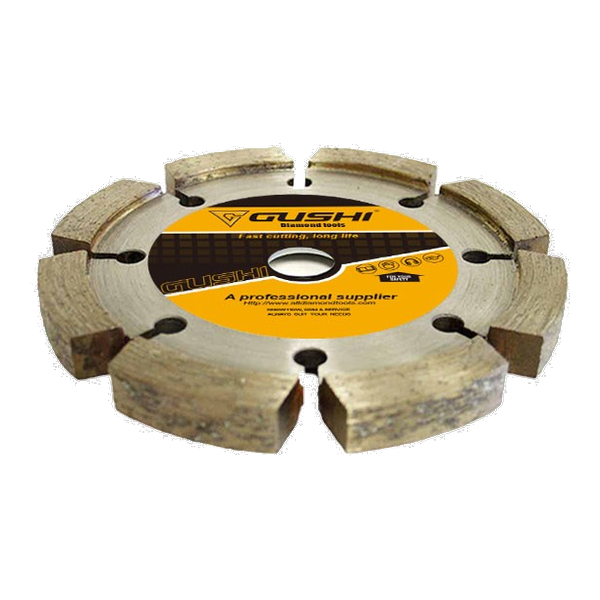
The wide segment also means the rim is a set of separate teeth with gaps between them rather than one continuous band. The gaps give the cut a way to shed the dust and grit it throws up, so the blade keeps advancing along the joint instead of loading against a bed of ground out mortar. On a brick or stone face that clearance is what keeps the cut smooth and keeps the stone from chipping at the edge while the joint is opened.
Cut with water, on a grinder or saw
The listing describes smooth and fast cutting with water, so this blade is used with water. Water keeps the cut cool and keeps the dust down while the wide segment rakes the joint, which suits the enclosed spaces of a wall or a floor where dry dust would spread. The listing does not describe a dry mode for this blade, so water is the stated cutting condition rather than an option the source offers.
The machines named are angle grinders, circular saws and tuck pointers, all small to mid size. Angle grinders take the 100 to 180 mm sizes for hand held joint work, circular saws and tuck pointers take the larger 200 and 230 mm sizes for a steadier pass along a longer run of wall or floor. None of the diameters here is a road saw blade, and the 22.23 mm arbor fits the grinders and small saws these diameters mount on. Pick the diameter to the machine, and the machine to the length and position of the joint.
Cutting with water suits the wide segment because the gaps between the segments are what carry the coolant and the slurry away, and those gaps are there in the rim’s own design. The material stays concrete, brick, block, stone or masonry; the blade does not change its cut because the feed changed. The listing’s wording of smooth cutting with water is the condition the blade is built for.
Seven sizes, three fixed columns
The diameter column runs 100, 115, 125, 150, 180, 200 and 230 mm, the seven sizes from 4 to 9 inch. That is the only column in the table that changes from row to row. The item numbers 4HCTP through 9HCTP mark each diameter, and the diameters are what a buyer matches to the grinder or saw on site. Everything else in the table is the same line repeated seven times.
The segment width column reads 6.4 mm on every row. The segment height column reads 8 / 10 mm on every row. The arbor column reads 22.23 mm on every row. So a buyer choosing between the seven sizes is choosing only the diameter; the rim, the height and the bore are already decided by the series. That is a simple buy, because there is no second variable to weigh once the machine is known.
The 22.23 mm arbor is the reason the sizes stay this small. A 22.23 mm bore fits the grinders and small saws these diameters mount on, and it does not change because the diameter does not cross into road saw territory. The blade is built as a tuck pointing and repointing tool across its whole range, so the fixed arbor, fixed 6.4 mm segment and fixed 8 / 10 mm height are the constants, and the diameter is the one dial the table turns.
Private Label and Export Supply
The range is supplied under the GUSHI mark or made to order under a buyer’s own label. What can be set is the printing on the core, the item numbering and the carton or sleeve print for the export carton. The seven sizes, the 6.4 mm segment width and the 22.23 mm bore stay as listed, because the table publishes them as fixed at every diameter; there is no second bore or second segment width in the source to choose between.
For the rest of the cutting range, the mortar joint and repointing work belongs to this heavy duty tuck point blade, the crack cleaning and repair work to the V crack chaser, and the brittle tile and glass work to the continuous rim. The family splits by the shape of the cut and the material, and this blade is the one shaped to rake a mortar joint. The seven diameters cover the grinder and small saw sizes a repointing crew runs, and the fixed rim means the same groove comes out of each.
Frequently Asked Questions
- What is a tuck point blade used for?
- It is used to make grooves and repair mortar joints in concrete, stone or brick masonry walls. The listing describes the blade as a tool for fast, efficient removal of mortar joints in brick, block and stone, and for repair and resurfacing of concrete and masonry on exterior building surfaces and interior floors and walls.
- Which materials can the tuck point blade cut?
- The listing names concrete, brick, block, stone and masonry for making grooves and repairing mortar joints. The blade is a tuck pointing and masonry tool for those surfaces, used on walls, floors and building faces. It is not a blade for metal or wood, and it is shaped to rake a mortar joint rather than to cross cut a large slab the way a road blade does.
- Is the tuck point blade used wet or dry?
- The listing describes smooth and fast cutting with water, so the blade is used with water. Water keeps the cut cool and controls dust while the wide segment rakes the mortar joint. The listing does not describe a dry mode for this blade, so water is the stated cutting condition.
- What diameters are available?
- Seven sizes from 4 inch (100 mm) to 9 inch (230 mm): 100, 115, 125, 150, 180, 200 and 230 mm. Every size shares the same segment width, segment height and arbor, so the diameter is the only variable in the table. Pick the size to the grinder or saw in hand rather than to a change in the rim geometry.
- What is the segment width, height and arbor of the tuck point blade?
- Segment width is 6.4 mm and the arbor hole is 22.23 mm at every listed size. The segment height is 8 or 10 mm at every size. These numbers do not change across the seven diameters, which is why the table reads as one fixed rim at seven diameters and the diameter is the only thing that moves.
- What is the thickness of the tuck point blade?
- The listing gives the blade thickness as 6 to 8 mm. The rim itself carries a 6.4 mm wide segment at a height of 8 or 10 mm on a 22.23 mm arbor. The thickness figure is the overall blade section from the listing; the segment width is the figure that sets the groove width raked into the mortar joint.
- Why a wide segment for tuck pointing?
- The segment width of 6.4 mm sets the groove the blade cuts into the mortar joint, which is the channel the new mortar is raked out of and refilled into. A wide segment clears the old mortar in one pass so the joint can be repointed and the wall or floor resurfaced. Because the segment width, height and arbor stay fixed, the buyer chooses only the diameter for the machine on site.