Why Choose a Brazed Rim for Concrete Sawing
Concrete, pavers and block are highly abrasive. A blade that buries its diamond too deep loses cutting speed, while one that sheds diamond too fast burns through segments. The brazed construction solves this by brazing a single, fully exposed layer of diamond onto the steel core: every grit cuts, so the rim bites hard from the first pass.
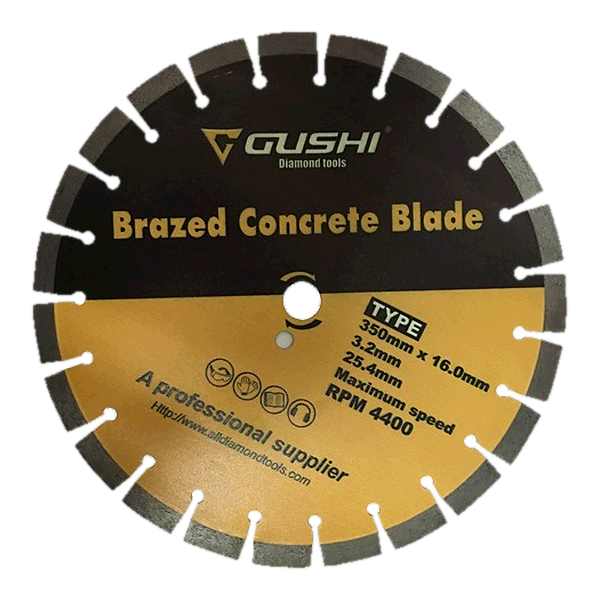
For road, pavement and slab contractors the payoff is throughput. The GUSHI brazed concrete blade removes material quickly on walk-behind and flat saws, and the 16 mm segment height carries enough diamond reserve to keep that pace across long jobs. Where a job mixes cured concrete, brick and block, one brazed blade covers all three without swapping.
Full Specifications
| Parameter | 350 mm (14 in) | 400 mm (16 in) | 500 mm (20 in) |
|---|---|---|---|
| Diameter | 350 mm | 400 mm | 500 mm |
| Arbor hole (bore) | 25.4 mm (1 in) | 25.4 mm (1 in) | 25.4 mm (1 in) |
| Segment width | 3.2 mm | 3.8 mm | 3.8 mm |
| Segment height | 16 mm | 16 mm | 16 mm |
| Segment number | 23 | 27 | 33 |
| Max RPM (at 80 m/s) | 4,400 | 3,820 | 3,056 |
| Rim type | Segmented, brazed single-layer diamond | ||
| Bond | Wear-resistant braze alloy, soft-to-medium for concrete | ||
| Diamond exposure | High (single-layer, fully exposed grit) | ||
| Steel core | Hardened, two-tone (black / gold) with dampening | ||
| Cutting mode | Wet and dry | ||
| Max rim speed | 80 m/s | ||
| Recommended machines | Walk-behind saw, flat / road saw, high-speed cut-off saw | ||
| Suitable materials | Cured concrete, pavers, brick, block, masonry | ||
| Not recommended for | Steel, cast iron, heavy rebar, non-mineral metal | ||
| Cooling | Water recommended for long life; dry for short passes | ||
| Certifications | ISO 9001, CE, EN13236 | ||
| Brand | GUSHI Tools / Roycel | ||
| MOQ | 20 pcs per size (mixed sizes accepted) | ||
| Lead time | 25-30 days after confirmation (stock faster) | ||
How a Brazed Diamond Blade Works
A brazed blade is built differently from a sintered or laser-welded one. Instead of a tall powder segment, it carries one exposed layer of diamond fixed in a braze alloy. That single layer is the whole cutting face, which changes how the blade behaves in concrete.
Single-layer brazed diamond bond
The diamond grits are brazed individually to the steel core at high temperature. Because there is no matrix covering them, each diamond stands proud of the surface. The cutting points stay sharp and bite aggressively rather than grinding slowly through a bonded layer.
High diamond exposure for aggressive cutting
With the grit fully exposed, the rim removes concrete and masonry fast and with less downward pressure. On abrasive slab and pavement this translates directly into more linear metres cut per hour on a walk-behind or road saw.
Segmented rim for debris clearance
The rim is divided into separate segments with gaps between them. Those gaps let water, slurry and cutting dust escape, keep the core cooler, and reduce the chance of binding in a deep concrete cut. Segment counts are 23 (350 mm), 27 (400 mm) and 33 (500 mm).
Key Features Explained
Fast, aggressive cutting on concrete
The fully exposed brazed diamond layer bites from the first pass, so the blade cuts cured concrete, pavers and block quickly with lower feed force than a buried-diamond segment.
Wet or dry operation
Run it wet on long floor and road-sawing jobs for cooling and dust control, or dry on shorter block and brick passes with a cut-off saw. The brazed rim stays stable in both modes.
16 mm segment height for long service
A tall 16 mm segment carries a large diamond reserve and keeps the steel core away from the cut, extending working life on abrasive pavement and slab versus thin-rim blades.
Built for floor and road saws
At 350-500 mm with a 25.4 mm arbor, the blade fits walk-behind, flat and high-speed saws used in slab, pavement and trench work. One arbor covers the full diameter range.
EN13236 safety compliant
Marked and documented to EN13236, the European safety standard for bonded abrasive products, with ISO 9001 manufacturing control and CE marking for export markets.
Size Selection Guide
| Diameter | Best machine | Typical use | Max RPM |
|---|---|---|---|
| 350 mm (14 in) | Portable flat / cut-off saw | Curbs, sidewalks, short slab cuts, brick and block | 4,400 |
| 400 mm (16 in) | Walk-behind / road saw | Road repair, pavement, medium slab | 3,820 |
| 500 mm (20 in) | Walk-behind / road saw | Deep slab, long pavement and trench runs | 3,056 |
Pick the largest diameter your saw’s guard allows for the deepest single-pass cut, then confirm the saw’s maximum RPM clears the blade’s marked maximum. For mixed curb, sidewalk and slab work the 350 mm size is the most portable; for continuous road and floor jobs step up to 400 or 500 mm.
Applications & Suitable Materials
Applications
| Application | Notes |
|---|---|
| Cured concrete slab cutting | Walk-behind saws, expansion and control joints |
| Road and pavement repair | Asphalt-concrete interface, patch cuts |
| Paver and block cutting | Wet or dry on hard landscaping units |
| Brick and masonry | Short passes, cut-off saws |
| Trench and utility cuts | Deep single-pass on 400/500 mm sizes |
Suitable materials
| Material | Cut quality | Tip |
|---|---|---|
| Cured concrete | Excellent | Use water for long life |
| Pavers | Excellent | Dry acceptable for short runs |
| Brick / block | Very good | Low feed pressure |
| Green concrete | Good | Soft bond dresses fast |
| Asphalt | Good | Water controls bitumen build-up |
| Reinforced concrete (light) | Fair | Slow down at rebar |
How to Use the Brazed Concrete Blade
- Confirm the saw’s guard accepts the blade diameter and its maximum RPM exceeds the blade’s marked maximum.
- Check the 25.4 mm arbor; fit a reducer ring only if the spindle is smaller and the ring is rated for the speed.
- Inspect the blade for cracks, core warping or missing segments before every shift.
- Mount the blade with the rotation arrow matching the saw’s spin direction.
- Tighten the flange nut to the saw maker’s torque; a loose blade wobbles and cracks.
- For wet cutting, connect the water supply and verify flow before starting the cut.
- Start the cut shallow to seat the rim, then increase depth in controlled passes.
- Apply steady, moderate feed pressure; let the diamond cut rather than forcing it.
- Keep the saw moving. Stopping in a deep cut can bind the blade and stall the motor.
- On rebar or embedded steel, slow down and keep the rim cool to limit diamond loss.
- Between dry passes, let the blade spin free so the steel core cools and avoids warping.
- Track segment height; replace the blade before the core is exposed to avoid core damage.
Frequently Asked Questions
- What is a brazed diamond blade and how is it different from a laser-welded blade?
- A brazed blade holds a single layer of diamond in a braze alloy on the steel core, so every grit is fully exposed for aggressive cutting. A laser-welded blade fuses a taller multi-layer segment to the core. Brazed cuts faster on concrete and masonry; laser-welded lasts longer and is safer at very high RPM.
- What materials can the GUSHI brazed concrete blade cut?
- Cured concrete, pavers, brick, block and general masonry, plus green concrete, asphalt and soft stone. Avoid steel, cast iron and heavy rebar. For metal use a dedicated laser-welded metal blade.
- Can this brazed concrete blade be used wet and dry?
- Yes. Wet cutting is best for long road and floor jobs (cooling, dust control, longer life). Dry cutting suits shorter block, brick and paver passes; let the blade spin free between passes so the core does not overheat.
- What diameters are available for the brazed concrete blade?
- 350 mm (14 in), 400 mm (16 in) and 500 mm (20 in). The 350 mm size fits portable flat and cut-off saws; 400 and 500 mm suit walk-behind and road saws for longer, deeper cuts. All share a 25.4 mm arbor.
- What arbor (bore) size does the blade use?
- Every diameter uses a 25.4 mm (1 inch) arbor, the standard bore for floor, road and cut-off saws. A reducer ring adapts it to a smaller spindle. Confirm the saw’s arbor and guard capacity before ordering.
- Why is the segment height 16 mm and does it matter?
- The 16 mm segment is unusually tall, giving a large diamond reserve and long service on abrasive slab and pavement while keeping the core away from the cut. Because the rim is single-layer, plan changes around wear on the segment rather than a renewing bed.
- What RPM can the brazed concrete blade run at?
- At the 80 m/s rim-speed limit: 350 mm about 4,400 RPM (the marked value), 400 mm about 3,820 RPM, 500 mm about 3,056 RPM. Always obey the RPM printed on the blade you receive, because that is the legal limit for that core.
- Which machines fit this brazed blade?
- Walk-behind floor saws, flat or road saws, and high-speed cut-off saws. It is too large for angle grinders and hand-held saws. Match diameter to the guarded capacity and verify the saw’s RPM margin.
- Can the brazed concrete blade cut rebar or reinforced concrete?
- It passes occasional light rebar but is not a metal blade; heavy or continuous rebar contact strips the single-layer diamond quickly. Cut slowly and keep it cool, or use a laser-welded metal-cutting blade for heavy steel.
- How long does the brazed concrete blade last?
- Life depends on material, feed pressure, wet versus dry use and rebar contact. The 16 mm segment gives a long interval on cured concrete with water; dry abrasive block wears faster. Performance stays steady until the diamond is consumed, then replace before the core shows.
- Is the brazed concrete blade certified and safe to use?
- Yes. Made under ISO 9001 with CE and EN13236 marking. EN13236 governs segment retention, markings and the technical file; conformity is declared in the technical file unless a third-party certificate is on file. Run within the marked RPM and use guards and protection.
- What is the minimum order quantity and can you OEM this blade?
- MOQ is 20 pcs per size, mixed sizes accepted for distributors; lead time 25-30 days. GUSHI offers OEM and private label: custom laser marking, packaging, and bespoke diameter, segment height and arbor. Manufacturer since 2004, exporting to 20 plus countries.