Full Specifications
| Item | HTW series narrow turbo wave diamond blade |
|---|---|
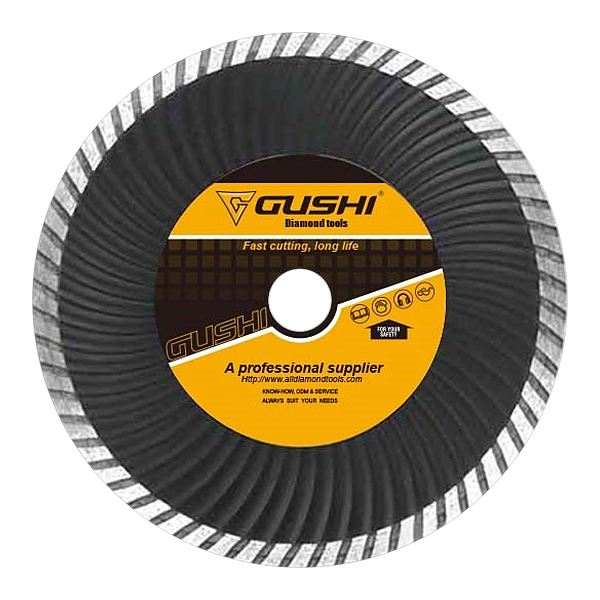
| Construction | Continuous turbo rim, laser welded to a wave formed steel core |
| Diameters | 100, 115, 125, 150, 180, 200, 230, 250, 300 and 350 mm |
| Kerf (segment width) | 2.1 mm at 100 mm, rising to 3.6 mm at 300 and 350 mm |
| Rim height | 5, 7, 8 or 10 mm, chosen at order |
| Arbor | 16, 20, 22.23 or 25.4 mm; reducing bushings to order |
| Rim type | Continuous band with slanted turbo grooves pressed across the full width |
| Cutting mode | Wet or dry |
| Materials | Granite, marble, engineered stone, concrete, sandstone, limestone, tile |
| Machine types | Angle grinder, tile saw, hand-held stone saw, small bench saw |
| Packing | Individual sleeve, then export carton; 25 to 50 pcs per carton by size |
| Standards | Made under ISO 9001; finished blades carry the CE mark |
Why the Core Is Waved
A diamond blade is a disc held at the centre and loaded at the rim, the least stable arrangement a cutting tool can have. Everything that goes wrong with a thin blade starts there: the rim drifts, the slot closes on the disc, the operator corrects by twisting the machine, and the blade comes out bent.
What the wave does to a flat disc
Press a shallow wave into a steel disc and its axial stiffness goes up without adding a gram of thickness. A flat 1.2 mm core resists a sideways push with little more than its own tension; the same core with a wave running round it behaves like a shallow cone spring and pushes back. The result is a rim that stays in the line it started in, which is what lets the band be 2.1 mm wide.
The wave also takes the ring out of the blade. A flat disc of this diameter rings at a few thousand rpm, and a ringing blade is a vibrating blade: the rim chatters on the stone and the edge crumbles. The wave breaks that resonance up, so the blade runs quieter and the cut face comes out flatter.
The wave is not a slot pattern
People see a shaped core and assume it is a gullet design. It is not. The wave is a form pressed into the disc itself, and there is no break in the rim anywhere on the circumference. That is what the blade is for: a continuous rim strikes the stone once and stays in contact, so the exit edge of a granite slab comes away with a clean line instead of the scalloped edge a segmented blade leaves. The turbo grooves do the clearing work that gullets would otherwise do.
Heat, tension and the limits of the idea
Steel loses tension as it heats, and a blade that has lost tension dishes and binds. The wave gives the disc something to fall back on, which is why this blade runs dry on granite without the trouble a flat rim would find. It is not a licence to abuse the blade: a disc that has been dropped, or run until it went blue, has lost the wave where it matters.
What a Narrow Turbo Rim Actually Does
The rim is a continuous ring of diamond bond with a row of slanted grooves pressed across it. Three things are happening at once, and each one answers a different problem.
Continuous contact, grooved face
The band is unbroken, so the diamond is in the cut all the way round and the load on the machine stays steady. A smooth continuous rim would cut well for a few metres and then polish itself shut, because there is nowhere for the slurry to go and no free face for the bond to wear back against. The grooves solve that: they carry water in, give the swarf a path out, and leave the bond edges exposed so the metal wears back and fresh diamond comes up.
Because the grooves are shallow and cut at a low angle, the rim still meets the stone as an almost continuous edge, which is why it behaves like a continuous rim on granite rather than a turbo blade with deep gullets.
What the narrow kerf is worth
Kerf is the width of stone the blade turns into dust, and on a blade this size it decides how the machine feels. Segment width is 2.1 mm at 100 mm and 2.6 mm from 150 to 200 mm. Against a 20 mm deep cut the arithmetic is blunt: a 2.1 mm kerf removes 42 square millimetres of section for every millimetre of travel, so at a metre a minute around 42 cubic centimetres of granite goes to slurry, and every cubic centimetre of it is motor current, water and heat.
On a corded grinder it shows as a blade that keeps its speed in the cut; on a cordless one, as cuts per charge.
Size Chart: Diameter, Kerf, Arbor and Speed
| Item | Diameter | Kerf | Rim height | Arbor | Max rpm |
|---|---|---|---|---|---|
| 4HTW | 4 in / 100 mm | 2.1 mm | 5 / 7 / 8 / 10 mm | 16 / 20 / 22.23 mm | 15,300 |
| 4.5HTW | 4.5 in / 115 mm | 2.2 mm | 5 / 7 / 8 / 10 mm | 16 / 20 / 22.23 mm | 13,300 |
| 5HTW | 5 in / 125 mm | 2.4 mm | 5 / 7 / 8 / 10 mm | 20 / 22.23 mm | 12,200 |
| 6HTW | 6 in / 150 mm | 2.6 mm | 5 / 7 / 8 / 10 mm | 20 / 22.23 mm | 10,200 |
| 7HTW | 7 in / 180 mm | 2.6 mm | 5 / 7 / 8 / 10 mm | 22.23 / 25.4 mm | 8,500 |
| 8HTW | 8 in / 200 mm | 2.6 mm | 5 / 7 / 8 / 10 mm | 22.23 / 25.4 mm | 7,600 |
| 9HTW | 9 in / 230 mm | 2.8 mm | 5 / 7 / 8 / 10 mm | 22.23 / 25.4 mm | 6,600 |
| 10HTW | 10 in / 250 mm | 3.0 mm | 5 / 7 / 8 / 10 mm | 22.23 / 25.4 mm | 6,100 |
| 12HTW | 12 in / 300 mm | 3.6 mm | 5 / 7 / 8 / 10 mm | 22.23 / 25.4 mm | 5,100 |
| 14HTW | 14 in / 350 mm | 3.6 mm | 5 / 7 / 8 / 10 mm | 22.23 / 25.4 mm | 4,400 |
Kerf widens with diameter because a larger disc needs a stiffer rim to hold its line, and above 250 mm the blade is usually on a saw. Rim height is chosen at order and changes neither the diameter nor the kerf.
Choosing a Rim Height
The diamond lives in the band and nowhere else. Once the band is down to about 1.5 mm above the steel, the blade is cutting stone with a steel edge: it stops cutting, it heats up, and it can crack at the weld. Rim height is the working life of the blade, and the four heights are aimed at four different jobs.
| Rim height | Usable band | What it suits |
|---|---|---|
| 5 mm | about 3.5 mm | Tile, thin slab, trim and cut-out work where the blade is not expected to last a season |
| 7 mm | about 5.5 mm | Marble and soft stone, general workshop use, low-power machines |
| 8 mm | about 6.5 mm | Mixed stonework, restoration and fit-out where one blade has to do several materials |
| 10 mm | about 8.5 mm | Granite worktops, concrete kerbs and pavers, daily contractor work |
The price gap between a 5 mm and a 10 mm blade is small next to the gap in metres of cut, so the figure that matters is cost per metre. A 5 mm rim on granite worktops is a false economy; a 10 mm rim on tile trim is money left in the rim when the blade goes in the bin.
Maximum rpm and Machine Match
Every diameter has a speed above which the rim is travelling past what the bond can stand, and the number on the label is a limit, not a target. The figure comes from peripheral speed: for a diamond blade the rating is 80 metres per second at the rim, so rpm falls as diameter rises because the circumference grows.
| Diameter | 100 | 115 | 125 | 150 | 180 | 200 | 230 | 250 | 300 | 350 |
|---|---|---|---|---|---|---|---|---|---|---|
| Max rpm | 15,300 | 13,300 | 12,200 | 10,200 | 8,500 | 7,600 | 6,600 | 6,100 | 5,100 | 4,400 |
The sizes sort themselves in practice. A 100 or 115 mm grinder turns about 11,000 rpm, which leaves headroom under the 15,300 and 13,300 limits. A 125 mm grinder runs 10,000 to 11,000, just inside 12,200. A 180 mm grinder runs about 8,500, exactly the limit for a 180 mm blade. From 250 mm up the blade belongs on a bench or masonry saw with water, not in a hand.
Two rules follow. Never fit a blade larger than the machine was built for, because the machine will spin it at the smaller blade’s speed and the rim will be over its limit. And never run a blade above the rpm printed on it, however slow the cut feels, because the failure is the rim letting go rather than the blade wearing out.
Wet Cutting and Dry Cutting
This blade is rated for both, and the job usually decides. Water buys rim life, a cleaner edge and no dust. Dry buys a faster set-up and work where a hose is not going to happen.
Running wet
Water wants to arrive where the rim enters the stone, not sprayed over the guard. Three to five litres a minute is enough on a 125 to 180 mm blade, and the flow should be steady enough that the slurry leaves the cut milky rather than thick. On a tile saw the pump and tray do it for you; on a grinder it means a bottle and a second pair of hands, and it is worth the trouble. Water keeps the bond from softening, keeps the diamond from graphitising, and holds the dust down, which on engineered quartz is the difference between a tolerable job and a silica exposure.
Running dry
Dry cutting on granite works, but it is a technique rather than a switch. Take about 10 mm a pass on a 30 mm slab instead of plunging, let the blade spin free for ten or fifteen seconds between passes, and keep the feed steady. Listen as well: a blade that is cutting has a flat note, a blade that is rubbing climbs in pitch. If the cut starts to steer, stop and restart rather than levering, because levering is what bends a narrow core.
The wave core is what makes dry cutting reasonable here. A flat disc of the same thickness loses tension sooner, dishes, binds, and the binding adds the heat that caused the dish. The wave interrupts that spiral, but it does not remove the reason to keep passes shallow.
Arbor, Bushing and Flange
The arbor is the bore in the middle of the blade, and it has to match the machine spindle exactly. Three sizes cover most of the world: 22.23 mm, which is 7/8 inch and the standard on angle grinders and tile saws; 20 mm, common on European and Asian machines; and 16 mm, used on small 100 and 115 mm grinders and marble cutters. The 250 to 350 mm blades are also offered in 25.4 mm for bench and masonry saws.
Bushings: pressed, not loose
A reducing bushing takes a 22.23 mm bore down to 20 mm or 16 mm, and it has to be a press fit in the blade and a close fit on the spindle. A loose bushing is the commonest cause of a blade that will not run true: a few tenths of a millimetre of play at the centre becomes visible swing at the rim, the blade cuts a curve, one side of the band does all the work, and the rim wears into a taper no adjustment will correct. If the bushing drops in and falls out, it is the wrong bushing.
Flanges and mounting
Both flange faces have to be clean, flat and free of burrs, and the flange has to be large enough to support the disc. Dirt on one face tilts the blade by more than the wave can absorb, and the symptom is a blade that cuts well for a metre and then wanders. Tighten firmly but do not hang off the spanner: over-tightening distorts the flange and puts a permanent dish in the core. On a used machine, check spindle runout before blaming the blade.
Matching the Blade to the Material
The blade is one specification, so what is left to choose is rim height, mode and feed. The table is the short version of how those get assigned.
| Material | Rim height | Mode | What to expect |
|---|---|---|---|
| Granite, slabs and worktops | 10 mm | Wet preferred | Hard and abrasive. Steady feed, full water, and the rim lasts. Dry cuts work in 10 mm passes |
| Marble and soft stone | 7 or 8 mm | Wet | Cuts quickly and the rim barely works. Dry cutting risks heat marks on the face |
| Engineered quartz | 10 mm | Wet only | Resin binder. Heat ruins the cut edge, and the dust is the one to avoid |
| Concrete, kerbs, pavers | 10 mm | Either | Abrasive and often reinforced. Ease the feed where the rim meets steel |
| Sandstone and limestone | 7 or 8 mm | Either | Very abrasive, so the rim wears quickly whatever you do. Expect short life |
| Porcelain and tile | 5 mm | Wet | Works with a slow feed and full support under the tile. A finer bond chips less |
Two patterns run across the table. Hard dense material wants the tall rim and water, because the diamond does the work and heat is the enemy. Abrasive material consumes rim height before it dulls the diamond, so a taller rim than the job needs buys nothing.
Troubleshooting
| Symptom | Usual cause | What to do |
|---|---|---|
| Rim looks polished and the blade stops cutting | Glaze: feed too light, or the material is softer than the bond was made for | Open the rim on an abrasive block for 20 to 30 seconds, then keep the feed up |
| Chips along the exit edge of a granite cut | Feed too fast, water off, or a glazed rim skating rather than cutting | Slow the feed, restore the water, dress the rim before the next cut |
| Blade wobbles from the first cut | Missing or loose bushing, dirt or a burr on the flange | Clean both flange faces, fit a pressed bushing, check spindle runout |
| Cut curves away from the line | Rim worn to a taper, often from running a loose bushing | Replace the blade. A tapered rim cannot be dressed back straight in the field |
| Blue or straw colour on the core | Overheated from dry cutting with too deep a pass | Water, or 10 mm passes with a free run between them. A blue core has lost tension |
| Rim separates from the core | Cutting past the band so the weld runs on stone, or sustained overheating | Replace at about 1.5 mm of band. This is a wear limit, not a repairable fault |
| Loud ring or howl in the cut | Blade not supported by the flange, or a core that has lost its wave | Check flange diameter and flatness first, then replace the blade |
| Cut closes and grips the blade | Deep cut in a material that relaxes, or the blade is being levered | Step cut, use a wedge behind the cut, and keep the machine square to the line |
Frequently Asked Questions
- What is a narrow turbo wave diamond blade?
- It is a continuous rim blade with a narrow diamond band and a wave pressed into the steel core. The narrow band keeps the kerf at 2.1 to 2.6 mm on the common 100 to 200 mm sizes, which means less stone turned to dust and less load on a small grinder. The wave in the core is there to hold a thin disc straight in a deep cut. Ten sizes cover 100 mm to 350 mm.
- What does wave core mean and does it change how the blade cuts?
- The core is formed with a shallow dished wave instead of being dead flat, and the wave runs around the disc rather than across it. A flat disc of 1.2 mm steel has almost no resistance to sideways load, so in a deep cut the rim wanders and the cut closes on the blade. The wave stiffens the disc in that direction, keeps the rim tracking, and takes some of the ring out of the blade. It does not change the diamond or the bond.
- Why is the kerf only 2.1 to 2.6 mm?
- Kerf equals segment width, and segment width is set by what the core can hold straight. A wave core can carry a thinner rim than a flat one, so the 100 mm blade runs a 2.1 mm kerf and the 200 mm runs 2.6 mm. The saving is real: on a 20 mm deep cut a 2.1 mm kerf removes 42 square millimetres of section for every millimetre of travel, so at a metre a minute that is about 42 cubic centimetres of granite turned to slurry per minute.
- Which rim height should I order, 5, 7, 8 or 10 mm?
- Rim height is the working life of the blade. The diamond is only in the band, so the blade is finished when about 1.5 mm of band is left above the steel. A 10 mm rim gives roughly 8.5 mm of usable band and is the contractor choice for granite worktops and concrete kerbs. 7 and 8 mm suit general stonework. 5 mm is a trim blade for tile, thin slab and shallow cuts where the blade is not expected to last a season.
- Can this blade cut granite dry?
- Yes, the blade is rated for dry cutting and the wave core holds its shape as it heats, but dry granite wants discipline. Take 10 mm passes on a 30 mm slab rather than one plunge, let the blade run free for ten or fifteen seconds between passes, and stop the moment the cut starts to steer. Dry cutting costs rim life and it puts respirable silica in the air, so water or extraction is the better default indoors.
- Will it cut porcelain tile without chipping?
- It will, with the 5 mm rim and a slow feed, but a continuous rim blade with a finer bond is the better tool for porcelain. This blade is built around granite and hard stone, where a fine bond would glaze. On porcelain, support the tile right up to the cut line, use water, and let the blade cut rather than pushing it through. Chipping at the exit edge is nearly always feed rate, not the blade.
- What arbor do I need and can you supply a bushing?
- The 100 and 115 mm blades come in 16, 20 or 22.23 mm; the 125 and 150 mm in 20 or 22.23 mm; from 180 mm up in 22.23 or 25.4 mm. 22.23 mm is 7/8 inch, the common angle grinder and tile saw bore. 20 mm suits most European and Asian machines, 16 mm the small marble cutters, and 25.4 mm bench and masonry saws. Reducing bushings are supplied with the blade on request and are pressed in, not loose.
- What is the maximum rpm for each diameter?
- It is set by peripheral speed, and for a diamond blade the rated figure is 80 metres per second at the rim. That gives 15,300 rpm at 100 mm, 13,300 at 115 mm, 12,200 at 125 mm, 10,200 at 150 mm, 8,500 at 180 mm, 7,600 at 200 mm, 6,600 at 230 mm, 6,100 at 250 mm, 5,100 at 300 mm and 4,400 at 350 mm. The figure is printed on the blade; never run a blade above the marking, and never fit a blade larger than the machine was built for.
- Why did my blade glaze and stop cutting?
- Glaze is a polished rim: the diamond is still in the bond but blunt, and the metal around it has been rubbed smooth instead of wearing back. It comes from feed that is too light for the material, from cutting something softer than the blade was bonded for, or from running without enough water. Open the rim again on an abrasive block or a piece of sandstone for twenty or thirty seconds, then keep the feed up so it does not happen a second time.
- How long does the rim last?
- Rim life is quoted in linear metres of cut, not in hours, because the blade wears per metre of stone. As an industry reference, a 10 mm rim on a 125 mm blade gives roughly 60 to 120 m of 20 mm deep cut in granite, less in engineered quartz, more in marble and soft limestone. Feed rate moves that figure more than anything else: a blade that is pushed wears the rim out sooner than one that is allowed to cut.
- Will one blade work on both an angle grinder and a tile saw?
- If the arbor and the speed match, yes. A 125 mm blade with a 22.23 mm bore fits both a 125 mm grinder and most 125 mm tile saws, and the saw will run it slower and wetter, which suits granite. Check the machine spindle speed against the blade marking first: a tile saw that turns slower than the blade is rated for is fine, one that turns faster is not.
- What is the minimum order and can you print my brand?
- Minimum order is 100 pieces per size, and mixed sizes in one order are accepted so a distributor can build a range. Lead time is 20 to 30 days after the artwork and the specification are confirmed. We print your logo and grade on the label, supply the blade with your own sleeve or blister, and hold the same bond and diamond specification from order to order so a re-order behaves like the first.