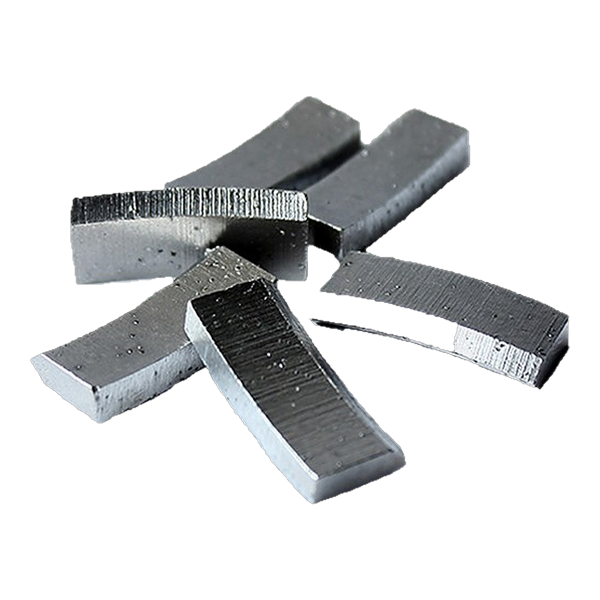
Full Specifications
| Item | HSRDS series diamond segment for core drill bits |
|---|---|
| Construction | Hot pressed and sintered diamond in a cobalt based metal bond |
| Drill diameter range | 20 mm to 600 mm (0.8 in to 23.6 in), standard listing 2 in to 9 in |
| Segment length | 14, 16, 19, 20 and 24 mm, matched to diameter and slot spacing |
| Wall thickness | 3.0, 3.2, 3.5, 4.0, 4.5 and 5.0 mm |
| Segment height | 7, 8 or 10 mm, quoted as 7/8/10 on the size table |
| Diamond depth | 0.25 in (6.35 mm) standard; other depths to drawing |
| Teeth per bit | 2 to 40, set by diameter |
| Profile | Flat, roof, turbo, Arix type |
| Bond hardness | Soft, medium, hard and extra hard, matched to material abrasiveness |
| Diamond grit | 30/40 standard for concrete; 40/50 and 60/80 available |
| Diamond concentration | 12.5 to 20 percent, stated per order |
| Joint method | Laser welded for dry and heavy rebar work; silver brazed for wet cutting |
| Packing | Sealed bag by size, then export carton; approx. 20 kg per carton |
| Certification | ISO 9001 quality system, CE; finished bits carry the EN 13236 marking |
| MOQ | 200 pieces per size, mixed sizes accepted |
| Lead time | 20 to 30 days after drawing confirmation |
Dimensions are confirmed against your barrel drawing before production. Where the chart does not fit, the segment is made to your length, thickness and radius instead.
How a Diamond Segment Cuts a Core
A core bit cuts a ring, not a hole. The segments sit on the rim of a steel tube, the rim is pressed to the surface, and the bit removes an annulus and leaves a solid core in the middle. A 100 mm bit with a 3.5 mm wall cuts from 100 mm down to 93 mm, about 13 percent of the area of the full circle. That is why coring is fast and low powered: most of the material is never touched.
The segment carries the diamond, the backing carries the load
A segment is two parts in one block. The upper 6.35 mm carries diamond dispersed through sintered metal powder; the base below it is the same metal without diamond, and it exists so the joint can be made without cooking the diamond. Diamond graphitises and the bond softens well below steel welding heat, so the joint is made in the diamond free zone and the heat is kept there.
That is also why a segment is replaced with about 1 mm of diamond layer still showing. Past that point it polishes instead of cutting, the load climbs, and the joint overheats.
Why the segments are spaced apart
Water has to reach the cutting face and slurry has to leave it. A continuous crown would leave nowhere for either to go, so the segments are separated by slots that act as water channels. Across the standard range they cover roughly 51 to 64 percent of the crown circle; the rest is slot.
What wears out
Three things, in this order: the diamond layer, the bond around it, and the joint. The bond has to wear back at the rate the diamond dulls, or the segment glazes when the bond is too hard and sheds diamond when it is too soft. The joint fails only when overheated: run dry, run past the diamond layer, or held by a barrel wall too thin to keep the segment flat.
Key Features
1. Geometry matched to the barrel, not to a catalogue number
A segment only works if it seats on the crown without rocking, so arc length, radius and thickness have to belong to one barrel. A segment for a 152 mm four-slot barrel differs from one for a six-slot barrel, though both are quoted as 24 mm long.
2. 6.35 mm diamond layer on a steel backed base
The 0.25 in diamond depth sets how much hole a segment can drill. It is deep enough to keep a free cutting face through most of the height and shallow enough to leave backing thick enough to weld. On a 10 mm segment the split is roughly two thirds diamond layer and one third backing.
3. Bond hardness chosen by material, not by price
The same geometry in a soft bond and a hard bond behaves like two different parts. A hard bond holds diamond in abrasive material such as asphalt, where a soft bond would shed it before it had done any work. A soft bond keeps the face open in hard dense concrete, where a hard bond glazes within the first metre.
4. Four crown profiles for four starting conditions
Flat for a stable rig and a known surface, roof for starting without a guide, turbo for abrasive material that needs an open face, Arix type for hard aggregate on a rigid machine.
5. One bond family across 20 mm to 600 mm
A distributor can build a range from a 20 mm tile bit to a 600 mm bridge bit from one supplier, with teeth counts from 2 to 40, so drilling behaviour stays consistent across the range and one bond specification covers the catalogue.
Diameter, Teeth and Segment Size
The chart below is the standard build: for each barrel diameter it gives the number of segments and the segment size. Height is quoted as 7/8/10, meaning the same length and thickness are available in 7 mm, 8 mm and 10 mm. Find your size here, then confirm radius and slot spacing against the barrel.
| Drill dia. (mm) | Teeth | Segment L x W x H (mm) |
|---|---|---|
| 20 | 2 | 19 x 3.0 x 7/8/10 |
| 22 | 2 | 20 x 3.0 x 7/8/10 |
| 25 | 3 | 14 x 3.0 x 7/8/10 |
| 28 | 3 | 14 x 3.0 x 7/8/10 |
| 32 | 4 | 16 x 3.0 x 7/8/10 |
| 38 | 4 | 20 x 3.2 x 7/8/10 |
| 42 | 4 | 20 x 3.5 x 7/8/10 |
| 48 | 4 | 24 x 3.5 x 7/8/10 |
| 52 | 4 | 24 x 3.5 x 7/8/10 |
| 55 | 4 | 24 x 3.5 x 7/8/10 |
| 60 | 5 | 24 x 3.5 x 7/8/10 |
| 65 | 6 | 24 x 3.5 x 7/8/10 |
| 70 | 6 | 24 x 3.5 x 7/8/10 |
| 78 | 6 | 24 x 3.5 x 7/8/10 |
| 83 | 7 | 24 x 3.5 x 7/8/10 |
| 87 | 7 | 24 x 3.5 x 7/8/10 |
| 92 | 8 | 24 x 3.5 x 7/8/10 |
| 102 | 9 | 24 x 4.0 x 7/8/10 |
| 107 | 9 | 24 x 4.0 x 7/8/10 |
| 110 | 9 | 24 x 4.0 x 7/8/10 |
| 120 | 10 | 24 x 4.0 x 7/8/10 |
| 127 | 10 | 24 x 4.0 x 7/8/10 |
| 132 | 10 | 24 x 4.0 x 7/8/10 |
| 140 | 11 | 24 x 4.0 x 7/8/10 |
| 152 | 12 | 24 x 4.0 x 7/8/10 |
| 160 | 12 | 24 x 4.0 x 7/8/10 |
| 168 | 13 | 24 x 4.0 x 7/8/10 |
| 180 | 13 | 24 x 4.5 x 7/8/10 |
| 194 | 14 | 24 x 4.5 x 7/8/10 |
| 203 | 14 | 24 x 4.5 x 7/8/10 |
| 212 | 15 | 24 x 4.5 x 7/8/10 |
| 219 | 16 | 24 x 4.5 x 7/8/10 |
| 245 | 18 | 24 x 4.5 x 7/8/10 |
| 273 | 20 | 24 x 4.5 x 7/8/10 |
| 300 | 24 | 24 x 5.0 x 7/8/10 |
| 350 | 28 | 24 x 5.0 x 7/8/10 |
| 400 | 28 | 24 x 5.0 x 7/8/10 |
| 450 | 30 | 24 x 5.0 x 7/8/10 |
| 500 | 32 | 24 x 5.0 x 7/8/10 |
| 550 | 35 | 24 x 5.0 x 7/8/10 |
| 600 | 40 | 24 x 5.0 x 7/8/10 |
Profile Options
Profile is the shape of the cutting face. It changes how the bit starts, how the face clears and how the hole edge looks. It does not change the fit.
| Profile | Cutting face | How it behaves | Where it suits |
|---|---|---|---|
| Flat | Full flat crown | Contact from the first turn, steady load, smooth hole wall | Reinforced concrete on a fixed rig, marble, general coring |
| Roof | Raised or chamfered crown | Starts on a small area, so the bit does not walk on a smooth floor | Hard dense concrete, hand held rigs, starting without a guide |
| Turbo | Grooved or slotted face | Open face clears slurry and keeps the segment cool, ragged hole edge | Abrasive concrete, asphalt, block and brick, green concrete |
| Arix type | Diamond in an oriented pattern | Many small cutting points, low load per point, needs a rigid machine | Hard aggregate, rebar dense sections, high production coring |
Wall Thickness and Barrel Fit
Three dimensions decide whether a segment fits: thickness against wall, radius against barrel, and length against slot. Thickness is the one that goes wrong most often, because a segment narrower than the wall leaves an unwelded ledge, and one wider than the wall cuts a kerf the barrel cannot follow.
| Drill dia. (mm) | Segment thickness | Typical barrel wall | What to check |
|---|---|---|---|
| 20 – 32 | 3.0 mm | 2.5 mm | Small barrels distort easily; do not over-clamp when welding |
| 38 – 55 | 3.2 – 3.5 mm | 2.75 – 3.0 mm | Check the barrel is round; out of round shows as uneven wear |
| 60 – 92 | 3.5 mm | 3.0 mm | Most common range; hold thickness tolerance at 0.1 mm |
| 102 – 160 | 4.0 mm | 3.25 mm | Slot width must clear the segment; check slot roots for cracks |
| 168 – 245 | 4.5 mm | 3.5 mm | Barrel stiffness matters; a thin wall bends and lifts the segment |
| 273 – 400 | 4.5 – 5.0 mm | 3.75 mm | Use a welding fixture, not freehand alignment |
| 450 – 600 | 5.0 mm | 4.0 mm | Check each segment seats before welding the full ring |
Measure the wall with a caliper at four points around the crown, not at one. A barrel re-tipped twice is often thinner at the slots than between them, and a wall that varies by more than 0.2 mm seats some segments badly.
Diamond Depth and Segment Life
Segment life is quoted in metres of hole drilled, because that is the unit the customer pays in. It is not fixed: material, aggregate, rebar density, water supply, rig rigidity and feed all move it. What the segment controls is how much cutting edge is available before the tool comes off.
With a 6.35 mm diamond layer, a 10 mm segment has about 63 percent of its height as cutting material. As a reference that is commonly 120 to 250 m of 100 mm hole in reinforced concrete, less in flint or hard aggregate, more in soft block. A 7 mm segment carries the same diamond depth, so it has a shorter working window at a lower price per piece.
| Segment height | Diamond layer | Steel backing | Best for |
|---|---|---|---|
| 7 mm | 6.35 mm | 0.65 mm | Hard dense concrete where a free cutting face matters more than total life |
| 8 mm | 6.35 mm | 1.65 mm | General purpose range, a compromise between life and cutting feel |
| 10 mm | 6.35 mm | 3.65 mm | Abrasive concrete and high production work where re-setting the bit costs more than the segment |
Running Parameters
Spindle speed follows diameter, because what wears a segment is the peripheral speed at the crown. The ranges below are calculated from 1.5 to 2.5 metres per second at the segment, a normal band for diamond coring in concrete. They are arithmetic, not a machine recommendation: the rig maker’s rating and the material decide the final setting.
| Drill dia. (mm) | At 1.5 m/s | At 2.5 m/s | Common working band (rpm) |
|---|---|---|---|
| 20 | 1430 rpm | 2390 rpm | 1400 – 2400 |
| 25 | 1150 rpm | 1910 rpm | 1150 – 1900 |
| 32 | 895 rpm | 1490 rpm | 900 – 1500 |
| 50 | 575 rpm | 955 rpm | 570 – 950 |
| 76 | 375 rpm | 630 rpm | 375 – 630 |
| 100 | 285 rpm | 480 rpm | 285 – 480 |
| 150 | 190 rpm | 320 rpm | 190 – 320 |
| 200 | 145 rpm | 240 rpm | 145 – 240 |
| 300 | 95 rpm | 160 rpm | 95 – 160 |
| 400 | 72 rpm | 120 rpm | 72 – 120 |
| 500 | 57 rpm | 95 rpm | 57 – 95 |
Two rules hold across the range. Water has to reach every segment, which on a large bit means more than one water point. And feed has to keep the segment cutting: too light and it polishes, too hard and the rig stalls. A steady note that drops slightly as the segment loads is right; a rising note with no penetration is glaze.
Applications and Materials
Segments are bought by bit makers matching to their own barrel drawing, re-tipping shops matching to whatever barrel arrives, and distributors matching to their market. The material table below decides bond, grit and profile.
| Material | Bond | Grit | Profile that suits |
|---|---|---|---|
| Reinforced concrete | Medium to hard cobalt bond | 30/40 | Flat or turbo |
| Hard dense concrete, high strength | Soft bond, keeps the face open | 30/40 | Roof or flat |
| Abrasive concrete and sandstone | Hard bond, holds diamond longer | 40/50 | Turbo |
| Asphalt and green concrete | Hard bond | 30/40 | Turbo |
| Granite and hard stone | Hard bond, high diamond concentration | 30/40 | Turbo or Arix type |
| Marble and soft stone | Soft free cutting bond | 40/50 | Flat |
| Brick, block and masonry | Soft bond | 30/40 | Roof or turbo |
| Refractory and firebrick | Soft bond | 40/50 | Flat |
For the barrel side of the assembly, see our diamond core drill bits, concrete core drill bits and diamond core drill bits set. For cutting the same concrete with a circular machine, the laser welded diamond blade and brazed concrete diamond cutting blade cover it; for stone shop work the marble cutting blade and turbo granite cutting blade.
Fitting Segments to a Barrel
The order below is the sequence a re-tipping shop should follow. Most segment failures that look like product faults are decided in steps 2, 3 and 7.
- Cut the old segment off, do not pry it. Cut through the weld at the base with a thin disc. Prying lifts the barrel wall, and no amount of care in welding brings it back to round.
- Grind the crown flat and square. The seat has to be flat across the wall and square to the axis. A 0.2 mm gap under a segment is weld depth you have lost.
- Measure the wall at four points. Thickness has to equal wall thickness within about 0.1 mm. A wall varying by more than 0.2 mm around the crown needs a new barrel, not new segments.
- Check for cracks at the slot roots. A crack at a slot root will run into the new weld. A cracked barrel is scrap however good the segments are.
- Trial fit every segment dry. Each one should sit with no rocking and no gap at either end. If it rocks, the radius is wrong and no weld will hold it flat.
- Choose the joint before you start. Laser welding for dry and heavy rebar work, silver brazing for wet cutting. It sets the preparation, the heat and the clamping.
- Clamp the segment centred on the wall. Not on the outside diameter, which is the mistake that leaves an unwelded ledge. Overhang should be equal on both sides.
- Keep the heat at the base. Weld or braze into the joint, not across the diamond face. Let a brazed joint cool in air; quenching cracks it at the fillet.
- Dress the new ring in. Run the first metre at reduced feed on abrasive material so all segments come to the same height before the bit meets hard aggregate.
Troubleshooting
| Symptom | Most likely cause | What to do |
|---|---|---|
| Bit stops cutting, faces look polished | Bond glazed: too hard for the material, feed too light, rpm too high, or no water at the face | Open the face on block or brick for 20 to 30 seconds, then change the bond or raise the feed |
| Segment wears away fast, diamond still sharp | Bond too soft for abrasive material, or water washing the bond away | Move one grade harder in bond, reduce water to a steady flush |
| Segment comes off the barrel | Joint overheated: run dry on a brazed bit, or run past the diamond layer into the backing | Replace at about 1 mm of diamond left, specify laser welded if the bit runs dry |
| One or two segments wear much faster | Barrel out of round, or a segment seated proud on a crown that was not ground flat | Check runout, re-grind the crown, dress the ring in before production work |
| Bit grabs and stalls in the hole | Segment wider than the barrel wall, so the kerf closes behind the barrel | Match thickness to wall, check the barrel has not been reamed undersize |
| Barrel cracks at a slot | Wall too thin for the segment width, or weld heat concentrated at the slot root | Step up wall thickness or reduce segment width; scrap the barrel |
| Bit wanders on start-up | Flat crown on a smooth surface, or the rig is not anchored | Use a roof profile, an anchor and a guide plate for the first 10 mm |
Frequently Asked Questions
- What is a diamond segment for core drill bits?
- It is the cutting block welded or brazed around the rim of a core drill bit barrel, and the only part of the bit that touches the concrete. Each segment cuts an arc of the annular kerf, so a 100 mm bit with nine segments cuts nine arcs at once. Segments are supplied loose to bit makers, to re-tipping workshops and to distributors who stock them as a wear part.
- What do the numbers 24 x 3.5 x 10 mean on a segment?
- They are length, wall thickness and height in millimetres, always in that order. 24 mm is the arc length on the barrel crown, 3.5 mm is the thickness that becomes the kerf and must match the barrel wall, and 10 mm is total height, of which about 6.35 mm is diamond bearing layer and the rest is steel backing that the weld needs. A segment listed as 24×3.5×7/8/10 is the same part in three heights.
- How many teeth should my core bit have?
- Teeth count is set by diameter, because the segments must cover enough crown to cut evenly without blocking the flush. On our standard range it runs from 2 teeth at 20 and 22 mm, 4 at 32 to 55 mm, 6 at 65 to 78 mm, 9 at 102 to 110 mm, 12 at 152 and 160 mm, 20 at 273 mm and 40 at 600 mm. Across that range the segments cover roughly 51 to 64 percent of the crown circle.
- What does the 0.25 inch diamond depth mean?
- It is how deep the diamond impregnation runs into the segment, measured from the cutting face towards the weld. 0.25 inch is 6.35 mm. On a 10 mm segment that leaves about 3.65 mm of steel backing, which is what the weld keys into and what keeps the barrel from being ground away. Below about 1 mm of diamond left, the segment cuts steel instead of stone and the joint overheats.
- Flat, roof, turbo or Arix type, which profile do I need?
- Flat is the general purpose crown: full contact from the first turn, steady, best on concrete and stone with a stable rig. Roof starts on a small area so the bit does not walk, and suits hard dense material. Turbo opens the face and clears slurry, for abrasive concrete, asphalt and block. Arix type sets diamond in an oriented pattern for many small cutting points on a rigid machine in hard aggregate.
- Can I re-tip a worn core bit with new segments?
- Yes, and it is routine. Old segments are cut off rather than pried off, because prying bends the barrel and a bent barrel never runs true again. The crown is then ground flat and square, the wall is measured, and new segments go on. Check the barrel for cracks at the slot roots and for wall thinning: a cracked barrel will crack again beside the new segment.
- Laser welding or brazing, which joint should I use?
- Laser welding fuses the segment base into the barrel wall and holds its strength to a much higher temperature, so it is the joint for dry cutting and heavy rebar work. Silver brazing is a lower temperature joint and is normal on wet bits, where water keeps it cool. A brazed segment run dry will let go, and it will let go suddenly.
- Why did a segment come off the barrel?
- Almost always heat at the joint, from running a brazed bit dry or from a segment worn past its diamond layer so the steel backing grinds the concrete. Two other causes are worth checking: a barrel wall too thin for the segment width, which flexes under load, and a segment seated on a crown that was not ground flat, so the weld caught one edge. Read the failed face before cleaning it up.
- My bit stopped cutting and the segments look polished, why?
- The bond has glazed. The diamond is still there but blunt, and the metal around it has been polished instead of wearing back, so the segment rubs rather than cuts. Causes are a bond too hard for the material, feed too light, rpm too high, or water not reaching the kerf. Open the face on block or brick for 20 or 30 seconds, then correct the bond or the feed.
- What rpm should I run a core drill bit at?
- Rpm follows diameter, because what matters is peripheral speed at the segment. At 1.5 to 2.5 metres per second that is roughly 1430 to 2390 rpm at 20 mm, 570 to 950 rpm at 50 mm, 286 to 477 rpm at 100 mm, 143 to 239 rpm at 200 mm and 57 to 95 rpm at 500 mm. Those figures are arithmetic from the peripheral speed, not a machine recommendation.
- Do these segments fit any brand of core drill bit?
- The segment has to match the barrel, not the brand. Three things decide fit: wall thickness, which must equal segment thickness within about 0.1 mm; crown radius, which must match the barrel diameter so the segment seats without rocking; and slot position, which sets the maximum segment length. Send the barrel outside diameter, wall thickness, slot width and old segment size and we match from that.
- What is the minimum order and can you make segments to my drawing?
- Standard MOQ is 200 pieces per size, and mixed sizes in one order are accepted so a distributor can build a full range. Lead time is 20 to 30 days after drawing confirmation. We make to drawing on length, thickness, height, radius, diamond depth, bond hardness, grit and diamond concentration, and print your grade marking. Send a sample or a dimensioned sketch.