Full Specifications
| Item number | Diameter | Segment width | Segment height | Arbor hole |
|---|---|---|---|---|
| 4HHPST | 4 in / 100 mm | 1.0 mm | 5 / 7 / 8 / 10 mm | 16 / 20 / 22.23 mm |
| 4.5HHPST | 4.5 in / 115 mm | 1.2 mm | 5 / 7 / 8 / 10 mm | 16 / 20 / 22.23 mm |
| 5HHPST | 5 in / 125 mm | 1.4 mm | 5 / 7 / 8 / 10 mm | 20 / 22.23 mm |
| 6HHPST | 6 in / 150 mm | 1.4 mm | 5 / 7 / 8 / 10 mm | 20 / 22.23 mm |
| 7HHPST | 7 in / 180 mm | 1.4 mm | 5 / 7 / 8 / 10 mm | 22.23 / 25.4 mm |
| 8HHPST | 8 in / 200 mm | 1.6 mm | 5 / 7 / 8 / 10 mm | 22.23 / 25.4 mm |
| 9HHPST | 9 in / 230 mm | 1.6 mm | 5 / 7 / 8 / 10 mm | 22.23 / 25.4 mm |
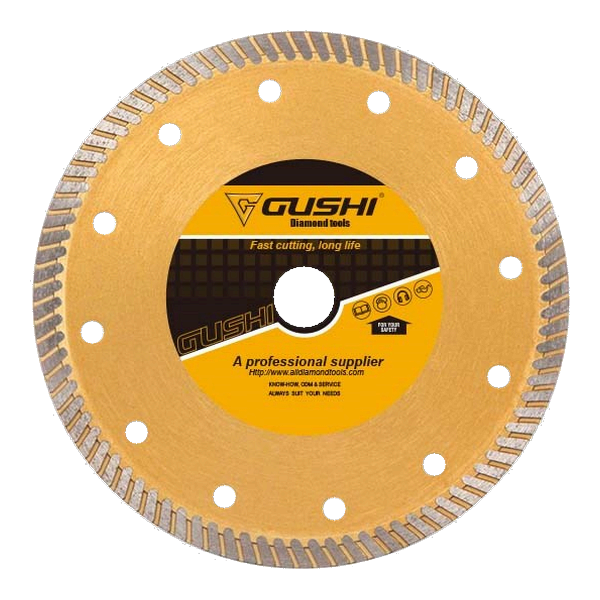
Seven sizes as published for this series. Production is hot pressed and sintered, the rim is a continuous turbo band rather than separate segments, and the core is available silent or non silent at the buyer’s choice. Dry and wet cutting are both listed. No speed rating, core thickness or diamond specification is published with this table.
Reading the table from the 1.0 mm row
Start at the smallest row, because that is where the design was decided. A 100 mm blade at 1.0 mm. Every other row is the factory trying to keep that kerf while the disc grows, and it only partly succeeds, which is exactly what the numbers show.
From 100 to 230 mm the diameter grows by 130 per cent. The width grows by 60 per cent, from 1.0 to 1.6. Divide one by the other and the ratio of diameter to kerf rises from 100 at the 4 inch to 144 at the 9 inch. In plain terms the blade gets proportionally more slender as it gets bigger, which runs against the usual instinct that bigger tools are heavier-built.
The ladder is not smooth, though, because width can only move in whole tenths of a millimetre. Read the ratio down the table and it falls first, to 96 at 115 mm and 89 at 125 mm, before it climbs. That dip is the whole story. The 125 mm size is the most heavily built blade in the family relative to its own diameter, and everything above it is progressively lighter. The factory did not pick 125 mm by accident: it is the size that has to survive being pushed through a hard tile on a bench saw by an operator who is not being gentle.
What that means for a buyer is that the seven sizes are not seven copies of one blade. They are one blade at three levels of resolve, and the top of the range is a different proposition from the bottom.
What the kerf actually removes
Kerf is easy to read as a specification and easy to ignore as a cost. Take a cut 10 mm deep and one metre long, and multiply. At 1.0 mm the cut turns 10 cubic centimetres of tile into dust. At 1.2 mm it is 12. At 1.4 mm it is 14. At 1.6 mm it is 16. That is arithmetic on the width column, not a measured figure, and it is the honest way to see the range: the largest blade in the family removes 60 per cent more material per metre than the smallest one, for the same length of cut.
Every cubic centimetre of that has to be ground by diamond, accelerated by the motor and carried out of the slot. The slot is the second half of the story. A cut 1.0 mm wide and 10 mm deep leaves a channel with a cross section of 10 square millimetres for the water and the swarf to climb, and it has to climb it while the rim is passing overhead at working speed. Narrow the kerf and the grinding force drops, but the exit gets tighter.
That trade explains the shape of the range. A thin kerf is comfortable where cuts are shallow and the rim leaves the work often, which is the case on tile and thin stone. It becomes awkward where the blade is buried in a deep cut for a long arc, because the swarf has nowhere to go and starts to be re-ground. This blade is listed for tile, marble and granite, and those are the jobs where a 1.0 mm kerf is an advantage rather than a liability.
Two plateaus in the width column
Look at the width column as a sequence rather than as seven facts. It moves at every step for the first three sizes, 1.0, 1.2, 1.4, and then it stops. The 150 mm stays at 1.4. The 180 mm stays at 1.4 as well. Then it moves again, to 1.6, and holds for 200 and 230.
Two plateaus, one covering a 55 mm span of diameters and one covering 30 mm. This is how a rolled and ground steel plate behaves: core thickness comes in steps, and neighbouring diameters share a blank because tooling a new thickness for one size is not worth it. The consequence for the buyer is more useful than the reason.
It means the 150 and the 180 cut an identical slot. If a job needs more reach than a 6 inch gives, the 7 inch adds 30 mm of diameter and 15 mm of radius without adding a single tenth of a millimetre to the kerf. The same is true of the 200 and the 230. Where the cut is width-critical, which on tile it usually is, the larger size in each pair is free in kerf terms.
The other side of the same fact is that the step from 180 to 200 is the one place where a buyer gets both more reach and a wider cut at once, and it happens at the point where the bore menu also changes. That combination is worth noticing before an order is placed.
Four segment heights at every single size
The height column does not vary at all. All seven sizes are offered at 5, 7, 8 or 10 mm. In most families the height menu narrows as the diameter grows, because a large blade has more rim to pay for and the factory trims the options. Here it does not, and that is the most unusual thing in the table.
The four options are not evenly spaced, and the spacing says something. There is no 6 mm and no 9 mm. The steps are 5, then 7, then 8, then 10. Read that as three products rather than four settings: 5 mm is the job blade that a tiler buys by the box, 7 and 8 mm are the two working middle options where most orders land, and 10 mm is the blade for a shop that does not want to change discs.
Height is wear reserve, and it is the only way to buy more of it here. A 10 mm segment carries twice the diamond-bearing depth of a 5 mm one at an identical 1.0 to 1.6 mm kerf, so the cut does not change at all when the height changes. How much longer it lasts is a function of the bond and of what is being cut, and the listing does not give the bond, so this page will not put a number on it.
One structural consequence is worth stating plainly. A taller segment stands further above the core, so the rim is a taller stack on the same thin plate. That is a reason to keep the height matched to the job rather than ordering the tallest option by default.
Why the rim is continuous instead of segmented
A segmented rim cuts by hitting the work with separate blocks. Each block enters, loads the plate, and leaves. On a normal 2.5 mm core that is a tolerable rhythm. On a 1.0 mm core it is a bending load applied and released hundreds of times a second to a piece of steel with very little stiffness in the direction that matters.
A continuous turbo rim keeps abrasive in the cut at all times. There is no moment when the blade is between teeth, so the load on the plate is steady rather than pulsed, and a thin core can survive it. That is the mechanical reason this family pairs ultra thin with turbo rather than with segments, and it is also why the listing can claim a smooth cut: a rim that never leaves the work does not hammer the edge it is cutting.
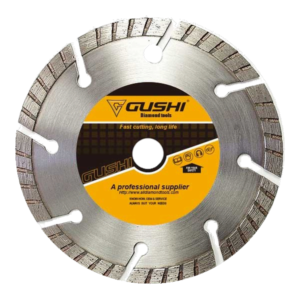
The angled grooves across the band are not decoration. They break the continuous rim into overlapping lands so that the rim does not skate on a polished surface at the start of a cut, they carry swarf sideways out of the slot, and they interrupt the contact pattern so that the rim is always cutting on a fresh edge rather than polishing a groove into itself.
The cost of the design is that a continuous rim has no open gullet. Debris that a segmented blade would throw clear has to travel along the grooves and out. That is why feed rate and water matter more on this blade than on a segmented one, and why a rim that is fed too fast glazes instead of cutting.
What chip free really depends on
The listing states a narrow gap and less chipping, and that the blade will not damage the edge of a ceramic tile. It is a fair claim for the design, and it is not a guarantee that follows the blade around. Chip free cutting is a property of a system, and the blade is one part of it.
The first part is runout. A blade that does not sit flat cuts on one side of the rim only, and the side load is what lifts glaze. A burr on the flange, a worn collar or a bore that is a loose fit on the spindle will each produce that condition on their own, and none of them is the blade’s fault.
The second part is exit. Every cut breaks out somewhere, and at the exit the material ahead of the rim has nothing behind it to support it. Supporting the tile close to the line, cutting onto a sacrificial bed, or running the cut from the face that has to stay good are technique decisions that decide the result more often than the blade does.
The third part is feed. A thin rim cuts by grinding, so it wants a steady advance. Pushing loads it sideways, and a 1.0 mm plate flexes sideways readily. A blade that is being forced will wander, and a wandering thin blade chips on the side that is being pushed into the tile, not on the leading edge.
Silent core or plain core
The listing offers silent and non silent cores at the buyer’s choice, which is a real decision rather than a catalogue detail. A plain steel disc has a resonance of its own, and it sings at it. The thinner the plate, the higher and the more penetrating that note, so an ultra thin blade is naturally a louder object than a heavy one.
A silent core is a core with narrow cuts through the plate that interrupt the path the vibration travels around the disc. The disc is broken into arcs that no longer share one frequency, so the ring is damped. It is the same principle as a slit in a cymbal and it works the same way.
The cost is honest and worth knowing. Every one of those cuts is a stress riser in a plate that is already thin, and every one is a slot that can collect slurry. On a well maintained machine the trade is worth it; on a machine with runout, a slitted thin core is more fragile than a plain one.
Where the choice actually gets made is on the site rather than at the bench. Interior tiling in an occupied building, hospital and school work, and night shifts are the jobs where the damped core earns its place. On a new build with nobody to disturb, the plain core is the cheaper and slightly more robust answer.
Dry or wet, and what the thin core changes
Both are listed, so both are available, and the choice belongs to the machine and the site. What changes on a blade this thin is where the heat goes.
A heavy blade has enough steel to soak up heat and spread it over a large area. A 1.0 mm plate has almost nothing. Heat generated at the rim stays near the rim, and the exposed edge of the plate, the part not covered by the segment, is the thinnest steel on the whole tool. That edge is where a thin blade distorts first, and distortion in steel is not reversible: a warped plate stays warped, and a warped plate cuts on one side and chips.
Water does three things on this blade rather than one. It cools the rim, it flushes swarf out of a slot that has very little room in it, and it lubricates the sides of the plate against the walls of the cut. On tile work with a bench saw the water is normally already there, and it is the difference between a blade that lasts its segment and one that glazes halfway through.
Dry cutting is listed and is entirely practical on short runs and on sites with no water supply. The rule that matters is not to let the blade sit in the cut while running. A thin disc held stationary in a slot with the motor turning builds heat in one small arc and has no way to shed it.
Choosing between the seven
Four questions settle the order, and the table answers them in a fixed sequence.
First the spindle. The bore column splits the range into three groups: 16, 20 or 22.23 mm for the 100 and 115; 20 or 22.23 mm for the 125 and 150; 22.23 or 25.4 mm for the 180, 200 and 230. A machine with a 16 mm spindle cannot take anything above 115 mm, and this is the constraint that decides the range before any question about the work is asked.
Second the depth. The ceiling is the radius: 50 mm at 100 mm diameter, 65 at 125, 90 at 180, 115 at 230. That is geometry, not a rating, and the usable figure is smaller because the flange and the guard occupy part of the radius. Where the required depth sits close to the radius, the next size up is the honest choice rather than a deeper single pass.
Third the volume. This is the only question the height column answers, and it is why four options exist at every size. Occasional work takes the 5 mm. Continuous production takes the 10 mm.
Fourth the noise. That is the silent or plain core decision, and it is made by where the saw is used rather than by what it cuts.
What to send with an enquiry
Six lines make a quotation exact instead of indicative: the machine make and model, the spindle bore measured rather than assumed, the material list, the depth of cut, whether water is available, and the monthly quantity by size.
The two that get skipped are the ones that come back as a problem. Bore is skipped because the buyer assumes the machine is standard, and it is the one dimension that cannot be adjusted on site without a bushing, which on a thin blade is the last thing wanted. Height is skipped because it looks like a detail, and it is the only column that changes what the order costs without changing what it cuts.
If the material list includes something dense and fired, say so. The listing covers ceramic, tile, marble, granite and other hard material, and a rim that is right for a soft glazed wall tile is being asked to do a different job on a fully vitrified floor tile. Naming the material is what lets the height and the core be chosen for it.
Private Label and Export Supply
The range is supplied under the GUSHI mark or made to order under a buyer’s own. What can be set is the core printing on both faces, the item numbering, the bore within each size group, the segment height where every size offers four options, the silent or plain core, and the sleeve or carton print.
One detail is worth flagging because it catches first orders. Because the height menu is four options at every diameter, an order that does not name a height per size will be filled at whatever the factory runs, and a mixed pallet can arrive with a different reserve on the 4 inch than on the 9 inch. Naming the height per size in the purchase order is the difference between a consistent line and a pallet that has to be sorted at the warehouse.
For the rest of the cutting range, the thin rim J slot tile blade covers tile work where a slotted plate is wanted instead of a turbo band, the turbo granite blade covers counter and slab work, the general purpose diamond saw blade covers masonry where the kerf is not the constraint, the mesh turbo blade covers dry cutting where dust control decides the rim, and the segmented turbo cup wheel covers the grinding that follows a cut.
Frequently Asked Questions
- What is a super thin turbo diamond saw blade?
- A hot pressed and sintered blade whose diamond rim is a continuous band with angled turbo grooves rather than a row of separate segments, on a core thin enough that the whole kerf is 1.0 to 1.6 mm. It is listed for ceramic, tile, marble, granite and other hard materials, dry or wet.
- What sizes are available?
- Seven: 100, 115, 125, 150, 180, 200 and 230 mm, which is 4, 4.5, 5, 6, 7, 8 and 9 inch. Item numbers run from 4HHPST to 9HHPST. Segment width goes 1.0, 1.2, 1.4, 1.4, 1.4, 1.6 and 1.6 mm across those seven sizes.
- What materials will it cut?
- The listing gives ceramic, tile, marble, granite and other hard material. Those are dense, brittle materials that want a narrow kerf and a rim that stays in contact with the work. It is not listed for steel, asphalt or green concrete, and a bond set for fired clay and stone is the wrong bond for those.
- Why is the blade only 1.0 to 1.6 mm wide?
- Because width is what the cut costs. A narrower kerf removes less material, so the motor does less work, the dust is reduced and the edge is loaded less. The price is stiffness: a 1.0 mm core has very little steel behind the rim, so the blade depends on running true and on being fed steadily.
- What is the segment height choice for?
- It is wear reserve. Every one of the seven sizes is offered at 5, 7, 8 or 10 mm. A 10 mm segment carries twice the diamond-bearing depth of a 5 mm one at the same 1.0 to 1.6 mm kerf, so it lasts longer in the same cut. How much longer depends on the bond, which the listing does not give.
- Which arbor bore do I need?
- The 100 and 115 mm sizes are listed at 16, 20 or 22.23 mm. The 125 and 150 mm are listed at 20 or 22.23 mm. The 180, 200 and 230 mm are listed at 22.23 or 25.4 mm. Measure the spindle rather than assuming, because a bore that is even slightly loose lets a thin blade orbit.
- Will it chip tile?
- The listing states a narrow gap with less chipping that will not damage the edge of a ceramic tile. Whether an individual cut stays clean depends on the blade running true, on the flange being flat, and on feed. Support the tile close to the cut and let the rim cut rather than pressing the plate sideways.
- Should it be cut wet or dry?
- The listing gives both. A core this thin has almost no steel to absorb heat, so the rim and the exposed plate edge take it instead. Water cools, flushes the narrow slot and lubricates. On a machine with no water, keep the passes shallow and never let the blade sit in the cut running.
- What is a silent core?
- The listing offers silent and non silent cores at the buyer’s choice. A silent core has narrow laser cuts that interrupt the path the vibration travels round the disc, so it does not ring on one frequency. The cost is that each cut is a stress riser and a place where slurry can pack.
- How deep will each size cut?
- The ceiling is the radius, so 100 mm reaches 50 mm and 230 mm reaches 115 mm. That is geometry, not a rating. Real depth is less because the flange and the guard take up part of the radius, and any cut that has to go deeper than the blade allows is normally worked from both faces.
- Can it cut porcelain or dekton?
- The listing names ceramic, tile, marble, granite and other hard material, and porcelain is a ceramic. Very dense porcelain and sintered stone are the hardest end of that list and will dull a rim that is fed too fast. Where the whole job is that material, order the size and height for it rather than the general one.
- Can you supply these under our brand?
- Yes. Core printing on both faces, item numbering, the bore per size group, the segment height where a size offers four options, the silent or non silent core, and the sleeve or carton print are all made to order. Send the machine and the material mix and the specification comes back fixed.