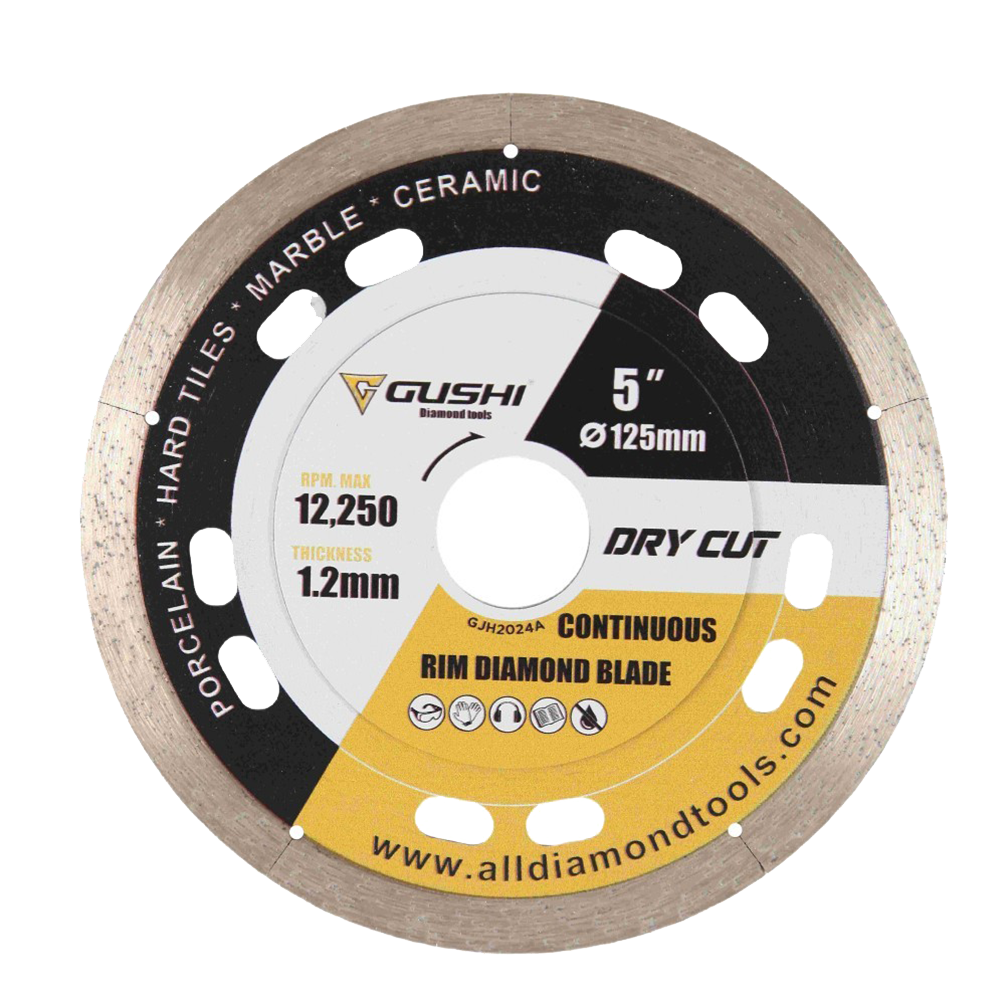
Product Overview
The GUSHI Dry Cutting Diamond Blade is a hot-pressed sintered diamond saw blade engineered for fast, dry cutting of concrete, brick, block, masonry, granite and tile with hand-held angle grinders and cut-off saws. Available in 4″ (105mm), 4.5″ (115mm), 5″ (125mm), 7″ (180mm) and 9″ (230mm) diameters with 16/20/22.23mm arbors, it uses industrial 40/50 mesh diamond grit in a cobalt-nickel matrix to deliver up to 100× the life of abrasive discs. Manufactured by Huzhou Gu’s Imp. & Exp. Co., Ltd. (founded 2004, ISO 9001:2015, CE and EN13236 certified), it is exported to 20+ countries with an OEM MOQ of 500 pieces.
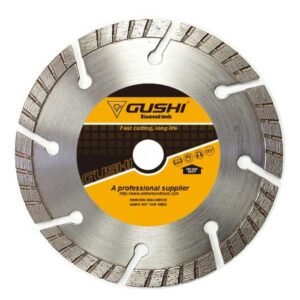
Every blade core is cut from 65Mn spring steel, laser-stress-relieved and computer-balanced to a runout tolerance of 0.1mm, so the blade runs true at speeds up to 13,300 RPM. The segmented rim geometry — with 8 to 16 segments depending on diameter — creates deep gullets that pull cutting debris away from the kerf, keep the segment edge cool, and prevent glazing on abrasive materials.
GUSHI is one of only 23 Chinese companies that won the U.S. anti-dumping case for diamond blades, exporting under a competitive 6.2% duty rate, and operates a production capacity of 100,000 sets per month. The same factory that supplies your local distributor’s private label also builds the GUSHI-branded range — quality, pricing and lead times are identical.
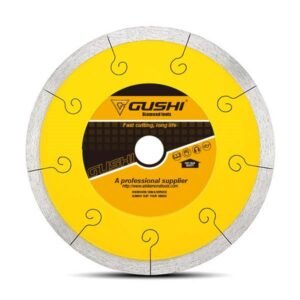
Dry cutting is a convenience-first technology: no water supply, no slurry cleanup and no freeze risk on winter job sites. If you cut tile, porcelain or engineered quartz, ask about our turbo and continuous-rim versions, or the wet-cutting range, for a chip-free edge.
Full Specifications
| Parameter | Specification |
|---|---|
| Product Type | Dry cutting diamond blade (segmented / turbo / continuous rim) |
| Available Diameters | 4″ (105mm), 4.5″ (115mm), 5″ (125mm), 7″ (180mm), 9″ (230mm); up to 14″ (350mm) on request |
| Arbor Size | 16 / 20 / 22.23mm (bushing adapters included) |
| Segment Technology | Hot-pressed sintering; laser-welded option for reinforced concrete |
| Segment Height | 7 / 10 / 12mm by specification |
| Segment Thickness | 1.8 – 2.8mm (increases with diameter) |
| Segment Count | 8 (4″) to 16 (9″); up to 24 (14″) |
| Diamond Grit | Industrial diamond, 40/50 mesh (concentration tuned to application) |
| Bond Type | Metal bond — cobalt-nickel matrix |
| Core Material | 65Mn spring steel, laser stress-relieved |
| Runout Tolerance | ≤ 0.1mm (computer-balanced) |
| Max Speed — 4″ | 13,300 RPM |
| Max Speed — 4.5″ | 12,200 RPM |
| Max Speed — 5″ | 10,200 RPM |
| Max Speed — 7″ | 8,500 RPM |
| Max Speed — 9″ | 6,600 RPM |
| Cutting Method | Dry (wet use optional — extends segment life 20–40%) |
| Suitable Materials | Concrete, reinforced concrete, brick, block, masonry, granite, sandstone, tile, marble |
| Standards & Certifications | ISO 9001:2015, CE, EN13236, RoHS; SGS inspection available |
| Blade Color | Green / blue / black (custom per OEM) |
| Packaging | Single sleeve, blister card, retail box or bulk carton |
| OEM MOQ | 500 pieces per size (mixed sizes negotiable) |
| Sample Policy | Available at cost price + shipping |
| Payment Terms | L/C, T/T, Western Union, PayPal |
| Port of Loading | Shanghai or Ningbo, China |
| Lead Time | 20–30 days after deposit |
How the Dry Cutting Diamond Blade Works
1. Sintered Diamond Segments Do the Cutting
Each segment is a composite of industrial diamond grit (40/50 mesh) and powdered cobalt-nickel metal, compressed and sintered at high temperature. The metal matrix holds each diamond particle in place until it dulls, then erodes to expose a fresh cutting edge — a continuous self-sharpening cycle that keeps the blade aggressive for its entire life. The matrix hardness is tuned per application: softer bond for hard granite, harder bond for soft brick.
2. Segmented Rim Geometry Manages Heat and Debris
The cutting rim is interrupted by 8–16 deep gullets. In dry operation, friction between the segment and the workpiece generates heat at the cut line; the gullets allow the blade to cool on every rotation and give chips a path out of the kerf. This is what makes sustained dry cutting possible without the core overheating, warping or cracking.
3. Thermal Stress Is Engineered Out of the Steel Core
The 65Mn spring steel core is laser-cut with expansion slots and stress-relieved during manufacturing, then computer-balanced to 0.1mm runout. At 13,300 RPM, even a small imbalance creates vibration that wears the spindle bearing and degrades cut quality; the relieved core absorbs differential expansion between the hot cutting edge and the cool center, keeping the blade flat and true.
Key Features Explained
Sintered Metal-Bond Segments with 40/50 Mesh Diamond
Industrial-grade diamond grit is used at a concentration matched to the target material. Compared to cheap electroplated blades, the sintered bond holds grit 8–10× longer and survives the impact loads of masonry cutting. The result is a working life of roughly 300–500 linear meters on a 4–5″ blade and 600–1,000 linear meters on 7–9″ blades.
Deep Gullets for Dry-Cut Cooling
Gullet depth and segment count are calculated per diameter to maximize chip clearance without weakening the rim. Debris is ejected continuously instead of being re-ground, which is why the blade stays cool enough to cut concrete and brick without water — and why porcelain and quartz should be cut wet with a continuous rim instead.
65Mn Spring Steel Core, Stress-Relieved and Balanced
The core is not a stamped blank — it is heat-treated 65Mn spring steel, laser stress-relieved and balanced to a 0.1mm runout tolerance. Operators running at 13,300 RPM get a smooth, vibration-free cut, no premature spindle wear on the angle grinder, and no blade wobble that produces bell-mouthed kerfs.
EN13236 Safety Compliance
The blade is manufactured and tested in line with EN13236, the European safety standard for diamond tools, covering burst speed, balance and core integrity. Max RPM is marked on every blade core, and each batch can be supplied with an SGS inspection report — documentation your compliance team will want before import.
OEM Flexibility: Bond, Color, Logo, Packaging
The same blade platform is built for distributors and brands. You can specify the segment bond for your local material mix, your brand color, laser-etched or printed logo, and packaging from single sleeves to retail blister cards — at the 500-piece MOQ with a 20–30 day lead time.
Blade Size Selection Guide
Match the blade diameter to your machine and job size. The 22.23mm arbor is the angle-grinder standard; 16mm and 20mm bushings are included.
| Blade Diameter | Typical Machine | Max RPM | Best Application |
|---|---|---|---|
| 4″ (105mm) | 4″ angle grinder | 13,300 | Tile, thin brick, small stone, cutting patch repairs |
| 4.5″ (115mm) | 4.5″ angle grinder | 12,200 | Brick, block, tile, granite — general contractor workhorse |
| 5″ (125mm) | 5″ angle grinder | 10,200 | Concrete slabs, masonry, deeper cuts on stone |
| 7″ (180mm) | 7″ angle grinder | 8,500 | Concrete, curbing, pipes, longer straight cuts |
| 9″ (230mm) | 9″ cut-off saw | 6,600 | Deep concrete cuts, thick masonry, demolition work |
| 12″–14″ (300–350mm) | Hand-held circular / cut-off saw | 3,500–4,500 | Road work, large block, asphalt (custom order) |
Applications & Suitable Materials
Typical Applications
| Application | Recommended Blade Type | Notes |
|---|---|---|
| Concrete slab & driveway cutting | Segmented (dry) | Reduce feed rate when rebar is encountered |
| Brick, block & masonry | Segmented (dry) | Fastest chip removal, best value |
| Granite & natural stone | Turbo (dry/wet) | Serrated rim balances speed and edge quality |
| Ceramic & porcelain tile | Continuous rim (wet preferred) | Minimal chipping; use turbo for speed |
| Concrete pipe & curbing | Segmented 7″–14″ (dry) | Deep gullets handle curved surfaces |
| Demolition & renovation | Segmented (dry) | No water on site — ideal for interior work |
Suitable Materials
| Material | Cutting Performance | Best Blade |
|---|---|---|
| Cured & green concrete | Excellent — fast, clean | Segmented |
| Reinforced concrete (light rebar) | Good — slow feed on steel | Laser-welded segmented |
| Brick, block, cinder block | Excellent — high speed | Segmented |
| Aerated concrete (AAC) | Excellent — very fast | Segmented |
| Sandstone & limestone | Excellent | Segmented / turbo |
| Granite & basalt | Good — slower feed required | Turbo |
| Marble | Good — wet recommended | Continuous rim / turbo |
| Ceramic & porcelain tile | Good — wet recommended | Continuous rim |
| Steel, structural rebar | Not recommended | Use dedicated steel blade |
| Glass | Not recommended | Use diamond glass drill / grinder |
Diamond Blade vs. Abrasive Cutting Disc
Contractors often ask whether to switch from traditional aluminum-oxide abrasive discs to sintered diamond blades for dry cutting. The comparison below is based on 4.5″ blades on the same angle grinder:
| Dimension | GUSHI Dry Cutting Diamond Blade | Abrasive Cutting Disc (Al₂O₃) |
|---|---|---|
| Cutting media | Industrial diamond grit (40/50 mesh) — Mohs 10 | Fused aluminum oxide — Mohs 9 |
| Lifespan | 300–500 linear meters (concrete/brick) | 3–10 linear meters per disc |
| Cost per cut | ~$0.02–0.05 | ~$0.15–0.40 |
| Cutting speed | Up to 40% faster on concrete, brick & stone | Fast on steel, slower on masonry |
| Dry cutting capability | Designed for dry use, no water needed | Dry OK but disc wears rapidly on masonry |
| Heat & spark control | Minimal sparks; segment dissipates heat | Heavy spark showers; disc shrinks as it wears |
| Cut quality / chipping | Cleaner kerf on brick & stone | More chipping on brittle materials |
| Initial cost per piece | US$0.45–10.00 | US$0.10–0.30 |
| Steel / rebar cutting | Not recommended (rebar slows feed) | Cuts steel and rebar easily |
| Best for | Concrete, brick, block, masonry, stone, tile | Steel, stainless, thin sheet metal |
Bottom line: For masonry and stone work, a sintered diamond blade pays for itself within the first few jobs — one blade replaces 30–100 abrasive discs. Keep an abrasive disc in the van only for steel and rebar.
How to Use: Step-by-Step Guide
- Check the blade for damage, cracks or missing segments before every use — never mount a damaged blade.
- Confirm the blade’s marked max RPM is equal to or higher than your grinder’s no-load speed.
- Clean the arbor and flanges; mount the blade with the correct orientation (laser mark / logo facing out).
- Tighten the spindle nut to the grinder manufacturer’s torque spec using the wrench — never hand-tighten.
- Do a 60-second test run at full speed with the grinder clear of the workpiece; listen for vibration or wobble.
- Position yourself to the side of the cut plane, never in line with the blade, and wear eye, ear and dust protection.
- For straight cuts, score a guide line and start cutting with the blade at full speed, feeding gently into the material.
- Move the blade back and forth in the kerf in a sawing motion to clear chips and let the segment cool.
- Let the blade cut at its own pace — do not force or twist it; on rebar, slow the feed and keep the cut straight.
- For deep cuts, work in 10–20mm passes: complete the first pass, then deepen it rather than plunging once.
- Stop immediately if you see blue discoloration, burning smell or vibration — the segments are glazing or the bond is wrong for the material.
- After use, let the blade spin down fully, inspect the segments, and store flat in a dry place.
For more guidance, see our related guides on choosing the right diamond saw blade, diamond segment design & selection, and abrasive cutting disc range.
Frequently Asked Questions
What sizes of dry cutting diamond blades are available?
GUSHI dry cutting diamond blades are available in 4″ (105mm), 4.5″ (115mm), 5″ (125mm), 7″ (180mm), 9″ (230mm) and up to 14″ (350mm) for larger saws. Small diameters fit angle grinders, while 9″ and larger blades fit hand-held cut-off saws and circular saws. Custom diameters can be produced for OEM orders of 500+ pieces.
Can this blade be used wet?
Yes. The blade is designed for dry cutting but can be used wet when water is available. Wet cutting reduces dust exposure, keeps the segment cooler, and typically extends blade life by 20-40%. On porcelain and engineered quartz we strongly recommend wet cutting to prevent thermal cracking of the workpiece.
What materials can a dry cutting diamond blade cut?
This blade cuts cured and reinforced concrete, brick, cinder block, masonry, aerated concrete, sandstone, granite, marble, ceramic and porcelain tile, and most natural stone. It is not recommended for steel, rebar-heavy structural steel, or glass. For rebar cutting, reduce feed rate or use a dedicated steel-cutting blade.
What is the maximum RPM and will it fit my angle grinder?
Maximum speeds by diameter: 13,300 RPM (4″), 12,200 RPM (4.5″), 10,200 RPM (5″), 8,500 RPM (7″), 6,600 RPM (9″). The 22.23mm (7/8″) arbor fits standard angle grinders from Bosch, Makita, DeWalt, Milwaukee and Hilti; 16mm and 20mm bushings are included. Never exceed the rated speed printed on the blade core.
How long does a dry cutting diamond blade last?
With correct use, a 4-5″ blade cuts roughly 300-500 linear meters of concrete or brick; 7-9″ blades typically reach 600-1,000 linear meters. Segment height is 7-12mm, and the blade should be replaced when segments wear to 2-3mm above the steel core. Actual life depends on material hardness, feed pressure and RPM.
What is the difference between segmented, turbo and continuous rim blades?
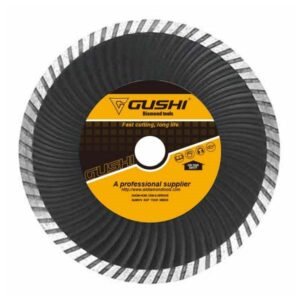
Segmented blades have deep gullets between segments, cutting fast and cool in concrete, brick and stone. Turbo blades use a serrated continuous rim, balancing speed and smoothness for tile and granite. Continuous rim blades cut the smoothest edge with minimal chipping, ideal for ceramic tile and marble. GUSHI offers all three designs for different materials.
What is the OEM MOQ and what customization is available?
The standard OEM MOQ is 500 pieces per size. Customization includes your logo printed or laser-etched on the core, blade color (green, blue, black, or matched to your brand), blister card or retail box packaging, and specific segment bonds tuned to your target material. Samples are available at cost price plus shipping, with a 20-30 day lead time for bulk orders.
Is this blade certified for international markets?
Yes. GUSHI dry cutting diamond blades are manufactured under an ISO 9001:2015 quality management system and comply with CE and EN13236 safety standards for diamond tools. Materials are RoHS compliant and SGS inspection reports can be provided before shipment. Huzhou Gu’s Imp. & Exp. Co., Ltd. has exported diamond tools to 20+ countries since 2004.
OEM & Wholesale Information
| Parameter | Detail |
|---|---|
| MOQ (diamond tools) | 500 pieces per size |
| Sample policy | Available at cost price + buyer pays shipping |
| Customization | Logo (printed / laser-etched), blade color, packaging, segment bond, arbor size |
| Private label | Yes — GUSHI also builds blades for distributor brands |
| Payment terms | L/C, T/T, Western Union, PayPal |
| Port of loading | Shanghai or Ningbo, China |
| Production capacity | 100,000 sets / month |
| Languages | English, Spanish, Japanese, Russian, French, German |
Huzhou Gu’s Imp. & Exp. Co., Ltd. has manufactured and exported diamond tools since 2004. The company is one of 23 Chinese manufacturers that won the U.S. anti-dumping case for diamond blades (exporting under a competitive 6.2% duty), and counts distributors in the USA, Canada, Germany, UK, Netherlands, Italy, Portugal, Poland, Czech Republic, Brazil, Chile, Australia and South Africa among its customers — many for more than 10 years. Every 10 pieces of Chinese diamond blades exported to Brazil, 2 come from GUSHI.
Explore our complete range: Diamond Saw Blades, Diamond Cup Wheels, and Diamond Core Drill Bits.