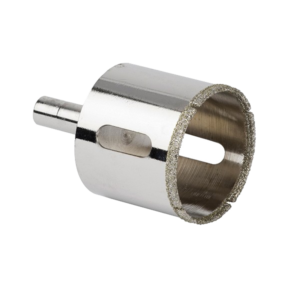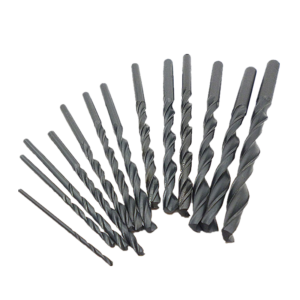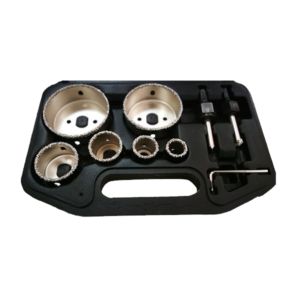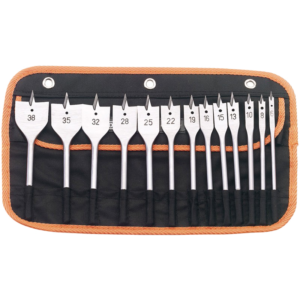
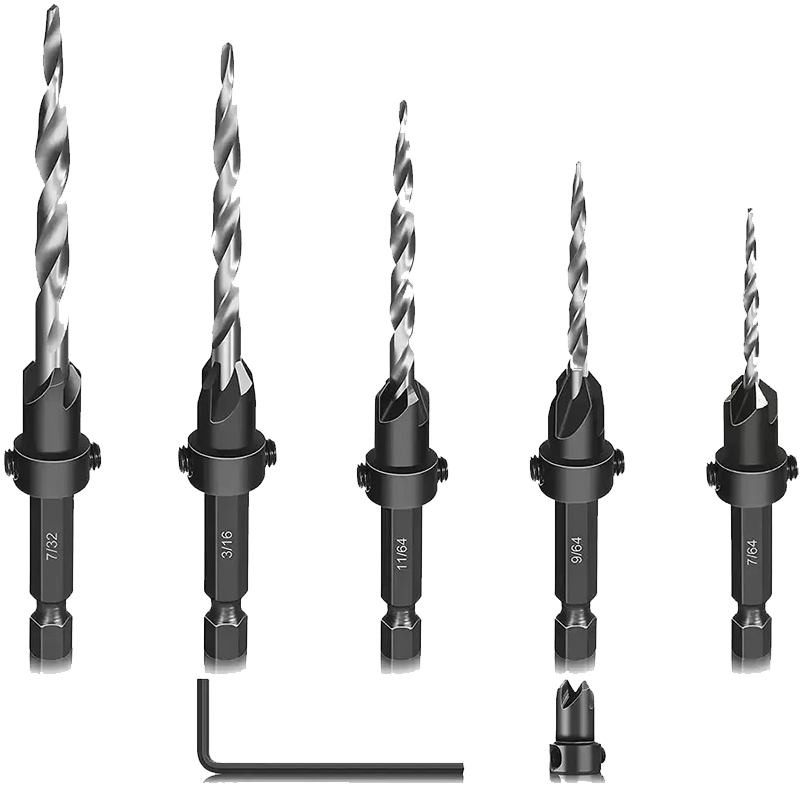
1. Our own listing copy is wrong: this is not a countersink
Three corrections, made in one place so they are easy to check:
| What the source copy says | What is wrong with it | What we say instead |
|---|---|---|
| “Excellent drilling performance: a countersunk drill bit suitable for wood” | Wrong product. A countersink does not drill a hole; it finishes one. Its cone angle is set by the fastener standard, and it is a separate catalogue item with a separate page | These are wood drill bits with a hex shank. The shank is the specification. See our countersink page for what that other tool actually does |
| Nothing whatsoever about the shank | The only thing that distinguishes this product from every other wood drill bit we sell is omitted entirely | Shank form, across-flats dimension, quick-change compatibility, impact rating and run-out are all stated on this page |
| “Suitable for wood, plastic, soft metal, plywood, fiberboard, particle board, aluminum board, etc.” | One cutting geometry does not suit all of those. Wood wants a sharp, long-cutting edge and generous clearance for fibre; aluminium wants chip room and a geometry that stops it sticking. A bit optimised for one is mediocre at the other | We state the materials each bit form is actually for, and we name the ones to keep it away from |
2. What run-out costs: the number is 2×, not 1×
Run-out is the wobble of the bit about its intended axis. It is measured at the tip, because that is where it becomes a hole. The published production figures for the three holding systems you are likely to meet:
| Holding system | Typical run-out at the tip | What it is good for |
|---|---|---|
| Three-jaw chuck, straight round shank | 0.05–0.15 mm | The accuracy benchmark. Precision drilling, drill press work, tight hole position |
| Quick-change hex holder | 0.10–0.30 mm | The convenience champion. One-handed change, impact drivers, work at height |
| Hex in a three-jaw chuck (not recommended — see section 5) | Worse than either, and it damages the jaws | Nothing. Use the right holder |
| Morse taper in a machine spindle | Lowest of the self-holding forms | Drill press and machine work where accuracy dominates |
Now the part that matters. Run-out does not make a hole smaller, and it does not merely make it rough. It makes it larger and off-centre.
If the tip is orbiting by r millimetres, the cutting edge sweeps a circle whose diameter is the nominal diameter plus 2r. And the centre of that swept circle is not where you aimed — it is wherever the orbit happens to be centred at the moment the bit enters.
| Nominal hole | In a three-jaw chuck (0.10 mm) | In a quick-change hex holder (0.20 mm) | What you actually get |
|---|---|---|---|
| 3 mm | 3.2 mm | 3.4 mm | Shelf pin and dowel holes care about this |
| 5 mm | 5.2 mm | 5.4 mm | Loose shelf pins, rattle |
| 8 mm | 8.2 mm | 8.4 mm | A hinge or slide fixing that is 0.4 mm proud of position |
| 12 mm | 12.2 mm | 12.4 mm | Usually a clearance hole — nobody cares |
Two things follow. First, only one side of the cutting edge is really cutting; the other side is scraping and rubbing. That is why a wobbly hole comes out with a rough wall, a hot edge and a bit that dulls long before it should. Second, the error is positional, and positional errors accumulate. One hole 0.4 mm out can be lived with. A run of twelve holes each 0.4 mm out in the same direction is a carcass that will not stand up.
3. Why hex cannot self-centre and a chuck can
This is not a build-quality problem, and buying a better bit does not fix it. It is geometry.
A three-jaw chuck converges
A three-jaw chuck closes three jaws simultaneously and equally onto a continuous cylindrical surface. Because the surface is continuous and round, the geometry forces the workpiece onto the axis regardless of where the jaws started. A round shank is, in effect, self-centring — and that is why the 0.05–0.15 mm figure is achievable without special care.
A hex holder locates
A hex shank in a quick-change holder does not converge on anything. It is located: a detent engages a groove to hold the bit axially, and the flats bear against the holder walls. Six flats meet a holder that is not a mirror of all six, so the bit sits against whichever contacts happen to be closest, and any clearance in those contacts becomes a lateral offset of the axis.
Tooling literature describes the hex as having geometric discontinuities that slightly lower centring precision, and the round shank as having superior concentricity. Both statements are the same sentence read twice. A hexagonal body is not a round body with flats ground off it; it is a different locating problem.
The second-order effects that make it worse
- The holder is a separate part. Every interface in the chain adds its own tolerance and its own run-out, and an adapter in the chain adds more again
- Detent wear is invisible. The balls and groove that hold the bit axially wear silently, and the symptom is a bit that starts running out more without any visible damage
- Across-flats tolerance compounds. A 6.35 mm nominal hex that is actually 6.30 mm across the flats has more play in the holder, and play is offset
- Cheap holders are the usual culprit. The form is sound; the tolerance stack in a poor holder is not
4. The trade runs both ways: hex holds, round slips
It would be easy to leave the impression that round is simply better. It is not, and the reason is worth stating plainly, because it is the reason hex dominates cordless work at all.
A round shank in a three-jaw chuck is held by friction. The jaws squeeze a smooth cylinder and rely on normal force to transmit torque. When torque demand rises — a large diameter in hardwood, a bit meeting a knot, a snatch on break-through — the friction limit can be reached, and the bit spins in the chuck.
A hex shank in a holder is held by geometric constraint. The flats cannot rotate inside the holder without deforming one of them. There is no friction limit to reach.
| Behaviour | Round shank, three-jaw chuck | Hex shank, quick-change holder |
|---|---|---|
| Centring accuracy | Better — self-centring | Worse — located, not converged |
| Torque at the limit | Slips once friction is exceeded | Holds — geometric constraint |
| Micro-movement under load | Can creep in the jaws | Reduced — cannot rotate freely |
| Changeover time | Two hands and a key | Under two seconds, one-handed |
| Impact driver | Not compatible | Compatible if impact-rated |
| Failure mode when it fails | Slips, scores the shank, bit spins | Runs out, cuts oversize and off-centre |
| Damage when it fails | A scored round shank will never grip again | A scored flat will never locate again; a worn detent is invisible |
5. Which geometry for which machine
The selection rule is not “which shank is best”. It is “which machine is this bit going into, and what does the hole have to do”.
| Work | Machine | Right shank | Why |
|---|---|---|---|
| Hinge, slide and shelf-pin positions; anything with a positional tolerance | Drill press or bench drill | Straight round in a good three-jaw chuck | Best available centring. The press also gives perpendicular entry and controlled feed, which matters as much as the shank |
| Dowel, biscuit and mortise work | Drill press | Straight round | Position accumulates across a run; the chuck is the accuracy-limiting component and round wins it |
| Cable entries, wire routes, ventilation and drainage holes | Cordless drill, often at height | Quick-change hex | Clearance holes do not care about 0.2 mm. Changeover speed is the whole game |
| Assembly and batch screwdriving around a cabinet | Cordless drill or impact driver | Quick-change hex, impact-rated | One-handed changeover per screw, and impact rating is mandatory on an impact driver |
| Large diameters in hardwood, high torque | Low-gear cordless or a drill press | Three-flat | Positive drive on a plain chuck. Keeps most of the self-centring while eliminating slip |
| Anything in the largest diameters, any material | Drill press | Round or three-flat, never hex | The shank stops being the right specification long before the bit does — see section 7 |
And do not put a hex shank in a three-jaw chuck
It is tempting, it half-works, and it damages the chuck. A three-jaw chuck is designed to converge on a round surface; on a hex it bears unevenly on three corners and three flats, concentrating load on the jaw edges. The result is less clamping force than you would get on the same diameter round shank, accelerated jaw wear, and a keyless chuck that will score the flats. A scored flat never locates properly again.
6. The form family: round, hex, three-flat, triangular, Morse
Five forms cover essentially everything in wood drilling, and they are not interchangeable.
| Shank form | Held by | Drive | Centring | Where it belongs |
|---|---|---|---|---|
| Straight round | Three-jaw chuck, keyed or keyless | Friction | Best — 0.05–0.15 mm | Precision and drill press work. The universal default |
| Plain hex | Three-jaw chuck on the flats | Positive | Moderate | Anti-slip without a holder. Damages a good chuck, so use a dedicated one |
| Grooved quick-change hex | ISO 1173 quick-change holder or impact driver | Positive, detent-retained | 0.10–0.30 mm | Cordless and field work. One-handed change, impact compatible |
| Three-flat (three flats at 120°) | Three-jaw chuck, landing on the flats | Positive | Good — keeps most self-centring | Large diameters at high torque. The standard answer when hex stops being enough |
| Triangular drive | Matching triangular holder or chuck | Positive | Moderate | The largest diameters, where even three flats are marginal |
| Morse taper | Machine spindle socket | Self-holding friction taper | Lowest of all | Drill press and machine work at the top of the accuracy range |
What is shared and what is not
- 6.35 mm across flats is the dimension shared by the 1/4″ hex family, whatever the holder. This is why a hex bit drops into any standard quick-change holder and why the diameter ceiling is the same everywhere
- A quick-change groove is a separate feature from the hex. A plain hex has no groove and cannot be retained by a detent
- Three flats are not a smaller hex. Three-flat and hex are different solutions to different problems: three-flat keeps the self-centring chuck and adds positive drive; hex abandons self-centring for one-handed change
- Impact rating is a heat treatment, not a shape. It can be applied to any of these forms, and it must be for impact driver use
7. The 12 mm ceiling and the 38 mm reality
Published guidance puts the practical ceiling for quarter-inch hex at about 12 mm in most holders, and it is clear about why: the ceiling is set by torque transfer, not by the strength of the bit body.
Yet wood hex shank bits are routinely sold at 25 mm, 32 mm and 38 mm. Both statements are true, and understanding why is the difference between a sensible catalogue and a returns problem.
| Diameter | In a quick-change holder | In a three-jaw chuck on the flats | What to tell the customer |
|---|---|---|---|
| 3–12 mm | Ideal — the design range | Works, but wears the chuck | Sell hex without qualification |
| 13–20 mm | Marginal — holder and detent are now the limit | Acceptable in low gear | State the machine requirement |
| 21–32 mm | Outside the holder’s design range | Workable with a low-gear, high-torque machine | Sell as a three-jaw-chuck bit, not a quick-change bit |
| 33 mm and up | No | Drill press, low belt, side handle | Sell the machine with the bit |
The honest catalogue line
If your catalogue says “1/4 inch hex shank” on a 32 mm bit, that is not dishonest — but it is incomplete, and the customer discovers the incompleteness on site. The complete sentence names the holder and the machine: 1/4″ hex shank, for use in a three-jaw chuck on the flats above 20 mm, low gear, side handle. One extra clause, no return.
8. Where run-out matters in wood, and where it does not
Run-out is only a problem when the hole has a job beyond letting something pass through it. Sort your work into two piles before you spend anything on shanks.
Pile one: run-out matters
- Hinge positions. A door is hung on a line, not on a hole. Two hinges each 0.4 mm out of line is a door that binds or stands proud
- Drawer slide fixings. Slides are the least forgiving hardware in a cabinet; the tolerance stack is tight and positional error is unrecoverable
- Shelf pin holes. The pin is a close fit by design, so an oversize hole means a loose shelf, and a run of loose holes means a shelf that rocks
- Dowels, biscuits and tenon alignment. Two parts that each fit their own hole do not necessarily fit each other
- Anything repeated in a jig or against a stop. Repeatability is the whole point, and run-out breaks it in a consistent direction, which is worse than random error
- Visible holes with no plug. A 0.2 mm offset is invisible in a hole you will never see and obvious in one that is the only feature on a panel
Pile two: run-out is irrelevant
- Cable and wire entries — the requirement is clearance, and clearance is measured in millimetres you are not using
- Ventilation, drainage and light access holes in backs and bases
- Rough service holes behind a back panel or under a floor
- Any hole that will be enlarged, cut out or finished by another tool
- Pilot and clearance holes where the screw or plug takes up the difference
That single sentence is the practical output of this page. A cabinet shop that drills hinge and slide positions on a press with round shanks, and everything else on cordless with hex, has made the right decision twice — and has not overpaid for either.
9. Drilling more accurately with only a hand drill
Most people reading this do not have a drill press. Here is what actually works, in order of effect.
- Spot the position. A centre punch or an awl makes a mechanical reference that the bit has to engage. This does more for position than any shank upgrade, and it costs nothing
- Make a shallow seat first. Bring the bit in at low speed and cut only one or two millimetres. That seat is now a guide, and the rest of the hole follows the seat instead of following the wobble. This is the single highest-value technique on this page
- Hold the tool square. A hand drill held at an angle produces an oval entry that no amount of run-out correction will fix afterwards
- Feed steadily, and do not correct. Every attempt to steer with the drill handle adds a side load, and a side load is what run-out turns into an oval hole
- Back thin and veneered material. A backing board holds the fibre down at entry and stops break-out at exit. This is a tear-out fix, not a position fix, but it belongs in the same list
- Use a guide where you have one. A jig, a stop block, a set square held to the line — anything that takes the position decision away from your wrist
And the honest upgrade path
- Free: spot, shallow seat, square, steady feed. Do these before anything else
- Cheap: a backing board, a stop block, and a quick-change holder that is actually well made rather than the one that came free with a drill
- Worth it if you drill a lot of position-critical holes: round shanks in those sizes and a decent three-jaw chuck
- The real answer: a drill press. It fixes perpendicular entry, controlled feed and depth in one purchase, and it does more for hole position than any shank decision
10. Measuring run-out without a dial gauge
Two methods, both free, both good enough to tell you whether a bit is bad enough to explain a problem.
Method one: spin against a reference
Clamp the bit and spin it slowly by hand with a vertical rule, the edge of a set square or a fixed pointer held close to the tip. Watch the tip, not the shank. If it stays in one place the bit runs true. If it describes a small circle, the circle is your run-out and it is the reason your holes are oversized and rough.
Method two: roll it on a flat surface
Roll the unclamped bit along a flat surface and watch the cutting edge rather than the shank. A bent shank is rare; a cutting edge ground off-axis is not. This also catches a bent bit, which is the most common transit and handling damage and which no chuck will ever hold true.
If you do have a dial gauge
Indicate the tip and rotate. Anything inside about 0.15 mm at the tip on a wood bit is good. Between 0.15 and 0.30 mm is worth knowing about. Above 0.30 mm, retire the holder or the bit, and check whether the bit itself is bent before you blame the chuck.
11. Full specifications
| Parameter | Specification |
|---|---|
| Product | Wood hex shank drill bits, supplied in bit forms across the wood drilling range |
| Shank forms offered | Straight round; plain hex; grooved quick-change hex; three-flat (three flats at 120°); triangular drive; Morse taper to order |
| Hex across-flats | 6.35 mm (1/4″), the dimension shared by the quarter-inch hex family |
| Quick-change standard | ISO 1173 quick-change holders and impact drivers |
| Run-out, three-jaw chuck on round shank | Typically 0.05–0.15 mm at the tip — the accuracy benchmark |
| Run-out, quick-change hex holder | Typically 0.10–0.30 mm at the tip — the price of one-handed changeover |
| Practical diameter ceiling, quarter-inch hex | About 12 mm in most quick-change holders; set by torque transfer, not by bit strength |
| Diameter range, hex shank bits | 3–12 mm for quick-change use; to 38 mm where a three-jaw chuck on the flats and a low-gear machine are specified |
| Impact rating | Impact-rated heat treatment available and required for impact driver use |
| Bit forms covered | Twist drill, spade / paddle bit, auger bit, Forstner bit, countersink, hole saw arbor and screwdriver bit |
| Substrates | M2 high speed steel, carbon steel and HSS bodies with carbide tip options, per bit form |
| Surface finishes | Bright, TiN, TiCN, TiAlN, black oxide and steam oxide |
| Suitable materials | Softwood, hardwood, plywood, MDF, particleboard, hardboard and plastics |
| Not suitable for | Precision drill press work at tight positional tolerance (use round shank); masonry; hardened steel; impact drivers without impact-rated heat treatment |
| Packaging | Single bit in tube, blister card or cloth bag; sets in moulded case. Private label packaging to order |
| MOQ | Indicative: from 500 pieces for a stock diameter and shank combination; from 1,000 pieces for private profile or private label |
| Lead time | Indicative: 15–25 days for stock configurations; 30–45 days for OEM production |
12. How to specify a hex shank bit on an export order
Eight parameters, and the first two are the ones that get missed:
- Bit form first. Twist, spade, auger, Forstner, countersink or screwdriver bit. The shank is the second question, not the first
- Diameter, and the maximum diameter the customer will run. This decides whether hex is right at all — see section 7
- Shank form: round, plain hex, grooved quick-change hex, three-flat, triangular or Morse
- Groove or no groove. A quick-change hex needs the detent groove; a plain hex does not have one and cannot be retained by a detent
- Impact-rated heat treatment: yes or no. Mandatory where impact drivers are in use, and it is a heat treatment, not a shape
- Across-flats tolerance. Tight tolerance costs more and buys run-out. Say which you want
- Surface finish and substrate. Bright, TiN, TiAlN, black oxide; M2, carbon steel or carbide-tipped
- Marking and packaging. Diameter and shank marking, private label, barcode and insert cards to order
13. Incoming inspection
Six checks, and the last one is the one that catches the failures this page is about:
- Measure the across-flats dimension. 6.35 mm nominal. Undersize means play in the holder, and play is run-out
- Confirm the groove is present on quick-change parts and absent on plain hex
- Roll the bit on a flat surface and watch the cutting edge, not the shank. A bent bit is the most common handling damage and cannot be held true by any chuck
- Spin it in a holder and look at the tip. Method one from section 10. If the tip describes a visible circle, the bit or the holder is out
- Check the flats and groove for scoring. A scored flat never locates again, and a scored round shank never grips again
- Cut a test hole and measure it. A 8 mm bit that produces a measured 8.4 mm hole in a sound holder is a bit problem, not a technique problem — and it is the only check that catches eccentric grinding
14. Troubleshooting
| Symptom | Most likely cause | What to change |
|---|---|---|
| Holes consistently oversize by 0.2–0.4 mm | Run-out in the holder or the bit | Measure it — section 10. A good holder runs 0.10–0.30 mm; if yours is worse, replace the holder |
| Holes off-centre in a consistent direction | Orbiting bit, so every hole inherits the same offset | Fix the run-out, and spot the position first |
| Hole wall rough, bit running hot | Only one edge is cutting; the other is rubbing | Run-out again. Sharpen or replace, then re-measure |
| Bit spins in the chuck | Round shank under high torque, or worn oily jaws | Clean the jaws, drop to low gear, or move to three-flat. A scored shank never grips again |
| Hex bit will not stay put in the holder | Worn detent or balls | Replace the holder. This wear is invisible until the holes go wrong |
| Chuck jaws worn, reduced grip | Hex shanks run in a three-jaw chuck | Stop doing it. Use a quick-change holder for hex sizes |
| Bit twisted or cracked at the shank | Impact driver without impact-rated heat treatment | Specify impact-rated. See our spade bit page for the torque budget |
| Large bit stalls in hardwood | Diameter beyond the shank’s torque range | Low gear, side handle, or a drill press. See section 7 |
| Oval entry, bit wandering at start | No spot, or the drill held off square | Centre punch, then a shallow seat — section 9 |
| Exit face torn on thin panel | No backing board | Clamp a sacrificial board to the underside |
15. Applications
Where hex is the right specification
- Electrical and data installation. Cable entries, containment fixings and wire routes, mostly clearance holes, mostly at height
- Site assembly. Cabinets and furniture put together on site, where every screw is a bit change
- Service and maintenance. Working off a ladder or in a ceiling void, where two hands are a luxury
- Production assembly lines. Where the arithmetic is changeover time multiplied by the number of screws
Where round is the right specification
- Drill press work of any kind, on any material
- Positional hardware: hinges, drawer slides, shelf pins, connector plates
- Joinery with alignment requirements: dowels, biscuits, tenons and dowel-reinforced mitres
- Small diameters at tight tolerance, where the shank is the accuracy-limiting component
Where three-flat is the right specification
- Large diameters in hardwood where a hex would slip and a round shank is not offered
- High-torque work in a plain chuck, where you want positive drive without abandoning self-centring
- The top of a diameter range, where makers themselves switch away from hex
16. Frequently asked questions
Is a hex shank less accurate than a round shank?
For centring accuracy, yes, and the numbers are not subtle. In production checks a three-jaw chuck holding a straight round shank usually measures 0.05 to 0.15 mm of run-out at the tip, while a quick-change hex holder measures 0.10 to 0.30 mm. That is two to six times the wobble for identical cutting geometry. The reason is mechanical rather than a matter of build quality: a three-jaw chuck converges on a continuous cylindrical surface and centres itself, whereas a hex in a quick-change holder locates through a detent against six flats and cannot self-centre. In fairness the trade runs both ways — once under load a hex holds its position through geometric constraint where a round shank relies on friction and can slip — so hex is right for field work and round is right for the drill press.
How much does run-out affect hole size?
It adds roughly twice the run-out figure to the diameter, and it offsets the hole from centre at the same time. If the bit is wobbling by 0.1 mm at the tip, the cutting edge sweeps a circle 0.2 mm larger than the nominal diameter, and the centre of the swept circle is not where you aimed. So an 8 mm bit with 0.2 mm of run-out produces a hole about 8.4 mm across and slightly off-centre, and it produces it with only one side of the edge actually cutting while the other rubs. That is why run-out shows up as a rough wall and a hot edge rather than as a tidy undersized or oversized hole.
Can I use a hex shank drill bit in a normal three-jaw chuck?
You can clamp it and it will drive, but it is a poor fit and it damages the chuck. A three-jaw chuck is designed to converge on a round surface, and on a hex it bears on three corners and three flats unevenly, concentrating load on the jaw edges, wearing them, and reducing the clamping force you would get on the same diameter round shank. A keyless chuck on a hex will also mark and score the flats, and a scored flat will never grip properly again. If you already own hex shank bits and a three-jaw chuck, buy a quick-change holder for the hex sizes and keep the chuck for round shanks.
What is the largest drill bit I can put on a 1/4 inch hex shank?
About 12 mm in most quick-change holders, because that is where the shank stops being able to carry the torque rather than where the bit stops being able to cut. Wood hex shank bits are routinely sold up to 25 mm and beyond, and they work, but they work by being clamped in a three-jaw chuck on the flats or driven on a low gear with plenty of torque — not by dropping into a quick-change holder. If your catalogue says 1/4 inch hex and your work is 25 mm and up in hardwood, the shank is not the specification you should be reading first.
Do I need an impact-rated drill bit for an impact driver?
Yes, and the requirement is on the shank as much as on the body. An impact driver delivers its torque as a series of rotational hammer blows, so the shank is loaded in fatigue rather than in steady torsion, and a standard bit can twist or crack at the shank. Two limits apply at once: the shank needs the impact-rated heat treatment, and the quarter-inch hex section has a torque ceiling of its own that a large wood bit in hard material can exceed. Our spade bit page works that budget through in detail, including the roughly six-to-one lever between a 6.35 mm shank and a 38 mm cutting diameter.
Why does my listing call these a countersunk drill bit?
Because our own source copy is wrong, and we have corrected it on this page rather than quietly deleting it. The supplied text describes a countersunk drill bit, which is a different product with a different job, and it says nothing at all about the shank — the only feature that distinguishes these bits. It also lists wood, plastic, soft metal, plywood, fibrefboard, particleboard and aluminium board as though one cutting geometry suited all of them, which it does not. A countersink finishes a hole somebody else has drilled and its geometry is set by the screw standard, not by cutting theory.
Where does run-out matter in wood and where does it not?
It matters wherever the hole has a job beyond letting something pass through it. Hinge positions, drawer slide fixings, shelf pin holes, dowel and biscuit slots, and anything that has to line up with a fitting all care, because the error is positional and it accumulates across a run of holes. It matters far less on through holes whose only requirement is clearance: cable entries, wire routes, drainage and ventilation holes, and the back of a cabinet that nobody sees. Sort your work into those two piles before you spend money on shanks.
How do I check run-out without a dial gauge?
Two ways, both free. First, chuck the bit, spin it by hand against a fixed reference such as a vertical rule or the edge of a set square, and watch whether the tip stays in one place or describes a small circle. Second, roll the unclamped bit across a flat surface and watch the cutting edge rather than the shank, because that is the part that has to run true. Neither will give you a number in millimetres, but both will tell you whether a bit is bad enough to explain a hole that is coming out rough, oversized or off-centre.
How can I drill more accurately with just a hand drill and hex bits?
Separate the start from the cut. Spot the position first with a centre punch or an awl so there is a mechanical reference, then bring the bit in at low speed and make a shallow seat only one or two millimetres deep. That seat is a guide, and once it exists the rest of the hole follows it instead of following the wobble. Use a backing board under thin or veneered material to hold the fibre down at entry and to stop break-out at exit. Beyond that, hold the tool square, feed steadily, and do not try to correct with the drill handle, because every correction adds a side load and a side load is what run-out turns into an oval hole.
Is a three-flat shank more accurate than a hex shank?
For centring, a three-flat shank in a three-jaw chuck is better than a quick-change hex, because the three jaws land directly on three milled flats at 120 degrees and the chuck still converges on a largely circular body, so you keep most of the self-centring behaviour while gaining positive drive. It is also the standard answer when a hex stops being enough, which is why makers switch to three-flat or a full triangular drive as the bit gets larger. The cost is that you give up one-handed quick change, because a three-flat still needs a chuck, and a chuck needs hands and a key.
What shank should I buy for a shop that has both a drill press and cordless drills?
Buy by machine, not by bit. Round shanks for the drill press, where the chuck centres well and the press gives you perpendicular entry and controlled feed. Hex shanks for the cordless work, where the gain is one-handed changeover and impact-driver compatibility, and where most holes are clearance holes that do not care about a tenth of a millimetre of position. Three-flat where a large diameter meets high torque and you still want to use the chuck you own. If you are forced to choose one, choose round, because a round shank works everywhere and a hex shank quietly excludes you from precision work.
MOQ, lead time, OEM and samples?
Hex shank wood bits are specified by bit form, diameter, shank form and surface rather than picked from a fixed list, so terms follow the configuration. Indicative minimum order quantity starts from 500 pieces for a stock diameter and shank combination and from 1,000 pieces for a private profile, a non-standard shank form or private label packaging. Indicative lead time is 15 to 25 days for stock configurations and 30 to 45 days for OEM production. Samples are available for testing after terms are confirmed, with the sample cost credited against a subsequent order. Please confirm current figures with us before publishing them.
Related products
Shank and drive: Wood Step Drill Bits — shank diameter against drilling range, and where makers switch from hex to triangular drive. Wood boring: Wood Flat Drill Bits Set, Wood Forstner Drill Bits, Wood Forstner Drill Bits Set, Wood Auger Core Drill Bits Set, Wood Auger Core Drill Bits, Wood Step Drill Bits Set. Seats and finishes: Wood Countersink Drill Bits. Substrates and surfaces: HSS Twist Drill Bits Set, HSS Ti-coated Drill Bits Set, Black Oxide Drill Bits. Larger holes: Bi-Metal Hole Saw Sets.
OEM & Wholesale
GUSHI has manufactured drilling and cutting tools in Huzhou, Zhejiang since 1998, and we supply hex shank wood bits to importers, distributors and private label programmes. Because a shank is defined by form, groove, tolerance and heat treatment rather than by a dimension alone, most of what we ship in this category is configured.
- Shank forms. Round, plain hex, grooved quick-change hex, three-flat, triangular drive and Morse taper
- Tolerances. Across-flats tolerance specified to your run-out requirement, with tighter tolerance quoted separately
- Heat treatment. Impact-rated treatment for impact driver programmes
- Bit forms. Twist, spade, auger, Forstner, countersink, hole saw arbor and screwdriver bits
- Private label. Laser marking, packaging, barcode and insert cards
- Terms. T/T, L/C, D/A, D/P and PayPal according to circumstance. Samples after terms are confirmed, credited against a subsequent order