1. The listing, audited
This page is four sentences and a table, and the table contains a contradiction that would stop a buyer cold if they read it carefully. It is worth starting there, because the rest of the page depends on knowing which numbers can be trusted.
| What the listing says | What is wrong | What to write instead |
|---|---|---|
| Segment height 3 mm, drill depth 30 mm | These cannot both be literal. A 3 mm diamond band cannot cut a 30 mm deep hole in one pass, and a 70 mm diameter barrel cannot have a 30 mm overall length. One column is a different dimension, or one is transcribed from another product. | Separate the four lengths explicitly: band height, wall thickness, overall length, working depth. They are all different and only one of them is 3 mm. |
| Grit: #30, #40, #50, #60, #70 | A list is not a specification. Every diameter is offered in five grits and the page never says which to choose, though the choice decides both the edge quality and the life. | Coarse for tile and speed, fine for glass and edge quality, and a default grit per diameter band. |
| Electroplated and pressure technology | Electroplating is a bath process with no pressure stage. The phrase is either a translation of a different process or a claim with nothing behind it. | Nickel-bonded single layer, diamond partially embedded, no matrix behind the grit. That is the honest description and it explains the behaviour. |
| Use electric drills and angle grinder | An angle grinder runs at 10,000 rpm or more. On a 40 mm bit that is a rim speed near 21 m/s, far outside what a plated layer survives, and the tool will shed its band in one hole. | Drill or drill press up to 20 mm; grinder only for the smallest sizes at reduced speed, and never for a large barrel. |
| Good sharpness, high precision, no-chipping, hot selling | Three adjectives and a sales report. “No-chipping” is the only one with a mechanism behind it, and the page does not give the mechanism. | State the depth of cut per diamond, the feed per revolution that produces it, and the grit that sets the spacing. |
| Missing entirely | Wall thickness, diamond size in microns, number of slots, and the fact that the band cannot be renewed. | All four. The wall sets the kerf and the clearance, and the slots are what make this bit different from a continuous ring. |
The one thing the listing gets unambiguously right is wet only. That single word rules out most of the ways this tool gets destroyed, and it deserves more than two words on the page.
2. No-chipping is arithmetic
Every abrasive tool removes material as a series of scratches. What decides whether the material leaves cleanly or breaks away in chips is the depth of an individual scratch. Below a threshold set by the material, the cut is ductile: the material flows, the groove has clean walls and no crack propagates. Above it, the material behaves as the brittle solid it is, and a crack runs ahead of the diamond.
For glass and fine porcelain that threshold is on the order of a micron. So the question is not whether the diamond is good. It is how deep each diamond is cutting, and that is a number you can calculate from three things you already control.
depth per diamond h = fr ÷ diamonds in contact
| Plunge rate, 20 mm bit at 2,850 rpm | Feed per revolution | Depth per diamond | What the edge does | What you see |
|---|---|---|---|---|
| 0.5 mm/s | 10.5 µm | 0.34 µm | Ductile, well below the threshold | Clean wall, no chipping, slow |
| 1.0 mm/s | 21 µm | 0.68 µm | Ductile, near the threshold | Clean wall, practical speed |
| 2.0 mm/s | 42 µm | 1.35 µm | At or over the threshold | Small chips at the entry, glazed band |
| 5.0 mm/s | 105 µm | 3.38 µm | Brittle | Visible chipping, cracks at the exit |
The same bit produces all four of those results. Nothing about the tool changes between the first row and the last. That is the point the listing misses when it calls the product no-chipping: the property belongs to a cutting condition, and the cutting condition is set by the operator’s hand.
Why this matters commercially
A buyer comparing plated bits on price is comparing the wrong variable. Two bits at different prices will both chip glass if fed at 5 mm/s, and both will cut cleanly at 1 mm/s. What the price actually buys is the consistency of the layer: how evenly the grit is distributed, how well the nickel holds it, and therefore how many clean holes you get before the band is gone. That is a durability question, not a chipping question, and it should be asked separately.
3. Three numbers set the bite
Depth per diamond is not a single setting. It is the result of three variables that trade against each other, and understanding the trade is what lets you run the tool on a machine that has only two controls.
| Variable | What it does to the bite | Why | What it costs |
|---|---|---|---|
| Spindle speed | Raising it makes the bite shallower | More revolutions per second means less feed per revolution for the same plunge rate | Heat per unit of time goes up, and the nickel has a temperature limit |
| Plunge rate | Raising it makes the bite deeper, in direct proportion | Feed per revolution is linear in plunge rate | This is the one variable that breaks the edge first |
| Grit size | Finer grit means more diamonds in contact, so a shallower bite for the same feed | Particle spacing falls, so the load is shared between more points | Slower cutting and a shorter band life for the same depth |
There is a fourth variable that looks like it should matter and does not: the diameter. Because the number of diamonds in contact grows with the circumference while the correct spindle speed falls with diameter, the two effects cancel. At a constant rim speed, the same plunge rate gives the same bite whatever the size.
| Diameter | rpm for a 3 m/s rim | Diamonds in contact | Feed per revolution at 1 mm/s | Depth per diamond |
|---|---|---|---|---|
| 10 mm | 5,700 | 16 | 10.5 µm | 0.66 µm |
| 20 mm | 2,850 | 31 | 21.1 µm | 0.68 µm |
| 35 mm | 1,630 | 55 | 36.8 µm | 0.67 µm |
| 50 mm | 1,140 | 79 | 52.6 µm | 0.67 µm |
| 70 mm | 814 | 110 | 73.7 µm | 0.67 µm |
The right-hand column barely moves. That is a useful simplification and it is counter-intuitive: the bite is set by the plunge rate alone, provided the spindle is set for a constant rim speed. So the operating rule is a single line, and it applies to every size in the catalogue.
A 10 mm bit takes 1.4 mm/s, a 20 mm takes 0.7, a 50 mm takes 0.28, a 70 mm takes 0.2. Which is the opposite of what most operators do. The instinct on a big barrel is to lean on it because the hole is big; the physics says a big barrel has to be fed more slowly, because it already has more diamonds in contact and each of them has to keep its bite small.
4. Why a plated layer cuts shallower than a brazed one
Both this bit and a vacuum brazed bit carry a single row of diamond. The difference that matters is not the number of layers, it is the ratio of how far the diamond sticks out to how big the diamond is. A plated bond buries most of each particle in nickel, so only the tip is exposed. A brazed bond wets the particle and leaves more of it proud of the surface, and it typically uses a coarser particle to begin with.
| Electroplated (this bit) | Vacuum brazed | Sintered thin wall | |
|---|---|---|---|
| Bond | Nickel, deposited, mechanically gripping the particle | Filler alloy, wetting and metallurgically bonding | Metal matrix with diamond dispersed through it |
| Typical grit | #30 to #70, so 0.2 to 0.6 mm | #25 to #40, so 0.4 to 0.8 mm | Fine, often 0.1 to 0.3 mm |
| Exposure | Small: the particle sits deep in the nickel | Larger: more of the particle stands proud | Continuous, because the matrix wears back |
| Bond hardness | Soft relative to a brazed alloy | Harder, and it tolerates more heat | Hardest, and it is designed to wear |
| Maximum bite before the bond fails | Smallest of the three | Middle | Largest |
| What that buys | The cleanest edge on brittle material | Speed and life on tile and stone | Life and depth on dense surfaces |
| What it costs | Short life; the layer cannot be renewed | More chipping at the entry | Needs a rigid machine; more force |
The consequence is a clean division of labour. The plated bit is the one you reach for when the edge is the deliverable: a visible hole in glass, a tap hole in a glazed tile, a cut in a laminate that must not delaminate. The brazed bit is the one you reach for when the hole is the deliverable and the edge will be covered by a fitting.
5. Three slots and a side port
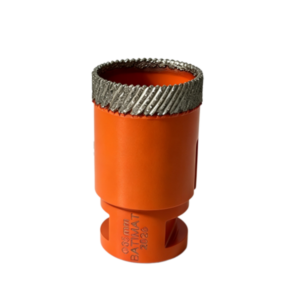
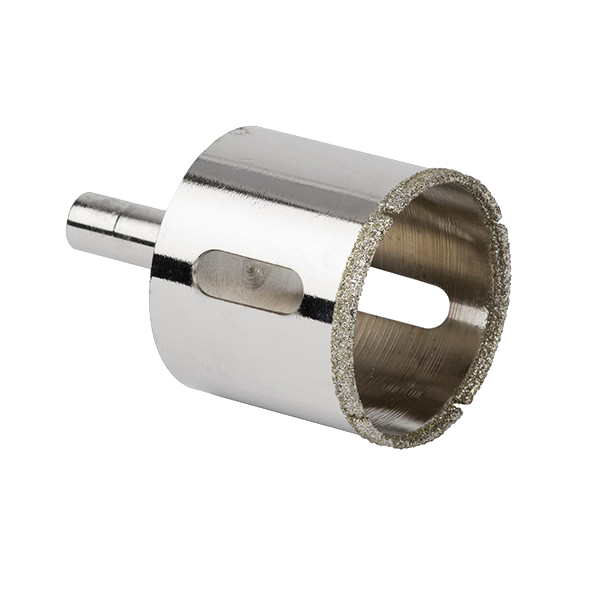
The photographs show something the listing never mentions: the diamond band is not continuous. Three narrow slots are cut through it, evenly spaced, and the barrel carries one elongated port in its wall. Between them they give the cuttings a way out that a continuous ring does not have.
| Feature | Where it is | What it does | What happens without it |
|---|---|---|---|
| Three slots in the band | Cut axially through the diamond layer, evenly spaced | Radial exit for the cuttings at the rim, and a break in the continuous contact that lets water reach the kerf | The band loads with paste within a few millimetres and stops cutting |
| Elongated side port | Through the barrel wall, above the band | Lets the cuttings leave the annulus once they have travelled up it, and lets you see the depth | The annulus packs and the core jams in the barrel |
| Thin wall | The whole barrel | Narrow kerf, low force, small volume of debris to clear | Wider kerf, more force, more chipping |
The slot ratio falls as the bit gets bigger
Three slots is a fixed count, but the circumference they are cut into is not. So the share of the rim that is open falls with diameter, and the largest bits have proportionally the least clearance of all — which is the opposite of what a buyer assumes.
| Diameter | Circumference | Open length (3 slots × 2.5 mm) | Open share of the rim | Consequence |
|---|---|---|---|---|
| 10 mm | 31 mm | 7.5 mm | 24% | Very open; water reaches the kerf easily |
| 20 mm | 63 mm | 7.5 mm | 12% | Comfortable |
| 35 mm | 110 mm | 7.5 mm | 7% | Needs steady water |
| 50 mm | 157 mm | 7.5 mm | 5% | Needs generous water and a slow feed |
| 70 mm | 220 mm | 7.5 mm | 3% | Effectively a continuous ring; clearance is the limit |
This is the same arithmetic that governs the brazed barrel next door in the range, and it is why both products have to be fed more slowly as they get larger. The difference is that this bit starts with a radial exit and loses it as it grows, while a continuous ring never had one.
What the slots cost
A slot is a place where the band is not cutting. As the bit rotates, the load per diamond rises and falls as each slot passes, which puts a small impact into the edge three times per revolution. On tile that is invisible. On glass it is the reason a plated bit can leave a very faint ripple on the wall of the hole, and it is why a fine grit and a slow feed matter more on glass than on anything else.
6. Thin wall, small diameter
A thin wall is what makes the narrow kerf possible, and a narrow kerf is most of why the tool cuts cool. But a thin tube is also a floppy tube, and the ratio that governs how floppy is the diameter divided by the wall.
| Diameter | Assumed wall | D ÷ t | What the barrel does | Practical limit |
|---|---|---|---|---|
| 10 mm | 0.8 mm | 12.5 | Stiff, holds its round under load | None at this size |
| 20 mm | 0.9 mm | 22 | Stiff enough for hand work | Watch lateral load |
| 35 mm | 1.0 mm | 35 | Slight ovalisation under a heavy hand | Two hands or a press |
| 50 mm | 1.1 mm | 45 | Visible deflection; runout shows up as an oversized hole | Press strongly preferred |
| 70 mm | 1.2 mm | 58 | Acts as a flexible ring; the band loads unevenly | Press only, with a depth stop |
The wall figures are read from the photographs and should be measured, but the trend is structural and it does not depend on the exact number. As the diameter grows, the wall has to grow with it or the barrel stops behaving like a ring and starts behaving like a spring. At 58:1 any lateral load from the operator is transferred to one side of the band, which wears that side first and produces a taper.
Why the range stops at 70 mm
Not because a bigger plated barrel cannot be made, but because beyond this size the economics stop working. A 100 mm plated ring would need a thicker wall to stay round, which widens the kerf and increases the force, which needs more pressure, which strips the nickel. At that point a segmented or brazed tool is simply the better answer, and the plated product stops being the one you would choose.
7. The speed and feed table
The two controls interact, so the table below gives them together. The spindle figure holds a rim speed near 3 m/s; the feed figure holds a bite near 15 microns per revolution; the time column is how long 30 mm of depth takes at that feed, before any withdrawal. The last column is what happens if the bit is put on an angle grinder, which the listing invites.
| Diameter | Spindle for a 3 m/s rim | Plunge for a 15 µm bite | Time for 30 mm | Rim at 12,000 rpm | Angle grinder |
|---|---|---|---|---|---|
| 10 mm | 5,700 | 1.4 mm/s | 21 s | 6.3 m/s | Possible at reduced speed |
| 12 mm | 4,750 | 1.2 mm/s | 25 s | 7.5 m/s | Marginal |
| 16 mm | 3,560 | 0.89 mm/s | 34 s | 10.1 m/s | Not advisable |
| 20 mm | 2,850 | 0.71 mm/s | 42 s | 12.6 m/s | No |
| 25 mm | 2,280 | 0.57 mm/s | 53 s | 15.7 m/s | No |
| 30 mm | 1,900 | 0.47 mm/s | 63 s | 18.8 m/s | No |
| 35 mm | 1,630 | 0.41 mm/s | 74 s | 22.0 m/s | No |
| 40 mm | 1,425 | 0.36 mm/s | 84 s | 25.1 m/s | No |
| 50 mm | 1,140 | 0.28 mm/s | 105 s | 31.4 m/s | No |
| 60 mm | 950 | 0.24 mm/s | 126 s | 37.7 m/s | No |
| 70 mm | 814 | 0.20 mm/s | 147 s | 44.0 m/s | No |
Three things in that table are worth pausing on.
The times are short. Even the 70 mm bit finishes 30 mm in under two and a half minutes at a feed that protects the edge. Most of the time lost on a chipped hole is spent recovering from the chip, not drilling.
The feed has to fall as the bit grows. This is the single most counter-intuitive instruction on the page. Operators push harder on big barrels because the hole is big; the correct response is the opposite, because a big barrel already has three times as many diamonds in contact and each of them needs the same shallow bite.
An angle grinder is only viable at the very bottom of the range. At 10 mm and 12,000 rpm the rim is at 6.3 m/s, which is fast for a plated layer but survivable with water and a light touch. At 20 mm it is 12.6 m/s and the band will not last; at 70 mm it is 44 m/s, which is beyond what any plated bond tolerates. The listing’s “use electric drills and angle grinder” is true for two sizes out of twenty.
8. Glass, tile and the materials to refuse
The listing says glass and tile, which is correct but too narrow in one direction and too generous in the other. It is narrow because the same bit is the right tool for composite panels, and generous because “tile” covers materials with very different behaviour.
| Material | Grit to choose | Verdict | What decides it | What to watch |
|---|---|---|---|---|
| Glass, 4–12 mm | #60 or #70 | Best material | Fails by conchoidal fracture, so the bite must stay sub-micron | Never start dry; never let the bit dwell; no lateral load |
| Mirror | #60 or #70 | Good | Same as glass, with a coating that lifts if heated | Enter from the coated side with tape over it |
| Porcelain tile | #40 or #50 | Good | Dense, hard, but tolerant of a slightly deeper bite | Exit chipping, so back the tile |
| Glazed wall tile | #30 or #40 | Good | Soft body, brittle glaze; the glaze chips before the body cuts | Enter slowly through the glaze, then speed up |
| Ultra-compact surface | #50 or #60 | Possible | Very dense and non-porous, so heat has nowhere to go | A thin-wall bit made for the material is better |
| CFRP and glass fibre laminate | #50 or #60 | Good | Low axial force is what prevents delamination, and a plated thin wall gives the lowest force available | Extraction for the dust; it is a respiratory hazard |
| Ceramic, unfired or green | #60 | Possible | Cuts easily but the edge crumbles if unsupported | Back the work and use almost no pressure |
| Granite, quartz, concrete | — | Refuse | Abrasive enough to wear the single row off in a short distance | Use a brazed, sintered or segmented bit |
| Steel, stainless, aluminium | — | Refuse | Diamond does not cut steel; the metal smears and strips the nickel | Use a carbide or HSS tool |
The composite row is the one most buyers miss. A plated thin-wall bit is the lowest-force way to put a hole in a laminate, because force is the product of contact area and pressure, and this tool minimises both. Delamination is driven by the axial force pushing the plies apart at the exit, so the bit that cuts with the least force is the one that delaminates least. That is a genuine second market for a product sold only as a tile and glass bit.
9. Water is not optional
The listing says wet, which is correct, and it does not say why. The reason is not that water makes the cut faster. It is that the nickel bond has a temperature limit, and above it the bond stops holding the diamond.
| What water does | What happens without it | How you know it is working |
|---|---|---|
| Keeps the nickel below the temperature at which it softens | The bond relaxes and the diamond is thrown out rather than worn | The band stays matte grey; a glazed, shiny band means it got hot |
| Carries the fines out through the slots and the port | Paste packs the kerf, the bit stops cutting and the operator pushes harder | Water returns cloudy at the hole and clears as the cut progresses |
| Suppresses silica and glass dust | Respirable dust at the operator’s face | No visible plume; the work stays wet |
The distinction that matters is between wear and loss. A worn plated bit has been used for its intended life; a bit that has lost its band has been overheated. They look different: wear leaves a thin but continuous band, loss leaves bare steel in patches, usually on one side, and it happens fast.
10. Machine and mount
The bit is offered with a round shank carrying a clamping flat, and with M14, M16 or 5/8-11 threads. The shank is the hand-drill option; the threads are for machines with a spindle nose. Neither is better in the abstract, but one of them suits this product much better than the other.
| Machine | Mount to use | Why | What to watch |
|---|---|---|---|
| Drill press | Round shank in the chuck | Constant feed, no lateral load, depth stop available | Set the stop so the bit cannot touch the table |
| Hand drill, variable speed | Round shank | Portable; the flat stops the shank spinning in a worn chuck | Chuck runout is the main enemy at 10 mm and below |
| Hand drill, single speed | Round shank | Workable only at the small end | Feed must be very light; water constant |
| Angle grinder | M14 thread | The native mount for a grinder, and rigid | Speed is far too high above 12 mm; use only the smallest sizes |
| Core drill with M14 or 5/8-11 nose | Thread | Rigid, repeatable, and the machine has the right speed range | Overkill below 20 mm; ideal above 35 mm |
The best machine for this bit is a drill press with a slow quill and a water feed, and it is also the least likely to be used, because most of these bits are sold to people drilling a hole in a bathroom tile with a hand drill. That is a fine use, provided the two things a hand cannot do are compensated for: keep the feed constant rather than surging, and keep the bit square to the surface.
Runout, again
A plated bit has no compliance in its cut. A brazed or sintered tool can absorb a little runout because the bond is thick and the segments are forgiving; a plated layer cannot. At 10 mm, 0.1 mm of runout is one percent of the diameter and it will load one side of a 0.8 mm band hard enough to strip it. Check the chuck before blaming the band.
11. Diagnosis
| Symptom | Most likely cause | Test | Fix |
|---|---|---|---|
| Chips at the entry on glass | Bite too deep: feed too high for the spindle speed | Calculate feed per revolution: 60 × mm/s ÷ rpm | Halve the plunge rate, keep the speed, and start with the bit already touching under water |
| Band turns shiny and stops cutting | Glazed from heat, usually a dry or under-watered cut | Look at the band: bright and smooth means glazed, grey and gritty means healthy | Water first, then a light pass on a scrap of soft abrasive tile to open the surface; do not raise the speed |
| Bare steel shows in patches | Bond stripped by heat or by lateral load | Look for patches on one side only, which means runout or a leaning hand | Replace; check the chuck and use a press |
| Hole comes out oversized | Runout, or the bit is being steered | Measure the hole at the entry and at the exit | Fix the mount; a core bit cannot be steered, only aimed |
| Core jams in the barrel | The plug is trapped because the cut went past the band, or debris packed the annulus | Look into the barrel; a ring of paste means clearance | Withdraw and flush from the shank end; reduce the depth per pass |
| Bit wanders on the start | Hard, polished surface with nothing to hold the edge | Look at the first contact: a crescent scar means it skated | Use a template or a guide block; start at a shallow angle; do not centre-punch glass |
| Works on tile, fails on glass | The window is narrower than expected, and the same feed is too heavy | Compare the chip size at the entry on both materials | One grit finer and half the feed for glass |
| Cut slows gradually over many holes | Normal wear of a layer that cannot renew | Compare band height with a new bit | Replace; this is the designed end of life, not a fault |
12. What to put on the purchase order
Five of these fields are missing from the listing, and two of them are the ones that decide whether the bit does the job you bought it for.
| Field | What to state | Why it matters |
|---|---|---|
| Diameter | One figure from the twenty | The ladder skips 22 and 28 mm; the nearest size is not always acceptable behind a fitting |
| Grit | One of #30, #40, #50, #60, #70 | Sets the particle spacing, which sets how many diamonds share the bite |
| Band height | In mm, measured on a sample | The listing says 3 mm and also says 30 mm depth; the two cannot both be right |
| Wall thickness | In mm | Sets the kerf, the clearance and the stiffness of the barrel |
| Overall length | In mm | Decides whether the barrel reaches past a tap body or a machine guard |
| Slot count and width | Three slots, width in mm | Sets the open share of the rim, which falls sharply as diameter rises |
| Mount | Round shank with flat, or M14 / M16 / 5/8-11 | The shank fits a chuck; the threads fit a spindle nose; they do not interchange |
| Diamond specification | Grade and coating, if the supplier will state it | Two bits at the same grit can differ twofold in how long the band lasts |
| Marking | Diameter and grit on the barrel | Twenty sizes and five grits with no marking is a counter error waiting to happen |
| Sample | Two or three diameters before production | The only way to resolve the band height and depth figures is to measure them |
13. Incoming inspection
A plated bit can be assessed almost completely without cutting anything, because the failure modes are visible: a thin or missing band, an uneven band, a burr in a slot, and a barrel that is not true to its shank.
| Check | Method | Accept | Reject |
|---|---|---|---|
| Band coverage | Visual all round at 2×, looking for bare steel | Continuous nickel-bonded grit across the full rim | Any bare patch inside the cutting band |
| Band height | Calipers at four points from the rim to the paint or nickel line | Uniform within 0.3 mm | More than 0.5 mm variation: the band will wear into a taper |
| Grit uniformity | Compare the texture at four points | Same apparent particle size and density all round | A coarse patch: that is where the layer will fail first |
| Slot condition | Look into each slot and feel with a fingernail | Clean edges, no nickel bridging across the slot | Bridging or a burr projecting into the kerf |
| Wall thickness | Micrometer across the rim at four points | Within 0.1 mm of the order | A thin side: the barrel will ovalise and load unevenly |
| Runout | Mount on a known-good arbor, dial gauge on the outside of the barrel | Under 0.1 mm at 20 mm and below, under 0.2 mm above | Over 0.25 mm at the small sizes |
| Shank and flat | Trial fit in a chuck, check the flat engages a jaw | Seats fully, no rotation under hand torque | Shank undersized, or the flat ground off-centre |
| Overall length | Tape or rule from the shank end to the rim | Matches the order, within 1 mm | Short by more than 2 mm: it will not clear the guard you measured for |
Do the band coverage check first and do it on a sample from every batch. A single bare patch is not a cosmetic issue; it is the point at which the tool will stop cutting, and it will do so while the operator is pressing, which is when a jam costs the most.
14. Full specifications
Twenty diameters share one grit list, one mount list and one pair of figures that do not reconcile. The table below reproduces the listing and marks the two figures that have to be measured before they can be ordered against.
| Item | Diameter | Grits | Band height* | Drilling depth* | Mount options |
|---|---|---|---|---|---|
| 5HSELCB | 5 mm | #30 – #70 | 3 mm | 30 mm | Shank, M14, M16, 5/8-11 |
| 6HSELCB | 6 mm | #30 – #70 | 3 mm | 30 mm | Shank, M14, M16, 5/8-11 |
| 8HSELCB | 8 mm | #30 – #70 | 3 mm | 30 mm | Shank, M14, M16, 5/8-11 |
| 10HSELCB | 10 mm | #30 – #70 | 3 mm | 30 mm | Shank, M14, M16, 5/8-11 |
| 12HSELCB | 12 mm | #30 – #70 | 3 mm | 30 mm | Shank, M14, M16, 5/8-11 |
| 14HSELCB | 14 mm | #30 – #70 | 3 mm | 30 mm | Shank, M14, M16, 5/8-11 |
| 16HSELCB | 16 mm | #30 – #70 | 3 mm | 30 mm | Shank, M14, M16, 5/8-11 |
| 18HSELCB | 18 mm | #30 – #70 | 3 mm | 30 mm | Shank, M14, M16, 5/8-11 |
| 20HSELCB | 20 mm | #30 – #70 | 3 mm | 30 mm | Shank, M14, M16, 5/8-11 |
| 25HSELCB | 25 mm | #30 – #70 | 3 mm | 30 mm | Shank, M14, M16, 5/8-11 |
| 30HSELCB | 30 mm | #30 – #70 | 3 mm | 30 mm | Shank, M14, M16, 5/8-11 |
| 32HSELCB | 32 mm | #30 – #70 | 3 mm | 30 mm | Shank, M14, M16, 5/8-11 |
| 35HSELCB | 35 mm | #30 – #70 | 3 mm | 30 mm | Shank, M14, M16, 5/8-11 |
| 40HSELCB | 40 mm | #30 – #70 | 3 mm | 30 mm | Shank, M14, M16, 5/8-11 |
| 45HSELCB | 45 mm | #30 – #70 | 3 mm | 30 mm | Shank, M14, M16, 5/8-11 |
| 50HSELCB | 50 mm | #30 – #70 | 3 mm | 30 mm | Shank, M14, M16, 5/8-11 |
| 55HSELCB | 55 mm | #30 – #70 | 3 mm | 30 mm | Shank, M14, M16, 5/8-11 |
| 60HSELCB | 60 mm | #30 – #70 | 3 mm | 30 mm | Shank, M14, M16, 5/8-11 |
| 65HSELCB | 65 mm | #30 – #70 | 3 mm | 30 mm | Shank, M14, M16, 5/8-11 |
| 70HSELCB | 70 mm | #30 – #70 | 3 mm | 30 mm | Shank, M14, M16, 5/8-11 |
* The two starred columns are reproduced exactly as the listing prints them, and they cannot both be literal: a 3 mm band cannot cut 30 mm deep, and a 70 mm barrel cannot be 30 mm long overall. The photographs show a band occupying a substantial share of the barrel, not a 3 mm strip. Measure the sample and replace both figures before this table goes to a customer.
Frequently Asked Questions
What does no-chipping actually mean?
It means the material is removed by plastic deformation at the edge of each cut rather than by brittle fracture. That happens when the depth of cut taken by one diamond is below a threshold set by the material, roughly a micron for glass and fine porcelain. A plated bit reaches that depth because the layer is thin, the grit is fine and the load per particle is small. It is a cutting condition, not a property of the abrasive.
Why 15 microns per revolution?
Fifteen microns of feed per revolution, spread over the thirty or so diamonds in contact at that moment, gives roughly half a micron per diamond. That is below the depth at which glass cracks, so the edge stays clean. At 5 mm/s on the same bit the feed per revolution is over 100 microns and each diamond takes three microns, which is deep enough to chip. The same bit is a clean tool or a chipping tool depending only on feed.
What grit should I choose?
Coarse grits, #30 and #40, cut faster and are the practical choice for tile and for anything where speed matters more than the edge. Fine grits, #60 and #70, give the cleanest entry and exit on glass and thin ceramic, at a lower feed and a shorter life. #50 is the middle. Because the grit fixes the particle spacing, it also fixes how many diamonds share the load, so a fine grit needs a lighter feed rather than a faster spindle.
Why does the table say 3 mm band and 30 mm depth?
Those two figures cannot both be literal: a 3 mm band cannot cut a 30 mm deep hole in one pass. Either the 3 mm is a wall or band dimension and the 30 mm is an overall length, or one column has been transcribed from a different product. The photographs show a band occupying a large share of the barrel, not a 3 mm strip. Treat both numbers as unconfirmed and measure the sample before ordering.
Can it drill glass?
Yes, and this is the material it is best at, provided three conditions hold: wet from the first touch, a feed low enough to keep the cut in the ductile range, and no runout at the spindle. Glass fails by conchoidal fracture, so any lateral load or any interruption in feed starts a crack that runs. A plated bit with a fine grit and a steady hand produces a hole that needs no dressing.
Can it drill concrete or stone?
No. The layer is a few tenths of a millimetre of nickel holding one row of diamond, and concrete is abrasive enough to wear that row off in a short distance. Aggregate also presents a series of hard inclusions that load individual diamonds far beyond what the nickel can hold. Use a segmented or laser-welded bit for concrete and a brazed or sintered bit for granite.
Wet or dry?
Wet only, and the listing is right to say so. Three reasons: the nickel bond softens and releases diamond if it overheats, the fines from glass and porcelain are a health hazard when airborne, and the clearance between core and barrel is so small that water is the only thing that moves them. A dry plated bit does not wear out gradually, it sheds its layer.
What speed should I run a 20 mm bit at?
About 2,800 rpm if you are holding a rim speed near 3 m/s, which is 57,000 divided by the diameter in millimetres. But speed is the wrong thing to set by feel, because it only works together with feed. What matters is feed per revolution: hold it near 15 microns and the peripheral speed can sit anywhere in a broad band. At 2,800 rpm that is about 0.7 mm/s of plunge.
Why does my bit stop cutting after a few holes?
Because the layer is gone, not because it is blunt. A plated tool has one row of diamond and no matrix behind it, so once the nickel has worn down to the steel there is nothing left to cut with and nothing that dressing can restore. If it stopped early, the cause is usually heat from insufficient water or too much pressure, either of which strips the bond before the diamond is worn.
Can I use it in a drill press?
It is the best way to use it. A press removes the two things that ruin plated bits: lateral load from an unsteady hand, and feed that varies because the operator is pushing. Set the quill for a slow, constant descent and let the water do the clearing. If the press has a depth stop, use it, because a plated bit that bottoms out on a steel table loses its edge in one revolution.
What is the side port and what are the slots in the band for?
Both are for clearing. The three slots cut through the diamond band give the cuttings a radial exit at the rim, and the elongated port in the barrel lets them leave the annulus once they are inside. That is the structural difference between this bit and a continuous brazed ring, which has no slots and depends entirely on side holes.
What are the MOQ, lead time, OEM and sample terms?
MOQ is quoted per diameter and per grit, because the plating bath and the mandrel are set per size. Standard lead time is 20 to 30 days. OEM covers the diameter range, the grit, the shank or thread, the barrel length and the printing. Samples in two or three diameters are recommended before a production order, specifically so the band height and the working depth can be measured rather than assumed from the table.