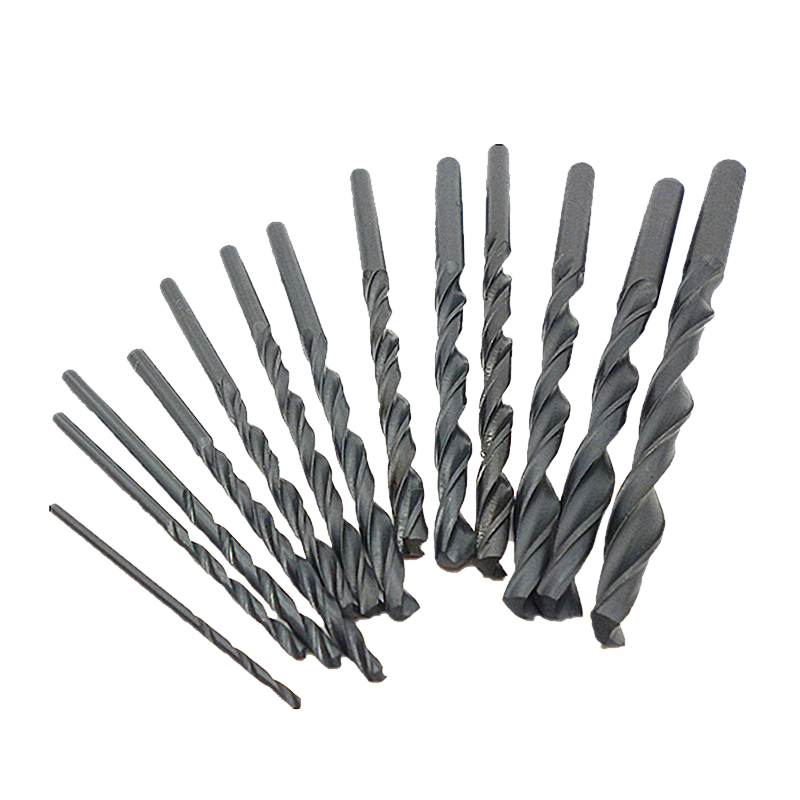
1. Our own copy: half right, half machine-translated
The supplied text has four sentences. Two are useful, one is vague, and one is a machine-translation error worth correcting rather than deleting.
| What the source copy says | Assessment | What we say instead |
|---|---|---|
| “Black oxides increase lubricity and form small pits on the tool surface, which are used to fix the coolant near the cutting edge.” | Correct, and rare. This is the real mechanism, stated accurately. It is simply never followed by an explanation of what it is worth or for how long | Kept and expanded in section 3, including the part the original leaves out: the charge is finite and is spent early |
| “High speed steel cutting tools are suitable for most general applications and have better overall wear resistance.” | Vague. Better than what? The comparison is missing, and “overall” hides which property is being claimed | HSS is stated against carbon tool steel and against carbide, with the property named each time. See our HSS twist drill page |
| “The round handle allows for more tool clamping systems to be used together.” | True but uninformative. Which systems? | Named: three-jaw chuck, drill press spindle, and a quick-change holder with an adapter. See our hex shank page for the accuracy trade that comes with each |
| “When running in a counterclockwise direction, the spiral groove tool will discharge the chips upwards from the incision, reducing blockage.” | Machine-translation error. The rotation direction does not belong in that sentence | Chip ejection follows from helix direction combined with rotation direction. A right-hand bit in a standard clockwise drill ejects upward already |
2. Conversion, not deposition: why it changes how you buy
Two physically different processes are sold under overlapping language, and the difference is not pedantry — it changes what you can measure, what you can claim, and what the finish is worth.
| Deposited coating (TiN, TiCN, TiAlN) | Black oxide — conversion layer | |
|---|---|---|
| What happens | A film of a different material is deposited onto the surface | The iron already in the surface is chemically converted into magnetite. Nothing new is added |
| The layer is | An added film sitting on top of the tool | The tool’s own skin, changed |
| Thickness | Measurable, in the low-micron band, and specified | Nothing to gauge in the film sense. You are measuring a property of the surface, not a layer on it |
| Surface hardness | Substantially higher than the substrate | No gain. The hardness is still the HSS underneath |
| Heat tolerance | Defined by the ceramic: TiN to roughly 600 °C, TiAlN to roughly 800–900 °C | Not a thermal barrier. It cannot help you with cutting heat |
| Corrosion | Incidental benefit where the film is continuous | A real and primary benefit in storage, until the layer is gone |
| Lubricity | Solid-film, lasts as long as the film | Fluid held in pores — real, but finite |
| Cost | A premium, typically in the tens of percent | The low-cost option |
| What you inspect at goods-in | Film thickness, film coverage, colour uniformity, edge condition | Colour uniformity, porosity behaviour, edge condition — no thickness measurement exists |
Our HSS Ti-coated drill bits page owns the full finish ladder, the deposition-versus-conversion mechanism table and the temperature ceiling argument. This page deliberately does not repeat them. What it takes from there is one line — black oxide and amber finish are not depositions at all but chemical conversion layers of magnetite, which add corrosion resistance and a little lubricity — and builds on it, because that sentence is where the interesting part starts.
3. What black oxide actually does: it stores oil
Our own copy got this right, so it is worth taking seriously. The conversion layer is slightly porous. Those pores hold a small volume of fluid against the cutting edge.
What that buys you, concretely:
- Lower friction at the start of a cut. A film of fluid between lip and workpiece is exactly what reduces friction, and the pores keep it where it is needed rather than letting it be thrown off
- Reduced welding and pick-up. In soft and gummy materials — resinous timber, softwood, aluminium, some plastics — material welds to a dry lip. A fluid film at the interface is the main defence
- Better storage behaviour. The converted surface is less reactive than bare steel and the pores hold a protective oil film, which is why black oxide bits usually arrive oiled and survive a toolbox better than bright ones
- Lower glare. Genuinely useful in a bright workshop and genuinely minor. It is the benefit most often listed last and it should be
What it does not do
- It does not add hardness. The surface hardness is the HSS. Any listing claiming a hard black oxide surface is describing a different product
- It does not add a wear-resistant film. There is no ceramic between the lip and the work
- It does not reduce cutting temperature. It has no thermal-barrier property, and in fast dry cutting it is not slowing the heat down at all
- It does not extend edge life in the way a coating does. The gain, where there is one, is early-stage and modest
4. The charge is finite: where the benefit lives and where it does not
This is the part our own copy leaves out, and it is the part that decides whether you should buy these.
The pores hold a small volume of fluid. Fluid is consumed, thrown off and burned off. Once the charge is spent, the bit behaves like a bright HSS bit — not worse, just without the black oxide advantage. That concentrates the benefit sharply:
| Duty | Does the black oxide benefit survive? | Why |
|---|---|---|
| Wet drilling, low speed, interrupted | Yes, and it can be replenished | You are reapplying fluid, so the pores keep getting reloaded |
| Wood, softwood and resinous timber | Partly — the resin problem is real | The fluid film fights gum build-up, which is a genuine wood problem the finish helps with |
| Short runs, occasional use, site work | Yes — this is the sweet spot | Few holes per bit, so the charge is never exhausted, and storage rust matters |
| Long production runs in mild steel, dry | No — gone within the first holes | No fluid to reload the pores and heat is the real limiter |
| Stainless and hardened steel | No | Work-hardening and heat dominate. Use a PVD coating and plenty of fluid |
| High-speed continuous cutting | No | The bit is heat-limited long before the finish is doing anything |
The temperature point, stated carefully
Black oxide is not a thermal barrier, and it cannot help you with cutting heat. That is not the same as saying it fails at temperature. The conversion bath runs well below the tempering temperature of HSS, so the substrate is undamaged by the treatment; the limit is simply that under the layer there is only HSS, and HSS’s red hardness is what it is. Our coating page has the temperature table and the reason PVD, not the finish, is the answer to a heat problem.
5. Colour is not a life signal
This is the most expensive misunderstanding in the category, and it runs in both directions.
Error one: throwing away a bit because the black came off
The layer sits on the surface. It is rubbed off by the walls of the first few holes, by a chuck, by a toolbox, by being dropped in a drawer. None of that touches the cutting edge. Once the colour is gone, the remaining life is governed entirely by the HSS substrate — which is exactly what governs the life of a bright bit. A bit with the flutes worn silver and a sharp, unchipped lip has most of its working life ahead of it.
Error two: trusting a bit because the colour is still there
Equally common, and it happens on the bench rather than in the store. A bit that has drilled three hundred holes in MDF can be uniformly, beautifully black and completely blunt. The layer says nothing about the lip. The symptoms to trust instead are the ordinary ones: the bit needs more pressure, it runs hot, the holes come out rough or oversize, and it stops clearing chips.
| What you observe | What it actually tells you | What to do |
|---|---|---|
| Colour rubbed off the flutes, edge sharp | Normal wear of a surface layer | Keep using it. Wipe it dry and oil it, because the storage protection is gone |
| Colour intact, edge blunt | Nothing — the layer does not report the lip | Sharpen or replace. Colour is not a defence |
| Colour patchy or streaked from new | Uneven conversion in the bath | Query it at goods-in. See section 8 |
| Colour gone and rust appearing | Layer gone, substrate exposed, damp storage | Clean, oil and store dry. It is ordinary HSS now |
| Colour gone only at the margin | Contact wear where the bit actually works | Normal. Judge the lip |
6. The honest tension with our own coating page
Our Ti-coated page concludes that for wood, plastics and PVC a bright finish is the better specification. That conclusion is correct on the grounds it was argued: wood does not generate the cutting heat that a hard coating addresses, so paying a premium for one does not pay back.
This page does not contradict it. It answers a different question.
| What you are buying | Right finish | Why |
|---|---|---|
| Edge life and cutting efficiency in wood | Bright (or a PVD coating if you also cut steel) | No heat to justify a hard film; the premium does not return |
| Corrosion resistance in storage and transit | Black oxide | A real, primary benefit. Converted surface plus held oil film |
| Early-stage lubricity and anti-gum | Black oxide | Fluid held at the edge fights resin build-up, which is a genuine wood problem |
| Lowest cost per bit | Black oxide | It is the cheap option, and in short-run work the cheap option is the right one |
| Edge life in ferrous work | TiN or TiCN | A deposited ceramic film, and it pays for itself in steel and cast iron |
| Heat tolerance and stainless | TiAlN | Stable far above where black oxide or TiN have anything left to give |
7. The single-bit case: what you are actually replenishing
These are supplied as single bits by diameter, and the replenishment logic is the ordinary one that works across our single-bit pages: consumption follows a power law, so a handful of diameters do most of the work and the rest of the drawer barely moves.
What is different about a black oxide single bit is that the thing you are replacing is a size, not a finish. Three consequences:
- Match the size, not the colour. When you reorder, you are buying back a diameter and a length. Whether it arrives black oxide or bright is a separate decision, and it should be made on section 6, not by matching what is in the drawer
- The finish does not survive into your replacement cycle. A bit that has lost its layer is still the right size, so there is no finish-based reason to retire it early
- Buy the sizes you actually use. A single bit in the diameter you drill weekly beats a set that covers twelve diameters you do not, and our step drill page makes the same argument about ranges rather than sizes
What to buy in single form and what to buy as a set
- Single: the two or three diameters you use constantly, where a spare in the working size is genuinely useful and where breakage is the usual cause of loss
- Single: odd sizes that a set does not contain, and sizes you only use for one recurring job
- Set: when you need coverage across a range, when the sizes are shared between several people, or when the case itself is doing work — see our HSS twist drill set page for why packaging is a specification and not an afterthought
8. Goods-in inspection when there is no film to measure
If you inspect a PVD-coated bit you measure the film. There is no film here, so the inspection list changes. Six checks:
- Colour uniformity. An even matte black across flutes, margins and point. Streaks, patches or bright spots mean an uneven conversion bath, and a bit with an incomplete layer will not hold its oil film where it matters
- Roll it on a flat surface and watch the cutting edge. Not the shank. A bent bit is the most common handling and transit damage, and no surface finish will hold a bent bit true
- Measure the diameter at the margin. Not at the coloured band and not at the shank. The margin is the dimension that makes the hole
- Check the point for grinding burn. A blue or straw tint on the point means the edge has been overheated in grinding and will be soft. This is the one place a colour change is meaningful, and it is not the black
- Look at the lip under magnification. Chips, burrs and an unsymmetrical grind are invisible to the eye and obvious to a loupe. An eccentric grind produces oversize holes and no visual check catches it
- Cut a test hole in your own material and measure it. The only check that catches eccentric grinding and a lip that is not cutting
9. Wood specifically: resin, gum and the first ten holes
In wood the black oxide question is really a resin question, and resin is a real problem that a bright bit does nothing about.
Why gum builds up
Softwood and resinous timber carry resins and sugars that soften with friction, migrate to the hot lip, and weld there. A packed flute stops clearing chips, temperature climbs, the hole burns, and the bit can seize. The fluid film held in the pores is the main defence a surface finish can offer, and it works best exactly where the problem is worst — at the lip, at the start of the cut.
What actually helps, in order
- Peck. Withdraw fully and often. This clears the flute, and a clear flute is worth more than any finish. It is the single highest-value habit on this page
- Reapply fluid on longer runs. The pores hold a charge; they do not generate one. A drop of oil every dozen holes reloads them
- Back the work. Stops break-out at the exit face and holds the fibre down at entry
- Feed steadily. A light feed rubs instead of shears, which is what generates the heat that softens the resin in the first place
- Clean the flutes. A wire brush takes dried resin off the steps and out of the flute. Dried resin in a packed flute is a permanent heat trap
10. Full specifications
| Parameter | Specification |
|---|---|
| Product | Black oxide drill bits, supplied as single bits by diameter |
| Surface treatment | Black oxide chemical conversion layer. Not a deposited coating — no film thickness, no hardness gain |
| Substrate | HSS M2 (W6Mo5Cr4V2 / 6542 / SKH51 / HS6-5-2) as standard |
| Shank | Straight round. Fits three-jaw chucks, drill press spindles and quick-change holders with an adapter |
| Diameter range | 1–13 mm typical jobber range; other diameters to order |
| Point angles | 118° and 135°; split point available |
| Flute | Right-hand spiral as standard; left-hand to order |
| Lengths | Jobber (DIN 338) as standard; stub and reduced lengths to order |
| Corrosion resistance | Better than bright finish while the layer is intact; none once it is rubbed off |
| Lubricity | Fluid held in the pores of the layer. Finite — spent early unless fluid is reapplied |
| Heat tolerance | No thermal-barrier property. The limit is the red hardness of the HSS substrate |
| Not suitable for | Dry high-speed continuous cutting in steel; stainless; hardened steel; masonry; impact drivers unless impact-rated |
| Alternative finishes | Bright, amber / bronze oxide, TiN, TiCN, TiAlN — see our Ti-coated page for the comparison |
| Packaging | Single bit in tube, blister card or cloth bag. Private label packaging to order |
| MOQ | Indicative: from 500 pieces for a stock diameter and length; from 1,000 pieces for private profile or private label |
| Lead time | Indicative: 15–25 days for stock configurations; 30–45 days for OEM production |
11. How to specify a black oxide bit on an export order
- Diameter, and the tolerance you hold it to. Measure at the margin. Undersize makes a loose hole; oversize makes a tight one, and neither is recoverable
- Length and length standard. Jobber, stub or reduced, and to which standard. A short bit in a deep hole is a returns problem
- Point angle. 118° for general work, 135° where you want less walking and more strength at the point; split point if self-centring matters
- Helix direction. Right-hand as standard. Left-hand only if the customer genuinely runs a reversible machine, and be sure they know what they are asking for — see section 1
- Substrate grade. M2 as standard. Do not upgrade to cobalt by reflex; read the argument on our step drill page first
- Surface treatment, named as what it is. Black oxide conversion, not a coating. If a customer asks for a black oxide coating thickness, clarify which product they mean
- Shank form. Straight round as standard; hex or three-flat to order, and note that shank choice is a machine decision — see our hex shank page
- Marking and packaging. Diameter marking, private label, barcode and insert cards to order
12. Troubleshooting
| Symptom | Most likely cause | What to change |
|---|---|---|
| Flute packing with gum or resin | Resinous timber, and the fluid charge in the pores is spent | Peck to clear, reapply fluid, brush the flute clean. See section 9 |
| Bit needs more pressure than it used to | The lip is blunt | Sharpen or replace. Colour is not a defence — section 5 |
| Holes rough or oversize | Dull lip, or eccentric grinding | Cut a test hole and measure. Judge the edge, not the finish |
| Rust on the flutes after storage | Layer rubbed off, damp storage | Wipe dry, oil, store dry. It is ordinary HSS now |
| Patchy black finish from new | Uneven conversion in the bath | Query it at goods-in. Section 8, check one |
| Blue or straw tint at the point | Grinding burn — the edge was overheated in manufacture | Reject. This is the one colour change that means something |
| Bit spins in the chuck | Round shank under high torque, or oily or worn jaws | Clean the jaws, drop to low gear, or move to a three-flat shank |
| Bit chatters or cuts a polygon | Hand-held with insufficient thrust, or drive-line run-out | Use a press; check run-out. See our hex shank page |
| Rapid edge wear in steel, dry | Black oxide is the wrong finish for the duty | Move to a PVD coating with fluid. Sections 4 and 6 |
| Bit twisted or cracked at the shank | Impact driver without impact-rated treatment | Use a conventional drill or a drill press |
13. Applications
Where black oxide is the right specification
- General woodworking in a home or small workshop. Short runs, mixed materials, storage in a toolbox rather than a climate-controlled store
- Resinous timber and softwood. Where gum build-up is the real enemy and a fluid film at the lip helps
- Occasional and maintenance use. Few holes per bit, so the charge is never exhausted and the storage benefit is real
- Wet drilling at low speed. Where you are applying fluid anyway and the pores keep getting reloaded
- Private label and retail programmes where the matte black finish photographs well and the cost per bit matters
Where a different finish is the right specification
- Production runs in steel, dry — use a PVD coating with fluid
- Stainless and hardened steel — use TiAlN, and never black oxide
- Pure wood where only edge life matters — a bright finish is the honest answer
- Impact drivers — a shank and heat-treatment question, not a surface question
Where none of them is the right tool
- Large holes in panel — use a wood hole saw set or a bi-metal hole saw
- Flat-bottomed holes — use a Forstner bit
- Fast rough holes in timber — use a spade bit
- Deep holes — use an auger bit
- Multiple diameters in thin sheet — use a step drill
14. Frequently asked questions
Is black oxide a coating?
No, and the difference is not pedantry. A coating such as TiN or TiAlN is a film of a different material deposited onto the surface, a couple of microns of ceramic that adds hardness and can be measured. Black oxide is a chemical conversion layer: the iron already in the surface is converted into magnetite, so the layer is the tool’s own skin changed rather than anything added. That is why a black oxide bit has no film thickness worth gauging and no surface hardness gain, and why the goods-in checks for a coated bit and a black oxide bit are different exercises.
What does black oxide actually do for a drill bit?
Two things, both modest and both real. The conversion layer is slightly porous, so it holds a thin charge of cutting fluid or oil against the edge, which lowers friction early in the cut and helps stop material welding to the lip. And the converted surface is less chemically reactive than bare steel, so the bit resists storage rust better than a bright finish. What it does not do is add hardness, add a wear-resistant film, or meaningfully reduce the temperature at the cutting edge.
How long does the black oxide benefit last?
The oil-storage part is finite and is spent early. The pores hold a small volume of fluid and once that charge is gone the bit behaves like a bright HSS bit, so the benefit is concentrated in the first few dozen holes and in work where fluid is present or reapplied. The corrosion-resistance part lasts as long as the layer does, which is until it is rubbed off or worn through. Neither benefit survives dry, high-speed, continuous cutting, where the layer is doing nothing for you and the heat is the thing that actually limits the bit.
Should I throw a drill bit away when the black colour wears off?
No, and this is one of the more expensive habits in a workshop. Once the layer is gone the remaining life is governed by the HSS substrate, so a bit with the colour rubbed off the flutes but a sharp, undamaged edge has most of its working life still in front of it. Judge the edge, not the colour. The reverse error is just as common: a bit that is still perfectly black can be completely blunt, because nothing about the layer tells you anything about the lip.
Is a black oxide drill bit better than a TiN coated one?
Not in the abstract, and asking the question that way is the mistake. TiN is a deposited ceramic film that adds hardness and stays stable to around 600 °C, so it pays for itself in ferrous work by extending edge life, and it typically costs 20 to 50 percent more than black oxide. Black oxide adds no hardness and its benefit is early-stage lubricity and storage corrosion resistance. If you are buying edge life in steel, buy TiN. If you are buying corrosion resistance, mild early-stage lubricity and the lowest cost per bit, buy black oxide. Our Ti-coated page works through the full comparison and the numbers.
Is black oxide good for drilling wood?
It is reasonable rather than ideal, and it is worth being precise about why. On edge life and cutting efficiency in wood, a bright finish is normally the better specification, because wood does not generate the heat that a hard coating addresses. What black oxide buys you in wood is different and genuine: the pores hold fluid against the edge, which helps with the gum and resin that build up on a bit working softwood or resinous timber, and the converted surface handles damp storage better than bare steel. If your problem is resin loading rather than edge life, black oxide is a sensible answer.
Do black oxide drill bits rust?
Less readily than a bright HSS bit, but they are not rustproof and they are not stainless. The conversion layer is less reactive than bare steel and it holds a film of oil, which is why black oxide bits usually arrive with a light oil film and survive storage better. Once the layer is worn or rubbed off, the exposed substrate is ordinary HSS and will rust in a damp toolbox, a wet van or an unheated container. Wipe them dry, keep them oiled, and do not read the black colour as a guarantee.
How do I check the quality of a black oxide drill bit if there is no coating to measure?
You inspect the things that are actually there. Check that the colour is even, because patchy or streaked finish means an uneven conversion bath. Roll the bit on a flat surface and watch the cutting edge rather than the shank, because a bent bit is the most common handling damage. Measure the diameter at the margin rather than at the coloured band. Look at the point for grinding burn. And cut a test hole in your own material, because eccentric grinding and a blunt lip are the two failures that no visual check catches.
Why does my listing say the spiral groove discharges chips upwards when running counterclockwise?
Because our own source copy contains a machine-translation error, and we have corrected it rather than quietly deleting it. The intended meaning is that the spiral groove lifts chips up and out of the cut, which reduces packing. The rotation direction was wrongly attached to that function. Chip ejection depends on the helix direction combined with the rotation direction, not on the machine running anticlockwise: a right-hand bit in a standard clockwise drill ejects chips upward already, and a genuinely anticlockwise-running bit would eject them downward and pack the flute worse.
Can I use a black oxide drill bit in an impact driver?
Not unless it is specifically impact-rated, and these are not. An impact driver delivers torque as rotational hammer blows, so the shank is loaded in fatigue rather than in steady torsion, and a standard HSS bit can twist or crack at the shank. Use a three-jaw chuck in a conventional drill or a drill press. If you need impact-driver compatibility, that is a shank and heat-treatment specification, not a surface finish, and our hex shank page covers what to ask for.
What does the round shank give me that a hex shank does not?
Centring accuracy, and a wider range of holding systems. A round shank in a three-jaw chuck self-centres as the jaws converge on a continuous cylindrical surface, which is why it is the standard for drill press work, while a quick-change hex holder locates the bit against discrete flats and runs out more. The round shank also drops into a drill press spindle and, with an adapter, into a quick-change holder. Our hex shank page sets out the run-out figures for both systems.
MOQ, lead time, OEM and samples?
Black oxide drill bits are specified by diameter, point angle, flute length and shank rather than picked from a fixed list, so terms follow the configuration. Indicative minimum order quantity starts from 500 pieces for a stock diameter and length combination and from 1,000 pieces for a private profile, a non-standard length or private label packaging. Indicative lead time is 15 to 25 days for stock configurations and 30 to 45 days for OEM production. Samples are available for testing after terms are confirmed, with the sample cost credited against a subsequent order. Please confirm current figures with us before publishing them.
Related products
Surfaces and substrates: HSS Ti-coated Drill Bits Set — the finish ladder, deposition against conversion, and the temperature ceiling. HSS Twist Drill Bits Set, Ti-coated Drill Bits, Amber-Finished Drill Bits. Shanks: Wood Hex Shank Drill Bits. Wood boring: Wood Step Drill Bits, Wood Step Drill Bits Set, Wood Forstner Drill Bits, Wood Forstner Drill Bits Set, Wood Flat Drill Bits Set, Wood Auger Core Drill Bits Set, Wood Auger Core Drill Bits, Wood Countersink Drill Bits. Larger holes: Bi-Metal Hole Saw Sets, 16 PCS Wood Hole Saw Sets.
OEM & Wholesale
GUSHI has manufactured drilling and cutting tools in Huzhou, Zhejiang since 1998, and we supply black oxide drill bits as single bits and in sets to importers, distributors and private label programmes. Because a single bit is defined by diameter, length, point angle and shank rather than by a catalogue number, most of what we ship in this category is configured.
- Configuration. Diameter, length and length standard, point angle, helix direction, shank form
- Substrate. M2 as standard, with substrate grades to order
- Surface. Black oxide conversion as standard, with bright, amber, TiN, TiCN and TiAlN available on the same geometry
- Private label. Laser marking, packaging, barcode and insert cards
- Quality. 100% inspection before shipment, with diameter at the margin, point condition and colour uniformity checked
- Terms. T/T, L/C, D/A, D/P and PayPal according to circumstance. Samples after terms are confirmed, credited against a subsequent order