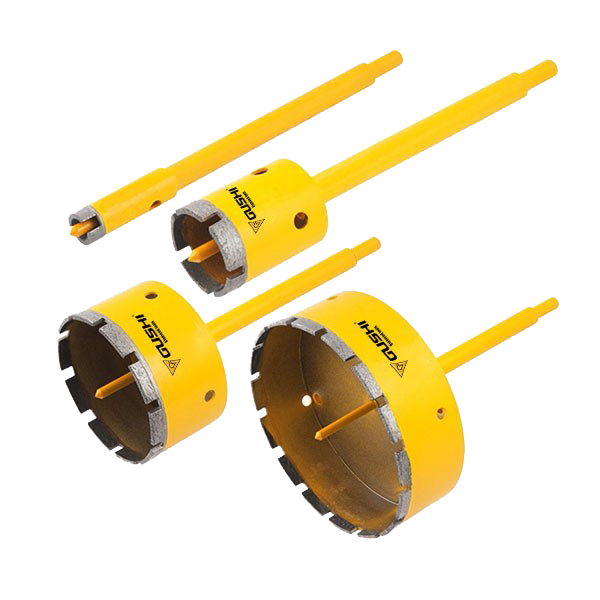
1. The listing, audited
The page for this bit is five lines long. Three of them are wrong in a way that would change what a buyer orders, and one is wrong in a way that would change whether the bit survives its first hole. It is worth going through them before anything else, because the rest of this page is built on what the numbers actually mean.
| What the listing says | What is wrong | What to write instead |
|---|---|---|
| Suitable machines: all electric drills | A 220 mm crown in masonry needs roughly 1.5 kW at the spindle and a torque a handheld drill cannot supply without stalling. A 19 mm crown needs a fraction of that. One sentence cannot cover both ends of a 26-size range. | Handheld rotary drill up to 65 mm; drill stand from 80 mm; fixed rig with water feed from 150 mm. |
| Guide rod length: 75 mm | Mislabelled. The 75 mm is the working length of the crown — the depth of one pass. The guide rod is the centre pin that projects ahead of the segments. The same product sold through another channel prints 75 mm as working length and 150–500 mm as guide rod length, which is the reverse of this page. | Working length 75 mm. Shank 150/200/300/400/500 mm. Centre guide rod fitted, projecting ahead of the rim. |
| No-load speed: maximum 3,000 rpm | This is a ceiling for the machine, not a setting for the bit. At 220 mm, 3,000 rpm puts the rim at 34.6 m/s, which is saw-blade territory and far outside what a coring crown tolerates. At 19 mm it is barely enough. | A rim speed around 2.5 m/s, which is about 48,000 divided by the diameter: 2,500 rpm at 19 mm down to 220 rpm at 220 mm. |
| Application: tiles, ceramic tiles, ceramic blocks | A wall tile is 8 to 12 mm thick. A 75 mm working length is five times the job, and a long shank converts every wrist movement into a lever at the rim, which is exactly how tile edges chip. Including tile in the list sells the bit into the job it is worst at. | Granite, natural stone, concrete block, brick, masonry and roof tile. Not a tile or porcelain bit. |
| Diameters 19–220 mm, shank 150–500 mm | Presented as two independent lists, which implies 130 usable combinations. The combinations are not equally usable: a 19 mm crown on a 500 mm shank is a 26:1 slender shaft and cannot be held straight by hand. | Publish the length-to-diameter ratio beside each combination, or restrict long shanks to the larger diameters. |
| Missing entirely | Shank fitting, segment count, segment height, bond, recommended condition, whether the centre rod ships with the bit. | All six, because the shank fitting alone decides whether the bit mounts at all. |
The listing does get one thing right that most competitor pages leave out: it prints the shank lengths as a separate field rather than folding them into one number. The problem is only that the two fields are the wrong way round.
2. Two lengths, two different jobs
Every core bit has a working length and every long shank bit has a shank length, and they are not interchangeable in either direction. One is how far the diamond can cut before the barrel is full. The other is how far the motor sits from the work. Confusing them produces two opposite mistakes, and both are common.
| Length on the drawing | The number | What it actually governs | What happens if you read it as the other one |
|---|---|---|---|
| Working length | 75 mm, all diameters | The cutting depth of one pass. When 75 mm of core is inside the barrel, the bit stops cutting and has to come out. | You expect a 500 mm shank to cut a 500 mm core in one go, fill the barrel, and stall or jam the bit. |
| Shank length | 150, 200, 300, 400, 500 mm | The reach. How far the chuck can be from the barrel, which is how far back the motor can sit. | You buy a 150 mm shank for a job that needs the motor held behind a pipe, and find the drill body still fouls the wall. |
| Extension ratio | 2.0 to 6.7 × the crown | How much the assembly amplifies a wrist movement, and how much room there is for the chips to travel. | Treated as a free upgrade: longer is assumed to be more capable, when it is mostly less rigid. |
The extension ratio is just shank divided by working length. At 150 mm it is 2.0; at 300 mm it is 4.0; at 500 mm it is 6.7. Nothing about the ratio makes the bit cut deeper. It only changes where the motor can be and how much leverage the operator has over the rim.
Why the crown is deliberately short
A 75 mm crown is not a cost saving. It is a decision about torque, friction and core removal, and each one gets worse quickly as the barrel lengthens.
- Friction area. The side wall of the barrel rubs the hole over its whole length. Doubling the barrel roughly doubles the drag, and the drag has to come out of the same motor.
- Core removal. A 75 mm core is short enough to break out with a wiggle or a tap. A 400 mm core in a slender barrel has to be pushed out, and pushing it out from the motor end is often impossible.
- Slurry transport. Wet cuttings have to travel up the annulus between core and barrel. The longer that path, the more likely the fines settle and pack.
- Weight at the rim. Mass at the far end of a slender shaft is what makes a long assembly feel like it has a mind of its own. Keeping the crown short keeps the mass near the cut.
So the design is: a short, stiff cutting head, and a long, light delivery tube. The tube is a positioning device. It is not a cutting structure, and it should not be asked to behave like one.
What the reach is actually for
Four situations account for almost every long shank order, and none of them is about depth.
| Situation | Why a short bit fails | Shank length that usually works |
|---|---|---|
| Drilling up into a ceiling or soffit | The drill body and the operator’s knuckles hit the slab before the crown reaches it | 200–300 mm |
| Between a pipe and a wall, or inside a service shaft | The chuck cannot get square to the surface | 300–500 mm |
| Through a wall from one side only, motor held clear of the face | The barrel bottoms out against the wall before the shank is long enough | 300–400 mm |
| Drilling down into a floor trough or a recessed slab | The motor fouls the upstand | 150–300 mm |
| Deep hole in a thick wall | This is the one case people assume, and it is the one where a short crown is least helpful | Any, but as multiple passes |
Read that table again: the reach is a rigging problem, not a drilling problem. The hole is never deeper than 75 mm in a single pass, whatever the shank.
3. One degree of wrist
The shank does not bend much under its own weight. A 19 mm tube 500 mm long sags about 0.07 mm at the tip, which is nothing. What it does instead is act as a lever arm, and a lever arm does not need to bend to move the far end a long way.
If the operator’s wrist is off square by an angle θ, the cutting end is displaced sideways by approximately L × tan θ, where L is the shank length. That is the whole mechanism behind most wandering holes on long shank bits.
| Wrist error | 150 mm shank | 200 mm | 300 mm | 400 mm | 500 mm |
|---|---|---|---|---|---|
| 0.5° | 1.3 mm | 1.7 mm | 2.6 mm | 3.5 mm | 4.4 mm |
| 1° | 2.6 mm | 3.5 mm | 5.2 mm | 7.0 mm | 8.7 mm |
| 2° | 5.2 mm | 7.0 mm | 10.5 mm | 14.0 mm | 17.5 mm |
| As a share of a 19 mm bit at 1° | 14% | 18% | 28% | 37% | 46% |
| As a share of a 220 mm bit at 1° | 1.2% | 1.6% | 2.4% | 3.2% | 4.0% |
Two things fall out of that table, and they pull in opposite directions.
Small diameters punish long shanks. On a 19 mm bit, one degree of wrist error at 500 mm is 46% of the hole diameter. The bit is not wandering because the diamond is bad or the material is variable; it is wandering because the operator is holding a lever. No amount of care removes this — it can only be reduced by shortening the shank, adding a stand, or accepting that the hole will be oval and off-centre.
Large diameters hardly notice it. The same 8.7 mm is 4% of a 220 mm hole, well inside what a core bit leaves anyway. So the long shank is at its most harmless on the big diameters and at its most destructive on the small ones — which is the exact opposite of how the listing presents the range, and the opposite of how most buyers order.
4. Slenderness: what stays straight
The number that decides whether a long shank assembly behaves or fights you is not the shank length on its own. It is the shank length divided by the diameter. A 300 mm shank on a 100 mm crown is a stubby, well-behaved tool. The same 300 mm on a 20 mm crown is a length of thin tube with a cutting ring on the end.
| Diameter | 150 mm | 200 mm | 300 mm | 400 mm | 500 mm |
|---|---|---|---|---|---|
| 19 mm | 7.9 | 10.5 | 15.8 | 21.1 | 26.3 |
| 20 mm | 7.5 | 10.0 | 15.0 | 20.0 | 25.0 |
| 25 mm | 6.0 | 8.0 | 12.0 | 16.0 | 20.0 |
| 30 mm | 5.0 | 6.7 | 10.0 | 13.3 | 16.7 |
| 35 mm | 4.3 | 5.7 | 8.6 | 11.4 | 14.3 |
| 40 mm | 3.8 | 5.0 | 7.5 | 10.0 | 12.5 |
| 50 mm | 3.0 | 4.0 | 6.0 | 8.0 | 10.0 |
| 60 mm | 2.5 | 3.3 | 5.0 | 6.7 | 8.3 |
| 80 mm | 1.9 | 2.5 | 3.8 | 5.0 | 6.3 |
| 100 mm | 1.5 | 2.0 | 3.0 | 4.0 | 5.0 |
| 120 mm | 1.3 | 1.7 | 2.5 | 3.3 | 4.2 |
| 150 mm | 1.0 | 1.3 | 2.0 | 2.7 | 3.3 |
| 220 mm | 0.7 | 0.9 | 1.4 | 1.8 | 2.3 |
The red figures are above 20:1. There are only five of them, and all five are in the bottom-left corner of the range — the small crowns on the long shanks. That is the region where the listing sells the most combinations and where the physics is least forgiving.
How to read the ratio
| Ratio | Behaviour | What it means for the operator | What to do |
|---|---|---|---|
| under 8 | Stiff, self-supporting | Handheld is realistic; the bit follows the hole | Normal drilling, watch the entry angle only |
| 8 to 15 | Compliant but controllable | Two hands, steady feed, no sideways pressure | Start on a guide mark, check the hole at half depth |
| 15 to 20 | Flexible | The bit starts to follow the operator rather than the hole | Shorten the shank, or use a stand |
| over 20 | Whip and wander | Vibration at the rim, oval hole, chipped segments | Rig-mounted only; do not attempt by hand |
The ratio is also why the same bit feels completely different in two materials. In soft block the crown bites and the hole self-centres, so a 20:1 assembly can still produce an acceptable hole. In hard granite the crown skates until it has a groove, and a 20:1 assembly will not hold the groove it starts. Slenderness tolerance is a function of how quickly the material gives the bit a track.
5. 75 mm per pass: the arithmetic of a wall
Because the working length is 75 mm, the number of passes is simply the wall thickness divided by 75, rounded up. That is not a limitation of the diamond — it is the point at which the barrel is full and the bit stops cutting.
| Wall or slab thickness | Passes required | Depth cut in the final pass | What usually goes wrong |
|---|---|---|---|
| 75 mm or less | 1 | Full 75 mm or less | Nothing, if the entry is square |
| 100 mm | 2 | 25 mm | Second entry is off-centre because the first hole is used as the guide |
| 120 mm | 2 | 45 mm | Core from the first pass left in the barrel and jammed by the second |
| 200 mm | 3 | 50 mm | Slurry packs in the barrel between passes |
| 240 mm | 4 | 15 mm | Breakthrough happens with the barrel nearly empty, so the exit chips |
| 300 mm | 4 | 75 mm | Alignment drift accumulates across four entries |
| 370 mm | 5 | 70 mm | Poor flushing at the third and fourth pass |
| 500 mm | 7 | 50 mm | Seven entries through one hole; drift is the whole problem |
The cost of re-entering
Each pass is a fresh entry. The crown has to find the existing hole, sit square in it, and start cutting without climbing the wall. On a well-guided bit the entry error is well under a millimetre. On a slender assembly held by hand, each entry can add one to three millimetres of offset, and the offsets do not cancel — they accumulate in whichever direction the operator leans.
Four passes at 2 mm each is 8 mm of drift on a 100 mm hole. That is not a drilling error, it is a geometry error, and it is the reason a 240 mm wall is the practical limit for handheld work on this type of bit even though the shank is long enough to reach much further.
Getting the core out between passes
- Withdraw with the motor running. Stopping the spindle with the crown still in the cut lets the fines settle around the barrel and set.
- Flush before you look. Water through the barrel from the shank end pushes the core out far more reliably than tapping the barrel on the floor.
- Never pry the core with the segments. The rim is the part that has to hold tolerance; a lever against it is how a segment gets a hairline crack that only shows up twenty holes later.
- Dry the fitting before re-entering. Grit left on the shank seat is what makes the next pass run out of true.
6. Speed follows diameter, not the label
The listing says maximum 3,000 rpm, which is a machine ceiling and not a setting. What actually matters is how fast the rim travels, because that is what the diamond sees. Hold the rim speed near 2.5 m/s, which is a normal wet-coring figure for a segmented crown in masonry, and the spindle speed falls as the diameter rises.
| Diameter | rpm for a 2.5 m/s rim | Rim speed at the listed 3,000 rpm | Verdict on 3,000 rpm |
|---|---|---|---|
| 19 mm | 2,500 | 2.98 m/s | Usable, at the top of the window |
| 20 mm | 2,400 | 3.14 m/s | Usable |
| 25 mm | 1,900 | 3.93 m/s | Above the window |
| 30 mm | 1,600 | 4.71 m/s | Above the window |
| 35 mm | 1,370 | 5.50 m/s | Too fast |
| 40 mm | 1,200 | 6.28 m/s | Too fast |
| 50 mm | 960 | 7.85 m/s | Too fast |
| 60 mm | 800 | 9.42 m/s | Too fast |
| 65 mm | 740 | 10.2 m/s | Segment glazing is likely |
| 80 mm | 600 | 12.6 m/s | Serious over-speed |
| 100 mm | 480 | 15.7 m/s | Serious over-speed |
| 120 mm | 400 | 18.8 m/s | Serious over-speed |
| 150 mm | 320 | 23.6 m/s | Blade territory, not coring |
| 165 mm | 290 | 25.9 m/s | Blade territory, not coring |
| 220 mm | 220 | 34.6 m/s | Dangerous; the crown will overheat and the bit will grab |
Doubling the diameter halves the correct spindle speed. That is all the table says, and it is enough to show why a single maximum cannot be printed without a diameter attached to it. A 3,000 rpm ceiling is a fair description of the smallest three sizes and a dangerous instruction for the largest five.
These figures are a rim-speed calculation, not a bond recommendation. The right speed for a specific crown also depends on how hard the bond is: a hard bond needs to run slower so it does not polish, a soft bond needs to run faster so it keeps exposing diamond. Use the table to bracket the setting, then adjust within it by watching the segments rather than the number.
7. What the short crown is for
The 75 mm crown is also a power decision. Cutting power is roughly the volume of material removed per second multiplied by the specific energy of the material, and the volume rate is the annulus area times the feed rate. Because the annulus area grows with diameter, keeping power inside a handheld drill’s budget means reducing the feed rate as the diameter rises.
| Diameter | Annulus area | Workable feed | Cutting power | Input at 60% efficiency | Time for one 75 mm pass |
|---|---|---|---|---|---|
| 19 mm | 90 mm² | 1.5 mm/s | 200 W | 335 W | 50 s |
| 25 mm | 118 mm² | 1.3 mm/s | 230 W | 385 W | 58 s |
| 32 mm | 201 mm² | 1.2 mm/s | 360 W | 600 W | 63 s |
| 40 mm | 251 mm² | 1.1 mm/s | 415 W | 690 W | 68 s |
| 50 mm | 314 mm² | 1.0 mm/s | 470 W | 785 W | 75 s |
| 65 mm | 511 mm² | 0.9 mm/s | 690 W | 1,150 W | 83 s |
| 80 mm | 628 mm² | 0.8 mm/s | 755 W | 1,260 W | 94 s |
| 100 mm | 785 mm² | 0.7 mm/s | 825 W | 1,375 W | 107 s |
| 120 mm | 942 mm² | 0.6 mm/s | 850 W | 1,415 W | 125 s |
| 150 mm | 1,178 mm² | 0.5 mm/s | 885 W | 1,475 W | 150 s |
| 165 mm | 1,296 mm² | 0.45 mm/s | 875 W | 1,460 W | 167 s |
| 220 mm | 1,728 mm² | 0.35 mm/s | 905 W | 1,510 W | 214 s |
This is why the listing’s “all electric drills” cannot stand. From 65 mm upward the input power is around 1.2 kW or more at a feed slow enough to be useful, and a typical handheld drill of 800 to 1,000 W will bog down and then stall. The workaround is to feed more slowly, which is exactly what the right-hand column shows: the power stays roughly flat because the feed is being cut, and the time per pass grows instead.
A 220 mm crown is three and a half minutes of continuous cutting for 75 mm of depth, before any withdrawal or core removal. Two passes through a 120 mm wall with cleaning between them is closer to twelve minutes. That number is what a quotation should be built on, not the diameter.
What this means for choosing the shank
Because the crown is short, the shank’s mass is the dominant weight in the assembly, and mass at the far end of a lever is what makes a long bit tiring. A 500 mm shank on a 220 mm crown is a heavy tool that wants a stand. The same 500 mm shank on a 25 mm crown is light enough to wave around and stiff enough to be a nuisance at the same time — light, but not straight. Those are the two failure modes at opposite ends of the range, and they are both worse than the middle.
8. Nine materials, three behaviours
The listing puts granite, marble, stone, walls, masonry, tile, floor, ceramic tile and ceramic block in one sentence. They do not behave alike, and two of them should not be on the list at all. What matters for a long shank bit is whether the material gives the crown a track quickly, and whether it wears the bond fast enough to keep the diamond exposed.
| Material | Hardness and abrasiveness | Long shank verdict | Reason |
|---|---|---|---|
| Granite | Hard, abrasive, homogeneous | Good | The crown bites, the hole self-centres and the abrasive wear keeps the bond open |
| Natural stone, hard limestone | Medium hard, low abrasiveness | Acceptable | Bond tends to polish; needs a softer bond or more feed pressure |
| Sandstone | Soft but extremely abrasive | Acceptable, short life | Wears the segment fast; a long shank magnifies vibration in a friable material |
| Marble | Soft, low abrasiveness | Poor | Soft material does not refresh the bond, so the crown glazes; long shank vibration chips the entry |
| Concrete block | Medium, with aggregate | Good | Even load, self-centring, the classic use for this bit |
| Brick | Soft, low abrasiveness | Good | Cuts easily; the risk is over-feeding rather than stalling |
| Masonry and blockwork | Mixed | Good | Layered material needs flushing more than it needs speed |
| Floor slab and soffit | Medium to hard | Good, with a stand | The reach is the reason for the bit; the stand is the reason the hole is straight |
| Wall tile, porcelain tile | Hard, thin, brittle | Wrong tool | 8 to 12 mm thick against a 75 mm crown, and edge chipping is guaranteed by the leverage |
| Ceramic block, hollow | Hard shell, empty core | Wrong tool | The shell breaks before the crown finishes; a hole saw or a small core bit is the right answer |
The two materials to take off the list
Tile. A 75 mm working length is five times what a 10 mm tile needs, and the shank turns a 1° wrist error into 8.7 mm at the rim. The bit will make the hole, chip the glaze and leave a ragged edge, and a cheap hole saw would have done it cleanly.
Hollow ceramic block. The crown enters the shell, meets air, and the unsupported shell breaks away. Nothing about a diamond crown is designed for a 20 mm wall followed by a void followed by another 20 mm wall. Use a masonry bit, or a hole saw, and accept a rougher hole.
Wet or dry, decided by the dust rather than the diamond
The listing says dry or wet, and both are true. What decides between them is not the segment but the air. Dry coring of masonry produces respirable crystalline silica, and the control for that is extraction at the rim. On a long shank bit the rim is 150 to 500 mm away from the motor, so an extraction hood has to be built around the barrel rather than clipped to the drill. Wet coring removes the dust problem and the flushing problem at once, which is why it is the default for this type of bit.
9. Diagnosis
| Symptom | Most likely cause | Test | Fix |
|---|---|---|---|
| Bit skates across the surface at the start | Centre rod not projecting, or the crown is being laid flat instead of started on an edge | Look at the rod: it should stand 20 mm or more ahead of the segments | Check the rod is fitted and free; start at a shallow angle until a crescent groove forms, then square up |
| Hole drifts a few millimetres over depth | Slenderness above 15:1, or accumulated entry error across passes | Measure the hole at half depth with a straight edge across the face | Shorten the shank, or move to a stand; on multi-pass work, re-enter with the rod in contact |
| Segments shiny, penetration collapses | Bond glazed from too much speed and too little pressure | Look at the segment face: bright and smooth means glazed | Drop the speed, increase the feed, and dress the crown on abrasive brick to open the bond |
| Barrel jams and the motor stalls | Core packed inside the 75 mm crown | Withdraw and look into the barrel | One pass is 75 mm, no more; withdraw and break the core out |
| Shank hot to the touch near the chuck | Chuck slipping, or a bent shank running out of true | Feel the shank 50 mm from the chuck after thirty seconds | Re-tighten or replace the chuck; check runout with a dial gauge |
| Exit face spalls or blows out | Feed held constant through breakthrough | Look at the exit side before the crown breaks through | Halve the feed over the last 5 mm and support the exit with a clamped board |
| Barrel fills with paste and stops cutting | Not enough water, or water going around the outside only | Look at what comes out of the slots | Increase flow, withdraw every 75 mm, and check the slots are not packed |
| Segment detaches at the weld | Overheating from dry running or a glazed crown run at speed | Look at the fracture: torn steel means the weld was stronger than the barrel; a clean grey face means the weld itself cooked | Wet cutting, correct speed, and never run a glazed crown at full speed to clean it |
10. What to put on the purchase order
The listing leaves six fields blank that a factory needs before it can make the bit. Writing them on the order is the difference between a bit that mounts and one that comes back.
| Field | What to state | Why it matters |
|---|---|---|
| Diameter | One figure in mm, from the 26 listed | 19 and 20 mm are 1 mm apart and functionally identical; 53 and 55 mm likewise. Do not order both. |
| Working length | 75 mm, confirmed | It is fixed across the range, but the listing mislabels it, so confirm it in writing |
| Shank length | 150, 200, 300, 400 or 500 mm | This is the reach, not the depth; pick it from the space around the hole |
| Shank fitting | SDS-Plus, hex, round or thread, with the machine model | The listing does not mention it at all, and the bit cannot be mounted without it |
| Segment count and height | Number of segments, height in mm | Decides the slot area, which decides how well the crown clears its own cuttings |
| Bond and diamond | Hard or soft bond, diamond grade, concentration | Matched to the material; a bond for granite glazes on marble and vice versa |
| Centre rod | Fitted or loose, and its projecting length | It is the entry aid; a bit shipped without one behaves differently on a polished face |
| Condition | Wet, or dry with extraction | Decides whether the barrel needs flushing holes and how the segments are specified |
| Marking | Laser-marked diameter on the barrel, or printed | A 26-size range with no marking means measuring every bit on site |
| Packaging | Single, or a set of three sizes | Long shanks do not fit standard core bit cases; state the carton length |
11. Incoming inspection
A long shank bit has one failure that cannot be seen after the fact and cannot be corrected: the barrel is not coaxial with the shank. Check it before the bit goes on a machine, because a 0.5 mm runout at the barrel is 0.5 mm at the rim and the operator will spend the rest of the job fighting a hole that will not go straight.
| Check | Method | Accept | Reject |
|---|---|---|---|
| Diameter | Calipers at three points around the crown | Within the stated size, ovality under 0.3 mm | Any point more than 0.5 mm under nominal |
| Working length | From the segment face to the inside shoulder of the barrel | 75 mm, plus or minus 1 mm | Under 70 mm: fewer passes than quoted |
| Shank length | From the end of the fitting to the barrel shoulder | The ordered figure, plus or minus 2 mm | Short by more than 3 mm: it will not reach |
| Coaxiality | Shank in a vice, dial gauge on the barrel outside diameter, rotate by hand | Total runout under 0.5 mm | Over 0.8 mm: the bit will drill a cone, not a cylinder |
| Shank straightness | Roll the shank on a flat surface | No visible gap under the middle | Any rock: the shank is bent in transit |
| Segment weld | Visual at 2× magnification, all round | Continuous weld, no undercut at the leading edge | Gaps, porosity or a segment sitting proud of its neighbours |
| Segment height | Calipers on three segments | Matched within 0.3 mm | One segment 1 mm lower: it will not share the load |
| Centre rod | Push it in and let it project | Free movement, projects 20 mm or more, not bent | Seized, missing, or shorter than the segments |
| Shank fitting | Trial fit on the machine, or on a matching adaptor | Seats fully, no play, releases cleanly | Any wobble at the fitting: wrong standard or worn tooling |
| Marking | Read the barrel | Diameter legible and correct | Unmarked, or marked with a different size |
The coaxiality check is the one worth doing first and the one nobody does. It takes two minutes with a dial gauge and it separates a bit that will drill a straight hole from one that will be blamed on the operator for a month.
12. Full specifications
Twenty-six diameters, one working length, five shank lengths. The ratio column is shank divided by diameter at the longest shank available, so it is the worst case for each size — the number that tells you whether the combination is a tool or a lever.
| Diameter | Working length | Shank lengths | Ratio at 500 mm | Handheld | Typical use |
|---|---|---|---|---|---|
| 19 mm | 75 mm | 150–500 mm | 26.3 | No | Pilot holes, cable entries, small pipe |
| 20 mm | 75 mm | 150–500 mm | 25.0 | No | Cable entries, small pipe |
| 25 mm | 75 mm | 150–500 mm | 20.0 | Marginal | Small conduit, ¾″ services |
| 30 mm | 75 mm | 150–500 mm | 16.7 | Marginal | Conduit, small water pipe |
| 35 mm | 75 mm | 150–500 mm | 14.3 | Short shank | Basin waste, small pipe |
| 40 mm | 75 mm | 150–500 mm | 12.5 | Yes | Waste pipe, small duct |
| 45 mm | 75 mm | 150–500 mm | 11.1 | Yes | Waste pipe, duct |
| 50 mm | 75 mm | 150–500 mm | 10.0 | Yes | Soil pipe, 50 mm duct |
| 53 mm | 75 mm | 150–500 mm | 9.4 | Yes | Soil pipe; functionally the same as 55 mm |
| 55 mm | 75 mm | 150–500 mm | 9.1 | Yes | Soil pipe |
| 60 mm | 75 mm | 150–500 mm | 8.3 | Yes | Drain, 60 mm duct |
| 65 mm | 75 mm | 150–500 mm | 7.7 | With care | Drain, small flue |
| 70 mm | 75 mm | 150–500 mm | 7.1 | With a stand | Drain, duct |
| 75 mm | 75 mm | 150–500 mm | 6.7 | With a stand | Drain, 75 mm duct |
| 80 mm | 75 mm | 150–500 mm | 6.3 | With a stand | Flue, 80 mm duct |
| 85 mm | 75 mm | 150–500 mm | 5.9 | With a stand | Duct, extract |
| 90 mm | 75 mm | 150–500 mm | 5.6 | Stand | Duct, extract fan |
| 95 mm | 75 mm | 150–500 mm | 5.3 | Stand | Duct |
| 100 mm | 75 mm | 150–500 mm | 5.0 | Stand | 100 mm duct, extract fan |
| 105 mm | 75 mm | 150–500 mm | 4.8 | Stand | Duct |
| 110 mm | 75 mm | 150–500 mm | 4.5 | Stand | 110 mm soil vent |
| 115 mm | 75 mm | 150–500 mm | 4.3 | Stand | Duct |
| 120 mm | 75 mm | 150–500 mm | 4.2 | Stand | 120 mm duct |
| 150 mm | 75 mm | 150–500 mm | 3.3 | Rig | Sleeve, small flue |
| 165 mm | 75 mm | 150–500 mm | 3.0 | Rig | Sleeve |
| 220 mm | 75 mm | 150–500 mm | 2.3 | Rig | Sleeve, large penetration |
Two pairs on that list are redundant in practice. 19 and 20 mm are 1 mm apart, and 53 and 55 mm are 2 mm apart, which is inside the ovality a used crown develops. Stocking both members of each pair doubles the line item for no gain in coverage.
Frequently Asked Questions
What is the difference between the working length and the shank length?
They measure two different things. The 75 mm working length is the cutting length of the crown, so it is the deepest one pass can go before the barrel is full of core. The 150 to 500 mm shank is the distance between the chuck and the barrel, so it is how far back the motor can sit. Neither number tells you how deep the hole can be, and the shank length does not add to the working length.
Can I drill a 500 mm deep hole with the 500 mm shank?
Not in one pass. The 500 mm shank still carries a 75 mm crown, so every pass removes at most 75 mm before the core has to come out. A 500 mm deep hole is seven passes, each one re-entered through a hole that is already there. The shank exists so the drill body can reach a place it would not otherwise fit into, not so the bit can swallow a longer core.
Why does the hole wander more as it gets deeper?
Because a small angle at the handle becomes a large distance at the rim. One degree of wrist tilt displaces the cutting end by 2.6 mm on a 150 mm shank, 5.2 mm on a 300 mm and 8.7 mm on a 500 mm. On a 19 mm bit that last figure is almost half the diameter. The shank does not bend much under its own weight; it amplifies the angle you put into it.
Which diameters can realistically be run handheld?
Up to about 50 mm on a short shank, and up to about 65 mm if the operator is strong and the material is soft. From 80 mm upward the reaction torque and the rim speed make a drill stand the only sensible choice, and from 150 mm upward a fixed rig with a water feed is the normal setup. The listing says all electric drills, which cannot be true across a 19 to 220 mm range.
What is the centre rod for?
It locates the start of the hole, it does not guide the whole hole. The rod projects ahead of the segments so the bit cannot skate across a polished or glazed surface before the rim has bitten. Once the crown is 20 to 30 mm into the material the rod has done its job and the hole wall becomes the guide. It is a starting aid, not a substitute for a drill stand.
Can this bit drill wall tile or porcelain tile?
It can, but it is the wrong tool. Tile is 8 to 12 mm thick, so a 75 mm working length is five times more than the job needs, and the long shank turns every small wrist movement into a lever at the rim, which is how tile edges chip. A short core bit or a diamond hole saw of the right diameter does the job better and costs less.
Dry or wet?
Wet is the default. A 75 mm crown is short enough that dry cutting is workable, but the dust has to be captured at the rim, and a long shank makes it harder to get an extraction hood close to the hole. Wet also carries the fines out of a barrel that has no room to store them. If the job is dry, plan for extraction rather than relying on the slots to throw dust clear.
What speed should I run it at?
Speed follows diameter, not the label on the drill. Holding a rim speed of about 2.5 m/s gives roughly 48,000 divided by the diameter in millimetres: about 2,500 rpm at 19 mm, 960 at 50 mm, 480 at 100 mm and 220 at 220 mm. The 3,000 rpm maximum on the listing is a no-load ceiling for the smallest sizes only; at 220 mm it would put the rim at 34.6 m/s.
Which shank should I order?
The listing does not say, and that is the single biggest gap on the page. The shank has to match the machine: SDS-Plus for most handheld rotary hammers, hex or a threaded connection for rig-mounted work, and a plain round shank for a standard chuck. State the machine model on the order rather than the shank name, because the same name is used for fittings that do not interchange.
Can it drill reinforced concrete?
It will cut rebar, but on a long shank it is a poor bet. The bar interrupts the feed, the interrupted load travels back up a slender shaft and shows up as vibration at the segment, and a segment that is already running hot is the one that cracks. If a bar is hit, stop, withdraw, and either move the hole or switch to a short bit with a rig.
How many passes does a 240 mm wall need?
Four. Three passes cover 225 mm of the 240 mm, and the fourth clears the remaining 15 mm and breaks through. Each pass means withdrawing the barrel, breaking out the core, and re-entering, so the entry geometry matters as much as the diamond. On a 370 mm wall it is five passes; on 500 mm it is seven.
What are the MOQ, lead time, OEM and sample terms?
MOQ is quoted per diameter and per shank length, because the barrel and the shank are joined as one assembly and small diameters in long shanks are made to order. Standard lead time is 20 to 30 days. OEM covers the diameter, the shank fitting, the crown specification, the barrel colour and the printing. Samples in one or two diameters can be supplied for a trial on the material you actually drill.
Related products
- Wet Diamond Core Drill Bit for Dekton — where the wall thickness, not the length, is the variable.
- Vacuum Brazed Core Drill Bits Set — single-layer crowns, grit pull-out and the heat limit.
- Diamond Core Drill Bits Set — the layered alternative, the size ladder and usable depth.
- Laser Welded Diamond Core Bit — the same segment technology on a short, standard barrel.
- Concrete Core Drill Bits — a different material class, with the bond to match.
- Core Drill Bits — the range page for the whole family.
- Vacuum Brazed Core Drill Bit Set — the smaller configuration of the same single-layer logic.
- Diamond Core Drill Bit Set — sets for general stone work.
- Electroplated Diamond Core Drill Bit — a thin abrasive layer, for glass and ceramics.
- Diamond Segment for Core Drill Bits — segments as a component, for shops that rebuild barrels.
- Diamond Non-Core Drill Bit — solid drilling where no plug is wanted.
- Wood Auger Core Drill Bits — the timber equivalent, with a different point geometry.
- Laser Welded Diamond Blade — the same welded-segment logic on a cutting disc.
- Diamond Grinding Cup Wheel — what to use when the hole has to be opened or dressed afterwards.