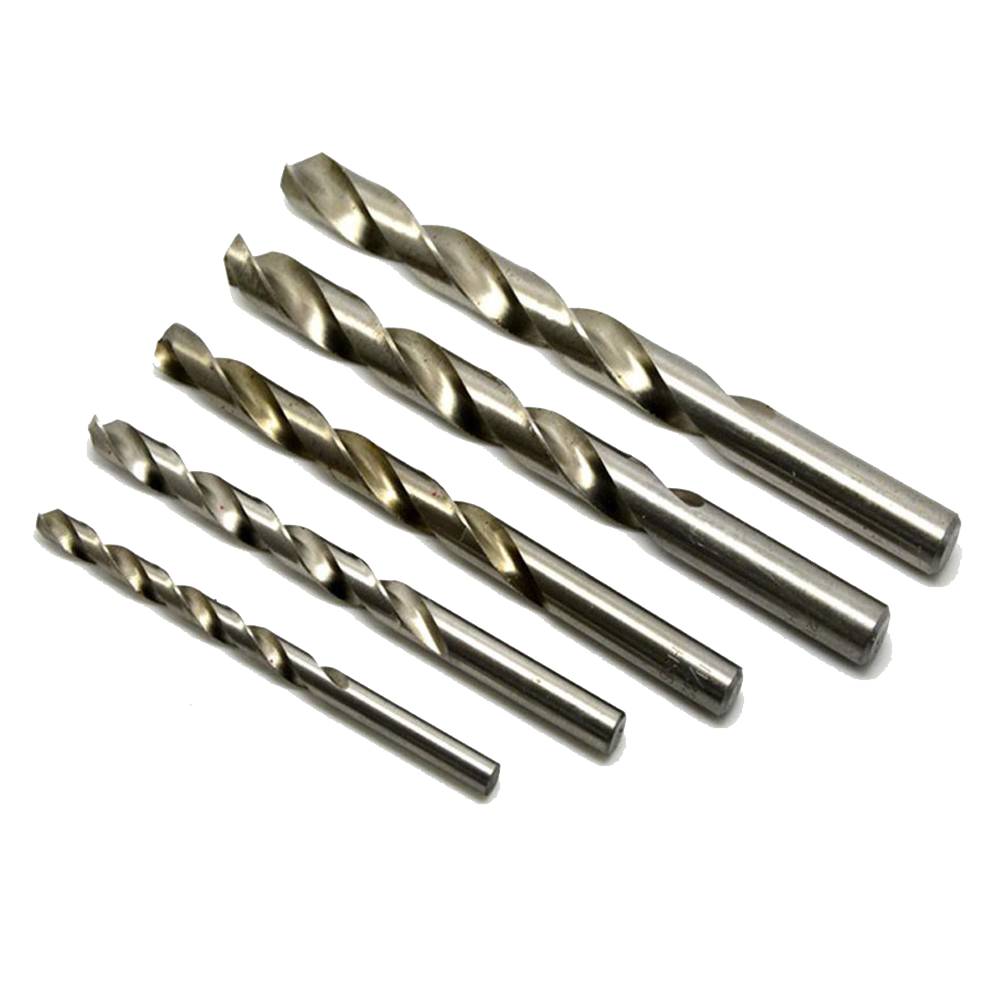
1. Our own copy: three specifications collapsed into one sentence
The supplied text is two sentences long and contains four problems. Each is a different kind of error, which is why they are worth separating.
| What the source copy says | What is wrong | What we say instead |
|---|---|---|
| “Adopting high-speed steel cobalt drill bits” … with an amber finish | Two orthogonal specifications welded into one. A reader concludes that amber is the cobalt, or that amber bits contain cobalt by definition | Substrate and surface are named separately. Amber on M2 and amber on M35 are different products. See section 5 |
| “Suitable for quenching steel”, along with stainless, cast iron, superalloys and titanium alloys | Not a material category. The intended term is hardened steel, or quenched and tempered steel. Worse, the promise is unsafe: a drill bit’s capability comes from substrate and geometry, not from a surface layer | The substrate sets the ceiling. An M2 bit is not a hardened-steel bit whatever colour it is. See our HSS twist drill page for the grade ladder |
| “The blade is hardened and polished” | A drill bit has a point, lips, margins and flutes — no blade. And the two operations conflict: polishing is the last step of a bright finish, while an amber layer is grown afterwards and is not polished, because polishing would remove it | Ground, then steam oxidised. No polishing after treatment. Surface condition is stated as what it is |
| “Ensuring precise cutting without shaking” | Run-out and chatter are set by the shank, the chuck, the drive line and the symmetry of the grind. No surface treatment delivers them | Judged the way our hex shank page judges it: measured at the tip, in millimetres |
2. Same family, different route: what steam oxidation is
Amber and black oxide are often described as if one were a shade of the other. They are the same family of treatment producing the same compound, reached by different routes at very different temperatures — and the temperature is the whole story.
| Black oxide | Amber / steam oxide | |
|---|---|---|
| Route | Alkaline oxidising salt bath | Steam oxidation in a heated furnace |
| Relative temperature | Comparatively low | Substantially higher |
| Compound formed | Magnetite (Fe3O4) | Magnetite (Fe3O4) |
| Morphology | Thin and dense, reads black | Thicker and more open, reads blue-grey through bronze to amber-brown |
| Relationship to tempering | A pure surface treatment; the bath runs well below the tempering range, so the substrate is untouched | Overlaps the tempering range — which is why the route is also called steam tempering |
| What that adds | Corrosion resistance and a little retained lubricity | The same, plus a marginal tempering contribution and micron-scale dimensional growth |
| Colour consistency | More consistent — a bath is easier to hold than a furnace atmosphere | Less consistent, because furnace load and steam flow vary |
So the honest description is not “amber is a warmer black oxide”. It is: amber is a surface treatment that happens to overlap a heat treatment, and that overlap is the source of both its advantages and its variability.
3. Why the colour moves, and why that is not a defect
The shade of an amber bit is not a pigment. It is thin-film interference: light reflecting off the top of the oxide layer interferes with light reflecting off the metal beneath it, and the resulting colour depends on how far apart those two reflections are — that is, on the layer thickness.
The thickness is set by the furnace, and the furnace is never perfectly uniform:
- Temperature. Oxidation rate is strongly temperature-dependent, so a small drift changes thickness measurably
- Dwell time. Longer in the furnace, thicker layer, deeper colour
- Steam partial pressure. The oxidising atmosphere itself varies across the load
- Load size and packing. Parts shadow each other; the ones at the centre of a dense load see less steam than the ones at the edge
- Part geometry. The flute roots and the outside diameter do not see the same flow, which is why a single bit can show two shades on different surfaces
A few tens of nanometres of thickness difference is enough to walk the colour from blue-grey to bronze to amber-brown. That is why two shipments can look like two products.
4. The aesthetic-versus-edge conflict
Here is the part that surprises buyers. If colour depth tracks layer thickness, then making the colour deeper means making the layer thicker — and a thicker oxide layer is not free.
Magnetite is hard and it is brittle. On the flanks of a flute that does not matter. At the lip, where the edge is thinnest and the load is highest, a thick brittle layer sits exactly where you can least afford it. The failure mode is spalling: the oxide breaks away in small flakes during the first cuts and takes a little edge material with it.
| Layer condition | Colour | Corrosion | Edge behaviour | Verdict |
|---|---|---|---|---|
| Thin, continuous | Light blue-grey to bronze | Adequate | Layer conforms to the edge; no spalling | The best purchase |
| Medium, continuous | Bronze to amber | Good | Usually fine | Acceptable |
| Thick, deep amber | Deep amber-brown | Best | Brittle at the lip; spalling risk in the first cuts | Cosmetically the best, functionally the riskiest |
| Patchy or bare | Blotchy | Compromised at the bare areas | Uneven | Reject — this is the failure that matters |
This is the single most useful thing to put in front of a buyer who wants “the darker ones”. The darker ones are not a better grade; they are a thicker, more brittle one. A slightly lighter bit with even coverage will out-cut a deep amber one whose lip has already shed its oxide.
5. Cobalt and amber are independent specifications
This is where the category loses the most money, because the two things are sold in one sentence.
| Substrate | Surface | |
|---|---|---|
| What it is | The steel the bit is made from | The treatment on the outside |
| Options here | M2 (no cobalt) or M35 (about 5% cobalt) | Bright, black oxide, amber, or a PVD film |
| What it changes | Hardness, red hardness, wear resistance, toughness | Corrosion resistance, early-stage lubricity, appearance |
| What it does not change | Appearance | Hardness, cutting speed, or what material the bit can address |
| Can they be combined freely? | Yes — all four surfaces can be applied to either substrate. Two amber bits can therefore be completely different tools. | |
How to tell what you actually have
- Read the substrate grade, not the colour. A listing that says “amber” and never names M2 or M35 has not told you the substrate
- Check whether the two are on separate lines. A competent spec sheet lists substrate and surface as separate attributes. A sentence that says “cobalt bits with an amber finish” may be accurate, but only if the cobalt is a named grade elsewhere
- Test the claim on the material that matters. Stainless is the discriminator: if the bit is presented as a stainless bit, it needs cobalt, a suitable geometry, low speed and fluid. The colour contributes none of those
- Do not pay a cobalt premium for a colour. If you need M35, buy M35 and accept whatever finish comes with it. If you need corrosion resistance, buy a conversion layer and do not assume it brought cobalt along
6. What amber buys, and what it does not
| Does amber deliver it? | Notes | |
|---|---|---|
| Corrosion resistance in storage and transit | Yes | The primary functional reason to buy it. Better than bright while the layer is intact |
| Low glare under workshop lighting | Yes | Genuinely useful and routinely dismissed. A bright bit under a bench light is hard to read |
| A visually identifiable range | Yes | Practical for a workshop that stocks several finishes, and for retail display |
| Early-stage lubricity | Some | Less than black oxide in most descriptions, since the layer is denser and less openly porous |
| Surface hardness | No | No added hardness from the layer. The steam route may contribute a marginal tempering effect, which is not the same claim |
| Wear resistance or edge life | No | No added film. A PVD coating is the answer to that question |
| Cutting speed | No | Speed is set by diameter and material, not by finish — see the speed formula |
| Ability to cut stainless, cast iron or superalloys | No | This is a substrate and geometry property. The most expensive mistake in the category |
| Reduced chatter or run-out | No | Shank, chuck and grind symmetry. See our hex shank page |
7. The micron question: does the treatment change the diameter?
Yes, slightly, and the mechanism matters more than the number. Because the oxide grows out of the surface rather than being laid on it, the outer boundary moves outward. That is a micron-scale effect.
- For general drilling: irrelevant. It is far below any tolerance that a wood or general-purpose hole cares about
- For a gauge application: relevant. A bit used to check a hole is a measuring instrument, and its diameter should be specified after treatment
- For a press fit: relevant, because a press fit is defined in microns
- At the edge of a tolerance band: relevant. If a bit is already at the top of its band, treatment can push it over
The practical rule: if your application is tight enough to care about microns, specify the diameter after treatment and say so on the order. Otherwise, ignore it — but do not let a supplier tell you the treatment has no dimensional effect at all, because that is not how a grown layer behaves.
8. The single-bit case: replenish by batch, not by shade
These are supplied as single bits by diameter. The replenishment logic is the ordinary one — a few sizes do most of the work — with one complication that is specific to this finish.
What to do instead
- Buy in batches that cover a set. Even if you only need two sizes now, buy them from the same run as the rest of the set
- Keep a batch reference. A production or lot number on the packaging lets you prove the drawer came from one run when the question is asked
- Do not reorder by shade. Reorder by diameter, substrate grade and length. The shade will follow the run, not the order
- Sort by size, not by colour. If two batches must coexist, separate them physically rather than trying to match them visually
This is the same logic that governs our black oxide singles — you replenish a size, not a finish — with one addition: here the finish is visible, so the batch becomes part of the buyer’s experience whether you manage it or not.
9. Goods-in inspection when colour is allowed to vary
You cannot inspect this finish by matching it to a swatch. Six checks that work instead:
- Coverage, not shade. The layer should be continuous across flutes, margin and point. Bare patches and blotches are the real defect; a different but even shade is not
- Check the margin diameter, not the coloured band and not the shank. The margin is what makes the hole
- Look at the point for grinding burn. A blue or straw tint from overheating in grinding is a genuine defect. Note the irony: on this finish, the colour you should worry about is the one that came from the grinder, not the one that came from the furnace
- Roll the bit and watch the cutting edge for bend. No treatment holds a bent bit true
- Look at the lip under magnification. Small chips and an asymmetric grind are invisible by eye and obvious under a loupe
- Cut a test hole in your own material and measure it. The only check that catches eccentric grinding and a lip that is not cutting
10. Full specifications
| Parameter | Specification |
|---|---|
| Product | Amber finished drill bits, supplied as single bits by diameter |
| Surface treatment | Steam oxide conversion layer. A process route, not a colour grade and not a deposited coating |
| Substrate | HSS M2 (W6Mo5Cr4V2 / 6542 / SKH51 / HS6-5-2) as standard; cobalt HSS M35 (about 5% Co) available and specified separately |
| Colour | Blue-grey through bronze to amber-brown. Set by layer thickness, not by grade |
| Shank | Straight round; three-jaw chucks and drill press spindles. Hex and three-flat to order |
| Diameter range | 1–13 mm jobber range; other diameters to order |
| Point angles | 118° and 135°; split point available |
| Lengths | Jobber (DIN 338) as standard; stub and reduced lengths to order |
| Corrosion resistance | Better than bright finish while the layer is intact |
| Surface hardness | No gain from the layer. The steam route can contribute a marginal tempering effect |
| Dimensional effect | Micron-scale growth on the margin. Specify diameter after treatment where tolerance is tight |
| Not suitable for | Hardened steel above the substrate’s capability; masonry; impact drivers unless impact-rated |
| Alternative surfaces | Bright, black oxide, TiN, TiCN, TiAlN — see our Ti-coated page for the ladder |
| Packaging | Single bit in tube, blister card or cloth bag. Batch reference on the pack to order |
| MOQ | Indicative: from 500 pieces for a stock diameter and length; from 1,000 pieces for a specified grade, private profile or private label |
| Lead time | Indicative: 15–25 days for stock configurations; 30–45 days for OEM production |
11. How to specify an amber bit on an export order
- Substrate grade, named. M2 or M35. This is the first line, not a footnote, because it sets what the bit can drill
- Surface, named as a route. Steam oxide, amber finish. Not “amber coating”, which invites a film-thickness question that has no answer
- Diameter and the point of measurement. State whether the diameter is before or after treatment, particularly at the small end
- Point angle and point form. 118° or 135°, split point or not
- Length and standard. Jobber, stub or reduced, and to which standard
- Colour tolerance, expressed correctly. Ask for coverage and continuity, and accept a shade band. A supplier who promises an exact shade is either lying or over-controlling the layer at the expense of the edge
- Batch consistency. If the customer stocks a range, ask for one production run per shipment and a lot reference on the pack
- Marking and packaging. Diameter marking, private label, barcode and insert cards to order
12. Troubleshooting
| Symptom | Most likely cause | What to change |
|---|---|---|
| New batch looks a different shade | Normal — furnace conditions moved the layer thickness | Accept it if coverage is even. See section 3 |
| Two shades on the same bit | Flute roots and outside diameter saw different steam flow | Normal. Judge continuity, not uniformity |
| Bare patches or blotches | Incomplete layer formation | Reject. This is the defect that matters |
| Small chips at the lip after a few holes | Thick brittle oxide spalling, often on a deep-amber batch | Move to a lighter, thinner layer; check the substrate grade before blaming the steel |
| Bit will not drill stainless | M2 substrate presented as a stainless bit | Specify M35. Colour is not the variable — section 5 |
| Customer says the drawer is mixed stock | Two production runs side by side | Sort by size, separate the batches, and use lot references. Section 8 |
| Rust in storage despite the finish | Layer rubbed off, or damp storage | Wipe dry, oil, store dry. Conversion layers are not stainless |
| Blue or straw tint at the point | Grinding burn — not the oxide layer | Reject. This is the colour change that indicates a real problem |
| Bit spins in the chuck | Round shank under high torque, or oily worn jaws | Clean the jaws, drop to low gear, or move to three-flat |
| Oversize holes from new | Eccentric grind, or diameter at the top of the band before treatment | Measure and, if tight, specify diameter after treatment |
13. Applications
Where amber is a sensible choice
- General woodworking and maintenance. A bit that lives in a toolbox, gets handled, and benefits from storage corrosion resistance
- Workshop ranges that need to be told apart. A visibly different finish from bright and from black oxide, which is useful when several are stocked together
- Retail and private label programmes where the finish is part of the product’s presentation and the packaging carries the shade story
- Bright-light environments. Low glare is a small thing that people who work under bench lights notice immediately
Where a different specification is the answer
- Stainless, cast iron and hard materials — the substrate decides, not the colour. See the grade ladder
- Edge life in ferrous work — a PVD film, covered on our Ti-coated page
- Gum and resin in softwood — the more openly porous black oxide layer, covered on our black oxide page
- Precision positional work — shank and machine, covered on our hex shank page
Where a different tool is the answer
- Flat-bottomed holes — Forstner bit
- Fast rough holes in timber — spade bit
- Deep holes — auger bit
- Multiple diameters in thin sheet — step drill
- Counterbored screw seats — countersink
- Large holes in panel — wood hole saw set or bi-metal hole saw
14. Frequently asked questions
Is amber finish the same as black oxide?
Same family, different route. Both produce magnetite on the surface and both are conversion layers with nothing added, but black oxide is grown in an alkaline salt bath at a comparatively low temperature while amber is produced by steam oxidation at a substantially higher temperature. The higher temperature matters twice: it changes the layer morphology and therefore the colour, and it sits near the HSS tempering range, which is why the steam route is also called steam tempering and can contribute a marginal tempering effect that a low-temperature bath does not. Black oxide is a pure surface treatment; amber is a surface treatment that overlaps a heat treatment.
Why do two batches of amber drill bits have different colours?
Because the colour is thin-film interference, and interference depends on layer thickness rather than on grade. A change of a few tens of nanometres in oxide thickness moves the shade from blue-grey through bronze to amber-brown. Furnace temperature, dwell time, steam partial pressure, load size and even the surface area of the parts in the load all shift that thickness. So variation between batches is expected, and variation across a single bit is normal too, because the flutes and the outside diameter see different steam flow. Colour is not a quality index.
Does a darker amber mean better quality?
No, and the assumption is mildly counterproductive. A deeper colour means a thicker oxide layer, and thickening the layer to chase colour puts more brittle oxide exactly where the cutting edge is thinnest. That oxide can spall at the lip early in the life of the bit and take edge material with it, producing the small chipping that buyers then blame on the steel. The useful acceptance criterion is not colour depth but layer continuity: no bare patches, no blotches, no missing coverage at the margin. A slightly lighter but evenly covered bit is the better purchase.
Is an amber drill bit a cobalt drill bit?
Not necessarily, and this is the most common confusion in the category. Cobalt is a substrate specification: M35 is M2 with about five percent cobalt added, and it buys red hardness and wear resistance. Amber is a surface specification: a steam oxide conversion layer. They are orthogonal, so you can have amber on M2, amber on M35, bright M35, or TiN on M35. Two bits can both be amber and one will drill stainless while the other will not. If a listing only says amber and never names the substrate grade, the substrate is unknown.
Our listing says the bit is suitable for quenching steel. Is that right?
No, and it is a translation artefact. Quenching steel is not a material category; the material meant is hardened steel, or quenched and tempered steel. More importantly, the claim itself is unsafe: the hardness a drill bit can address is set by the substrate and the geometry, not by the surface finish, and an M2 bit presented as suitable for hardened steel will fail and will damage the workpiece. We have corrected this on the page rather than leaving a promise the product cannot keep.
Why does the copy say the blade is hardened and polished?
Because the sentence was written for a different kind of tool and transferred. A drill bit has no blade; it has a point, lips, margins and flutes. And the two operations named are in tension: polishing is the final step of a bright finish, whereas an amber conversion layer is grown after grinding and is not polished afterwards, because polishing would remove the layer it was applied to produce. If a bit really were polished after treatment the colour would be patchy at best. The sentence cannot describe the product it is attached to.
Does the amber layer make the bit cut faster or stay sharp longer?
No. The layer adds no surface hardness and no wear-resistant film, so it does not change cutting speed or edge life in the way a PVD coating does. What it does is resist storage corrosion better than a bright finish, cut glare, and give the range a visually identifiable finish. Any listing that attributes drilling performance in stainless, cast iron or superalloys to the amber finish is attributing a substrate property to a surface treatment. Our Ti-coated page covers what a deposited film actually changes.
Does the treatment change the diameter?
It can, by a micron-scale amount, because the oxide grows out of the surface rather than sitting on it as a separate film. For general drilling this is far below any tolerance that matters. It becomes relevant only where a bit is being used as a gauge, where a press fit is being produced, or where the diameter is at the edge of its tolerance band. If your application is that tight, specify the diameter after treatment rather than before, and say so on the order.
How do I inspect an amber bit if the colour is allowed to vary?
Judge coverage rather than shade. Look for continuity across flutes, margin and point, with no bare patches and no blotchy areas where the layer failed to form. Check the margin diameter, because it is the dimension that makes the hole. Look at the point for grinding burn. Roll the bit and watch the cutting edge for bend. Then cut a test hole in your own material. A batch with a slightly different shade but even coverage is acceptable; a batch with the right shade and a bare patch is not.
Why should I buy amber bits in batches rather than one at a time?
Because the shade is a batch property. If you replenish one bit at a time from different production runs, the drawer fills with visibly different ambers and your customers read that as mixed or counterfeit stock even though every bit is correct. Buying a batch keeps the shade consistent within a set and removes an argument you cannot win at the counter. It does not make the bits better; it makes them defensible.
Can I use an amber finished bit on wood?
Yes, and it is a reasonable choice for general woodworking and maintenance work. The layer gives storage corrosion resistance, which matters for a bit that lives in a toolbox, and the low-glare finish is genuinely useful in a bright workshop. It does not add cutting performance in wood, and if edge life is the only thing you care about a bright finish is the honest answer. Our black oxide page sets out the same trade from the other direction.
MOQ, lead time, OEM and samples?
Amber finished drill bits are specified by diameter, substrate grade, point angle, length and shank rather than picked from a fixed list, so terms follow the configuration. Indicative minimum order quantity starts from 500 pieces for a stock diameter and length combination and from 1,000 pieces for a private profile, a non-standard length, a specified substrate grade or private label packaging. Indicative lead time is 15 to 25 days for stock configurations and 30 to 45 days for OEM production. Samples are available for testing after terms are confirmed, with the sample cost credited against a subsequent order. Please confirm current figures with us before publishing them.
Related products
Surfaces and substrates: HSS Ti-coated Drill Bits Set — the finish ladder and what a deposited film changes. Ti-coated Drill Bits, Black Oxide Drill Bits, HSS Twist Drill Bits Set. Shanks: Wood Hex Shank Drill Bits. Wood boring: Wood Step Drill Bits, Wood Step Drill Bits Set, Wood Forstner Drill Bits, Wood Forstner Drill Bits Set, Wood Flat Drill Bits Set, Wood Auger Core Drill Bits Set, Wood Auger Core Drill Bits, Wood Countersink Drill Bits. Larger holes: Bi-Metal Hole Saw Sets, 16 PCS Wood Hole Saw Sets.
OEM & Wholesale
GUSHI has manufactured drilling and cutting tools in Huzhou, Zhejiang since 1998, and we supply amber finished bits as single bits and in sets to importers, distributors and private label programmes. Because substrate and surface are separate decisions here, most of what we ship in this category is configured.
- Substrate. M2 as standard; cobalt M35 to order, named on the line item rather than implied by the colour
- Surface. Steam oxide amber as standard; bright, black oxide and PVD finishes available on the same geometry
- Configuration. Diameter, point angle, point form, length standard, shank form
- Batch control. One production run per shipment with a lot reference on the pack, for customers who stock a range
- Private label. Laser marking, packaging, barcode and insert cards
- Terms. T/T, L/C, D/A, D/P and PayPal according to circumstance. Samples after terms are confirmed, credited against a subsequent order