1. Our own copy, audited
Seven claims, and the most useful sentence on the whole page is hidden in the meta description.
| What the listing says | What is wrong | What to write instead |
|---|---|---|
| “Designed for CNC machines and radial arm workstations” | This appears only in the meta description. It is the single most decisive fact about the product: a machine-held bit with an integral thread is not a hand-drill accessory | Put it in the first sentence of the body, next to the thread |
| “Diamonds and Matrix Minimize Blow-Out” | Attributes the outcome to the abrasive. Blow-out is a force event at the exit face; the diamond and bond help only by keeping the cutting force low. As written it invites the buyer to think the bit alone prevents chipping | “Thin wall and a free-cutting bond keep the thrust low, which is what limits chipping at breakthrough” |
| “Thin-wall design provides fast, clean, precise holes” | True, and it omits the number that defines the product. “Thin” is not a specification; 1.5 mm and 3 mm are both “thin” to a catalogue and differ by a factor of two in force | “Wall 2.0 mm on the 35 mm bit, so 23% of the hole is removed as dust” |
| “Best core drill bit for Dekton…” | No comparator, and the group is not uniform: Dekton, Lapitec, Neolith and Geoluxe are all ultra-compact but differ in firing and in binder, which is why the bond is specified per material | “Specified for ultra-compact surfaces; bond matched to the slab you run” |
| “Extra long life thanks to special diamond/bond” | “Extra” against what, and “special” is not a grade. Life on this class of material is decided by the bond releasing dull diamond before it glazes | Name the diamond size and the bond hardness, and quote life in metres of cut |
| “provide an excellent solution” | A sentence with no field in it. It cannot be ordered from, tested or compared | Diameter, wall, working length, thread, grit, bond |
| Threads given: ½″ gas, 5/8″-11, M14 | The one genuinely useful line on the page — and it should be the headline, because it decides whether the bit fits the machine at all | Keep, and add the spindle side of the same question |
The pattern is worth naming because it is the opposite of the usual failure on this site. Most listings here describe the sensation of using a tool and omit the numbers. This one has a real number — three threads and a machine class — and buries it under adjectives. The fix is not more copy, it is moving two facts to the top.
2. Why ultra-compact is a different job
Ultra-compact surface is the trade category that includes Dekton®, Lapitec, Neolith and Geoluxe: a sintered slab, fired at high temperature and pressed, with almost no porosity. It is not a stone with a binder; it is closer to a glass-ceramic, and it behaves like one under a drill.
| Material | Structure | Porosity | How it fails at the drill | Can the hole be corrected? |
|---|---|---|---|---|
| Marble | Crystalline carbonate | Low | Soft, cuts easily, heat discolours it | Yes, with care |
| Granite | Crystalline silicate | Low | Abrasive, slow, chips at the rim | Partly |
| Porcelain tile | Vitrified clay body | Very low | Hard, brittle, chips on the exit face | Rarely |
| Ultra-compact (Dekton®) | Sintered, glass-ceramic | Near zero | Hard, brittle, no absorption, a chip is permanent | No |
Two consequences follow. Because the slab does not absorb water, all the cooling has to happen at the surface of the cut, in the kerf, not by wetting the body. And because the material is brittle and the slab is expensive and often already finished, there is no second attempt: you cannot file the hole, ream it, or fill a chip invisibly.
That changes the nature of the job. On metal, drilling is a process you steer. On a finished Dekton worktop, it is a measurement you execute once — which is why sections 8 to 11 spend their time on the exit, the speed and the thread rather than on cutting technique.
3. What the wall removes: 4t ÷ D
A core bit does not make a hole by removing a hole. It removes a ring and leaves the middle behind, and the fraction it removes has a one-line formula.
fraction removed = 4t ÷ D
| Diameter | Wall | Removed as dust | Comes out as a plug | Compared with a solid bit of the same size |
|---|---|---|---|---|
| 20 mm | 2 mm | 40% | 60% | 40% of the work |
| 35 mm | 2 mm | 23% | 77% | 23% of the work |
| 50 mm | 2 mm | 16% | 84% | 16% of the work |
| 75 mm | 2 mm | 11% | 89% | 11% of the work |
| 100 mm | 2 mm | 8% | 92% | 8% of the work |
| 35 mm | 3 mm | 34% | 66% | 34% of the work |
Read the last two rows together. The same hole, the same machine, the same material: changing the wall from 2 to 3 mm increases the cutting work by half. That is the whole commercial case for a thin wall, and it is also why a thin-wall bit is faster in a way that no amount of operator skill can replicate with a thicker one.
The counter-intuitive column
The fraction removed falls as the diameter rises, because the wall stays roughly constant while the circumference grows. So a 100 mm core removes eight percent of the hole, and a 20 mm core removes forty. Core drilling gets more efficient the bigger the hole — which is exactly the opposite of solid drilling, and the reason a 100 mm tap cut-out is a routine job on a machining centre while a 100 mm twist drill does not exist.
4. Force grows with diameter, not its square
This is the mechanical consequence of section 3, and it explains why core bits behave so differently from solid drills at large sizes.
| Diameter | Core bit, 2 mm wall: relative cutting area | Solid drill: relative cutting area | Ratio | Practical meaning |
|---|---|---|---|---|
| 20 mm | 1.0 | 1.0 | 1.0× | Same as a solid bit at this size |
| 35 mm | 1.75 | 3.06 | 0.57× | Half the load of a solid bit |
| 50 mm | 2.50 | 6.25 | 0.40× | Well under half |
| 100 mm | 5.00 | 25.0 | 0.20× | A fifth of the load a solid bit would need |
A solid drill’s cutting area rises with the square of the diameter, which is why big twist drills are so demanding. A core bit’s rises linearly, because the wall does not grow with the diameter. At 100 mm the difference is a factor of five.
That linear growth is why the same thin-wall bit can be run on a spindle that would never turn a solid drill of that size, and why the limiting factor on a large core becomes stiffness and runout rather than power. The machine has plenty of torque for a ring; what it does not have is tolerance for a barrel that is not running true.
5. What thin wall costs: stiffness
Nothing in engineering is free. The wall that halves the cutting force also removes most of the barrel’s resistance to bending, and it does so faster than linearly.
2 mm against 3 mm → (2/3)³ = 30% of the stiffness
| Wall | Cutting force | Stiffness | Runout it can absorb | What the operator notices |
|---|---|---|---|---|
| 1.5 mm | Lowest | Very low | Almost none | A clean hole on a good spindle; a bell-mouthed hole on a tired one |
| 2 mm | Low | Low | Slight | The usual compromise for ultra-compact |
| 3 mm | Higher | Higher | Moderate | More forgiving, slower, more chipping at the rim |
| 4 mm and above | High | High | Most | A tile bit, not a slab bit: too much force for a brittle surface |
So the thin wall moves the difficulty from the cutting edge to the machine. A two-millimetre barrel has almost no ability to correct a bad start, a worn collet or a spindle with runout, and it will show that as a hole that is bell-mouthed at the top or slightly oval all the way down.
The three checks that matter more than the bit
- Spindle runout — measure at the thread, not at the flange. A few hundredths of a millimetre at the spindle becomes a visible error at a 50 mm working length.
- Thread seating — an integral thread seats on its shoulder, so the shoulder faces must be clean. A chip of dried slurry between them tilts the bit by more than the wall can absorb.
- Water reaching the crown — not the barrel. If the water lands above the crown it cools the steel and misses the diamonds, which is the most common invisible fault on a wet set-up.
6. Why wet is three jobs, not one
“Wet” is usually explained as cooling. On this material it is doing three separate jobs, and the second one is a health control rather than a performance feature.
| Job | What it protects | What happens without it | How you know it is working |
|---|---|---|---|
| Cooling the crown | The bond and the diamond | Bond softens or glazes, diamond graphitises, the rim blues and stops cutting | Water leaves the kerf warm, not steaming; the crown stays the same colour |
| Suppressing dust | The operator’s lungs | Respirable crystalline silica in the air — ultra-compact surfaces contain a high proportion of it | No visible dust cloud, and no dry dust settling on surfaces |
| Flushing the kerf | The cut itself | Fines pack the two-millimetre gap, the crown rubs instead of cutting | The water leaving is a thin slurry, not clear, and not thick |
The dust point deserves its own line, because it is the one place where a purchasing decision is also a safety decision. Dry drilling of ultra-compact surface is not a slower method; it is an uncontrolled exposure. Water suppression, local extraction and respiratory protection are the standard controls, and a wet bit is the first of them. If a job cannot be run wet, it should not be run dry with this tool on this material.
7. The slots are the water path
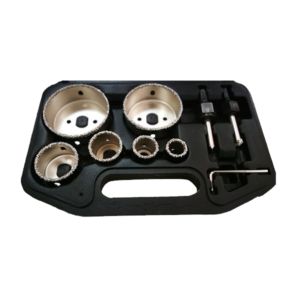
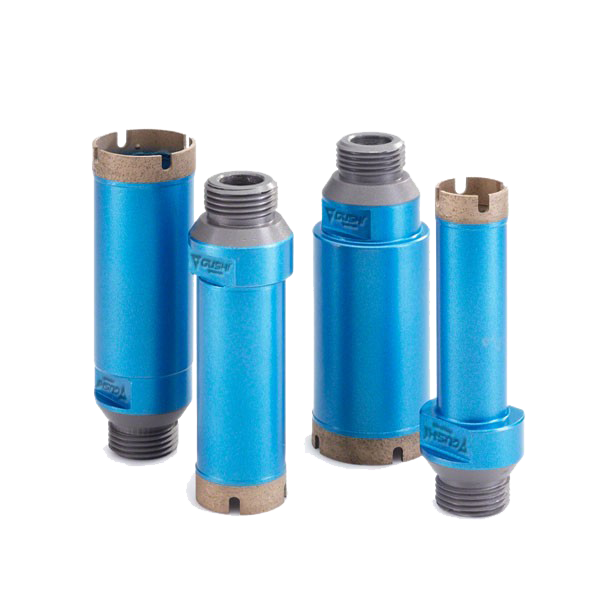
The photograph shows two slots cut through the diamond band on each bit. They are not chip breakers and they are not decoration: they are the only way water gets from one side of the wall to the other.
Think about the geometry. The crown is a closed ring. Water fed from outside the barrel reaches the outer face of the kerf and stops there, because the kerf is exactly as wide as the wall — two millimetres. The inner face of the kerf, the one that forms the plug, gets nothing, and that half of the ring runs dry while the other half is wet.
The slots let coolant cross the wall, so both faces of the cut see water and the whole ring cuts. That is also why the slots have to be kept open: a slot packed with cured slurry is a slot that no longer passes water, and the symptom is a bit that cuts well on the outside of the hole and burns on the inside.
| Feature | What it does | What it looks like when it fails | Fix |
|---|---|---|---|
| Rim slots | Carries water across the wall to the core side | Inner half of the crown glazed, outer half clean | Clear the slots with a pick; increase flow |
| Barrel bore | Lets the plug and the water out | Water backs up, flow at the crown drops | Lift the bit periodically to clear the core |
| Thread shoulder | Seats the bit square on the spindle | Hole oval or bell-mouthed at the entry | Clean both faces before mounting |
8. Breakthrough: the real cause of chipping
The listing says the diamond and matrix minimise blow-out. They do not, in the sense the sentence implies. What limits chipping is the force at the moment the crown leaves the material, and force is controlled by feed, support and wall thickness.
At breakthrough the crown stops cutting a full ring and starts cutting a thin, unsupported one. Thrust that was resisted by the whole slab now has nothing behind it, the bit surges forward, and the last few millimetres of rim break out instead of cutting out. On a brittle, non-porous slab that breakout is a chip, and a chip in a finished worktop is a replacement.
| Method | What it does at the exit | Effect on chipping | When to use it |
|---|---|---|---|
| Halve the feed over the last 3–5 mm | Removes the surge | Largest single improvement, costs nothing | Always |
| Backer board clamped underneath | Supports the breakout edge | Large | Through-holes in a slab you can turn over |
| Drill to just short, finish from the other face | Two supported cuts meet in the middle | Largest on thick material | Deep holes, visible both sides |
| Thin wall | Lower thrust to begin with | Moderate, continuous | Designed in, not chosen at the machine |
| Higher spindle speed | More cuts per second, each lighter | Small, and it costs bond life | Only if the bond is glazing |
| Pushing through the last millimetre | Maximum force at the weakest section | Worst outcome | Never |
Notice that the top three rows are all about force and support, and none of them is about the diamond. That is the correction to the listing in one sentence: the bit sets the force it is capable of, and the operator decides how much of that is applied at the exit.
9. Speed belongs to the bond, not the material
Two suppliers both sell a 35 mm thin-wall bit for Dekton, both wet, both with a ½″ gas thread. One recommends 1,000 to 1,600 rpm and a feed of 20 mm per minute; the other recommends 2,300 rpm and 40 mm per minute. Neither is wrong.
| Bit A | Bit B | Why the difference | |
|---|---|---|---|
| Diameter | 35 mm | 35 mm | Same hole |
| Recommended speed | 1,000–1,600 rpm | 2,300 rpm | Harder, finer bond runs slower; softer bond needs speed to keep shedding |
| Recommended feed | 20 mm/min | 40 mm/min | Follows the speed: a slower spindle takes a lighter chip per revolution |
| Rim speed at that setting | 1.8–2.9 m/s | 4.2 m/s | Not normalised — the bond, not the rim speed, is the reference |
| Failure if run too slow | Glazes, polishes, stops cutting | Glazes even faster | A hard bond needs speed to self-sharpen |
| Failure if run too fast | Bond softens, rim blues | Segment wear accelerates | Heat into a small contact area |
The practical lesson is that a recommended speed is a property of the bit, not a constant for the material. Copying a number from another supplier’s page is how a good bit gets destroyed in an afternoon. What the number is doing is keeping the bond at the temperature where it sheds dull diamond at the same rate the work dulls it.
The engraved number is a limit, not a setting
If a maximum speed is marked on the tool, it is the maximum permitted by the standard, not a recommendation. On thin-wall bits of this class the marked maximum is often far above the working speed — four to five thousand rpm on small diameters, less as the diameter grows. Running at the marked maximum on ultra-compact surface will not break the bit; it will cook the bond and chip the slab.
10. The thread is the mount
The bits in the photograph have the thread cut into the barrel. There is no arbor, no adaptor and no separate flange, which is unusual in this catalogue and important on this material.
| Thread | Where it is found | Consequence | Adaptor possible? |
|---|---|---|---|
| ½″ gas (G½) | Many CNC stone centres and radial arm machines, especially European | The bit screws directly onto the spindle nose | Yes, but every adaptor adds runout |
| 5/8″-11 UNC | North American machines, most hand-held core drills and grinders | Direct mount on that spindle | Yes, with the same penalty |
| M14 | European hand-held grinders and some CNC tool holders | Direct mount | Yes |
Three threads, one bit design, and a buyer who orders the wrong one owns a bit that cannot be mounted. That is why the thread belongs in the title of the page rather than in the fourth bullet: it is the only field that can make the product useless while everything else is correct.
Why no arbor is the right choice here
An arbor is a second interface, and every interface on a rotating tool adds runout. On a stiff bit the error is absorbed; on a two-millimetre barrel with a fifty-millimetre working length it is not. The integral thread removes one joint, one seating face and one opportunity for a chip of slurry to sit between two surfaces that need to be flat.
The trade is that the thread fixes the machine. A shop with two spindle standards needs two sets of bits, or adaptors and the runout that comes with them. That is a purchasing fact, not a defect, and it is worth stating plainly rather than leaving the buyer to discover it at the machine.
11. Choose the diameter from the fitting
On metal you drill, measure and adjust. On a finished ultra-compact slab the sequence is reversed: measure, choose, drill once. The table is the decision.
| Feature | Measure | Bit to order | Why not the obvious choice |
|---|---|---|---|
| Tap hole for a monobloc mixer | The threaded shank diameter, not the body | Shank + 2 to 3 mm | The body is wider than the hole; the shank is what passes through |
| Pop-up waste | The waste body thread | Usually 35 mm | The flange covers the gap, the body does not |
| Soap dispenser | The pump body | Body + 2 mm | A pump that binds cannot be persuaded with a file |
| Hob or sink cut-out corner | Corner radius, then convert | Core equal to twice the radius | Four cores and two straight cuts, not one big hole |
| Cable grommet | Grommet outside diameter | Grommet OD + 1 mm | The grommet needs to clip, not to be forced |
| Repairing a hole that is 1 mm small | — | Not possible | Dekton cannot be opened up in place; the hole is replaced, not corrected |
Two rules follow from the last row. Measure the part, not the drawing, because fittings vary by a millimetre between suppliers and the slab does not. And buy the size you measured, not the nearest size in stock, because there is no second operation to close the difference.
12. Specifications, checks and diagnosis
Published values for this product. Diameters, working lengths and bond grades are confirmed per order; the reference example throughout this page is the 35 mm bit with a 2 mm wall.
| Product type | Wet diamond core drill bit, thin wall, integral threaded shank, for ultra-compact surfaces |
|---|---|
| Brand | GUSHI — Huzhou Gu’s Imp. & Exp. Co., Ltd. |
| Materials | Dekton®, Lapitec, Neolith, Geoluxe and other ultra-compact surfaces; also porcelain and ceramic |
| Diameters | 20 to 100 mm standard; other sizes to order |
| Wall | Thin wall, approximately 2 mm on the 35 mm bit |
| Working length | About 50 mm on the 35 mm bit; the barrel above it is shank, not cutting length |
| Threads | ½″ gas (G½), 5/8″-11 UNC or M14; integral to the barrel |
| Crown | Diamond band with two flush slots; bond grade matched to the slab |
| Barrel | Steel, painted; bore clear for the plug and the water |
| Use | Wet only, with continuous water at the crown |
| Machines | CNC machining centres and radial arm workstations; not a hand-drill accessory |
| Material removed | About 4t ÷ D of the hole area, so 23% at 35 mm with a 2 mm wall |
| Recommended speed | Set by the bond, not by the material; two 35 mm bits in current supply are quoted at 1,000–1,600 and 2,300 rpm |
| Recommended feed | 20 to 40 mm per minute on a 35 mm bit, following the speed |
| Marked maximum | The speed engraved on the tool is the permitted maximum, not a working setting |
| Cooling | Continuous, delivered to the crown; check flow before the first hole |
| Dust control | Water suppression is a primary control for respirable crystalline silica; dry use is not permitted |
| Pilot hole | Not required; the crown locates itself on a flat surface |
| Resharpening | Not practical on a thin-wall crown; a worn crown is replaced |
| Packaging | Individual tube or box; OEM print to order |
| MOQ | Quoted per size, because the crown is made to order |
| Lead time | 5 to 10 days standard; 15 to 30 days for custom diameter, length, thread or bond |
| Origin | Zhejiang, China |
Seven checks on arrival
- Measure the wall with a caliper at four points. A crown that is 2 mm on one side and 3 on the other will cut a tapered hole and cannot be corrected.
- Screw it onto the spindle dry and check the seat. The shoulder should meet with no gap, and the bit should spin without visible wobble.
- Check the slots are open. Look through them against a light; any braze or paint bridging the slot closes the water path.
- Confirm the working length against the slab thickness. On a 20 mm top with a 40 mm edge build-up, 50 mm is enough; on thicker work it is not.
- Measure the bore and the crown at four points for concentricity. A crown that is off-centre relative to the thread makes an oversize hole no matter how it is run.
- Run water through the spindle before mounting. Confirm it arrives at the crown, not at the barrel, and that it keeps arriving while the bit is loaded.
- Drill one hole in an offcut at the intended speed and feed, and fit the actual hardware. This is the only check that validates the whole set-up.
Diagnosis table
| Symptom | Most likely cause | Test | Fix |
|---|---|---|---|
| Crown turns glossy and stops cutting | Bond glazing: speed too low, or feed too light | Water runs clear, no slurry | Raise speed or feed until a slurry appears |
| Rim blues or the water steams | Heat: speed too high, or water not reaching the crown | Feel the water leaving the kerf | Slow down; move the water to the crown |
| Inner face of the hole burns, outer is clean | Slots blocked, so no water crosses the wall | Look through the slots | Clear them; increase flow |
| Hole is bell-mouthed at the entry | Runout or a bad seat at the thread | Dial the thread shoulder; reseat dry | Clean the shoulder, or repair the spindle |
| Hole is oval all the way down | Crown off-centre, or wall thickness uneven | Measure the crown at four points | Reject the bit |
| Chips the size of a fingernail at the exit | Full feed through breakthrough | Look at the chip shape: a curve means a surge | Halve the feed over the last 3–5 mm; add a backer |
| Bit stalls on a machine with plenty of power | Fines packing the kerf, or the plug jammed in the bore | Lift the bit and inspect the bore | Clear the core, increase flow, reduce feed |
13. What to put on a purchase order
Five lines, and the first two decide whether the bit can be used at all.
| Line | What to write | What it prevents |
|---|---|---|
| Thread | The spindle standard, measured, not assumed | A bit that cannot be mounted with everything else correct |
| Diameter and wall | Both numbers, with the wall in millimetres | A “thin wall” bit that is 3 mm and cuts half again as hard |
| Working length | The cutting length, not the overall length | A bit that bottoms out in a thick edge build-up |
| Bond and grit | The grade, plus the material it is matched to | A hard bond that glazes on Dekton, or a soft one wasted on porcelain |
| Speed and feed | The supplier’s recommendation for that bond, with the marked maximum separately | Copying a number from another brand’s page |
Those five lines turn a page of adjectives into a tool that can be ordered, mounted and run. The listing already has one of them right — the thread — and it needs the other four beside it.
Related products
- Vacuum Brazed Core Drill Bits Set — single-layer crowns, grit pull-out and the heat limit, for tile and general stone.
- Diamond Core Drill Bits Set — the layered alternative, the size ladder and the usable depth arithmetic.
- Vacuum Brazed Core Drill Bit Set — the same single-layer logic in a smaller configuration.
- Diamond Core Drill Bit Set — the set version for general stone work.
- Core Drill Bits — the range page for the family.
- Diamond Segment for Core Drill Bits — segments as a separate component, for a shop that rebuilds barrels.
- Electroplated Diamond Core Drill Bit — the thin abrasive layer, and where it is the right choice.
- Long Shank Diamond Core Drill Bit — when the working length, not the diameter, is the limit.
- Concrete Core Drill Bits — a different material class with a different bond.
- Diamond Non-Core Drill Bit — solid diamond drilling, where no plug is wanted.
- Turbo Blade for Cutting Dekton — the straight-cut half of the same job.
- Blade for Dekton — bridge saw blades for the slab.
- Dekton Turbo Diamond Blade — the range entry for this material.
- 230mm Dekton Turbo Diamond Saw Blade — the hand-held size for on-site work.
- Wet Polishing Pads — finishing the rim of a hole after drilling.
- Resin Bond Grinding Disc for Stone Grinding — easing an edge without chipping it.
Frequently Asked Questions
What makes a core bit suitable for Dekton rather than granite?
Three things: a thin wall, a bond soft enough to keep shedding diamond, and a diamond size fine enough not to chip a brittle surface. Dekton is sintered and non-porous, so it does not absorb coolant and it does not give at the exit; the cut has to be light and continuous rather than heavy and intermittent. A granite bit will drill it, but with more chipping and a shorter life.
How much of the hole does a core bit actually remove?
About four times the wall thickness divided by the diameter. A 35 mm bit with a 2 mm wall removes roughly 23 percent of the hole area as dust; the other 77 percent comes out as a plug. The same bit with a 3 mm wall removes 34 percent, which is half again as much work for the same hole.
Why quote 1,000 rpm on one 35 mm bit and 2,300 on another?
Because the recommended speed belongs to the bond, not to the material. A hard, fine bond needs a slower spindle so it is not overheated; a soft bond needs more speed to keep exposing new diamond instead of glazing. If a quoted speed is engraved on the tool it is the maximum permitted, not the recommended setting.
Is wet really necessary, or is it just better?
It is necessary, for three separate reasons. Water cools the crown so the bond does not soften or the steel discolor, it carries the fines out through a kerf only as wide as the wall, and it suppresses respirable crystalline silica, which ultra-compact surfaces contain in quantity. Dry drilling on this material is a health control failure as well as a tool-life one.
Can I open a hole by half a millimetre if it comes out small?
Not practically. Dekton cannot be filed or reamed, and a diamond tool used to open a hole in a finished slab will chip the rim. The diameter has to be decided from the fitting before the bit touches the surface, which is why the buying decision is a measurement rather than a preference.
How do I stop the exit face from chipping?
By reducing force at the moment the crown breaks through. A thin wall already helps, because force scales with wall thickness. Then: reduce feed to roughly half over the last few millimetres, keep the water on, support the exit face with a sacrificial board or a clamped backer, and never let the crown dwell. Chipping is a force event at exit, not a diamond quality.
What do the slots in the rim do?
They are the water path. The crown is a closed ring, so water fed from outside cannot reach the inside of the kerf unless it can cross the wall. The slots let coolant and slurry pass from the outside of the barrel to the core, which is what keeps the whole wall cutting rather than only its outer edge.
Which thread should I order?
Whichever your spindle has: 1/2 inch gas, 5/8-11 UNC or M14. The thread is cut into the barrel itself, so there is no arbor to change and no adaptor to introduce runout. A 5/8-11 machine cannot use a 1/2 inch gas bit, and an adaptor is a compromise on a tool that is already thin-walled.
How deep can it drill?
To the working length of the crown, which is around 50 mm on a 35 mm bit; the barrel above it is the shank and does not cut. For a 20 mm worktop that is more than enough, and for a thick edge build-up it is worth checking the working length rather than the overall length.
Does the bit need a pilot hole?
No. A core bit is located by its own crown, and a pilot would only add a second operation and a chance to wander. What it does need is a start on a flat, clean surface and a spindle that runs true, because a thin wall has very little stiffness to correct a bad start.
Can the same bit drill porcelain tile as well?
Usually yes, and often well, because porcelain and ultra-compact surfaces are both hard, dense and brittle. The settings are not identical: porcelain is thinner and is backed differently, so the exit support changes. If most of your work is tile, a bit specified for tile will have a different bond and a shorter working length.
MOQ, lead time, OEM and samples?
Standard diameters and threads ship in 5 to 10 days; custom diameter, working length, thread, bond and marking in 15 to 30 days. MOQ is quoted per size because the crown is brazed or sintered to order. OEM covers the diameter range, the thread, the crown specification, the barrel colour and the printing, and samples can be supplied for a trial on your own slab.