1. Our own copy, audited
One sentence. It is not wrong, it is empty, and for a product sold by diameter an empty specification is the whole problem.
| What the listing says | What is wrong | What to write instead |
|---|---|---|
| “Coating: Ti Coated” | “Ti” is the element; the coating is titanium nitride, a compound. The same shorthand covers TiN, TiCN and TiAlN, which behave differently. Naming the element instead of the compound leaves the film unidentified | “TiN (titanium nitride) PVD, 1–4 µm, on point and flutes” |
| No diameter | The single field that decides torque, speed, feed and whether the drill can turn it. Without it the product cannot be ordered | “Diameter 3.0, 3.5, 4.0 … 13.0 mm; state the size” |
| No point angle | A 118° point and a 135° split point are different tools for different materials, and the difference is invisible in a photograph | “118° standard; 135° split point to order” |
| No flute length or overall length | Jobber, mechanic’s and aircraft lengths share a diameter and none of them share a reach | Both numbers, plus the dimensional standard |
| No shank diameter | Above roughly 10 mm the shank may be reduced, which decides whether your chuck holds it | Shank diameter per size |
| No substrate grade | “HSS” covers M2, M35 and M42, whose red hardness differs by a hundred degrees | The grade, and the hardness range |
| No standard | DIN 338 and DIN 340 are both “jobber” to a catalogue and differ in length | DIN 338, or the drawing number |
This is the fifth page in this catalogue whose listing is a single field, and the pattern is the same each time: the copy describes what the object is made of and never what it is. For a drill bit that inversion is expensive, because the buyer’s decision is entirely dimensional — he has a hole to make and a drill to make it with, and neither number appears.
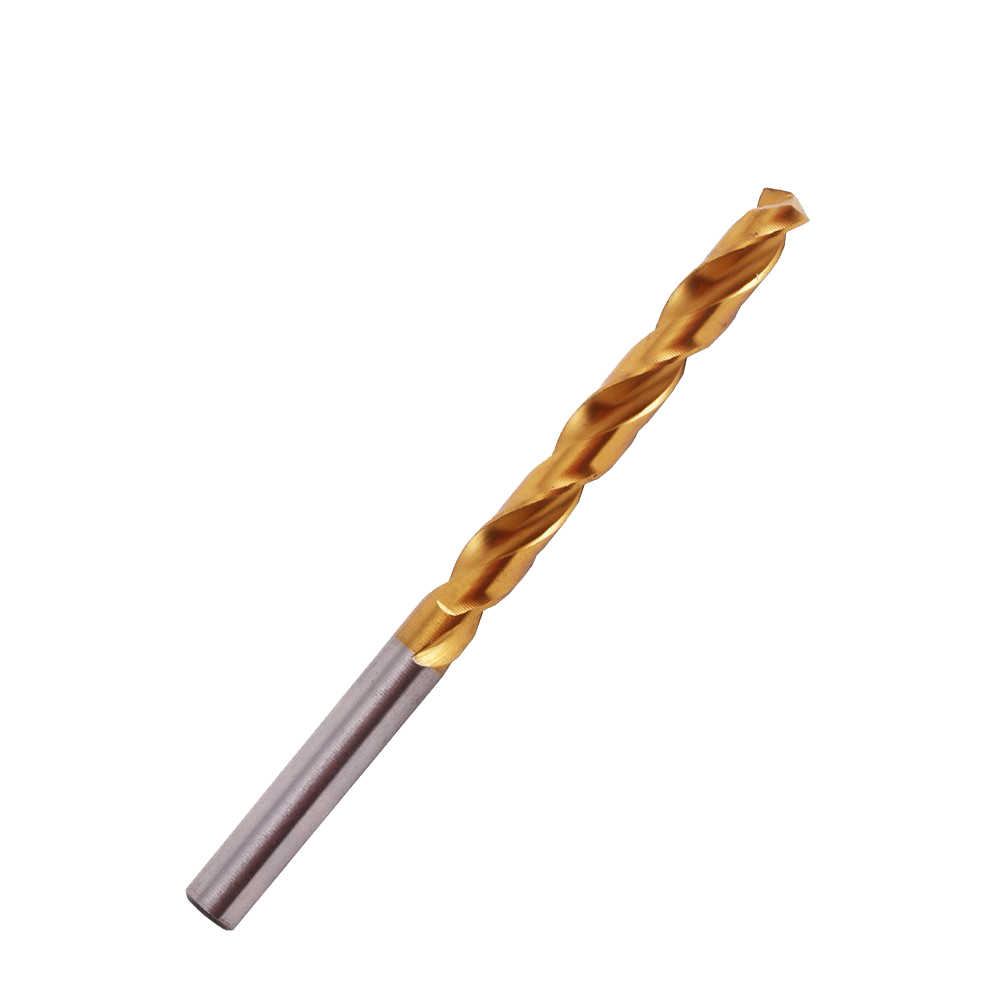
One thing the listing does get right, without saying so, is visible in the photograph: the coating stops at the flutes. That is a real manufacturing decision and a decent quality signal, and section 7 explains why.
2. What one bit actually is
A single twist drill is five dimensions and two decisions. Everything else is presentation.
| Field | What it decides | What happens if it is missing | This bit, as photographed |
|---|---|---|---|
| Diameter | Torque, speed, feed, hole size | The bit cannot be ordered, or the wrong one is shipped | Nominally 6–8 mm from the proportions; confirmed per order |
| Point angle | Which material it starts in, and how much thrust the chisel edge needs | It walks on sheet, or it burns in stainless | Standard 118° form; 135° split to order |
| Flute length | How deep it can cut before the chips have nowhere to go | You buy a reach you do not have | Jobber proportion, roughly 6× diameter |
| Overall length | Clearance past a jig, a bracket or a knuckle | The bit fouls the work before the hole is done | Jobber length, to the standard |
| Shank | Whether your chuck holds it and how the torque enters | It spins in the chuck, or will not enter it | Cylindrical, same as the body, bright and uncoated |
| Substrate grade | Red hardness, and whether it survives stainless | You pay for M35 and receive M2 | HSS; grade to be stated on the order |
| Standard | Every dimension above, in one reference | Two suppliers, two “jobber” lengths, one complaint | DIN 338 equivalent |
The photograph is worth reading closely, because it shows two of these fields. The flutes run about six diameters of length — the jobber proportion — and the shank is a plain cylinder of the same diameter, with no reduced step. So this is a bit that will fit any chuck that opens to its size, and it will not reach past an obstruction the way a longer pattern would.
3. Torque: the number that decides
A drill does not fail because the coating is wrong. It fails because the motor cannot turn the bit, or because the bit cannot be fed. Torque is the first half of that sentence, and it has a simple, brutal dependence on diameter.
kc = specific cutting force, f = feed per revolution, D = diameter
The diameter is squared. That single fact explains most of what a user experiences as “the big bits are useless”. Taking mild steel at kc ≈ 2,000 N/mm², a feed of 0.10 mm per revolution and 500 rpm:
| Diameter | Torque at the bit | Relative to 6 mm | Power at the bit | Material removed | What it feels like |
|---|---|---|---|---|---|
| 5 mm | 0.62 N·m | 0.7× | 33 W | 980 mm³/min | Any drill, any battery |
| 6 mm | 0.90 N·m | 1.0× | 47 W | 1,410 mm³/min | Comfortable |
| 8 mm | 1.60 N·m | 1.8× | 84 W | 2,510 mm³/min | Fine on 18 V, laboured on 12 V |
| 10 mm | 2.50 N·m | 2.8× | 131 W | 3,930 mm³/min | At the edge of a 12 V tool |
| 12 mm | 3.60 N·m | 4.0× | 188 W | 5,660 mm³/min | Beyond a 12 V tool |
| 13 mm | 4.22 N·m | 4.7× | 221 W | 6,640 mm³/min | Corded, or a drill press |
Two ways to read it. Down the torque column, a 12 mm bit is four times the 6 mm bit — not because it is twice as wide, but because width enters twice, once in the cutting area and once in the lever arm. Across to the material-removed column, the same 12 mm bit removes four times as much metal per minute, which is why nobody wants to use the 6 mm bit for a 12 mm hole.
4. What your drill really delivers
Torque and power are the same quantity expressed differently: power equals torque times angular velocity. At a given spindle speed, a drill’s usable torque is its continuous output divided by that angular velocity.
Taking a realistic transmission efficiency of about 60 percent from input watts to the chuck, at 500 rpm:
| Drill class | Input power | Approximate at the chuck | Continuous torque at 500 rpm | Largest steel diameter at 0.10 mm/rev |
|---|---|---|---|---|
| 12 V compact | 250 W | 150 W | 2.9 N·m | 10 mm, with 14% margin |
| 18 V combi | 550 W | 330 W | 6.3 N·m | 12 mm, with 75% margin |
| Corded 500 W | 500 W | 300 W | 5.7 N·m | 12 mm |
| Corded 900 W | 900 W | 540 W | 10.3 N·m | 13 mm and beyond |
Now the 12 mm verdict is exact rather than anecdotal. It needs 3.6 N·m; a 12 V compact has about 2.9 at that speed; the shortfall is 26 percent. That is why the bit stalls, why the motor gets hot, and why the hole ends up work-hardened — and none of it has anything to do with the coating.
Why the number on the box misleads
A cordless drill’s advertised torque is stall torque, measured at the point where the rotor stops, typically two to three times the continuous figure. A tool sold as “60 N·m” will not deliver 60 N·m for a minute; it will deliver something nearer 20, and it will get hot doing it. The practical rule: take a third of the advertised torque as the continuous figure, then compare it with the table in section 3.
Gearing changes the picture as well. Most combi drills have two ranges, and the low range multiplies torque while dividing speed. For a 10 mm hole in steel, the low range is usually the right one — not because the bit needs slowness for its own sake, but because it needs torque, and torque at the chuck is what the gearbox trades speed for.
5. Thrust: the limit nobody measures
Torque decides whether the bit turns. Thrust decides whether it cuts. And on a hand drill, thrust is almost always the binding constraint, because it comes from a person.
Feed force rises linearly with diameter and with feed, at roughly half the specific cutting force times the chip area:
| Diameter | Feed force at 0.10 mm/rev | In kilograms force | Can a person supply it? | What actually happens |
|---|---|---|---|---|
| 5 mm | 500 N | 51 kgf | Yes, with a firm lean | The bit cuts as intended |
| 6 mm | 600 N | 61 kgf | Yes | Cuts, though the arm tires |
| 8 mm | 800 N | 82 kgf | Only briefly | Feed falls off, the edge starts to rub |
| 10 mm | 1,000 N | 102 kgf | No | Rubbing, heat, a polished hole wall |
| 12 mm | 1,200 N | 122 kgf | No | The bit spins and the hole work-hardens |
A person leaning on a hand drill sustains something like 150 to 250 newtons — 15 to 25 kilograms — for more than a few seconds. Compare that with the 1,000 to 1,200 newtons the arithmetic asks for at 10 and 12 mm. The operator can supply roughly a fifth of the feed the cut needs.
That gap explains three things at once. It is why big holes are drilled with a pilot: removing the centre removes most of the chisel-edge thrust, and the remaining annulus cuts at a feed the arm can hold. It is why a drill press feels effortless at the same diameter. And it is why the same bit that cuts well in a drill press burns in a hand drill, with the same speed, the same material and the same coating.
What a pilot hole actually removes
The chisel edge at the centre contributes roughly half the thrust and cuts nothing useful. Removing it with a pilot leaves only the lips, and the lips are then cutting a narrower annulus. Taking the same 12 mm hole:
| Operation | Chisel-edge thrust | Lip thrust | Total feed force | Against a 250 N hand budget |
|---|---|---|---|---|
| Solid 12 mm | 600 N | 600 N | 1,200 N | About five times |
| 4 mm pilot, then 12 mm | 0 | 400 N | 400 N | Still 1.6 times |
| 4 mm, then 8 mm, then 12 mm | 0 at each step | 270 N, then 200 N | 270 and 200 N | Inside the budget |
| 8 mm drill press, then 12 mm by hand | 0 | 200 N | 200 N | Comfortable |
This is why large holes are drilled in steps, and it is a thrust argument rather than a torque one: every intermediate size removes the chisel edge and narrows the annulus, so each pass asks for less push than the last. The same ladder also keeps the torque per pass inside the tool’s capability, which is a second reason it works.
6. What the coating changes, and what it cannot
TiN is worth having. It is just worth the smallest amount in this particular argument, and it is worth knowing which column it sits in.
| Quantity | What the coating does | Approximate magnitude | Does it change the decision? |
|---|---|---|---|
| Friction at the chip interface | Lowers it; the chip slides instead of sticking | Meaningful at the rake face | Yes — less built-up edge |
| Feed force | Reduces it, because friction is part of the thrust | Perhaps 10 to 20% on a good film | Yes — thrust is the constraint |
| Torque | Reduces it slightly; the shear plane dominates | Perhaps 5 to 10% | Marginally |
| Tool life in abrasive or gummy material | Extends it, by slowing flank wear and suppressing welding | Often the largest effect of all | Yes, over a shift |
| Hole size | Adds twice the film thickness to the diameter | 2 to 8 µm | No |
| Whether your drill can turn the bit | Nothing measurable | — | No |
So the coating is not decoration and it is not marketing: it lowers the one force the operator is short of, and it extends life where the material is gummy. But it cannot convert a 12 mm cut into a 10 mm cut. The coating buys you a longer shift and a slightly lighter push; the diameter sets the requirement.
7. Why the shank is bright
In the photograph the gold stops at the end of the flutes and the shank is bare steel. Three reasons, and the third is the useful one for a buyer.
- It is masked during coating. PVD is applied to the finished, ground flute. The shank is the datum the bit was ground from, and coating it would add thickness to the surface the chuck grips.
- Thickness matters at the grip. A film of a few microns on a cylindrical shank is small, but the shank is where runout is set, and a coated shank in a three-jaw chuck is gripped on a harder, slicker surface than bare steel.
- The boundary is a process signature. A genuine film ends cleanly where the flutes end. Paint or a dipped imitation usually runs over the whole bit, or fades raggedly, or fills the flutes and blunts them.
That gives a check that costs nothing and works in a shop rather than a laboratory: look at where the gold stops. A sharp line at the flute end is what a masked PVD process produces. Gold on the shank is not automatically a fake — some suppliers coat the whole bit — but gold that fills the flute roots and rounds the margin is a coating applied over a finished edge, and that edge is no longer sharp.
The bright shank also tells you where the torque enters. Every newton metre in section 3 passes through a few square centimetres of chuck jaw, and a shank that has been spinning — polished rings, or bruises from the jaws — is telling you the drill has been slipping, which is a torque problem rather than a bit problem.
8. The diameter to buy for the drill you own
Combining the torque table with the thrust table gives a practical ceiling per tool class. This is the decision the listing should have helped you make.
| Drill | Torque ceiling | Thrust ceiling (hand) | Practical steel diameter | What to do above it |
|---|---|---|---|---|
| 12 V compact | 2.9 N·m | ≈200 N | 8 mm | Pilot 3–4 mm, then open out; or use a smaller drill |
| 18 V combi, low range | 6.3 N·m | ≈250 N | 10 mm | Pilot, then open to 12; expect a hot bit |
| Corded 500 W | 5.7 N·m | ≈250 N | 10 mm | Same, with a slower spindle |
| Drill press | Set by the chuck | Feed lever, hundreds of N | 13 mm and beyond | Clamp the work and use the quill |
Note that the thrust column, not the torque column, sets the ceiling on every hand-held row. An 18 V tool has enough torque for 12 mm and not enough operator for it. That is why the answer to “which size should I buy” is not the largest the chuck will hold.
When a single bit is the right purchase
If you know the diameter and you need one of it, a single bit is the cheapest way to own that size, and it avoids the set problem where three sizes do all the work and five sit unused. The trade is that a single bit carries the full setup cost, so it is dearer per piece than the same size inside a set. Buy singles for the sizes you actually wear out; buy the set for the sizes you occasionally need.
9. Stainless: when torque is fine and feed is the killer
Stainless is the material where this bit is most often blamed and least often at fault, and the arithmetic shows why.
| Material | Specific cutting force | Torque at 10 mm | Feed force at 10 mm | The real problem |
|---|---|---|---|---|
| Mild steel | 2,000 N/mm² | 2.5 N·m | 1,000 N | Feed, above 8 mm |
| Stainless 304 | 2,700 N/mm² | 2.7 N·m | 1,080 N | Work hardening when the edge rubs |
| Aluminium | 750 N/mm² | 1.4 N·m at 0.15 mm/rev | 560 N | Built-up edge, not force |
The torque difference between mild and stainless at 10 mm is only eight percent — far less than the difference between a 10 and a 12 mm bit. What makes stainless difficult is not the force; it is that the material hardens where the edge skates, so a feed shortfall becomes permanent. The remedy is the opposite of what a stalled motor suggests: slower spindle, firmer and more constant feed, sharp edge, and enough lubricant to keep the chip from welding. Pressing harder with a fast spindle is the one combination that guarantees failure.
Aluminium is the mirror case: the forces are low enough that any drill manages, and the failure is a built-up edge on the rake face — which is exactly the failure a TiN film is best at suppressing. That is the material where this coating earns its price most clearly on a single bit.
10. Specifications, checks and diagnosis
Published values for this product. Dimensions are confirmed per order, because the listing as it stands does not state them.
| Product type | Single TiN-coated HSS twist drill, jobber length, sold by diameter |
|---|---|
| Brand | GUSHI — Huzhou Gu’s Imp. & Exp. Co., Ltd. |
| Substrate | High speed steel; grade to be stated on the order (M2 standard, M35 and M42 available) |
| Coating | TiN, PVD, 1–4 µm, on point and flutes; shank left bright |
| Diameters | 3.0 to 13.0 mm in 0.5 mm steps as standard; other sizes to order |
| Point angle | 118° standard; 135° split point to order |
| Flute length | Jobber proportion, approximately 6× diameter |
| Overall length | To DIN 338 equivalent for the size; longer patterns to order |
| Shank | Cylindrical, same diameter as the body on standard sizes; reduced shank above 10 mm on request |
| Surface finish of flutes | Ground, with the film following the ground geometry |
| Hardness | Typically 62–65 HRC for M2; higher red hardness for M35 and M42 |
| Intended materials | Mild and carbon steel, alloy steel, stainless with the right speed and feed, aluminium, brass, plastics |
| Not intended for | Masonry and concrete; glass and tile; hardened steel above the substrate’s hardness; use without feed pressure |
| Typical spindle speed | Governed by diameter and material; the bands are on the point-angle and set pages |
| Torque at 10 mm in mild steel | About 2.5 N·m at 0.10 mm/rev; see section 3 for the full table |
| Resharpening | Possible; the coating is lost on the ground faces and the geometry matters more than the film |
| Marking | Diameter and grade laser-marked on the shank to order |
| Packaging | Plastic tube or wallet; bulk or OEM print to order |
| MOQ | Quoted per diameter, because small sizes run in larger batches |
| Lead time | 5 to 10 days standard; 15 to 30 days for custom geometry or coating |
| Origin | Zhejiang, China |
Seven checks on arrival
- Measure the diameter across the margin, not across the flutes, with a micrometer. A drill that is 0.1 mm under will make an undersize hole and the buyer will blame the drill.
- Look at where the gold stops. A clean boundary at the flute end is a masked PVD process; gold filling the flute roots suggests paint.
- Check the point is symmetric by rotating it against a light. Unequal lips make a hole 0.1 to 0.3 mm oversize and cause the bit to wander.
- Run a fingernail along the margin. It should feel like a smooth cylinder, not a file.
- Roll it on a flat surface. A bent bit shows as a wobble, and a bent bit cannot drill a straight hole at any speed.
- Fit the shank in the chuck you will use. Above 10 mm confirm the shank diameter before the first hole.
- Drill one hole in scrap at the intended speed and feed. Look at the swarf: a curl means it is cutting, dust means it is rubbing, and the answer to the second is feed and speed, not pressure.
Diagnosis table
| Symptom | Most likely cause | Test | Fix |
|---|---|---|---|
| Drill stalls and motor gets hot | Diameter beyond the drill’s continuous torque | Section 3 torque against section 4 capability | Smaller bit, low gear, or a corded tool |
| Bit spins but does not advance | Feed force beyond the operator | Look at the swarf: dust, not a curl | Pilot hole, drill press, or smaller size |
| Hole comes out 0.2 mm oversize | Unequal lips, or runout at the chuck | Rotate the point against a light; roll on a flat | Replace the bit, or reseat the chuck |
| Gold wears off the margin first | Normal — the margin rubs the wall | Compare with the flute roots | Nothing; it is the expected wear pattern |
| Bit turns blue near the point | The steel reached tempering temperature | Colour band position along the flute | Slow down and use coolant; the edge is softer there now |
| Stainless hardens and the bit squeals | Rubbing, then work hardening | Feel the hole wall after one pass | Slower speed, constant firm feed, fresh edge |
| Aluminium gums up the flutes | Built-up edge | Look for welded metal on the rake face | Higher speed, lubricant, or a coated bit like this one |
11. What to put on a purchase order
Six lines, and only one of them is about the coating.
| Line | What to write | What it prevents |
|---|---|---|
| Diameter | Every size, to 0.1 mm, as a list | The single field the listing omits |
| Point | 118° or 135° split, stated per size | Bits that walk on sheet or burn in stainless |
| Length | Flute length and overall length, plus the standard | Two “jobber” bits that are 20 mm apart in reach |
| Substrate | M2, M35 or M42, with the hardness range | Paying for cobalt and receiving plain HSS |
| Coating | TiN, PVD, thickness range, and the shank left bright | Paint, or a film over a blunt edge |
| Marking | Diameter and grade on the shank | A drawer of unidentifiable bits |
The order form is short because a drill bit is a simple object with a precise specification. The listing is one line because someone described the coating and stopped. Closing that gap is the entire commercial value of this page.
12. Where this page stops
This page deliberately does not repeat three subjects that are already covered in depth elsewhere in this catalogue, and it is worth saying which, so that a buyer looking for them is not sent in a circle.
- What a TiN film is, and how to tell it from paint or from another gold finish — six sources of gold, the magnetic check, the goods-in ladder: on Ti-coated drill bits.
- The finish ladder, PVD against CVD, the temperature ceiling and the aluminium exception — on the HSS Ti-coated drill bits set page.
- Point geometry, chisel-edge thrust and the 118° against 135° choice — on the HSS twist drill bits set page, which is where the split-point arithmetic lives.
What is left, and what this page adds, is the arithmetic between the bit and the tool in your hand: torque rising with the square of the diameter, the continuous torque a cordless drill actually has at the chuck, and the thrust an operator can supply. Those three numbers decide whether a single bit works, and none of them is printed anywhere on the product.
Related products
- Ti-coated Drill Bits — the range page: what the film is, how to verify it, and how to read colour on a coated bit.
- HSS Ti-coated Drill Bits Set — the finish ladder, PVD against CVD, and the temperature ceiling.
- HSS Ti-coated Drill Bit Set — the same coating as a set, where the ladder matters more than the film.
- HSS Twist Drill Bits Set — point geometry, chisel-edge thrust and the 118° against 135° choice.
- HSS Twist Drill Bit Set — the set version of the same question.
- HSS Twist Drill Bit — the same bit without the coating, for comparison of cost and life.
- Black Oxide Drill Bits — the conversion-layer finish, and what it does and does not do.
- Amber Finished Drill Bits — steam tempering, and why the colour is a process record.
- Wood Auger Core Drill Bits — the deep-hole answer for timber, where thrust comes from a screw point.
- Wood Forstner Drill Bit — flat-bottomed recesses, and the depth limit that comes with them.
- Wood Countersink Drill Bits — the tool that sizes a screw seat, which this bit does not.
- Wood Step Drill Bit — one bit, many diameters, for thin stock.
- Wood Flat Drill Bits Set — large shallow holes in timber, where the force budget is nothing like steel.
- Bi-Metal Hole Saw Sets — for diameters a jobber drill cannot reach.
- HSS Hole Saw Sets — the same diameter problem solved with a cup.
- 16 PCS Wood Hole Saw Sets — large holes in timber, where torque is supplied by the arbor.
Frequently Asked Questions
Will my drill turn a 12 mm Ti-coated HSS bit in steel?
Probably not, if it is a 12 V compact. A 12 mm bit at 0.10 mm per revolution and 500 rpm needs about 3.6 newton metres at the chuck, which is roughly 190 watts of mechanical power and about 310 watts at the input. A 12 V compact delivers around 2.9 newton metres continuously at that speed. An 18 V tool or a 500 W corded drill has the margin; a 12 V tool does not.
Why does torque matter more than the coating?
Because torque scales with the square of the diameter while the coating changes friction by single-digit percent. Moving from 10 to 12 mm raises the torque by 44 percent; a TiN film lowers it by perhaps 5 to 10 percent. The coating cannot make a bit that your drill cannot turn into one it can.
Is thrust or torque the real limit when drilling by hand?
Thrust, almost always. At 12 mm the arithmetic asks for about 1,200 newtons of feed force, roughly 120 kilograms, and a person leaning on a hand drill sustains perhaps 150 to 250 newtons. The drill can supply the torque; the operator cannot supply the feed, so the edge rubs instead of cutting. That is why a pilot hole works even when the motor is strong.
Does a TiN coating make the bit sharper?
No. The film is one to four microns thick and follows the ground geometry; the cutting edge is the substrate underneath. What the film does is lower friction at the chip interface, reduce built-up edge and slow wear. Sharpness comes from the grinding, and a coating over a badly ground point is a coated badly ground point.
Why is the shank of this bit not gold?
Because the shank is the grip, not the cut. It is masked during coating and left bright, so the film sits only where the chip runs. That is also a useful check on authenticity: a genuine PVD film has a clean boundary at the end of the flutes, while a painted imitation is usually gold over the whole bit or fades raggedly.
What diameter should I buy for a hand drill?
For mild steel by hand, 10 mm is the practical ceiling for an 18 V tool and about 8 mm for a 12 V compact, because above that the thrust required exceeds what you can push. If the hole must be 12 or 13 mm, drill a pilot 3 to 4 mm under size first, then open it out; the pilot removes most of the chisel-edge thrust.
Why does stainless steel break small bits?
Because stainless work-hardens when the edge rubs instead of cutting. The specific cutting force is higher, about 2,700 newtons per square millimetre against 2,000 for mild steel, but the real problem is that the needed feed is beyond hand pressure, so the edge skates, the surface hardens, and the next revolution cuts a harder skin. Slow speed, firm constant feed and a sharp edge matter more than the coating.
Does the coating change the hole size?
By microns at most. The film is one to four microns thick, so on a diameter it adds two to eight microns, which is inside the tolerance of any hole a jobber drill makes by hand. Hole size is set by the point geometry, the feed and the runout of the drill, not by the coating.
Can this bit be resharpened?
Yes, and the coating is lost on the ground faces when it is done. A reground bit cuts because the substrate is HSS, not because of the film; it simply wears faster at the newly exposed edge. The geometry of the regrind matters far more than the loss of the coating, which is why a jig or a proper sharpening service is worth more than a re-coating.
What does the listing tell me about this bit?
One line: coating, Ti coated. It does not give the diameter, the point angle, the flute length, the overall length, the shank diameter, the substrate grade or the dimensional standard. All seven are orderable fields, and the first one decides whether the bit is useful at all.
Is a single bit worth buying rather than a set?
When you know the diameter and you need one of it, yes: a single bit is the cheapest way to own the size you actually use, and it avoids the set problem where three sizes do all the work and the rest sit unused. The trade is that a single bit carries the full setup cost, so per piece it is dearer than the same size inside a set.
MOQ, lead time, OEM and samples?
Standard diameters ship in 5 to 10 days; custom diameter, point angle, length, shank, coating and marking in 15 to 30 days. MOQ is quoted per diameter because small sizes are made in larger batches. OEM covers the point geometry, the coating specification, the laser marking and the packaging, and samples can be supplied in the sizes you actually run.