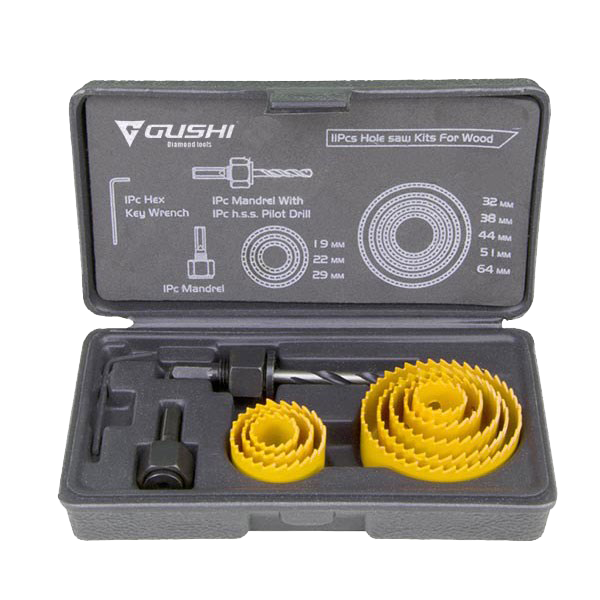
1. The listing, audited
This page contradicts itself twice inside six lines, and both contradictions come from the same cause: an imperial product described in metric. The case settles one of them and the arithmetic settles the other.
| What the listing says | What is wrong | What to write instead |
|---|---|---|
| Sizes 19, 22, 29, 32, 38, 44, 51, 64 (description) | Disagrees with the feature list three lines below, which says 28. Only one can be printed on the case, and the case says 29. | 29 mm, being 1-1/8 inch at 28.57 mm, and note that the earlier 28 was a rounding the other way. |
| 1 1/8″ – 28 mm | 1-1/8 inch is 28.57 mm. Calling it 28 understates it by half a millimetre and contradicts the case print. | 1-1/8 inch – 29 mm. |
| 1 1/3″ – 44 mm | One and one third inch is 33.87 mm, not 44. Nothing in the kit is 33.9 mm. The 44 mm saw is 1-3/4 inch, which is 44.45 mm. | 1-3/4 inch – 44 mm. |
| Induction teeth finis61711h of hardness 46–63 HRC | Corrupted text, and the hardness range is unexplained. A single hardness of 63 would be brittle; the range exists because only the teeth are hardened. | Induction-hardened teeth at 46 to 63 HRC: about 63 at the tip, about 46 at the root and body. |
| Can be used for drilling through drywall, plastic, MDF, thin aluminium and plywood | Four of those five are right. Thin aluminium is not: carbon steel teeth rub and load with aluminium instead of shearing it, and hardened tips chip when the chip welds on. | Drywall, plastic, MDF, plywood and softwood. Metal needs a bi-metal saw. |
| 11 PCS | Correct, but the count is not explained, so a buyer assumes eleven diameters. There are eight saws. | Eleven pieces: eight saws, two arbors, one hex key; one arbor carries the HSS pilot. |
| All sizes printed in mm only | Hides the fact that the ladder is imperial. A buyer who needs 25 mm sees 22 and 29 and cannot tell whether the product is badly made or simply imperial. | Print both: 3/4″ / 19 mm and so on, on the case, the page and the carton. |
Two lines on the original page are genuinely informative and should be kept: the steel is named as carbon steel, and the tooth hardness is given as a range rather than a single number. Both are real specification data, and both are rarer than they should be at this price point.
2. Eight numbers, eight fractions
Here is the whole kit decoded. The middle column is what the saw actually is; the fourth is how far the printed label sits from the inch it stands for. None of the deviations exceed half a millimetre, which is the tell that these are rounded conversions rather than design dimensions.
| Label on the case | Imperial size | True diameter | Label minus true | Step from the size below |
|---|---|---|---|---|
| 19 mm | 3/4″ | 19.05 mm | −0.05 mm | — |
| 22 mm | 7/8″ | 22.22 mm | −0.22 mm | +15.8% |
| 29 mm | 1-1/8″ | 28.57 mm | +0.43 mm | +31.8% |
| 32 mm | 1-1/4″ | 31.75 mm | +0.25 mm | +10.3% |
| 38 mm | 1-1/2″ | 38.10 mm | −0.10 mm | +18.8% |
| 44 mm | 1-3/4″ | 44.45 mm | −0.45 mm | +15.8% |
| 51 mm | 2″ | 50.80 mm | +0.20 mm | +15.9% |
| 64 mm | 2-1/2″ | 63.50 mm | +0.50 mm | +25.5% |
The two biggest steps are worth naming. The jump from 7/8 inch to 1-1/8 inch is 31.8%, the largest in the set, and it is the reason there is no 25 mm saw. The jump from 2 inch to 2-1/2 inch is 25.5%, and it is the reason a 54 mm door lock cannot be cut. Everything between those two outliers steps by 10 to 19%, which is a sensible progression for a general-purpose kit.
3. The label is not the hole
There are two ways to read a metric label on an imperial tool, and the difference is half a millimetre. If the saw is machined to the inch and the label is a rounded conversion, the cutting diameter is the true figure in the third column. If the saw is machined to the metric label, the cutting diameter is the label. The arithmetic in section 2 says the first is what is happening, but it is worth measuring rather than assuming.
| Question | If made to the inch | If made to the label | Which it is, and why |
|---|---|---|---|
| What does the 64 mm saw cut? | 63.50 mm | 64.00 mm | The inch, because 64 is not a round number in any metric series |
| What does the 44 mm saw cut? | 44.45 mm | 44.00 mm | The inch; 44.45 is exactly 1-3/4″ |
| Why does it matter? | Half a millimetre changes whether a fitting drops in or has to be filed | For a pipe sleeve or a grommet, 0.5 mm is the difference between a push fit and a ream | |
Practically, measure before you commit to a tolerance-sensitive job. Put calipers across the tooth tips, not across the cup body: a hole saw cuts on the outside of the teeth, so the outside diameter over the tips is the cutting diameter, and the cup behind it is smaller by the tooth height plus the set.
What to write when you order
State both. “1-3/4 inch / 44 mm” leaves no room for a rounding argument at either end. If the order says only 44 mm and the factory ships an imperial saw, nobody is wrong and the hole is still 44.45 mm.
4. How evenly the ladder steps
A set like this is judged by one thing: for any hole size you might want, how far is the nearest saw? That is not the same as the range, and it is not the same as the number of saws. It is the half-gap between adjacent sizes, and it varies by a factor of four in this kit.
| Gap | Midpoint, hardest size to hit | Worst error with the nearest saw | What lives at the midpoint |
|---|---|---|---|
| 19 → 22 mm | 20.5 mm | 1.5 mm | Nothing common; a 20 mm grommet at a push |
| 22 → 29 mm | 25.5 mm | 3.5 mm | 25 mm conduit, 25 mm pipe, 1 inch fittings |
| 29 → 32 mm | 30.5 mm | 1.5 mm | Little; the two sizes are close by design |
| 32 → 38 mm | 35.0 mm | 3.0 mm | 35 mm waste pipe, small cable glands |
| 38 → 44 mm | 41.0 mm | 3.0 mm | 40 mm pipe |
| 44 → 51 mm | 47.5 mm | 3.5 mm | 45 mm and 50 mm fittings |
| 51 → 64 mm | 57.5 mm | 6.5 mm | 54 mm door locks, 57 mm speakers, 60 mm duct |
The last row is the one that decides whether this kit is right for you. Between 51 and 64 mm there is no intermediate saw at all, so a 54 mm lock hole is three millimetres under with the 51 and ten millimetres over with the 64. Neither is acceptable for a latch that has to sit concentric with a spindle.
The arithmetic also explains why the kit feels complete in the hand. Eight saws nested in a case look like a full range, and for cabinet work, plumbing and light electrical it nearly is. The illusion breaks at the two largest gaps, and both of them are in the trades where hole size is specified by a fitting rather than chosen by the operator.
5. The four holes it cannot cut
Four openings account for most of the frustration with a kit like this, and all four sit outside the ladder or in its widest gap. Knowing them before the order is the difference between a useful set and a set that sends you back to the shop for a single saw.
| Opening | Size needed | Nearest saw in the kit | Error | What to buy instead |
|---|---|---|---|---|
| 25 mm conduit or pipe penetration | 25–26 mm | 22 or 29 mm | −3 or +4 mm | A single 25 or 26 mm saw |
| Tubular latch or mortice lock | 54 mm | 51 mm | −3 mm | The 54 mm saw supplied with most lock jigs |
| Single back box, UK or EU | 68–70 mm | 64 mm | −4 to −6 mm | A 68 mm saw, or a pad saw and a steady hand |
| Downlight | 75 or 90 mm | 64 mm | −11 or −26 mm | The size printed on the fitting, as a single saw |
There is a pattern in that table worth stating plainly: this kit is sized for holes that are chosen, not holes that are specified. Cabinet handles, cable runs, speaker recesses and vent spigots are chosen by the installer and the 19 to 64 mm ladder covers them well. Locks, back boxes and downlights are specified by a product standard, and those standards sit at 54, 68, 75 and 90 mm — three of which are outside the range and one of which is in the widest gap.
The improvised alternatives, and their cost
- Open the hole with the next size down and file it out. Works in plasterboard and softwood, takes several minutes per hole, and leaves a hole that is oval by however much your hand wandered.
- Use the next size up and cover it. Fine behind a bezel or a plate with a generous lip, and unacceptable anywhere the hole edge is visible.
- Drill a ring of small holes and break out the centre. A traditional method that produces a ragged edge and, in MDF, a lot of dust.
None of these is a reason to reject the kit. They are the reason to buy the kit plus the one or two sizes your trade actually repeats, and to keep those single saws on the same arbor.
6. Why 46 and 63 in the same sentence
“Hardness 46–63 HRC” reads like a quality problem — a spread of seventeen points on one component. It is not. It is a description of an induction-hardened edge, where only the teeth have been heated and quenched and the rest of the cup has been left as it was.
| Part of the saw | Hardness | Why that value | What goes wrong at the other value |
|---|---|---|---|
| Tooth tip | ~63 HRC | Hard enough to resist abrasion in plywood and MDF | Softer tips round over in a few holes |
| Tooth root and gullet | ~46 HRC | Tough enough to bend rather than crack when a tooth catches | Hardened roots crack, and a cracked gullet throws a tooth |
| Cup body and back | Soft, unhardened | Absorbs the torque of a stalled cut and the shock of a catch | A through-hardened cup shatters instead of stalling |
That gradient is the whole point of induction hardening, and it is why a carbon steel saw can be both hard enough to cut and tough enough to survive. It is also why you cannot judge the saw by running a file across the cup: the body is meant to be soft, and a file will bite.
How to check it in ten seconds
Run a fine file across a tooth tip and then across the cup body. The tip should skate; the body should cut. If both skate, the saw has been through-hardened and will be brittle. If both cut, the induction hardening is missing or has been ground away, and the teeth will dull quickly. This is the single most useful incoming check on a carbon steel hole saw, and it needs no instruments.
7. Carbon steel against metal
The listing includes thin aluminium in its material list, and that one entry does more damage than any other line on the page: it invites the buyer to use the saw in the one application where carbon steel fails fastest. The mechanism is worth understanding because it is not about hardness at all.
| Material | Carbon steel saw (this kit) | Bi-metal saw | What decides it |
|---|---|---|---|
| Pine, fir, softwood | Good | Good | Abrasion only; either tooth survives |
| Plywood and MDF | Good | Good | The glue line is abrasive; hardened tips last longer |
| Drywall | Good | Good | Paper and gypsum are soft; the risk is the paper tearing at the exit |
| PVC and ABS pipe | Good, with care | Good | Friction heat softens PVC; a fast saw smears it |
| Aluminium sheet, thin | Poor | Good | Aluminium welds to a carbon steel edge instead of shearing (built-up edge) |
| Aluminium section or plate | No | Marginal | Chip welding plus a brittle 63 HRC tip equals thrown teeth |
| Steel sheet, under 2 mm | No | Good | HSS teeth at 62–65 HRC with cobalt resist the heat |
| Stainless steel | No | Marginal | Work-hardens; needs slow speed, lubricant and a cobalt tooth |
| Tile, concrete, stone | No | No | Neither; these need a diamond or carbide grit edge |
The aluminium failure has a name and a temperature. As the tooth rubs, the aluminium under it reaches a few hundred degrees at the contact point, softens, and pressure-welds to the tooth. Once a lump of aluminium is sitting on the cutting edge, the tooth is no longer cutting; it is dragging. The lump grows until the tooth cannot clear the kerf and the hardened tip, which is brittle by design, breaks off under the load.
If you must cut aluminium with it
It can be done on sheet under about 1.5 mm, with three conditions: very slow speed, a lubricant on the cut, and a light feed so the tooth shears rather than rubs. Stop the moment the cut sounds different. That is not a recommendation, it is a description of the only way the attempt survives — a bi-metal saw is cheaper than the time it takes.
8. 25 mm of cup, and what that allows
All eight saws share one cup height, so all eight cut 25 mm deep. That is a shallow hole saw: most general-purpose saws run 40 to 45 mm, and the shallow type exists to keep the price down and the weight off a hand drill.
| Material | Thickness | Verdict at 25 mm | What to expect |
|---|---|---|---|
| Drywall, single layer | 12.5 mm | Comfortable | Half the cup unused; clean cut |
| Drywall, double layer | 25 mm | At the limit | The arbor shoulder touches the face as the tip exits |
| Plywood | 18 mm | Good | 7 mm spare |
| MDF | 18–19 mm | Good | MDF packs; withdraw once mid-cut |
| Melamine-faced board | 18 mm | Good, with a backer | The face chips without a sacrificial board |
| CLS or 2×4 stud | 38 mm | No | Cut from both sides, or use a deeper saw |
| Interior door | 35–44 mm | No | A door lock needs a 54 mm saw with 45 mm depth; this is not that tool |
| Two 18 mm boards stacked | 36 mm | No | Same as the stud: two-sided cut or a deeper cup |
There is a second consequence of a shallow cup that is easy to miss: the ratio of depth to diameter changes across the set. At 19 mm the cup is 1.3 times as deep as it is wide, which clears well. At 64 mm it is only 0.4 times as deep, so the same 25 mm of cut produces a ring of waste more than three times the volume, in a cup that is proportionally much flatter. That is why the large saws in this kit pack before the small ones do, and why they need a slower feed and a mid-cut withdrawal even though the depth is identical.
9. What the eleven pieces are
Eleven is an accurate count and a misleading number, because only eight of the pieces cut. The case print is actually clear about the split, and it is worth repeating on the page so nobody orders expecting eleven diameters.
| Piece | Quantity | What it does | What a buyer assumes instead |
|---|---|---|---|
| Hole saw, 19 to 64 mm | 8 | The cutting tools; nested by size in the case | That there are eleven sizes |
| Arbor with HSS pilot drill | 1 | Drives the saw and centres the hole | That the pilot is a separate item |
| Arbor, without pilot | 1 | A second mount, so a large and a small saw can stay set up | That it is a spare of the same part |
| Hex key | 1 | Tightens the grub screw that locks the saw on the arbor | That the saws are threaded on |
Quick-change, not threaded
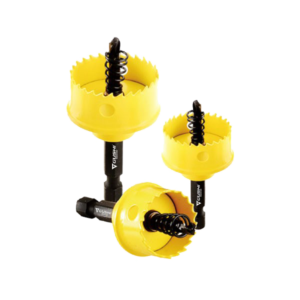
The photograph shows the arbor type: a hex shank with a cross pin, and a saw that slides over a shouldered boss and is locked by a grub screw. That is a quick-change system, not a threaded one, and the difference matters when you buy a spare. A threaded arbor takes saws with an internal thread of a specific standard; this one takes saws with a plain bore and a locking flat. The two do not interchange, and a replacement saw has to match the arbor type rather than the diameter.
The second arbor is not a spare in the ordinary sense. It lets you leave the large saw mounted while you work through the small sizes, which on a run of cabinet holes saves more time than the part costs. Keep the hex key taped inside the case; a loose grub screw is the most common reason a saw spins on the arbor.
10. Diagnosis
| Symptom | Most likely cause | Test | Fix |
|---|---|---|---|
| Saw spins but does not cut | Grub screw loose, saw slipping on the arbor | Mark the saw and the arbor, run a second, see if the marks move | Tighten with the hex key; check the flat on the saw bore is not worn |
| Cut slows halfway through | Cup packed with chips | Withdraw and look inside the cup | Clear it, then withdraw once mid-cut on every hole of that size |
| Teeth bright and rounded | Normal wear, or the saw has been run in metal | Look at the tip profile against a new saw | Replace; a rounded tip cannot be resharpened economically |
| Teeth loaded with a grey smear | Aluminium or PVC welded to the edge | Pick at it with a knife: metal smear means chip welding | Remove it, slow down, and stop cutting that material with this saw |
| Hole is oval or off the mark | Bent pilot drill, or the pilot wandered on a slick surface | Roll the pilot on a flat surface | Replace the pilot; start on a punch mark or a piece of tape |
| Face chips around the rim | No backer board, or the teeth exited into unsupported material | Look at the exit side of the last hole | Clamp a sacrificial board behind, and reduce feed at the exit |
| Saw grabs and stalls the drill | Too much feed, or a deep cup in a thick section | Note the depth at which it grabs | Lower the feed, withdraw more often, and check the material is within 25 mm |
| Tooth missing | Hardened tip hit a nail, a screw or metal lath | Look at the gullet: a clean break means impact | Replace the saw; a saw with one tooth gone will chatter and cut oversize |
11. What to put on the purchase order
Five fields are missing from the listing, and the first one is the reason the page contradicts itself.
| Field | What to state | Why it matters |
|---|---|---|
| Size list | Both the inch and the millimetre figure for each saw | 44 mm and 1-3/4 inch are the same saw described two ways, and one of them is 44.45 mm |
| Cutting diameter tolerance | Plus or minus what, measured over the tooth tips | Half a millimetre decides whether a fitting drops in |
| Arbor type | Quick-change with grub screw, or threaded, and the shank form | Replacement saws and arbors have to match the system, not just the diameter |
| Tooth hardness | Tip and root values separately | 46–63 HRC only means something if the reader knows which part is which |
| Cup depth | 25 mm, and whether a deeper version exists in the same diameters | A buyer who needs 38 mm has to know before the carton arrives |
| Case print | Piece count broken down, and the size list in both units | The case is the only documentation the end user keeps |
| Material statement | Wood, drywall, plastic, MDF; explicitly not metal | Removes the aluminium line that causes the returns |
| Packing | Moulded case, shrink-wrapped, or hanging card | Determines the carton quantity and the retail presentation |
12. Incoming inspection
A hole saw kit is easy to check because every fault is visible or measurable in a minute. The file test on the teeth is the only one that needs a judgement call, and it is the one that separates a hardened saw from a painted one.
| Check | Method | Accept | Reject |
|---|---|---|---|
| Tooth hardening | Fine file across a tip, then across the cup body | Tip skates, body cuts | Both skate, or both cut |
| Cutting diameter | Calipers over the tooth tips, not the body | Within 0.3 mm of the inch figure | More than 0.5 mm under: the hole will not pass the fitting |
| Tooth pitch | Count teeth over a quarter of the circumference on two saws | Consistent between saws of the same size | Irregular spacing: the saw will chatter |
| Cup depth | Rule from the tooth tips to the back plate | 25 mm, within 1 mm | Under 23 mm: fewer boards than quoted |
| Bore and flat | Slide the saw onto the arbor, check the locking flat engages | Seats fully, no rock, grub screw bites | Rocks on the boss, or the flat is missing |
| Arbor runout | Mount the arbor alone, spin it, watch the shoulder | No visible wobble | Visible wobble: every hole will be oversize |
| Pilot drill | Roll on a flat surface; check it is straight and the point is centred | Straight, sharp, brazed or clamped square | Bent, or set at an angle in the arbor |
| Case and print | Open, count the pieces, read the lid | 11 pieces, size list matches the contents in both units | Any mismatch between the lid and the box |
Do the file test on one saw per batch and the diameter check on all eight in the first kit. A set where one saw is 0.8 mm under its label will produce exactly one bad hole, on exactly the job where that size mattered, and it will be blamed on the operator.
13. Full specifications
Eight saws, one cup depth, one arbor system. The third column is the one to quote on an order, because it is the figure the hole will actually be.
| Saw | Label | Imperial | True diameter | Depth | Arbor |
|---|---|---|---|---|---|
| 1 | 19 mm | 3/4″ | 19.05 mm | 25 mm | Quick-change, grub screw |
| 2 | 22 mm | 7/8″ | 22.22 mm | 25 mm | Quick-change, grub screw |
| 3 | 29 mm | 1-1/8″ | 28.57 mm | 25 mm | Quick-change, grub screw |
| 4 | 32 mm | 1-1/4″ | 31.75 mm | 25 mm | Quick-change, grub screw |
| 5 | 38 mm | 1-1/2″ | 38.10 mm | 25 mm | Quick-change, grub screw |
| 6 | 44 mm | 1-3/4″ | 44.45 mm | 25 mm | Quick-change, grub screw |
| 7 | 51 mm | 2″ | 50.80 mm | 25 mm | Quick-change, grub screw |
| 8 | 64 mm | 2-1/2″ | 63.50 mm | 25 mm | Quick-change, grub screw |
| Arbor A | — | — | — | — | With HSS pilot drill |
| Arbor B | — | — | — | — | Without pilot |
| Hex key | — | — | — | — | For the grub screw |
The eleven rows above are the whole kit. If a supplier’s carton contains eleven saws, it is a different product, and the piece count alone will not tell you which one you have.
Frequently Asked Questions
Is this kit metric or imperial?
The saws are imperial and the labels are metric. The eight diameters are 3/4, 7/8, 1-1/8, 1-1/4, 1-1/2, 1-3/4, 2 and 2-1/2 inch, each converted to millimetres and rounded to the nearest whole number. So 19 means 19.05, 22 means 22.22, 29 means 28.57 and 64 means 63.50. Treat the printed figure as a label for the imperial size rather than as a tolerance on the hole.
Why does the listing say 28 mm in one place and 29 mm in another?
Because 1-1/8 inch is 28.57 mm, which rounds to 29 but also sits close enough to 28 to be written either way. The moulded case prints 29 and the feature list prints 28. The physical saw is the same. For ordering, ask for 1-1/8 inch or 29 mm and expect 28.6 mm of cutting diameter.
What is 1 1/3 inch minus 44 mm in the feature list?
It is a typographical error. One and one third inch is 33.9 mm, not 44. The saw that measures 44 mm is 1-3/4 inch, which is 44.45 mm. Nothing in the box is 33.9 mm, and nothing is 1-1/3 inch. Read that line as 1-3/4 inch to 44 mm.
Why is there no 25 mm saw?
Because the ladder is imperial. The step from 7/8 inch to 1-1/8 inch is the largest in the set, and 25 mm falls in the middle of it. The nearest sizes are 22 and 29 mm, which are three and four millimetres away respectively. If the job is a 25 mm conduit or pipe penetration, this kit does not do it and you need a single saw in that size.
Can I cut a door lock hole with this?
No. A standard tubular latch or mortice lock needs a 54 mm hole, and the kit jumps from 51 to 64 mm. The 51 mm saw is three millimetres small and the 64 mm saw is ten millimetres large. Door lock installation needs its own 54 mm saw, usually sold with the lock kit.
Can I cut a socket box opening?
Not cleanly. A single UK back box needs a 68 mm opening and a European box is around 68 to 70 mm; the largest saw here is 64 mm. You would be four millimetres under, which means filing or a second pass, and on plasterboard that usually means a ragged edge. Use a 68 mm saw or a pad saw.
Can I cut downlight holes?
No. Downlights are commonly 75 or 90 mm, both above the 64 mm maximum. This kit stops at 2-1/2 inch and the next common size is 3 inch, which is not included. For ceilings, buy the size the fitting specifies, usually as a single saw.
Can it cut thin aluminium?
It can be attempted, and the listing says so, but it is a poor match. Carbon steel teeth hard enough to cut wood will rub and load with aluminium rather than shear it, and the hardened tooth tips chip when the chip welds to the edge. For sheet aluminium a bi-metal saw with a fine variable pitch and a lubricated, slow cut is the right tool.
What does 46 to 63 HRC mean?
It is a range because only the teeth are hardened. The tooth tips reach about 63 HRC for wear resistance, while the body and the tooth roots stay softer, around 46 HRC, so the cup can flex without cracking. A saw hardened to 63 all through would be brittle and would shatter at the gullet. The range is a description of an induction-hardened edge, not an inconsistency.
Can it cut metal?
No. Carbon steel teeth are for wood, drywall and plastics. Steel sheet, stainless and even aluminium in any thickness will either dull the teeth immediately or load them with welded chips. If the job is metal, the saw has to be bi-metal or carbide tipped, which is a different product with different tooth geometry.
How deep can it cut?
25 mm, and that is the same for all eight saws because they share one cup height. That covers 18 mm plywood, 19 mm MDF, 12 mm drywall and two layers of 12 mm board at a push. It does not cover a 38 mm CLS stud or a doubled-up stud wall, and it will not cut through a 44 mm door.
Do I need both arbors?
One arbor carries the HSS pilot drill and is what you use for most holes; the second is a spare or a size change. Having two means you can leave one set up in a large saw and one in a small, which saves swapping. The hex key is for the grub screw that locks the saw to the arbor.
What are the MOQ, lead time, OEM and sample terms?
MOQ is quoted per kit and per carton, because the moulded case drives the packing quantity. Standard lead time is 20 to 30 days. OEM covers the case print, the saw colour, the blade diameter list, the arbor type and the retail packaging, including a hanging card or a shrink-wrapped case. Samples can be supplied for a trial on your own board material.