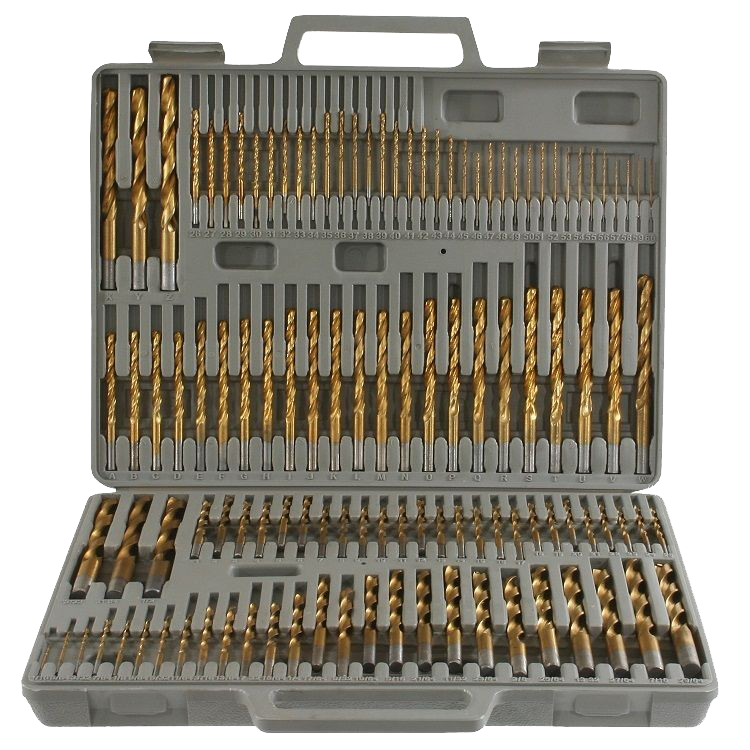
Product Overview
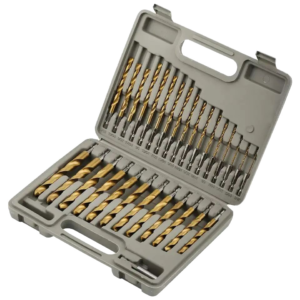
The HSS Ti-coated drill bit set is the general-purpose metal drilling set with one deliberate change: every drill in the case carries a physical vapour deposition titanium nitride film. The body is high-speed steel, fully ground, in the standard 1–13 mm half-millimetre ladder. The coating is applied after final grinding, which is the correct sequence — coat a rough or poorly finished flute and the film bridges the grinding marks instead of bonding to them.
The four claims the product makes, restated in engineering terms:
- “After high-density polishing, wear resistance, and heat resistance.” The polishing is not cosmetic. A PVD film only converts into tool life when the substrate is finished finer than the film is thick; this is the single most under-appreciated precondition in coated tooling, and we deal with it in detail below.
- “High cost-effectiveness and improved efficiency in use.” TiN typically costs 20–50 percent more than black oxide and returns two to five times the edge life in ferrous work. Cost per hole falls even though cost per bit rises.
- “Portable shell box with colour coded insertion corresponding positions and clips.” An index case where each diameter has its own slot, colour-coded and clipped, so a missing bit is visible at a glance from across a workshop.
- “Packaged in plastic containers, easy to reseal and carry.” A resealable two-piece shell that survives being thrown into a van, which is a different requirement from surviving a shelf.
What “Ti-coated” Actually Means
Three different physical processes get called “a coating” in drill marketing, and they behave nothing alike. Telling them apart is most of the skill in buying drills.
| Mechanism | What happens | Examples | Adds thickness? | Adds hardness? |
|---|---|---|---|---|
| Deposition (PVD) | Material is vaporised from a solid target in a vacuum and condensed onto the tool as a new, separate ceramic layer bonded at the atomic level | TiN, TiCN, TiAlN, AlTiN, CrN, DLC | Yes — 1–5 µm | Yes — 2300–3500 HV |
| Deposition (CVD) | Same idea, but the layer is grown from reacting gases at 800–1050 °C | TiC, TiN, Al2O3 on carbide inserts | Yes — 5–15 µm | Yes, but see the temperature problem below |
| Conversion | No new material is added. The iron already in the surface is chemically converted into an oxide; the layer is the tool’s own skin | Black oxide, amber / bronze oxide, steam tempering | Almost none — 0.5–2.5 µm | No measurable gain |
| None (bright) | Ground and polished steel, nothing else | Bright finish, polished HSS | No | No |
That table contains the answer to the most expensive mistake in this category. A gold-coloured bit is not necessarily a titanium-coated bit. Amber oxide is gold-brown too, it is produced in a hot alkaline bath rather than a vacuum chamber, and it costs a fraction as much. If you are buying on colour you are buying blind; buy on the stated coating and, for volume programmes, on a coating thickness and adhesion test report.
The Finish Ladder: Six Surfaces Compared
This is the master comparison. Every figure is a typical value from published coating data; individual supplier formulations and test methods vary, so treat them as bands for specification, not as guaranteed numbers.
| Finish | Bright | Black oxide | Amber / bronze | TiN (this set) | TiCN | TiAlN |
|---|---|---|---|---|---|---|
| Type | None | Conversion | Conversion | PVD film | PVD film | PVD film |
| Colour | Silver | Matte black | Gold-brown | Gold | Blue-grey / violet | Violet-black |
| Surface hardness | base, ~650–750 HV | no gain | no gain | ~2300 HV | ~3000 HV | ~3300 HV |
| Max service temp | base metal | base metal | base metal | ~600 °C | ~400 °C | 800–900 °C |
| Friction vs steel | ~0.78 baseline | ~0.65 | ~0.60–0.65 | 0.4–0.65 | ~0.40 | ~0.50 |
| Thickness | — | 0.5–2.5 µm | 1–2 µm | 2–5 µm | 2–4 µm | 2–4 µm |
| Life vs bright | 1× | ~1.5× | ~1.5× | 2–5× | 2–4× | 3–5× |
| Price premium | baseline | +5–15% | +5–15% | +20–50% | +30–60% | +40–80% |
| Corrosion resistance | Poor | Good | Good | Good | Very good | Very good |
| Sharpest possible edge | Best | Best | Best | Slightly rounded by the film | Rounded | Rounded |
| Resharpen friendly | Yes | Yes | Yes | Loses the film at the edge | Loses the film | Loses the film |
| Best for | Aluminium, copper, wood, plastics | General steel, cast iron, low volume | General steel, North American jobber market | Production drilling in steel and cast iron | Abrasive cast iron, stainless at low speed | Stainless, hardened steel, dry / high speed |
Why HSS Gets PVD and Carbide Gets CVD
There is one number behind this, and it is not the coating. It is the temperature at which the tool steel was tempered.
| Process or limit | Typical temperature | Consequence |
|---|---|---|
| PVD deposition | 200–500 °C (commonly 400–500 °C) | Below the HSS temper — substrate keeps its hardness |
| Plasma-assisted CVD | 450–650 °C | Marginal for HSS; the usual route for DLC on steel |
| HSS tempering temperature | ~540–560 °C | The line nothing may cross if the drill is to stay hard |
| Conventional CVD | 800–1050 °C | Above the temper — HSS softens and must be re-tempered |
| Cemented carbide (WC-Co) | unaffected at 1000 °C | Why carbide takes CVD happily and HSS cannot |
Run a hardened HSS drill through a conventional CVD cycle and you get the worst of both worlds: a hard ceramic skin on a core that has just been annealed. The substrate deflects under load, the brittle film cannot follow it, and the coating spalls off in flakes that take the cutting edge with them. This is why the whole HSS drill, tap, reamer and hob industry coatings by PVD, and why any supplier offering “CVD-coated HSS” deserves a hard question.
The rule worth memorising: name your substrate first, and the process follows from it. HSS means PVD. Carbide can take either, and the choice becomes cost and edge geometry rather than survival.
Four Things a Coating Can Never Fix
Every one of these is a failure mode we have seen blamed on a coating when the cause was somewhere else entirely.
| Symptom | Blamed on | Actual cause | Where to look instead |
|---|---|---|---|
| Bit dulls in a few holes in stainless | “Coating wore off” | TiN oxidises above ~600 °C; the substrate is also running past its red-hardness limit | Specify TiAlN, and an M35 or M42 cobalt substrate |
| Film flakes off in patches | “Bad batch” | Substrate too soft or too rough, or the film was deposited too thick. Above roughly 10 µm, compressive stress drives spallation on steel | Substrate grade and surface finish before coating — see the HSS grade argument |
| Bit walks and the hole is oversize | “Coating is slippery” | Point geometry, not surface. A coating changes friction; it does not centre a drill | Point angle, split point and lip symmetry |
| Drill breaks or the shank twists | “Coating made it brittle” | Bending and torsional strength come from the core. A 3 µm film contributes nothing to section modulus | Diameter, stick-out, flute length, feed rate, chuck condition |
Why the Polishing Claim Is the Real One
The product description leads with “after high-density polishing, wear resistance, and heat resistance,” which reads like marketing word order. It is actually the correct order, and there is a specific piece of published work behind it.
A PVD film is two to five microns thick. If the flute surface underneath it carries grinding scratches deeper than that, the film does not cover the surface — it bridges it. The coating lands on the crests of the grinding marks and the valleys stay bare metal. Under load the unsupported film on the crests is knocked off first, and what is left is a coating that has already failed before it has done any work. The condition, from work by Sundquist and co-workers, is blunt: a TiN coating only adds tool life when the substrate is finished finer than the coating is thick.
Two consequences follow, and both are useful in a buying conversation:
- It explains why two nominally identical coated drills perform differently. Same grade, same coating, same thickness — different pre-coat finish. This is the most common reason a coated-tool trial produces contradictory results between two suppliers.
- It makes “high-density polishing” a checkable specification. Ask for the pre-coat surface roughness, in Ra, and check it against the coating thickness. A supplier who cannot tell you the Ra of the flute before coating is not controlling the variable that decides whether the coating works.
The same logic runs the other way for black oxide and amber: because they are conversion layers grown out of the existing surface rather than laid on top of it, they are far more tolerant of a coarser substrate. That is part of why they are cheap and reliable, even though they add no hardness.
Coating by Workpiece Material
Match the coating to the workpiece, not to the price list. Where two finishes are listed, the first is the cost-effective choice and the second is the production choice.
| Workpiece | Specify | Why | Avoid |
|---|---|---|---|
| Mild steel <500 N/mm², low volume | Black oxide or amber | The steel is easy; you are buying corrosion resistance and a little lubricity, not hardness | TiAlN — over-specified and it will not pay back |
| Mild steel, production | TiN | Abrasion resistance plus lower friction; 2–5× life pays back the premium quickly | Bright — no wear protection |
| Alloy steel 500–800 N/mm² | TiN | Same argument, more heat; TiN’s 600 °C ceiling is still comfortable | TiCN — harder but only 400 °C |
| Stainless 304 / 316 | TiN minimum, TiAlN preferred | Stainless work-hardens and runs hot; TiAlN stays stable to 800–900 °C and forms an alumina layer that resists welding to the chip | Bright or black oxide — hopeless |
| Cast iron | TiN, or TiCN for very abrasive grades | Abrasion dominates; TiCN is harder but less heat tolerant, so pick by whether the job is wear-limited or heat-limited | Bright |
| Aluminium and its alloys | Bright, or TiN | Soft and gummy; a smooth uncoated flute resists built-up edge as well as anything | TiAlN — the aluminium in the coating has chemical affinity with an aluminium workpiece |
| Brass, copper, bronze | Bright or TiN | Free-cutting, low heat; no coating needed | Expensive coatings for no return |
| Titanium, Inconel, heat-resistant alloys | TiAlN on an M42 cobalt substrate | Heat and chemical affinity; this is close to the limit of what HSS should be asked to do | TiN — 600 °C ceiling is far too low |
| Hardened steel, >30 HRC | TiAlN on M42, or move to solid carbide | Above roughly 45 HRC, HSS is the wrong substrate regardless of coating | Any HSS with a bright finish |
| Wood, MDF, plastics, PVC | Bright | Coatings add cost without meaningful benefit; the wear mechanism is not the one a ceramic film addresses | Paying for TiN on a wood set |
| GRP, carbon fibre, abrasive composites | TiCN, or diamond-coated carbide | Glass and carbon fibre are abrasives; hardness wins | Bright — worn in a handful of holes |
The Temperature Ceiling and the Aluminium Exception
Two thermal facts decide most coating failures, and neither is intuitive.
TiN oxidises; TiAlN grows its own protection
TiN is stable to roughly 600 °C. Past that it oxidises and loses hardness fast, which is why a TiN drill that was excellent in mild steel dies young in stainless. TiAlN behaves differently: at cutting temperature the aluminium in the film oxidises into a thin, stable alumina (Al2O3) layer right at the cutting interface. That layer is a thermal barrier, it self-replenishes as it wears, and it is why TiAlN is the standard for dry and high-speed cutting. The counter-intuitive result is that TiAlN is one of the few coatings that gets better as it gets hotter, up to its limit.
The aluminium exception
The aluminium that makes TiAlN so good in steel is exactly what makes it wrong for aluminium workpieces: at cutting temperature there is chemical affinity between the aluminium in the coating and the aluminium being cut, and the result is material transfer and built-up edge. For aluminium, a bright finish or TiN is the right call. This is one of the few cases in tooling where the more expensive, harder coating is actively the wrong answer.
Coolant, and a caution
TiN in steel is happy with flood coolant and happier still with a steady feed. TiAlN was designed for dry and minimum-quantity lubrication, and there is a real caution the other way: dousing a red-hot TiAlN edge with flood coolant produces thermal shock and the associated heating and cooling cycles can crack the film. If you specify TiAlN, plan for dry or MQL, or accept a shorter coating life.
Thickness, Hole Size and Regrinding
A film has thickness, and thickness has consequences that most buyers never think about until a hole comes out wrong.
| Consequence | Magnitude | Does it matter? |
|---|---|---|
| The drill cuts slightly larger | 2–5 µm per coated face, so roughly 4–10 µm on diameter | No for clearance holes, pilot holes and tapping pre-drills. Yes if you are trying to hold a hole to a few microns — finish those with a reamer, not a coated drill |
| Repeated re-coating accumulates | A drill can be stripped and re-coated roughly 5–10 times before the accumulated error becomes a problem | Matters only for tools on tight-tolerance work. For general drilling, re-coating is rarely economic on a jobber drill anyway |
| Grinding the margins destroys the benefit | The margin is the narrow land along the flute that rubs the hole wall and sizes the hole | Never grind the margins or the land of a coated drill — you remove the film from the only part that is doing the sizing |
| Resharpening removes the film at the edge | The point is the hottest, hardest-working area | A resharpened coated bit performs as an uncoated bit at the edge while the flutes keep their low-friction skin. Expect less than new, not nothing |
| Re-coating requires stripping first | A new film will not adhere over a damaged or partially worn one | Strip chemically. Note that HSS tolerates chemical stripping far better than carbide — the strip solution attacks the cobalt binder in carbide and leaves a porous surface that will not re-coat |
| Films that are too thick spall | Above roughly 10 µm, residual compressive stress drives spallation on steel substrates | This is why PVD on steel is held to 1–5 µm. A supplier quoting 8 µm of TiN on HSS is quoting a flaking problem |
Reading the Gold: Wear Diagnosis
One genuinely useful property of a gold film is that it is a free wear indicator. Silver steel showing through gold tells you where the coating has gone, and where it has gone tells you what went wrong.
| What you see | What it means | Action |
|---|---|---|
| Silver right at the cutting edge, gold everywhere else | Normal. The extreme edge runs hottest and most loaded; the film goes there first while the flutes and margins keep working | Keep drilling. This is the expected wear pattern, not a defect |
| Gold gone along the margin for the first 5–10 mm | The margin has lost its film and is now burnishing the hole wall instead of cutting cleanly past it | Retire the bit. Hole size and finish are both degrading |
| Gold turned blue, purple or straw | The drill has been run past 600 °C — and past the tempering range of the steel underneath. The hardness is gone from the substrate, not just the film | Retire immediately. Reduce speed, increase feed, add cutting fluid |
| Gold flaking in patches | Adhesion failure: substrate too rough or too soft, or film deposited too thick. Not a wear problem, a manufacturing problem | Replace the bit and question the batch — ask for adhesion and thickness test reports |
| Gold intact but chips coming out blue or black | Speed too high or feed too light. The coating is fine; the parameters are not | Reduce speed, increase feed, apply cutting fluid |
| Gold intact, bit will not start without a centre punch | Nothing to do with the coating — the point geometry is doing this | Check point angle and whether the drill has a split point |
The Case: Why Packaging Is a Specification
Half of the complaints about a drill set are about the case, not the drills. A set that arrives with the bits shaken out of their slots, or rusty after six weeks in a container, has failed commercially even if every drill in it is excellent.
| Case type | Construction | Strengths | Weak points | Best for |
|---|---|---|---|---|
| Blow-moulded shell | Hinged two-piece PP or PE with formed bit slots | Impact resistant, cheap at volume, stacks well, reseals | Bulky; high tooling cost for a new mould | Trade and van sets — this set |
| ABS index cassette | Rigid ABS body, transparent lid, moulded index with clips | Premium shelf appearance, drop resistant, contents visible, accepts colour coding | Highest unit cost of the plastics | Retail and DIY, branded programmes |
| Metal index box | Folded steel box with a pivoting index leaf | Very durable, compact, premium mechanic appeal | Heavy, rattles, will rust if the plating is poor | Premium mechanic sets, workshop cabinets |
| Plastic tube or pouch | Extruded tube, or a printed pouch | Cheapest, lightest, lowest freight volume | No organisation; bits rub together and chip each other | Economy sets, promotions |
| Blister or hanging card | Transparent PVC front sealed to a printed card | Shelf-ready, tamper evident, peg-hook display | Single use, no storage value after opening | Supermarket and hypermarket pegs |
What a wholesale set has to survive
- The drop, not the shelf. Specify that a closed case dropped from bench height onto concrete keeps every bit in its slot. Friction-fit slots alone rarely pass; clips or a positive detent do.
- Moisture in transit. A sea container is a humidity chamber. Coated drills resist corrosion better than bright ones, but the shank end and any uncoated ground surface will still rust. Dry-pack or VCI for long sea routes.
- Size legibility. Laser-marked or printed sizes must survive being handled. If the marking wears off, the colour coding is the only remaining index — and it must match the actual sizes.
- Colour coding that survives. Confirm the coloured inserts are moulded in or securely fixed, not stickers that peel in the first month.
- Shelf or van. Decide early: a Euro hole for hanging, or a stackable footprint for a van racking system. The two are not interchangeable.
- Refillability. An index that accepts a single replacement bit turns a set into a system, and makes repeat orders of individual sizes possible.
- Labelling real estate. Barcode area, multilingual text, and the safety and material markings your market requires.
- Plastics compliance. REACH and RoHS declarations for the case material where your market requires them, plus recyclability marking.
Eight Checks Before You Buy a Coated Set
- Name the substrate first. Ask which HSS grade is under the coating — 4341, M2 or M35 — and buy the grade your hardest workpiece needs. The coating is a multiplier; it cannot substitute for the base.
- Ask for coating thickness in microns, and the pre-coat surface roughness. 2–5 µm of film on a surface finished finer than that. A supplier who will not state both is not controlling the process.
- Confirm the coating by name, not by colour. TiN, TiCN or TiAlN — and if the bit is gold-brown rather than gold, establish whether it is TiN or amber oxide.
- Match the coating to the workpiece, using the material table above. TiN for steel and cast iron production, TiAlN for stainless and dry work, bright or TiN for aluminium, bright for wood and plastics.
- Check the diameter ladder, not the piece count. A 25-piece set that skips the sizes your market drills is worth less than a 13-piece set that covers them. For metric markets, 1–13 mm in 0.5 mm steps is the standard that fits bolt clearance sizes.
- Establish whether the set is impact-driver rated. A coated standard jobber with a plain hex shank has no torsion zone and will not survive sustained impact use; the impact-rated version is a separate specification.
- Open and close the case, then shake it. Bits must stay in their slots when closed, and the lid must reseal after repeated use.
- Ask what happens when a bit breaks. Single replacements, refill packs and spare slots turn a consumable into a repeat-order business.
Full Specifications
| Product name | HSS Ti-coated Drill Bits Set |
|---|---|
| Brand | GUSHI (Huzhou Gu’s Imp. & Exp. Co., Ltd.) |
| Type | Twist drill bit set, PVD titanium nitride coated |
| Substrate | High-speed steel, fully ground from solid; M2 (W6Mo5Cr4V2) standard, 4341 for price-led programmes, M35 cobalt on request |
| Coating | Titanium nitride (TiN), physical vapour deposition, applied after final grinding |
| Coating thickness | 2–5 µm |
| Coating hardness | approximately 2300 HV (about three times the substrate) |
| Coating temperature limit | approximately 600 °C (oxidation limit) |
| Deposition temperature | 400–500 °C, below the ~540–560 °C tempering temperature of HSS |
| Surface preparation | High-density polishing before coating; pre-coat roughness finer than the coating thickness |
| Diameter range | 1.0–13.0 mm standard; 1/16–1/2 inch and wire-gauge ladders available |
| Diameter ladder | 0.5 mm steps as standard |
| Diameter tolerance | h8 |
| Point | 118° conical as standard, 135° split point on request — see the twist drill set for the geometry argument |
| Helix | Type N, 30°, right hand |
| Length series | Jobber to DIN 338; stub (DIN 1897) and long series (DIN 340) on request |
| Shank | 1/4″ hex quick-change as standard; straight, three-flat and reduced shank available |
| Set sizes | 13, 19, 25 and 29 pieces as standard production options |
| Case | Shell box with colour-coded insertion positions and clips, resealable; ABS index cassette, metal index box, pouch and blister alternatives |
| Colour coding | One colour per diameter band, moulded or fixed inserts |
| Finish alternatives | Bright, black oxide, amber / bronze oxide, TiCN, TiAlN — see black oxide, Ti-coated and amber finish ranges |
| Suitable materials | Alloy and non-alloy steel, cast iron and sintered iron, non-ferrous metals, sheet metal, plastics |
| Marking | Laser-marked size on the shank; logo on request |
| MOQ | 100 sets standard configuration; 500 sets custom |
| Lead time | 5–10 days standard, 15–30 days custom after advance payment |
| Payment | T/T, L/C, D/A, D/P, PayPal |
| Loading port | Shanghai or Ningbo |
| Quality system | 100% inspection before shipment; ISO 9001:2015 stated as a quality-system claim (confirm scope before publishing as a product certification) |
Applications
Fabrication and steelwork
Production drilling in mild and alloy steel — plate, angle, box section and beam work — is where a TiN set earns its premium. The coating resists the abrasive wear that dulls a bright drill in a few dozen holes, and the lower friction keeps chips moving up the flute instead of packing.
Maintenance, repair and overhaul
General workshop and site drilling in mixed materials. Here the case matters as much as the coating: colour-coded slots mean a missing bit is spotted before the box goes back in the van, and a resealable shell survives being thrown around.
Electrical and mechanical installation
Clearance and pilot holes in enclosure plate, conduit and bracketry, in steel and aluminium. Use the bright or TiN sizes for aluminium and avoid TiAlN there.
Automotive and vehicle work
Body and chassis steel, bracket repair, exhaust and general mechanical work. Keep the smallest diameters out of impact drivers — under about 3 mm they do not have the section to absorb rotational impulse.
Sheet metal and plastics
Thin plate, enclosure work and plastics. For larger holes in thin sheet, a step drill set or a hole saw set will give a cleaner result than a twist drill.
Woodworking and joinery
Only incidentally. Twist drills are the pilot-hole tool before a Forstner set, a flat bit set or an wood hole saw set does the real work; a coating adds nothing in wood.
Trade, wholesale and private label
Importer and distributor programmes in the 13 to 29 piece range, with coating, grade, ladder, shank and case configurable. Also available as individual sizes and refill packs, and in the hex shank format for quick-change markets.
Getting the Most Out of a Coated Set
- Set speed from the material and the diameter, and do not let the coating tempt you faster. TiN lowers friction, which lowers heat, which does permit a speed increase — but the substrate still has a red-hardness limit. Increase speed modestly and watch chip colour.
- Feed steadily and never let the drill dwell. Rubbing without cutting is the fastest way to destroy any coating; it generates heat with no chip to carry it away.
- Use cutting fluid in steel and stainless. With TiAlN, prefer dry or minimum-quantity lubrication and avoid quenching a hot edge with flood coolant.
- Watch the chip colour. Bright, uniform chips mean the parameters are right. Blue or black chips mean too much heat, regardless of what the coating is rated for.
- Never grind the margins. Regrind the point if you must, and accept that the edge will then behave as an uncoated one.
- Retire on the margin, not on the point. When the gold has gone along the margin for the first 5–10 mm, the bit has stopped sizing holes.
- Store dry and separated. Coated or not, drills that rattle against each other chip their cutting edges. Close the case.
- Replace singles, not sets, if your supplier offers refills. Most sets wear out two or three sizes long before the rest.
Safety
- Wear eye protection. Coating fragments and steel chips leave the hole at speed.
- Clamp the work. A drill that grabs the workpiece is the most common cause of injury with a hand-held drill, and a coated bit is no less capable of grabbing.
- Do not use these bits in a rotary hammer. The blows are axial and will destroy an HSS point in seconds; a hex shank fits an impact driver, whose blows are rotational, not a hammer drill.
- Keep the smallest diameters out of impact drivers — below about 3 mm they lack the section for rotational impulse.
- Use cutting fluid, and do not touch hot chips or a hot drill.
- Do not resharpen coated drills on a bench grinder without coolant; grinding burn destroys the temper of the steel under the film.
- Retire any drill whose coating has turned blue or straw. The substrate has been overheated and the hardness is gone.
Frequently Asked Questions
What is a Ti-coated drill bit?
A high-speed steel drill with an extremely thin ceramic film of titanium nitride bonded to its surface by physical vapour deposition. The film is 2 to 5 microns thick, gold in colour, about three times harder than the steel underneath, and it lowers friction so chips slide up the flutes instead of packing. The drill itself is still HSS; you are buying a surface treatment, not a different tool material.
Is a titanium-coated drill bit made of titanium?
No, and this is the most common misunderstanding in drill buying. The body is high-speed steel. Titanium nitride is a ceramic compound of titanium and nitrogen that exists only as a film two to five microns thick on the surface — roughly one twentieth the thickness of a human hair. There is no titanium in the bulk of the bit, and a coated bit is not stronger than an uncoated one of the same grade.
Does a TiN coating make a drill bit sharper?
No. Sharpness comes from the ground geometry of the cutting lips and point, and a coating is deposited after grinding. If anything a coating very slightly rounds the extreme edge, because a film has to wrap around it. What the coating changes is how long that edge survives: harder surface, lower friction, less heat, less built-up edge, so the edge you started with lasts longer.
How much longer does a TiN-coated drill bit last?
Typically two to five times an uncoated bright-finish HSS drill in mild steel, alloy steel and cast iron, with published shop comparisons showing figures such as 180 minutes of cutting against 45 minutes uncoated on 4140 steel at identical parameters. The gain is smallest in soft, non-ferrous and non-metallic materials, where coating adds cost without much benefit — wood, plastics and PVC are better served by a bright finish.
What is the difference between TiN, black oxide and amber finish?
TiN is a deposited ceramic film, 2 to 5 microns, around 2300 HV, stable to about 600 °C. Black oxide and amber are not depositions at all: they are chemical conversion layers, mostly magnetite Fe3O4, between 0.5 and 2.5 microns, produced in a hot alkaline or steam bath. They add corrosion resistance and a little lubricity and essentially no hardness. Crucially, a gold or bronze-brown bit is not necessarily titanium-coated — amber oxide is gold-brown too, so buy on the stated coating, not the colour.
Can I use TiN-coated bits on stainless steel?
Yes for occasional work, with reservations. Stainless work-hardens and runs hot, and TiN begins to oxidise around 600 °C, so the coating is the limiting factor rather than the steel. Use a cobalt-bearing substrate (M35 or M42), run a lower speed and a higher, steady feed with cutting fluid, and never let the drill dwell. For regular stainless production, specify TiAlN, which stays stable to 800–900 °C, or move to cobalt drills.
Can a TiN-coated drill bit be resharpened?
It can, but understand what you are giving up. Grinding the point removes the coating from exactly the surface it was protecting, so a resharpened coated bit performs as an uncoated bit at the edge while the flutes and margins keep their low-friction skin. Because the margins carry the coating, never grind the margins or the land — that is what sizes the hole. Professional re-coating is available but is only economic on larger or more expensive tools; it also requires chemically stripping the old film first, since a new coating will not adhere over a worn one.
Why is the gold colour wearing off my drill bit?
Some wear is normal and is in fact one of the useful features of a gold coating: it is a visual wear indicator. Expect to see silver appear first right at the cutting edge, which is the hottest and most heavily loaded part. The warning sign is when the gold has gone along the margin for the first five to ten millimetres, because the margin is what rubs the hole wall and sizes the hole — at that point the bit is on its way out. Gold that has turned blue or straw means the drill has been run past 600 °C and the temper is being drawn out of the steel; retire it.
Does the coating change the size of the hole?
Marginally, yes. A 2 to 5 micron film on each coated face makes the drill cut roughly 4 to 10 microns larger than its nominal diameter. That is irrelevant for clearance holes and for pilot holes before reaming or tapping, and it is one reason coated drills are not the tool for finishing a hole to a micron-level tolerance. It also matters when a tool is re-coated repeatedly: a drill can be stripped and re-coated up to about five to ten times before accumulated thickness becomes an error source.
What is the MOQ, lead time and OEM support for Ti-coated drill sets?
MOQ is 100 sets for standard configurations — piece count, diameter ladder, substrate grade, coating and case — and 500 sets for custom sets or private-label packaging. Standard sets ship in 5 to 10 days, custom sets in 15 to 30 days after advance payment. Payment is T/T, L/C, D/A, D/P or PayPal, and loading is from Shanghai or Ningbo. Samples are available for testing once pricing is agreed, with the sample and freight cost refunded against the first official order.
OEM & Wholesale
Huzhou Gu’s Imp. & Exp. Co., Ltd. manufactures and exports the GUSHI range of drilling, cutting and surface-preparation tooling from Zhejiang, China, supplying importers, distributors, tool brands and private-label programmes in more than 20 countries.
For this set we can customise:
- Substrate: 4341, M2 or M35 cobalt, specified by the hardest material your market drills. This is the decision that governs whether the coating pays back at all.
- Coating: TiN as standard, plus TiCN, TiAlN, black oxide, amber / bronze oxide and bright. Thickness, adhesion and hardness test reports on request.
- Surface preparation: pre-coat polishing to a specified Ra, which is the precondition for the coating to deliver its life.
- Set configuration: piece count, diameter ladder in metric, imperial, wire gauge or letter, and case layout. 13, 19, 25 and 29-piece sets are standard production options.
- Geometry: 118° or 135°, conical or split point, material-specific relief angles — see the HSS twist drill set for the full geometry options.
- Shank: 1/4 inch hex, straight, three-flat or reduced, matched to the chuck type your market uses; impact-rated torsion-zone versions on request.
- Packaging: shell box with colour-coded slots and clips, ABS index cassette, metal index box, pouch, blister or hanging card, with printed sleeves and colour boxes.
- Order terms: MOQ 100 sets standard and 500 sets custom; 5–10 days standard lead time and 15–30 days custom; T/T, L/C, D/A, D/P and PayPal; loading from Shanghai or Ningbo.