1. Our own copy: it calls a bi-metal saw hard alloy
| What the source copy says | What is wrong | What we say instead |
|---|---|---|
| “The saw blade is made of high-strength hard alloy steel” | Contradicts the product name. Hard alloy means cemented carbide — a sintered tungsten carbide material, not a steel, and not something welded to a spring-steel cup in this form. The next sentence calls the same tool a bimetallic HSS saw | Two steels joined by a weld: an HSS tooth strip on a spring-steel body. See section 2 |
| “suitable for soft metals, wood, PVC boards, gypsum boards, and gypsum boards” | Gypsum board appears twice. A copy-editing residue that signals the list was assembled rather than written | Materials stated once, and the list leads with what the product is actually for |
| Metal capability limited to “soft metals” | The reason to buy a bi-metal saw is missing. Its whole commercial case is steel and stainless. A list that stops at soft metals describes a cheaper saw | Mild steel to about 6 mm, and stainless with reduced speed and fluid. See section 5 |
| “Even under harsh conditions, it is very safe and easy to use” | No cutting tool is “safe” as an absolute claim, and a hole saw specifically can snag, spin a workpiece and — on large sizes — unscrew a cup if run in reverse | Safety stated as the conditions that make it safe: clamping, correct arbor, forward rotation, eye protection |
| “We will reply as soon as possible within 24 hours” | Not a product statement. It occupies a large share of the description and says nothing about the tool | Service terms moved to the commercial section and replaced with tooth material, pitch, depth and construction |
2. A bi-metal saw is a weld, not a material
The manufacturing sequence explains everything about how the saw behaves:
- Tooth strip production. A narrow strip of HSS is ground with the tooth form and the variable pitch. This strip is the only part of the tool that will ever cut
- Electron-beam welding. The strip is welded to the cutting edge of the spring-steel cup. Electron-beam welding is used because it puts a large amount of energy into a very small area, producing a narrow joint with a small heat-affected zone — which matters when one side of the joint must end up hard and the other must stay tough
- Heat treatment of the assembly. The finished saw is treated so the tooth strip reaches roughly 64–66 HRC while the body retains the flexibility of spring steel. This is the step that makes the product work, and it is why the body cannot simply be made of the same steel as the teeth
- Tooth setting. Teeth are alternately bent outward so the kerf is wider than the body, which stops the body rubbing in its own groove
| Requirement | What a single steel would do | What two steels do |
|---|---|---|
| Hard enough to cut steel | Possible — but the whole cup becomes hard | The tooth strip is hardened; the body is not |
| Tough enough to survive a snag | A fully hardened cup is brittle and can crack or shatter | The spring-steel body flexes and recovers |
| Resists deformation in a deep cut | Depends on hardness, which is the wrong property | Spring steel holds shape under load |
| Cost | All-HSS cup is expensive throughout | HSS only where it is needed |
| What becomes critical | — | The weld. It is the only place where both properties meet |
This is also why a bi-metal saw and a solid HSS saw are not interchangeable at the top of the market: each is optimised for a different failure mode. The solid saw has more tooth material to give up in regrinding; the bi-metal saw has a tougher body. Section 10 covers that trade properly.
3. Where it fails: the weld line, not the tooth
Two failures get confused because both make the saw stop working. They are not remotely equivalent.
| Dull or damaged tooth | Weld failure | |
|---|---|---|
| What happens | The edge rounds, chips or glazes | The tooth strip lifts, cracks along the joint, or detaches |
| Progress | Gradual — you feel it getting slower | Sudden |
| Sound | Higher pitch, more noise | Changes character; may rattle or ring |
| Hole quality | Rough, hot, oversize | Torn, then the saw stops cutting a circle at all |
| Risk | Low — a slow tool | High — a detached strip at speed is a projectile |
| Cause | Normal wear, wrong material, wrong pitch, heat | Poor weld, contamination, wrong heat treatment, impact damage |
| What to do | Resharpen or replace | Stop using it immediately |
The three weld defects to know
- Porosity. Gas bubbles trapped in the joint, which reduce the load-bearing section. Invisible from outside; visible as a speckled line if the joint is etched or if it fails
- Lack of fusion. The strip sits against the body but did not actually bond over its full width. This is the dangerous one, because the saw cuts normally until the unfused section propagates
- Under-cut. The weld consumed too much of the strip or the body, leaving a thin section at the joint. Shows as a saw that fails early under load rather than at the tooth
4. Inspecting a weld you cannot see inside
You cannot section a saw you are about to sell, so inspection is indirect. Five checks that catch most of it:
- Look at the joint line all the way round. It should be continuous, even in width and flush with both the strip and the body. A wandering line, a step, or a dark speckled band is a reason to look closer
- Check the strip sits flat and true. A strip that is visibly proud on one side and sunk on the other was not welded evenly, and it will cut a tapered kerf
- Look for heat discolouration spreading down the body. A narrow, tight band at the joint is normal. Colour running well down the cup means too much heat went in and the body has lost some of its temper
- Ring test. Tap the cup lightly. A clean ring suggests a continuous structure; a dead thud suggests a crack or a separated section. Crude, but it catches gross defects
- Destructive sample test. From each lot, take one saw and try to peel the strip with a chisel or press. A sound weld should tear the strip or the body before the joint opens. If the strip lifts cleanly, the lot is suspect
5. Cobalt earns its money here — the opposite of our step drill page
Our step drill page argues that M2 is often the correct grade and that cobalt is wasted, because a step drill works thin sheet in seconds and the edge never reaches a temperature where red hardness matters.
This page reaches the opposite conclusion, and the reason is the duty, not a contradiction.
| Step drill on thin sheet | Bi-metal hole saw on steel | |
|---|---|---|
| Time in the cut | Seconds | Tens of seconds to minutes |
| Chip path | Open, clears itself | Enclosed annular groove, must travel through the cup |
| Heat accumulation | Minimal | Significant — the kerf stays hot |
| Duty | Interrupted, brief | Continuous rubbing contact along a narrow band |
| Does red hardness help? | No — never gets there | Yes — heat is the limiter |
| Correct call | M2, tough and cheap | Cobalt grade for steel and stainless |
The rule that reconciles both pages: cobalt buys heat resistance, so it is worth paying for exactly when heat is the limiting factor. On a step drill that is almost never. On a hole saw in steel it frequently is.
Where cobalt still buys nothing
- Softwood, plywood, MDF, plasterboard. No heat, no benefit. A cheaper toothed saw does the same job
- Plastics. The limit is melting and chip clearance, not tooth hardness
- Occasional light use in mild steel sheet. If the saw is only ever in thin sheet, the standard grade will outlast the interest of the owner
6. M3, M42 and the label problem
The market labels tooth material inconsistently, and it is worth saying so plainly rather than picking a side.
| Label you will see | What it usually means | What it does not tell you |
|---|---|---|
| Standard HSS | A general-purpose high speed steel, no cobalt | Which grade. Budget ranges rarely say |
| M3 | A high-vanadium HSS, often described as general purpose | Whether cobalt is present at all. Some makers describe M3 as an 8% cobalt material, others do not |
| M42 | The cobalt grade normally quoted at about 8% cobalt, positioned for stainless and demanding metal | Nothing much — this is the most consistently used designation |
| “8% cobalt” with no grade | A marketing figure | Everything else. Cobalt percentage without a grade designation is not a specification |
| “HSS-Co” | Cobalt-bearing HSS, sold as HSS-E in some regions | The percentage |
On hardness, the industry figure for the finished tooth is roughly 64–66 HRC. That is a heat-treatment outcome rather than a property of the strip as supplied, which is why the assembly is treated after welding rather than before.
7. Tooth pitch is a material selector
Pitch is usually presented as a quality indicator. It is not. It is a choice about how large a bite each tooth takes, and therefore about which material the saw suits.
| Material | Pitch direction | Why | What goes wrong at the wrong pitch |
|---|---|---|---|
| Thin steel sheet, thin-wall tube | Finer | More teeth in contact, each taking a smaller bite | Coarse teeth hook the wall and tear it |
| Mild steel plate | Medium to fine | Balance between chip room and tooth load | Too coarse: snatching; too fine: packing |
| Stainless | Finer | Smaller bite, less work-hardening per tooth | Coarse teeth rub, harden the surface, then fail |
| Softwood, plywood | Coarser | Chip volume is large and soft; needs room | Fine teeth pack and burn |
| Plasterboard | Coarse to medium | Dust clears easily; speed matters | Fine teeth clog with powder |
| Plastic | Medium, with care | Heat is the limit, not tooth load | Either extreme melts or chips |
Most production saws sit at 4/6 TPI variable, which is a deliberate compromise: coarse enough to clear wood and soft metal chips, fine enough not to destroy thin sheet. It is a good default and a poor optimum. If your work is dominated by one material, a pitch aimed at that material will outperform the compromise saw.
8. Thin-wall tube: the failure is snagging
Cutting a hole in the wall of a tube is not the same job as cutting a hole in a plate, and the failure is different from the packing problem.
A coarse tooth presents a large cutting load to a very small section of thin wall. Instead of shearing a chip, the tooth catches the wall, pulls it, and deforms the tube before it cuts through. The result is an out-of-round hole, a torn edge, and sometimes a bent tube that is now scrap.
What actually works
- Finer pitch, so each tooth takes a smaller bite and more teeth share the load
- Light, steady feed. Pressing harder increases the chance of hooking, because the tooth drives into the wall instead of slicing it
- Support the tube. A tube that can flex will flex, and the flex is what turns a cut into a tear. Block it, clamp it, or cut it in a vice with soft jaws
- Enter slowly and keep the saw square. The first few degrees of engagement decide whether the tooth slices or grabs
9. Stainless: never stop in the cut
Stainless steel work-hardens. That single property explains almost every stainless hole-saw failure.
If the tooth rubs instead of cutting, the surface under it is deformed and its hardness rises. The next tooth now has to cut material that is harder than it was a second ago. Repeat that and the surface becomes harder than the saw can comfortably cut, the tooth dulls, the operator presses harder, the tooth rubs more, and the process runs away.
What follows from that one rule
- Do not stop halfway to inspect. Stopping and restarting in the same groove is the classic way to create a hardened band that the saw then cannot get through
- Steady feed, not heavy feed. Enough to keep the tooth biting, not enough to stall it. A stalling tooth is a rubbing tooth
- Cutting fluid, continuously. Not a squirt at the start. Stainless needs fluid at the tooth, throughout
- Accept a slower cut. The correct stainless cut sounds and feels slow. Rushing it is what produces the hardened surface
- Cobalt tooth material. This is the one application where the premium grade is not optional
10. How many regrinds? The tooth strip answers
This is the practical boundary between a bi-metal saw and a solid HSS saw, and it is decided by geometry rather than by grade.
The teeth on a bi-metal saw are a narrow strip welded onto the body. Every regrind removes material from that strip. Once the strip is ground back to the weld line — or worse, into the softer body behind it — there is nothing left to sharpen, and the saw is finished regardless of how much body remains.
| Bi-metal saw | Solid HSS saw | |
|---|---|---|
| Where the teeth live | A welded strip on the edge | Cut into the body itself |
| Material available to regrind | The strip width, and no more | The full wall thickness of the cup |
| Practical regrinds | Few | Many |
| Body toughness | Spring steel — survives snags | Harder, less forgiving |
| Economics | Replace when dull | Resharpen and keep using |
| Best for | Site work, mixed materials, hard-to-cut metal | Shops with a sharpening route and a steady material |
11. Side slots, heat and getting the core out
The slots in the side of the cup are not decoration and they are not only for ejection.
- They let heat out. The cup is otherwise a closed container with a hot kerf at the bottom. Slots give the heat somewhere to go and let fluid reach the tooth
- They let chips out during the cut, which matters on deep cuts where the cup would otherwise pack — the clearance argument is covered on our wood hole saw page
- They let you see the kerf. On a deep metal cut, looking through a slot is how you tell whether the saw is still cutting or has started rubbing
- They are the ejection point. Once the cut is through, a lever through a slot pops the core. Pushing it out from the arbor side with a drift also works but risks bending the cup
12. Full specifications
| Parameter | Specification |
|---|---|
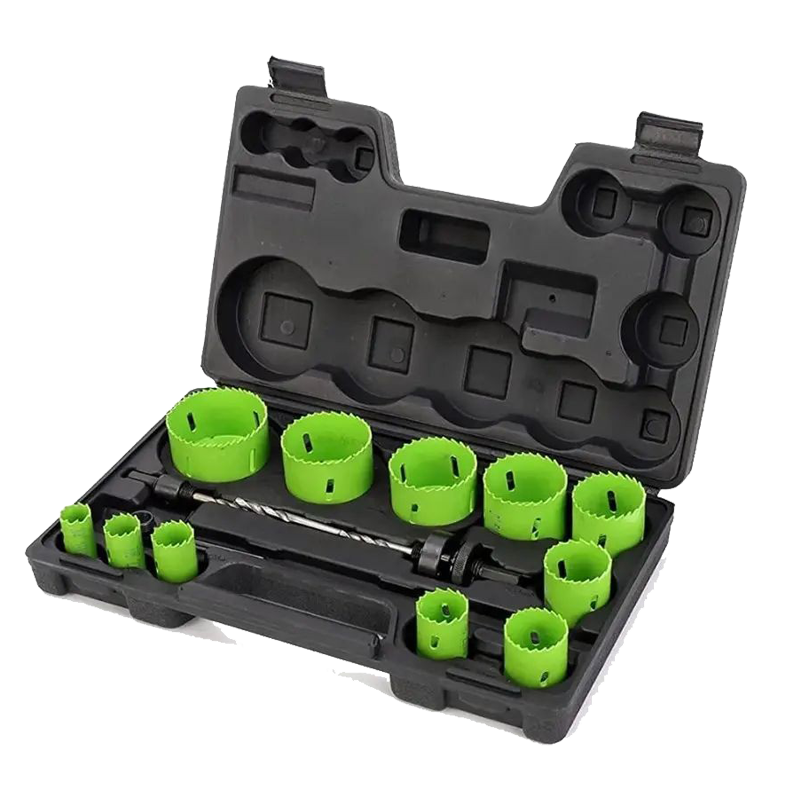
| Product | Bi-metal hole saw sets: cup saws, arbors, pilot drills and case |
| Construction | HSS tooth strip electron-beam welded to a low-carbon spring-steel body, then heat treated as an assembly |
| Tooth hardness | Approximately 64–66 HRC; body left flexible |
| Tooth material options | Standard HSS; M3 HSS; M42 HSS at about 8% cobalt for stainless and demanding metal |
| Tooth pitch | Variable 4/6 TPI as standard; finer pitches available for thin-wall material |
| Tooth set | Alternate set, producing a kerf wider than the body |
| Cutting depth | 38–44 mm standard; deep-cut versions 50–75 mm |
| Diameter range | 14–152 mm typical; larger sizes to order |
| Arbor threads | 1/2″-20 UNF for small saws, 5/8″-18 UNF for large; see the wood hole saw page |
| Pilot drill | HSS, 135° split point, replaceable |
| Body finish | Powder coat or paint for corrosion protection. A finish, not a wear surface |
| Suitable materials | Wood, plywood, MDF, plasterboard, plastics, mild steel to about 6 mm, stainless with reduced speed and fluid, aluminium, copper, brass |
| Not suitable for | Hardened steel, cast iron above about 200 HB, masonry, tile, glass, ceramic; reverse rotation on large saws |
| Regrinding | Limited by tooth strip width. A consumable, not a long-service tool |
| Packaging | Moulded case as standard; colour box, blister or private label to order |
| MOQ | Indicative: from 500 sets for a stock configuration; from 1,000 sets for a private range, grade or label |
| Lead time | Indicative: 15–25 days for stock configurations; 30–45 days for OEM production |
13. How to specify a bi-metal set on an export order
- Construction, stated. Electron-beam welded HSS strip on spring-steel body. If a supplier cannot describe the joint, they are reselling rather than making
- Tooth grade and cobalt percentage as two separate fields. Not “8% cobalt” alone. See section 6
- Pitch, and the material it is aimed at. 4/6 TPI is the default; say if the market is dominated by thin-wall tube or by wood
- Cutting depth. 38–44 mm standard, or deep-cut 50–75 mm. State which, because it changes the cup and the price
- Diameter ladder. The diameters, not the piece count
- Arbor configuration. Both thread standards where the set spans 32 mm — the full argument is on the wood hole saw page
- Weld inspection standard. Ask what the supplier checks and how. A maker who tests welds destructively per lot will say so
- Case, finish and packaging. Moulded case, colour box, barcode, insert card, private label
14. Troubleshooting
| Symptom | Most likely cause | What to change |
|---|---|---|
| Bright line along the base of the teeth | Weld distress | Stop using it. Section 3 |
| Saw rattles or rings differently | Crack or partial weld separation | Stop and inspect the joint before the next hole |
| Teeth glaze and stop cutting in stainless | Rub instead of cut; surface work-hardened | Fresh tooth, steady feed, continuous fluid. Section 9 |
| Tube wall torn and out of round | Pitch too coarse for wall thickness | Finer pitch, lighter feed, support the tube. Section 8 |
| Saw jumps rather than labours | Snagging, not packing | Finer pitch. Pressure makes it worse |
| Hole tapers along its depth | Strip welded unevenly, or body distorted | Reject the saw. This is a manufacturing defect |
| Cut is slow from new in mild steel | Standard HSS where cobalt is needed, or wrong pitch | Move to M42 for steel work. Section 5 |
| Body discoloured well below the teeth | Excess welding heat; body temper lost | Reject the lot. Section 4, check three |
| Core stuck and will not come out | Left to cool in the cup | Eject while warm, through a side slot. Section 11 |
| Teeth chip on the first hole | Hardened material, or the saw was dropped | Check material against section 12; inspect tooth set |
15. Applications
Where a bi-metal saw is the right tool
- Electrical and plumbing penetrations through steel — junction boxes, panels, pipe entries
- Stainless sheet and tube — with a cobalt tooth, reduced speed and continuous fluid
- Mixed-material site work, where the same saw meets wood, plastic and metal in one day
- HVAC and ducting — thin sheet, moderate diameters
- Anywhere the saw may snag — the spring-steel body is specifically there for that
Where a different tooth material is the answer
- Wood and plasterboard only — a wood hole saw costs less and cuts as well
- Long service life through repeated sharpening — a solid HSS hole saw, which has body material to give up
- Hardened steel, cast iron, fibre cement — a carbide-tipped saw, not bi-metal
- Tile, porcelain, stone — a diamond grit saw with water cooling
Where a different tool is the answer
- Small holes below about 19 mm — a step drill or twist drill is faster
- Sheet under about 3 mm at volume — a step drill makes the hole in one pass with no cup to clear
- Flat-bottomed or clean-rimmed holes — a Forstner bit
- Deep bores — an auger bit or an annular cutter
16. Frequently asked questions
What does bi-metal actually mean in a hole saw?
It means two different steels joined into one tool. A strip of high speed steel forms the teeth and is electron-beam welded to the cutting edge of a low-carbon spring-steel cup. The assembly is then heat treated so the tooth strip reaches roughly 64 to 66 HRC while the body stays flexible. That division of labour is the whole point: the tooth needs to be hard enough to cut steel, and the body needs to be tough enough not to shatter when the saw snags. A single steel cannot do both well.
Is a bi-metal hole saw made of hard alloy or carbide?
No, and our own listing copy gets this wrong by calling the blade high-strength hard alloy steel. Hard alloy means cemented carbide, which is a sintered tungsten carbide material, not a steel, and it cannot be welded to a spring-steel cup in this form. A bi-metal saw is two steels. Carbide does appear in hole saws, but as tungsten carbide tipped teeth brazed onto a body, which is a different product with a different price and a different material range. Calling a bi-metal saw hard alloy contradicts the bi-metal name in the same sentence.
Where does a bi-metal hole saw fail first?
At the weld line, if the joint is poor, and at the tooth if the joint is good. Those are different failures with different symptoms. A dull tooth makes the saw slow, hot and noisy but still controllable. A weld failure lets the tooth strip lift or detach, which changes the tool from cutting to throwing, and that is a safety event rather than a performance one. When you inspect a new saw, look at the weld line before you look at the teeth: it should be continuous, flush and free of porosity or unfused sections.
Do I need cobalt in a bi-metal hole saw?
It depends entirely on what you cut, and our step drill page reaches the opposite conclusion for a good reason. A step drill works thin sheet in seconds, so the edge never gets hot and red hardness is dead weight. A hole saw cuts an enclosed annular groove, the chips have to travel through the cup, and the tooth stays in the cut far longer, so heat accumulates and red hardness starts to matter. In mild steel, stainless and thicker sections, cobalt is worth paying for. In wood, plasterboard and plastic it buys nothing.
What is the difference between M3 and M42 tooth material?
Both are high speed steels, and the honest answer is that published labels are inconsistent. M42 is the cobalt grade usually quoted at about 8 percent cobalt and is the premium choice for stainless and demanding metal. M3 is a high-vanadium grade that some makers describe as general purpose and others label as an 8 percent cobalt material, so the trade name alone does not tell you the composition. Ask for two things separately: the grade designation and the cobalt percentage. A listing that says only 8 percent cobalt without naming the grade has given you a marketing figure, not a specification.
Why does my hole saw snag and deform thin-wall tube?
Because the tooth pitch is too coarse for the wall thickness. A coarse tooth puts a large load on a small section of thin wall, and instead of cutting a chip it hooks the wall and pulls it. The result is a torn, out-of-round hole and often a bent tube. Thin-wall material needs a finer pitch, so more teeth are in contact and each one takes a smaller bite, plus a lighter feed. This is a different failure from packing, which is about chip clearance rather than tooth load.
Why is stainless steel so hard on hole saws?
Because stainless work-hardens. If the tooth rubs instead of cutting, the surface beneath it gets harder, and the next pass has to cut material that is now more difficult than it was. That is why the discipline is to keep the cut moving: steady feed, no dwelling, no stopping halfway to inspect and restarting in the same groove. A saw that is allowed to rub will glaze the work, dull quickly and then struggle even more, which the operator tends to read as a bad saw rather than a feed problem.
Can a bi-metal hole saw be resharpened?
Only a limited number of times, and the limit is the width of the tooth strip. The teeth are a narrow band welded to the body, so each regrind removes material from that band. Once the strip is ground back to the weld or into the softer body, there is nothing left to sharpen. This is the practical difference from a solid HSS saw, where the teeth are cut into the body itself and there is more material to work with. If long-term resharpening matters to you, that is a reason to choose the solid saw rather than the bi-metal one.
What are the slots in the side of a hole saw for?
Two jobs. They let chips and heat escape from the cup while the cut is running, which matters because the cup is otherwise a closed container, and they give you somewhere to put a lever to eject the core once the cut is through. On a deep cut in metal they also let you see the kerf, which is how experienced users judge whether the saw is still cutting or has started rubbing.
Can I use a bi-metal hole saw on wood?
Yes, and it will cut wood very well, but you are paying for a tooth that wood does not need. A bi-metal saw earns its price in steel and stainless, where hardness and heat resistance matter. In softwood, plywood and plasterboard the same saw works, the cobalt contributes nothing, and a cheaper toothed saw will do the job for less. If wood is all you cut, buy the wood saw and spend the difference on more diameters.
Does the tooth set matter?
Yes, and it is easy to overlook. The teeth are alternately bent outward so the kerf is wider than the body. Without that set the body would rub in its own groove, which raises friction, heat and torque until the saw binds. Set also affects hole quality: too little set gives a tight, hot cut, and too much gives a loose, ragged one. A saw that has been dropped on its teeth often has an uneven set, which shows up as a hole that cuts freely on one side and binds on the other.
MOQ, lead time, OEM and samples?
Bi-metal hole saw sets are specified by diameter range, tooth material and grade, pitch, cutting depth, arbor configuration and case rather than picked from a fixed list, so terms follow the configuration. Indicative minimum order quantity starts from 500 sets for a stock configuration and from 1,000 sets for a private range, a specified tooth grade, a private case or private label packaging. Indicative lead time is 15 to 25 days for stock configurations and 30 to 45 days for OEM production. Samples are available for testing after terms are confirmed, with the sample cost credited against a subsequent order. Please confirm current figures with us before publishing them.
Related products
Other hole saws: 16 PCS Wood Hole Saw Sets, HSS Hole Saw Sets. Boring: Wood Step Drill Bits, Wood Step Drill Bits Set, Wood Forstner Drill Bits, Wood Forstner Drill Bits Set, Wood Flat Drill Bits Set, Wood Auger Core Drill Bits Set, Wood Auger Core Drill Bits, Wood Countersink Drill Bits, Wood Hex Shank Drill Bits. Substrates and finishes: HSS Twist Drill Bits Set, HSS Ti-coated Drill Bits Set, Black Oxide Drill Bits, Amber Finished Drill Bits, Ti-coated Drill Bits.
OEM & Wholesale
GUSHI has manufactured drilling and cutting tools in Huzhou, Zhejiang since 1998, and we supply bi-metal hole saw sets to importers, distributors and private label programmes. Because a bi-metal saw is defined by its joint, its tooth grade and its pitch rather than by a piece count, most of what we ship in this category is configured.
- Tooth material. Standard HSS, M3 and M42 cobalt, with the grade and the cobalt percentage stated separately on the line item
- Pitch. Variable 4/6 TPI as standard; finer pitches for thin-wall markets
- Cutting depth. 38–44 mm standard or deep-cut 50–75 mm
- Diameter ladders. Standard ranges or built around the fittings your market installs
- Weld control. Electron-beam welding with per-lot destructive peel testing on request
- Case and packaging. Moulded case, colour box, barcode, insert card, private label
- Terms. T/T, L/C, D/A, D/P and PayPal according to circumstance. Samples after terms are confirmed, credited against a subsequent order