1. The poster, decoded: four numbers and what they commit to
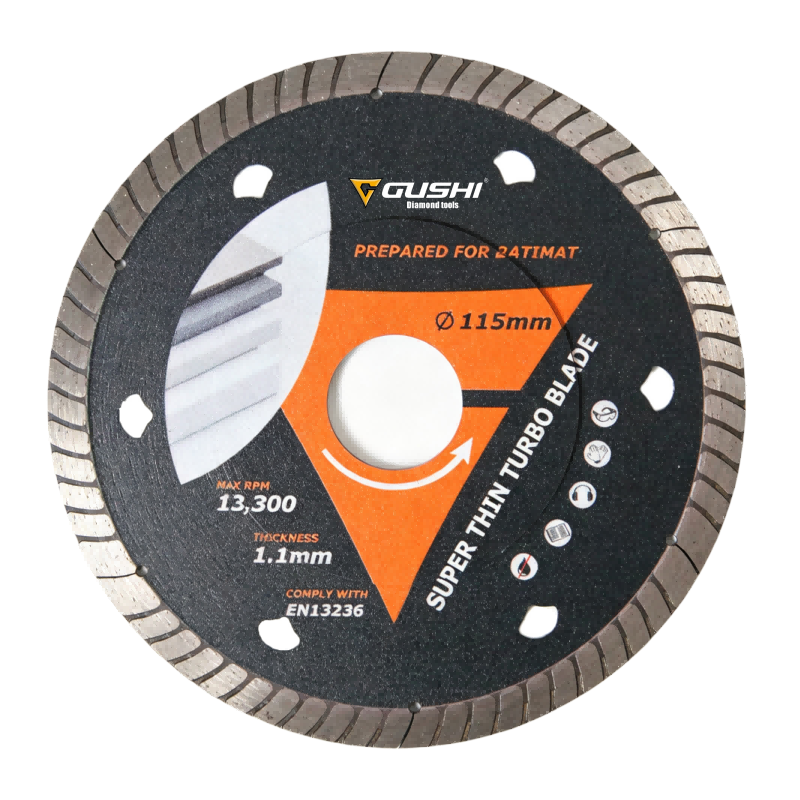
The exhibition poster for this blade is unusually honest, because it prints the specification on the product rather than the adjectives around it. Four numbers appear on the blade itself, and every one of them is a commitment a buyer can hold the supplier to.
| What the poster says | What it specifies | What it commits the supplier to | How you check it |
|---|---|---|---|
| Ø115 mm | Nominal diameter — the 125 mm version is the second size in the range | A blade that fits 4.5″ grinders and saws; the rating below is derived for this diameter | Measure across the rim with a caliper; check the marked diameter matches |
| THICKNESS 1.1 mm | Kerf width — the slot the blade cuts, dimension A in the poster diagram | A thin rim that wastes less tile, draws less power and runs cooler — and that is less forgiving to use | Micrometer across the segment; a 1.1 mm blade measures 1.1, not “about 1.2” |
| MAX RPM 13,300 | Maximum operating speed — dimension-specific, 12,500 for the 125 mm blade | The rim and core survive an over-speed test above this figure; the marking must match the blade | Compare against your machine’s no-load speed on its rating plate (section 4) |
| COMPLY WITH EN 13236 | Conformity with the European safety standard for superabrasive products | A technical file exists: speed calculation, balance, segment retention, traceability code (section 5) | Ask for the declaration of conformity and the batch code on the packaging |
There is also a rotation-direction arrow and the bore, both of which are EN 13236 marking requirements rather than decoration. What the poster does not claim is a life figure in hours or a number of cuts — and that restraint is correct, because blade life on porcelain depends on the bond, the tile’s own abrasiveness, the cutting mode and the feed, and any supplier who prints a universal life figure is printing marketing. The rest of this page is about turning those four numbers into a buying and using decision.
2. What a 1.1 mm kerf buys — and what it costs
Kerf is the slot the blade leaves behind: the width of material turned into powder by every cut. A standard turbo blade for tile runs about 2.2 mm; this one runs 1.1 mm, and that single millimetre is the whole product. Thin kerfs are not a marketing tier — they are an engineering trade with a buy side and a cost side, and buyers who only hear the buy side end up forcing a blade that was never designed to be forced.
What the thin kerf buys
| Benefit | The mechanism | What it is worth on the bench |
|---|---|---|
| Less material destroyed | Kerf width × cut length × tile thickness is the volume of tile that becomes dust | A 600 mm cut through 10 mm porcelain loses about 6.6 cm³ of tile at 1.1 mm against about 13.2 cm³ at 2.2 mm — roughly 16 g against 32 g of porcelain per cut |
| Less power and less heat | Only the diamond at the rim’s leading edge is cutting; a thinner rim means a narrower contact band and less friction per revolution | A 4.5″ grinder runs the thin blade without labouring, which is what keeps a dry cut viable at all |
| Faster feed | Less material to remove per millimetre of advance means the blade advances further per revolution at the same power | The cut feels easier, not just quicker — and easy cuts are where chip-free edges come from |
| Chip-free edges on brittle tile | A thin, smooth turbo rim glides through porcelain instead of tearing it, and the serrations clear the swarf before it can bruise the edge | The tile stays usable — which is worth far more than the kerf it saves |
What the thin kerf costs
| Cost | The mechanism | What it means in use |
|---|---|---|
| Less rigidity | A 1.1 mm rim has half the stiffness of a 2.2 mm rim and will wander if pushed sideways | Feed straight and steady; never twist the blade in the cut, and never use it to grind or widen a slot |
| RPM discipline | A thin rim at the rated speed cuts; the same rim below the rated speed rubs, overheats and dulls | Run at or near the marked maximum, not below it — the opposite of the instinct most users have |
| Faster wear in abrasive materials | There is less diamond in the rim to begin with, and granite and engineered stone consume diamond aggressively | Stick to porcelain, ceramic and marble dry; take granite and engineered stone wet, and expect a shorter run |
| Less forgiveness | A thin blade has no margin for the abuses a thick blade survives: sideways pressure, jammed cuts, cutting between two supports | Clamp the work, let the offcut fall free, and retire the blade at the first sign of wandering |
The honest economics
Run the numbers and the material saving is real but modest: about 16 g of porcelain per 600 mm cut, so roughly 8 kg over a 500-tile job. Compare that with what one chipped tile costs — a cracked 600 × 600 porcelain slab is a total loss of the slab, its adhesive and the labour to re-lay it. One avoided chip per job is worth more than the entire kerf saving of that job. That is the correct way to think about a 1.1 mm blade: you are buying yield, not thrift. The kerf saving is the bonus; the chip-free edge is the product.
3. Reading the dimension table: Ø, A, B and C
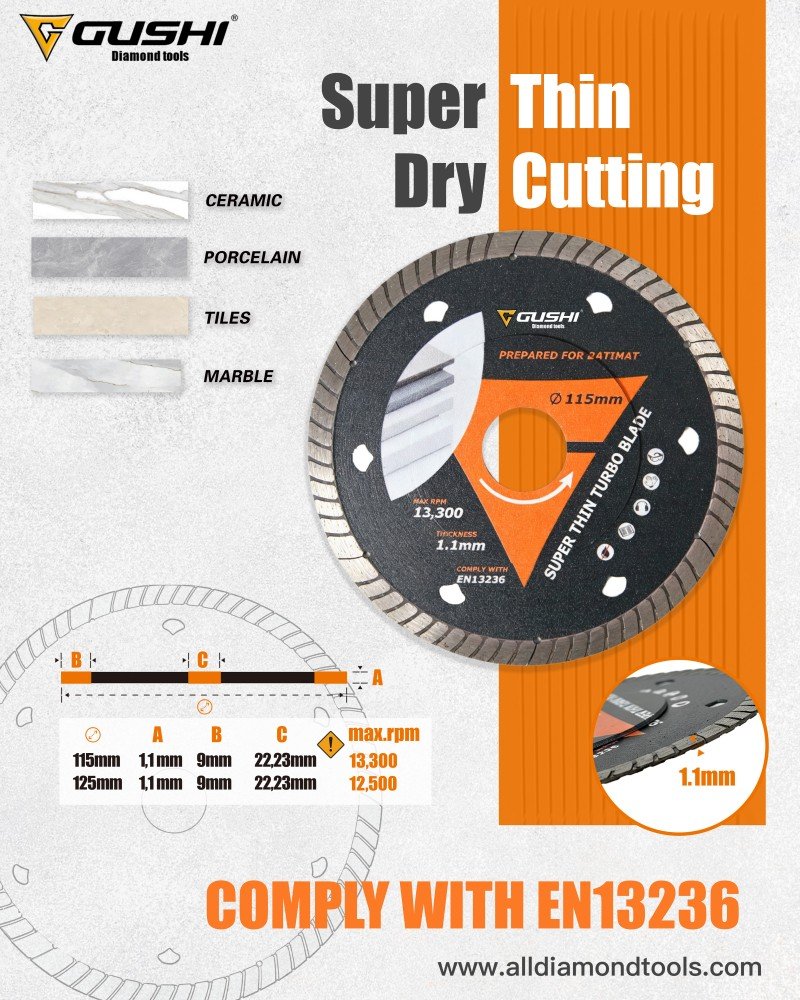
The poster prints a small diagram of the blade’s cross-section with three callouts, and a table that fills them in for each diameter. It is the most useful thing on the poster, because it is the complete mechanical interface between the blade and your machine.
| Callout | What it measures | 115 mm | 125 mm | Why it matters |
|---|---|---|---|---|
| Ø | Blade diameter | 115 mm (4.5″) | 125 mm (5″) | Decides the machine, the cutting depth and the maximum RPM (section 4) |
| A | Kerf / rim thickness | 1.1 mm | 1.1 mm | The slot the blade cuts — section 2 |
| B | Segment height | 9 mm | 9 mm | How much diamond is on the rim: depth capability and re-exposure as the rim wears |
| C | Arbor bore | 22.23 mm | 22.23 mm | The shaft the blade mounts on — 22.23 mm is exactly 7/8″ |
| max.rpm | Maximum operating speed | 13,300 | 12,500 | A safety ceiling derived from peripheral speed (section 4) |
Why the bore is specified to two decimal places
22.23 mm is not rounding. Seven-eighths of an inch is 22.225 mm, and the abrasive industry specifies the metric equivalent as 22.23 mm — explicitly not 22.2 mm and not 22 mm, both of which appear on cheaper blades and both of which leave a blade running eccentric on a 7/8″ arbor. A blade that runs out of round vibrates, cuts oversize, overheats the rim and can crack the core under centrifugal load. This is the kind of detail that separates a blade specified to a standard from a blade specified to a price, and it is why the EN 13236 marking guidance calls out the 22.23 mm bore by name for hand-held machines.
If your machine takes a 20 mm arbor — common on smaller tile saws — use the reducing rings supplied with the blade. Never force a 22.23 mm bore onto a 20 mm shaft with washers, and never open the bore with a file: an out-of-round or oversized bore is a scrapped blade, not a field repair.
What the 9 mm segment height gives you
Nine millimetres of segment is a deliberate middle position. It clears standard 8–12 mm porcelain and ceramic tile in a single pass, and it holds enough diamond that the bond can wear back and expose fresh grit as the rim dulls — the self-sharpening behaviour that makes a hot-pressed blade outlast an electroplated one on tile. Taller segments, at 10 mm and above, buy depth for stone work at the cost of more friction and heat in the cut, which is the enemy of a dry cut on porcelain; shorter segments save heat and run out of diamond sooner. Nine is the compromise that suits the material this blade is built for.
4. Why the maximum RPM is a limit, not a recommendation
The poster prints 13,300 RPM against the 115 mm blade and 12,500 against the 125 mm blade. The first question every buyer should ask is why the smaller blade gets the higher number, and the answer explains the entire speed logic of thin blades.
The limit is a peripheral speed, not a rotation speed
What actually stresses a rim is the speed at which its edge travels through the air — the peripheral speed, in metres per second. Rotation speed is just the peripheral speed divided by the blade’s circumference: a bigger blade covers more ground per revolution, so it must turn more slowly to reach the same rim speed. Both of this blade’s diameters are rated at roughly the same peripheral speed:
peripheral speed (m/s) = π × D (mm) × n (RPM) ÷ 60,000
Ø115 mm at 13,300 RPM → 3.1416 × 115 × 13,300 ÷ 60,000 = 80.1 m/s
Ø125 mm at 12,500 RPM → 3.1416 × 125 × 12,500 ÷ 60,000 = 81.8 m/s
Two different RPM figures, one rim speed. This is exactly how EN 13236 derives the marked maximum operating speed: from the maximum permitted peripheral speed and the diameter, tabulated by diameter in the standard’s annex. It is also why you must read the rating printed on the blade in your hand — there is no family-wide number, and a 125 mm blade run at 13,300 RPM would be pushed past its tested rim speed.
The rating is a ceiling set by a test, not a target
The marked maximum is what the rim and core survived in an over-speed or proof rotation test above the operating figure — the strength verification EN 13236 exists to enforce. It is a ceiling. Running a thin blade continuously at its ceiling in dry cutting is one of the fastest ways to kill it, because the rim has no water to carry the heat away and the bond is being asked to hold diamond at the edge of its thermal comfort. The correct operating point for dry porcelain work is at or just under the rated speed with a steady feed and pauses to let the rim cool — not held at maximum until the steel discolours.
Matching the machine
| Check | What to look for | If it fails |
|---|---|---|
| Machine no-load speed | The RPM figure on the grinder’s rating plate, compared against the blade’s marked maximum | No match. Many 4.5″ grinders run 11,000–13,000 RPM, just under the 13,300 rating; high-speed models that exceed it are not a match for this blade |
| Blade size versus machine rating | 115 mm on a 4.5″ machine, 125 mm on a 5″ machine | Never fit a larger blade to a machine rated for a smaller one — the guard will not cover the rim and the speed will be wrong |
| Guard | The correct guard for the blade size, fitted, with the machine’s speed rating respected | No guard, no cut. There is no awkward cut line that justifies removing it |
| Arbor and flanges | Correct bore (or reducing rings), clean flanges, correct rotation direction | A blade mounted backwards, on the wrong shaft or with dirty flanges will fail regardless of its rating |
5. EN 13236: what the marking means and what to ask for
“Comply with EN 13236” appears on this blade because the blade is built for the European market, where end-user safety regulations for power-tool accessories are strictly applied — Germany, Austria, Switzerland, the Benelux and France in particular. Most buyers know the marking matters. Far fewer know what it actually is, and the gap between the two is where mis-specified blades enter the supply chain. This section closes it.
What the standard is
EN 13236 is the European standard titled Safety requirements for superabrasive products. It covers diamond and cubic-boron-nitride tools — saw blades, core drills, grinding wheels — and it sits inside the Machinery Directive supply chain, underpinning the conformity of the angle grinder or tile saw the blade runs on. The current edition is EN 13236:2019. Four requirement groups matter to a buyer:
| Requirement group | What the standard governs | What it means for this blade |
|---|---|---|
| Maximum operating speed | The manufacturer must declare the maximum permitted RPM, derived from the maximum permitted peripheral speed and the diameter, and mark it on the tool and packaging | 13,300 RPM at 115 mm and 12,500 at 125 mm — both roughly 80 m/s at the rim (section 4) |
| Balance and unbalance | Rotating tools must be balanced to a specified class so that vibration cannot build to failure or injure the operator | A balanced thin blade cuts straight; an unbalanced one wanders and cracks — ask for the balance class |
| Mounting integrity | Bore, flanges and shaft engagement must meet dimensional tolerance | The 22.23 mm bore, exactly 7/8″ (section 3), with reducing rings for 20 mm arbors |
| Segment or rim retention | The diamond rim must stay bonded to the steel core under the declared operating loads, verified by over-speed or proof rotation testing | Why the marked maximum is a tested ceiling and not a marketing number (section 4) |
The marking itself: ten elements
An EN 13236-conforming blade carries a defined set of markings, on the blade and on the smallest packaging unit. Reading them is a two-minute goods-in check:
| # | Marking element | On this blade |
|---|---|---|
| 1 | Manufacturer, supplier or registered trademark | GUSHI, with the brand mark on the blade face |
| 2 | Dimensions, including the bore in mm | Ø115 mm, thickness 1.1 mm, bore 22.23 mm |
| 3 | Maximum operating speed (peripheral, m/s) and maximum RPM | MAX RPM 13,300 marked; ~80 m/s rim speed |
| 4 | Direction of rotation | Arrow marked on the blade face |
| 5 | Declaration of conformity with the standard | COMPLY WITH EN 13236 on the blade |
| 6 | Restrictions of use, in full or by pictogram | No wet-only restriction on this blade — it is marked for dry use (section 6) |
| 7 | Traceability code linking the blade to a production batch | Batch or order code — check it is present on the packaging |
| 8 | Safety signs and, where required, PPE pictograms | Eye and hearing protection pictograms on the artwork |
| 9 | Supplier or private-label number where applicable | OEM marking position on the blade and card |
| 10 | Plastics and packaging compliance where your market requires it | Packaging declarations on request |
The correction most buyers need: there is no EN 13236 certificate
The technical file behind this blade should contain, at minimum: the product description and intended use; the maximum operating speed calculation showing peripheral speed and the RPM derived at nominal diameter; the balance or unbalance measurement record or class declaration; the mounting and bore dimensional inspection; the segment retention test result, typically an over-speed or proof rotation test; the marking layout for blade, packaging and instructions; and the signed, dated declaration of conformity. An EU importer or authorised representative keeps a copy and produces it on request from market surveillance. As a distributor, your job is to verify that the file exists and that the marking on the blade matches it — not to expect a certificate number.
That is what “comply with EN 13236” on this blade commits us to, and it is also the answer to give your own customer when they ask where the declaration is: the marking on the blade, the batch code on the packaging, and the technical file behind both.
6. Dry cutting porcelain: what works and what it costs
The poster leads with three words: Super Thin Dry Cutting. Dry cutting is the design case for this blade on porcelain, ceramic and tile, and it is what makes the blade useful on site, in renovation and anywhere there is no water supply. It is also the mode with the most honest caveats, and this section states them before the technique.
Why dry works on this blade
Three properties of the thin turbo rim make a dry cut viable where a thick segmented blade would fail. The 1.1 mm kerf means less material is being abraded per revolution, so less heat is generated in the first place. The turbo rim’s serrations break the contact band into short segments, letting the rim shed heat between them and clearing swarf before it can pack and rub. And the soft-medium bond is tuned for porcelain and ceramic: hard enough to hold the diamond through a cut, soft enough to expose fresh grit as the rim dulls, so the blade keeps cutting instead of glazing. Together they keep the cutting edge below the temperature at which porcelain micro-cracks and the bond starts to lose its grip.
What dry costs
| Cost | Why | The mitigation |
|---|---|---|
| Shorter blade life | No water carries heat away and no slurry keeps the rim cool, so the bond and diamond run hotter and the rim wears faster — the trade every thin-blade maker documents when they note that dry cutting is possible with reduced life | Shallow passes, pauses to let the rim cool, and honest budgeting: a dry blade will not last as long as the same blade run wet |
| Dust | Porcelain, ceramic and stone contain silica; fine dry cutting dust is respirable crystalline silica, and the disease it causes is not curable | Respiratory protection rated for fine dust, ventilation or extraction, and a decision at the start of the job about which mode is acceptable |
| Heat discolouration | A rim pushed too hard, too slow or too long will discolour, and a discoloured rim has already lost the temper that holds the diamond | Watch the rim and the chips: discoloured rim or blue-tinted chips mean stop, cool, and change the parameters |
The technique that makes dry work
- Score the start. Mark the cut line and start the blade at the edge of the tile, never in the middle — a blade started mid-tile grabs and walks.
- Take shallow passes. 10–20 mm of advance per pass on standard tile; deeper cuts invite the rim to rub and the tile to chip.
- Feed lightly and steadily. Let the blade cut. Pressure does not speed up a diamond blade; it overheats it.
- Pause to cool. Every 30–60 seconds of continuous cutting, back the blade out and let the rim air-cool for a few seconds. A rim that is cool to a careful touch after the pause is being run correctly.
- Watch the chips and the rim. Clean, light-coloured swarf is a healthy cut. Blue or purple swarf, a discoloured rim or a rising squeal means the parameters are wrong, not that the blade needs more pressure.
- Support the tile flat and let the offcut fall. Never cut between two unsupported spans, and never hold the offcut while the blade is in the cut.
When to switch to wet anyway
Dry is the right default for quick porcelain and ceramic cuts. Switch to water — the same turbo geometry runs wet without modification — for granite and engineered stone, for long production runs where blade life dominates the economics, for thick material where heat accumulates, and for any indoor job where dust control is not solved by extraction. Wet cutting suppresses the great majority of cutting dust, cools the rim and extends its life; the only thing it costs is the water supply and the slurry to manage. The blade is not a dry-only tool. The poster says dry because that is the harder case, and the one this specification was tuned for.
7. How the turbo rim cuts without chipping the tile
The chip-free edge on porcelain is not one feature; it is four mechanisms that have to work together, and the thin kerf is only the most visible of them. This is the bench version of the mechanism — the full rim comparison across our range is on the general super thin turbo diamond blade page.
The serrated continuous rim
A turbo rim looks like a continuous rim but is cut with a pattern of serrations around its circumference. The serrations do two jobs at once: they break the contact band into short arcs, so heat is shed into the air between contacts instead of accumulating in one hot line; and they act like the gullets of a segmented rim, giving swarf somewhere to go so it cannot pack into the cut and bruise the tile edge. The result cuts as smoothly as a continuous rim — which is what porcelain needs — while clearing swarf almost as well as segments, which is what keeps the edge clean.
The bond and the diamond
The rim is hot-pressed: synthetic diamond grits are mixed with a metal bond and pressed and sintered in one operation, so each grit is held in a matrix engineered to wear at a controlled rate. The soft-medium bond used on this blade is tuned for porcelain and ceramic — hard enough to keep the diamond through a cut, soft enough to erode and expose fresh grit as the old grit dulls. That self-sharpening behaviour is why a hot-pressed blade keeps cutting when an electroplated one starts to glaze, and it is why the 9 mm segment height matters: there is enough diamond behind the working surface for several cycles of exposure.
The core
The hardened steel core does the work no diamond does: it holds the rim true under centrifugal load, carries the tension that keeps a thin blade running flat instead of dishing, and provides the flat mounting surfaces the flanges clamp against. On a 1.1 mm blade the core is doing proportionally more of the engineering than on a thick one, because the rim has no stiffness of its own to contribute. That is why balance, bore tolerance and core condition are EN 13236 requirements rather than quality flourishes (section 5), and why a blade with a bent or cracked core is scrap the moment the damage is found.
The geometry that starts the cut
The last mechanism is the one users control: a steady feed at the rated speed. The thin rim removes material efficiently at speed, which is why the rating exists; at lower speed the same rim rubs, heats and dulls. The blade cuts the tile; the operator supplies the discipline. When all four mechanisms are working — serrated rim, self-sharpening bond, tensioned core, correct feed — the porcelain separates along the cut line instead of shattering across it, and the edge that comes out of the cut needs no grinding.
8. Full specifications
| Product name | Super Thin Turbo Diamond Blade (EN13236, dry cutting) |
|---|---|
| Brand / manufacturer | GUSHI — Huzhou Gu’s Imp. & Exp. Co., Ltd., Huzhou, Zhejiang, China |
| Blade type | Super thin turbo-rim diamond blade (serrated continuous rim) |
| Diameters | 115 mm (4.5″) and 125 mm (5″) |
| Kerf / rim thickness (dimension A) | 1.1 mm |
| Segment height (dimension B) | 9 mm |
| Bore (dimension C) | 22.23 mm (exactly 7/8″); reducing rings for 20 mm arbors |
| Maximum operating speed | 13,300 RPM at 115 mm; 12,500 RPM at 125 mm |
| Maximum peripheral speed | Approximately 80 m/s at both diameters |
| Diamond matrix | Hot-pressed synthetic diamond |
| Bond | Soft–medium, porcelain / ceramic / tile optimised |
| Core | Hardened steel, tensioned, balanced to EN 13236 practice |
| Cutting mode | Dry cutting primary; wet cutting supported and extends rim life |
| Applications | Porcelain, ceramic, tile, marble; granite and engineered stone wet |
| Machines | 4.5″ / 5″ angle grinders, tile saws with matching arbor and speed rating |
| Marking | EN 13236 declaration, diameter, thickness, bore, max RPM, rotation direction, batch code |
| Safety standard | EN 13236 (safety requirements for superabrasive products) |
| Quality system | ISO 9001:2015; 100% inspection before shipment; SGS inspection on request |
| Other certifications | CE and RoHS references — confirm scope before publishing as product certifications |
| Packing | Skin card / blister / white box; colour box for wholesale |
| HS code | 8202.39 |
| MOQ | 500 pieces (indicative) |
| Lead time | 25–30 days after advance payment |
| Payment terms | T/T, L/C, D/A, D/P, PayPal |
| Port of loading | Shanghai or Ningbo, China |
9. Applications and materials
The poster lists four materials — ceramic, porcelain, tiles and marble — and that list is the design brief. This is a precision tile blade: it exists to separate brittle, high-value material along a clean line, and its bond, rim and kerf are all tuned for that job.
Where this blade is the right specification
| Application | The job | Mode |
|---|---|---|
| Porcelain tile | The core case: chip-free cuts on the hardest, most brittle tile, including rectified porcelain | Dry primary, wet for production runs |
| Ceramic tile | Wall and floor ceramic, including glaze-sensitive tiles where a torn edge is visible | Dry |
| General tile | Cut-to-size on site and in the workshop, plunge and short curved cuts | Dry |
| Marble | Clean splitting cuts on soft natural stone | Wet preferred — dust and life both improve |
| Granite and engineered stone | Possible, but abrasive: expect a shortened run and more heat | Wet only — dry will consume the rim |
Where this blade is the wrong specification
| Material | Why not | Use instead |
|---|---|---|
| Ferrous metals, steel | The soft-medium bond is formulated for mineral abrasion; steel work-hardens and gums the rim | A metal-cutting blade from our cut-off wheel range |
| Concrete, brick, masonry | Abrasive and impact-prone; the thin rim has no margin for it | A segmented concrete cutting blade |
| Wood and plastics | The wear mechanism is not one a diamond rim addresses economically | A dedicated woodworking blade |
| Dekton and ultra-compact surfaces | The hardest material in the tile family; needs a bond and geometry tuned for it | Our Dekton-specific turbo blade |
The pattern is deliberate: this blade is narrow on purpose. A blade that claims to cut everything cuts nothing well, and on porcelain the difference between a bond tuned for the material and a general-purpose bond is the difference between a clean edge and a re-laid tile.
10. 1.1 mm against 1.3 mm and against 2.2 mm
Three ways to buy a thin turbo blade, side by side: this EN blade at 1.1 mm, the typical competitor thin turbo at 1.2–1.4 mm, and a standard 2.2 mm turbo. The middle column is where most of the market sits, which makes the comparison the most useful one on this page.
| Dimension | This blade: 1.1 mm, EN 13236 | Typical competitor thin turbo: 1.2–1.4 mm | Standard turbo: 2.2 mm |
|---|---|---|---|
| Kerf width | 1.1 mm — the thinnest in its class | 1.2–1.4 mm | 2.2 mm |
| Material lost per 600 mm cut, 10 mm tile | About 6.6 cm³ (~16 g) | 7.2–8.4 cm³ (~17–20 g) | 13.2 cm³ (~32 g) |
| Cutting feel on porcelain | Fastest, lowest effort of the three | Fast, slightly more effort | Slower, more power drawn |
| Chip-free edge on porcelain | The design case — thin rim plus serrated turbo | Good | Acceptable; more liable to chip on the exit side |
| Rigidity / forgiveness | Lowest — demands technique | Moderate | Highest — survives abuse |
| RPM discipline | Highest — below rating it rubs and dulls | High | Most tolerant of lower speeds |
| Segment height | 9 mm — depth for 8–12 mm tile plus re-exposure | 7–10 mm | 7–10 mm |
| Bore specification | 22.23 mm exactly (7/8″), rings for 20 mm | Usually 22.23 mm | 20 / 22.23 / 25.4 mm |
| Safety documentation | EN 13236 marked, technical file behind it | Often marked, sometimes without a file | Usually marked |
| Dry cutting support | The design case | Common, often with “reduced life” caveats | Possible; heat load is higher |
| Best for | Production and site cutting of porcelain and ceramic where yield decides the economics | General tile work where forgiveness matters | Mixed site work, rougher materials, occasional use |
Read the winners column and the position is clear: this blade wins on everything the thin kerf touches — waste, speed, edge quality, documentation — and loses on exactly two things, rigidity and tolerance of low speed, which are the two things a 1.1 mm rim cannot have. The blade is not better than a 2.2 mm turbo; it is better for the job it is specified for. Buy it for porcelain production and site cutting where a chipped tile is a lost tile; buy a thicker blade for mixed site work where the blade will be knocked about and the material is not precious.
11. How to use: step by step
- Read the blade before you mount it. Confirm the EN 13236 marking, the maximum RPM, the diameter, the bore and the rotation arrow. Inspect the rim and core for cracks, missing segments, deformation or rust — a damaged thin blade is scrap, not a repair job.
- Match the arbor. 22.23 mm bore direct, or the reducing rings for a 20 mm shaft. Clean the flanges, mount the blade flat, and turn it by hand once before power to confirm it runs true.
- Check the machine against the rating. The grinder’s no-load speed on its rating plate must not exceed the blade’s marked maximum. 115 mm on a 4.5″ machine, 125 mm on a 5″. Fit the guard — every time.
- Confirm the rotation direction. The arrow on the blade must match the machine’s rotation. A turbo blade run backwards cuts badly and can shed its rim.
- Clamp the tile flat and mark the line. Support the whole tile; never cut between two unsupported spans. A clamped tile is a chip-free tile.
- Start at the edge. Bring the blade to full speed away from the work, then enter at the edge of the tile at the marked line — never plunge into the middle.
- Cut at the rated speed with a light, steady feed. Let the blade advance at its own rate. Pressure does not help; the thin rim removes material efficiently at speed, and forcing it only heats the rim.
- Take shallow passes and pause to cool. 10–20 mm per pass on standard tile; back out every 30–60 seconds to let the rim air-cool. Watch the swarf: clean and light is healthy, blue or purple means stop.
- Finish the cut cleanly. Ease the feed for the last few millimetres so the tile separates instead of snapping, and let the offcut fall free — never hold it.
- Retire on condition, not on hope. Retire when the blade wanders, when the exposed diamond is gone and the bond rubs, when the core shows through the rim, or immediately if any crack or deformation appears. Then store it dry and flat, rim protected.
Starting parameters by diameter
| Diameter | Machine | Operating speed | Feed |
|---|---|---|---|
| 115 mm (4.5″) | 4.5″ angle grinder, 11,000–13,000 RPM no-load | At the machine’s rated speed — at or just under the blade’s 13,300 RPM maximum | Light and steady; 10–20 mm passes on 10 mm tile |
| 125 mm (5″) | 5″ angle grinder or tile saw, up to 12,500 RPM no-load | At the machine’s rated speed — at or just under the blade’s 12,500 RPM maximum | Light and steady; 10–20 mm passes on 10 mm tile |
These are starting points for porcelain and ceramic. Granite and engineered stone want wet cutting and a slower feed; thicker tile wants shallower passes. If the blade is rubbing rather than cutting, raise the speed before you touch the feed — that is the thin-blade rule that most often saves the rim.
12. Frequently asked questions
What does a 1.1 mm kerf actually change?
Three things. Less material is turned to powder: a 600 mm cut through 10 mm porcelain loses about 6.6 cubic centimetres of tile at 1.1 mm kerf against about 13.2 at a standard 2.2 mm. Less friction means less power drawn and less heat generated, which is what allows a fast dry cut on brittle porcelain at all. And a thin turbo rim glides rather than tears, which is where the chip-free edge comes from. What it costs is rigidity: a 1.1 mm blade wanders if forced and needs the rated RPM and a steady feed, and it is less forgiving of sideways pressure than a 2.2 mm blade.
Can this blade cut porcelain dry?
Yes — dry cutting is the primary design case for this blade on porcelain, ceramic and tile, and the thin kerf keeps the heat load low enough to make it practical. Two honest qualifications. Dry cutting shortens blade life compared with wet, because there is no water to carry heat away and no slurry to keep the rim cool, so budget for a shorter service life in continuous dry production. And dry cutting of porcelain and ceramic produces fine silica dust, so respiratory protection and ventilation are not optional; if the job allows water, wet cutting suppresses dust substantially and extends the life of the rim.
What does “comply with EN 13236” mean on a diamond blade?
EN 13236 is the European standard titled Safety requirements for superabrasive products, and it governs diamond and CBN tools sold in the EU: maximum operating speed, balance, mounting integrity, segment retention and marking. When a blade is marked EN 13236, the manufacturer is declaring conformity in a technical file rather than presenting a third-party certificate — no notified body issues an EN 13236 certificate. What the marking commits the supplier to is a set of declarations you can ask to see: the maximum operating speed calculation, the over-speed or proof rotation test result, the balance class, and a traceability code linking the blade to its production batch. Section 5 lists the full set.
Why is the maximum RPM different for the 115 mm and 125 mm blades?
Because the safety limit is a peripheral speed, not a rotation speed. At roughly 80 m/s the same rim speed is reached at 13,300 RPM on a 115 mm blade and at about 12,200 to 12,500 RPM on a 125 mm blade — the larger diameter covers more ground per revolution, so it must turn more slowly to reach the same rim speed. This is why EN 13236 derives the marked RPM from the maximum permitted peripheral speed and the diameter, and why you must read the rating printed on the blade you are holding rather than assuming a family-wide number.
Is a 22.23 mm bore the same as 7/8 inch?
Exactly, and the precision matters. Seven-eighths of an inch is 22.225 mm, which the abrasive industry rounds and specifies as 22.23 mm — not 22.2 mm and not 22 mm, both of which appear on cheaper blades and both of which run out of round on a 7/8 inch arbor. A blade that runs eccentric vibrates, cuts oversize and can crack. If your machine takes a 20 mm arbor, use the reducing rings supplied with the blade rather than forcing a 22.23 mm bore onto the wrong shaft.
What is the difference between a turbo rim and a segmented rim?
A segmented rim has visible slots or gaps between the diamond sections, which clear swarf aggressively and suits concrete, brick and masonry, at the cost of a rougher cut and more chipping on brittle tile. A turbo rim is continuous but serrated, so it cuts as smoothly as a continuous rim while the serrations cool the rim and clear swarf almost as well as segments. For porcelain and ceramic, where edge quality decides whether the tile is usable, the turbo rim is the standard answer — and our general super thin turbo diamond blade page covers the full rim comparison.
Does dry cutting shorten the blade’s life?
Yes, measurably. Without water to carry heat away and keep the rim cool, the bond and the diamond run hotter, and the rim wears faster — the same effect every thin-blade maker documents when they note that dry cutting is possible with reduced life. The practical answer is to match the cutting mode to the job: dry for quick porcelain and ceramic cuts on site and in renovation, wet for granite, engineered stone, long production runs and anything where dust control matters, because wet cutting both extends the life of the rim and suppresses the great majority of the dust.
Can I use this blade on an angle grinder?
Yes, on a 4.5 inch grinder with the 115 mm blade or a 5 inch grinder with the 125 mm blade, provided the grinder’s no-load speed does not exceed the blade’s marked maximum and the correct guard is fitted. Check the machine’s rating plate: many 4.5 inch grinders run at 11,000 to 13,000 RPM, which sits just under the 13,300 RPM rating of this blade, while some high-speed models exceed it and are not a match. Never fit a larger blade to a machine rated for a smaller one, and never remove the guard because the cut line is awkward.
How deep can a 9 mm segment cut, and what wears it out?
The 9 mm segment height gives useful depth through standard 8 to 12 mm porcelain and ceramic tile, and leaves enough diamond to re-expose as the rim wears, which is part of why a hot-pressed blade outlasts an electroplated one on tile. The blade is finished when it stops cutting freely and starts wandering, when the exposed diamond is gone and the bond is rubbing, when the core shows through the rim, or immediately if any crack, missing segment or deformation appears. At that point the blade is scrap, not a resharpening candidate.
What is the MOQ, lead time and OEM support?
The indicative MOQ is 500 pieces, with a lead time of 25 to 30 days after receipt of advance payment; loading ports are Shanghai and Ningbo. OEM and private-label programmes are supported on the same specification, including laser marking, skin card, blister and white-box packing, and your own barcode. Samples are available at cost price plus freight, credited against a subsequent order. Payment terms are T/T, L/C, D/A, D/P and PayPal. All figures are indicative and should be confirmed against current production terms.
OEM & wholesale
Huzhou Gu’s Imp. & Exp. Co., Ltd. has manufactured and exported diamond tools from Huzhou, Zhejiang since 2004, and supplies this super thin turbo blade as single blades and in retail packing to importers, distributors and private-label programmes. GUSHI is one of the 23 Chinese manufacturers that won the anti-dumping case for diamond blades exported to the USA, holding a 6.2% tariff rate — a compliance heritage that matters to distributors serving regulated markets. Production capacity is 100,000 diamond-tool sets per month.
| Parameter | Standard | To order |
|---|---|---|
| Configuration | 115 mm or 125 mm, 1.1 mm kerf, 9 mm segments, 22.23 mm bore | Diameters and bond formulations across the family range; reducing rings as standard |
| Substrate and bond | Hot-pressed synthetic diamond, soft–medium bond, hardened steel core | Bond tuned to your market’s dominant material |
| Marking | EN 13236 declaration, diameter, thickness, bore, max RPM, rotation arrow, batch code | Laser logo, brand and barcode |
| Packing | Skin card / blister / white box | Colour box, private-label artwork, your own barcode |
| Documentation | EN 13236 technical file available on request | Balance records, over-speed test report, batch traceability |
| Quality | 100% inspection before shipment under ISO 9001:2015 | SGS inspection |
| Terms | T/T, L/C, D/A, D/P, PayPal; MOQ 500 pieces; lead 25–30 days | Samples at cost plus freight, credited against the first order |
| Port of loading | Shanghai or Ningbo, China |
For European programmes, the two items worth settling before the first order are the EN 13236 technical file — because your importer will be asked for it — and the packing specification, because skin-card and blister blades that arrive with chipped rims fail commercially no matter how well they cut. Both are in the specification table above for exactly that reason.