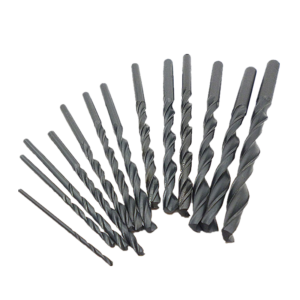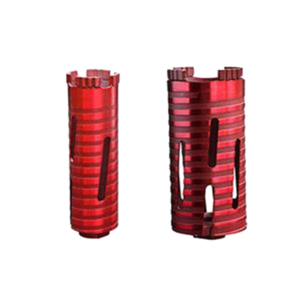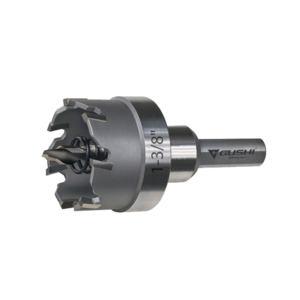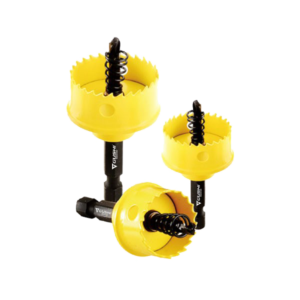
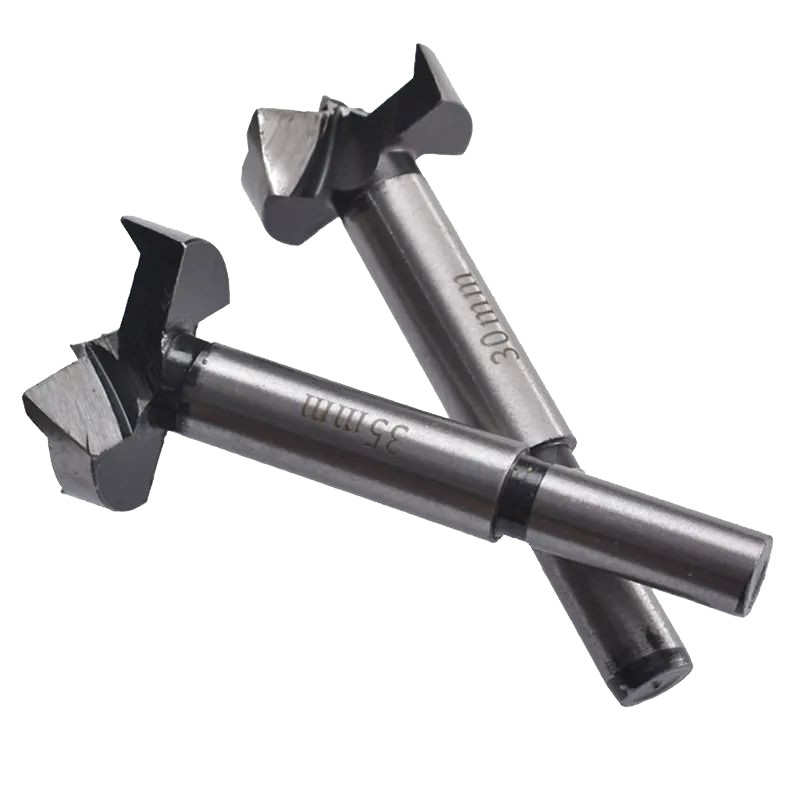
Why Four Identical Photographs Hide Four Different Tools
The Forstner silhouette is not a design choice any more, it is a functional requirement. Every one of them needs a continuous outer rim to score the circumference and steer the cut, a small central point to establish the axis before the rim touches, and two substantial wings behind the rim to lift the waste out of the bore. Give a factory those three requirements and it will draw the same shape whether the bit costs four dollars or sixty.
What differs is entirely invisible at catalogue resolution:
- What is doing the cutting — the steel body itself, or discrete tips of cemented carbide brazed on.
- How the body was made — stamped and formed from sheet, forged and machined from solid, or built to take replaceable cutters.
- Whether the edge can be restored — some grades have enough material behind the edge to be honed repeatedly, others have none at all, and carbide cannot be sharpened by hand in any practical sense.
- How accurately the rim runs — runout at the rim translates directly into an oversize, out-of-round bore, and it is the first thing sacrificed in a cheap body.
The practical consequence is that buying a Forstner bit by photograph, or by diameter and nothing else, is closer to a lottery than a specification. Two quotations for “35 mm carbide Forstner” can describe tools with a fivefold difference in service life.
The three questions that actually separate them
When you compare two offers, ask these in order, because they account for almost all of the difference:
- How many carbide tips, and where? Two, three or four around the rim, and does that count include the centre point? A different answer here means a different tool.
- Is the body machined or stamped? Look at the surfaces behind the cutting edges. A machined body has consistent, finished faces throughout; a stamped one leaves press marks, parting-line burrs and unmachined surfaces.
- How many times can it be resharpened, and by whom? Steel bodies can be honed by hand several times. Carbide needs a diamond wheel and usually a professional service, which is rarely economic for a single small bit.
The Four Grades Side by Side
Four grades cover almost everything on the market. The boundaries are not formal standards — they are the practical bands that prices and construction tend to fall into — so read the table as a map rather than a specification.
| Economy pressed | High carbon steel (HCS) | Carbide-tipped (TCT) | Indexable / interchangeable | |
|---|---|---|---|---|
| What cuts | The steel rim and wings, usually hardened only at the edge | The steel rim and wings, through-hardened body | Two to four brazed carbide tips doing the cutting, steel body carrying them | Replaceable carbide or steel cutters bolted to a permanent body |
| How the body is made | Stamped and formed from sheet | Forged or machined from solid bar, then ground | Machined steel body with brazed tips | Machined steel or alloy body, either fixed diameter or adjustable |
| Typical hardness | Edge-hardened only; body stays comparatively soft | Commonly in the high 50s to low 60s HRC range | Carbide tips around 90–92 HRA, far above any steel | As carbide, plus a hardened steel carrier |
| Can it be resharpened? | Effectively no — no material behind the edge to give | Yes — typically three to five honings by hand with a diamond file | Only with a diamond wheel and usually a professional service; often uneconomic per bit | Yes — the cutter is replaced rather than sharpened |
| Where it wins | Occasional softwood; a job where the bit will be lost before it dulls | Clean solid timber, jobbing work, anything you will hone yourself | MDF, particleboard, laminated board, dense hardwood, production volume | Large diameters used repeatedly, and anything above roughly 50 mm that will get dull regularly |
| Where it loses | Anything abrasive, anything with hidden fasteners, any visible finish work | Abrasive board and production volume — the edge goes quickly and the labour to restore it is recurring | Clean softwood at low volume; impact damage, since carbide chips rather than bends | Small diameters, one-off sizes, and any shop without a spare-cutter habit |
| Indicative single price band | Around US$3–8 | Around US$10–30 | Around US$30–75 | US$80 and upward for the body plus cutters |
| Typical buyer | Promotional sets, DIY blister packs, single-job work | Joinery shops, furniture makers, general trade | Cabinet production lines, fit-out contractors, board-heavy shops | Specialist joinery, repeat large-diameter work, rental fleets |
Why Carbide Is Not Automatically Better: The Edge Radius Argument
This is the point most catalogues skip, and it is the one that actually decides whether you should be buying the more expensive tool.
Something has to hold an edge, and that something is a material. Cemented carbide is made of hard grains sintered together, and the grain size sets a floor on how sharp the edge can ever be: you cannot produce a cutting edge finer than roughly the grains it cuts through. Published figures for tungsten carbide put a new tool edge in the region of 5 to 15 microns of radius depending on grade and application, with values around 8–12 microns typical for micrograin carbide. For comparison, tooling intended for this needs rather than to shave wood is deliberately rounded further still, in the 6–25 micron range for metal-cutting end mills.
Steel has no such floor. A high carbon or high speed steel edge can be honed far finer than any carbide grain structure allows, which is why the hand tools that must be genuinely sharp — chisels, plane irons, carving tools — are still made of steel and not carbide.
What that means in wood
Wood fibres are cut by shearing them, and shearing cleanly needs a fine edge presented at a low angle. Put those two facts together and the conclusion follows:
- On clean, non-abrasive solid timber, a sharp steel bit is the sharper tool. It takes less force to push through the fibres, it leaves a cleaner wall, and it produces shavings rather than dust.
- On manufactured board, that advantage lasts minutes. MDF, particleboard and laminated sheet are held together with resin and glue, and in aggregate those adhesives act as an abrasive. Board stock also carries silica and hard mineral filler into the cut. A fine steel edge that would sail through pine gets rounded against board in a fraction of the time.
- Carbide wins on wear, not on sharpness. Its advantage is that it stays where it started for far longer on the materials that would otherwise destroy a steel edge quickly.
- The honest summary: carbide you buy for board and volume. Steel you buy for timber and for the ability to touch it up yourself.
The corollary nobody mentions: carbide is brittle
Carbide buys its hardness with toughness. Drop a carbide-tipped bit rim-first onto concrete and the usual result is not a dent, it is one or more missing tips. The same happens at lower drama inside the work: a hidden screw, a staple in a pallet, a knot hit at full feed. Steel tends to deform and can often be filed back; carbide tends to fracture, and a missing tip at the rim means an out-of-balance bit that cuts oversize.
So the grade question has a second half. If your work is demolition-adjacent, reclaimed timber, site work or anything with a plausible chance of embedded metal, the expensive carbide bit is the wrong tool not because it wears badly but because it fails catastrophically. Buy the cheaper steel version where the risk is high.
Choosing the Grade by Material, Not by Budget
Once the edge radius argument is understood, the selection becomes material-led. The table below is what we would specify against; it assumes each grade is bought sharp and used with adequate chip clearance.
| Workpiece | Recommended grade | Why | Grade to avoid | Why avoid it |
|---|---|---|---|---|
| Softwood, clean and kiln-dried | HCS | Steel takes the finer edge and woods this soft abrade very little; HCS is also cheaper and can be honed | Economy pressed | Softwood hides knots that will destroy a thin stamped rim |
| Hardwood, clear stock | HCS, honed often | Carbide’s lack of initial sharpness matters more here than longevity; a honed steel edge leaves the cleaner wall | Economy pressed | Will not hold an edge long enough to finish a run of visible joinery |
| Hardwood, reclaimed or unknown history | HCS, cheap enough to sacrifice | Impact risk from nails and screws; lose a steel bit, not a carbide one | Carbide-tipped | Chips on impact, and the failure is unrepairable in the field |
| MDF and HDF | Carbide-tipped | Resin-rich and uniformly abrasive; published comparisons repeatedly show carbide outlasting steel several times over on this material | Economy pressed and HCS | Both lose their edge fast; regular resharpening then dominates the cost |
| Particleboard and chipboard | Carbide-tipped | High adhesive content relative to fibre; same abrasive mechanism as MDF | HCS | The glue lines are harder than the stock around them and blunt steel quickly |
| Melamine or laminate-faced board | Carbide-tipped | The facing layer ishard and abrasive, and it demands a sharp edge throughout life to avoid chipping the visible face | Anything stamp-pressed | Neither holds an edge nor holds tolerance well enough for a visible surface |
| Veneered board, show faces | HCS with a fine-tooth rim, or carbide kept sharp | Entry quality dominates; whichever you choose, the rim must be sharp and undamaged at the moment of entry | A tired example of anything | Exit tear-out and entry chipping are both edge condition problems before they are geometry problems |
| Plywood | Carbide-tipped | Alternating grain and glue lines are both abrasive and unevenly loaded | Economy pressed | Cross-grain plies lift a stamped rim at the entry face |
| Worktops and high-pressure laminate | Carbide-tipped, generous numbers | The hardest common substrate; expect short edge life even from carbide | Single-bit economy purchases | You will replace often enough that unit cost becomes misleading |
| Thin plastics and acrylic sheet | Not a Forstner at all — use a step bit | Thermoplastics melt rather than shear, and a rim-guided bit that removes this much material generates the heat that does it | Any Forstner grade | See our step drill bit for thin sheet work |
Price Per Bit Versus Cost Per Thousand Holes
The cheapest bit is rarely the cheapest boring. Because purchase prices differ by up to ten times across the grades and service lives differ by more, the only figure worth comparing is what each hole actually costs you.
The arithmetic is simple: take the purchase price, divide by the total number of holes you expect the bit to produce across its whole life including every resharpening, and multiply by a thousand. Everything else — downtime, rework, the labour to hone — makes the case for the better bit stronger rather than weaker, so leaving them out is the conservative choice.
The same comparison, two different jobs
Below is a worked example at 35 mm, the diameter where this question most often arises because it is both a hinge cup size and a common hardware size. Figures are modelled from typical catalogue price levels and typical life ratios, not measured in a single controlled trial.
| HCS in clean hardwood | TCT in clean hardwood | HCS in MDF | TCT in MDF | |
|---|---|---|---|---|
| Purchase price | US$31 | US$75 | US$31 | US$75 |
| Holes before the edge is finished | Roughly 1,200 across four honings | Roughly 2,400 | Roughly 200–250 | Roughly 1,500 |
| Resharpening available | Three to five hand honings | Professional service; often uneconomic | Same as hardwood, but reached far sooner | As left |
| Cost per 1,000 holes | US$26 | US$31 | US$124–155 | US$50 |
| Additionally | Needs a few minutes of honing every few hundred holes | No honing, but impact chips are unrecoverable | Frequent changeovers and rework as the edge fades | Longest uninterrupted run; highest downtime saving |
| Verdict | Cheapest per hole, and the cleaner cut | Competitive but not the winner here | Expensive, and the wall quality fades as the edge does | About three times cheaper per hole |
The same two bits reverse places depending entirely on what you put under them. A buyer who runs one material gets one answer; a shop running both should own both, which is precisely the argument for the single format. There is no such thing as the cheapest Forstner bit in the abstract — only the cheapest one for the stack of material you are about to put through it.
Three things the table hides, all of which strengthen the better bit
- Downtime. Every bit change is a stoppage. On a production boring line those minutes are usually worth more than the bit itself.
- Rework. A fading edge does not fail all at once. It progressively leaves rougher walls and more entry chipping, so the cost shows up as sanding and rejected parts well before anyone calls the bit dead.
- The labour to keep it sharp. A bit you hone yourself is not free to hone. Four honings is four interruptions, and each one is also an opportunity to get the geometry slightly wrong.
What the Label “Carbide-Tipped” Does and Does Not Cover
If “carbide-tipped” meant one thing, this section would be unnecessary. In practice the phrase is applied to four quite different products, three of which are legitimate but easily confused with each other.
| Construction | What it is | Legitimately called carbide-tipped? | How it behaves |
|---|---|---|---|
| Full perimeter TCT | Two to four carbide tips brazed around the rim and onto the cutting wings, so every part of the cutting perimeter is carbide | Yes, and this is what the phrase should mean | Longest life on abrasive board; chips rather than bends on impact |
| Centre-point-only carbide | The locating point at the centre is carbide, while the rim and wings remain steel | Technically yes, and often sold that way | Helps the point survive, changes nothing about how fast the rim wears. Priced accordingly |
| Solid carbide head | A head largely of cemented carbide brazed or fixed to a steel shank | Usually described as solid carbide rather than tipped | Excellent life, high cost, highest impact fragility. Rare above modest diameters |
| Coloured coating on steel | A gold, bronze, dark or black surface treatment over a steel cutting edge | No — and this is the one that costs buyers real money | Reasonable corrosion resistance, adds nothing to edge life or sharpness |
Identifying the Grade Without a Laboratory
You do not need a metallurgy bench to separate the grades. Six checks, none requiring more than a loupe and a small diamond file, resolve most cases.
- Look for the braze line. Under ten-to-twenty times magnification, a genuine carbide tip meets the steel body across a visible braze fillet, usually a slightly different colour from both. No braze line anywhere on the rim means no carbide tipping there, whatever the packaging says.
- Count the tips, and check whether the centre is one of them. A bit with four perimeter tips is a different tool from one with two plus a carbide centre point. Count them, and record whether the centre point is included in the count or is the only carbide part.
- Read a broken edge if there is one. Carbide fractures with a flat, matte, fine-grained surface. Steel tears with a bright, fibrous, obviously metallic one. This is the clearest single tell and it only appears on damaged tools, which is exactly when you want to know.
- Examine the surfaces behind cutting edges. Press marks, parting-line burrs and unmachined areas in the gullets and on the inside faces indicate a stamped economy body. Consistent, finished surfaces throughout indicate machined construction.
- Touch a fine diamond file to a non-functional area. Steel marks readily; carbide barely yields at all. Do it on the shank or on a flat well away from any cutting edge, never on the edges themselves.
- Check how the size isapplied. Laser or electrolytic etching tends to accompany higher grades. Rolled, stamped or screened markings are not proof of anything, but cheap marking plus a cheap price is a consistent pattern.
Where a Set Stops and Single Bits Begin
A set is a sensible purchase until it is not. There are three places where it stops being the answer, and all three are reasons a shop ends up buying singly.
1. Sets stop at around 50 mm. Real work does not.
Almost every Forstner set tops out somewhere between 35 mm and 50 mm, because that covers hinge cups and the common furniture sizes and because anything larger gets expensive to include. Single bits commonly run to 100 mm and beyond.
Large diameters bring their own constraints, and they change the buying decision rather than just the price:
- Significant torque. A large Forstner removes a great deal of material per revolution. Practical guidance is a drill press of at least 3/4 hp, around 560 W, for anything above roughly 2 in, and above about 60 mm a hand-held machine should not be considered at all.
- Reduced shanks. Bits above approximately 50 mm often use a reduced shank — a large head carried on a smaller shank — so that they can be chucked in a standard three-eighths inch drill. Check chuck capacity against shank form before you order, because a beautiful oversize bit you cannot hold is scrap.
- Three-flat and hex shanks. A round shank can slip in a three-jaw chuck under high torque, which scores the shank and ruins depth consistency. Shanks with three milled flats, and quick-change hex shanks, grip far better under exactly the conditions a large bit creates.
- Workpiece restraint is not optional. The failure mode is not a bad hole; it is a workpiece spinning out of your hands. Clamp it, and use a sacrificial backer board even on a blind bore to protect the machine table.
Everything about running these safely belongs to the set page, along with the rim form comparison and the 35 mm hinge cup detail — see the Forstner set page for that. The point here is narrower: if your work occasionally needs a 68 mm or a 90 mm bit, no set will ever contain it, and buying that one diameter singly is not a compromise.
2. The size you use daily is the size you need three of
A set contains exactly one of each diameter, which is the wrong quantity for anything you use constantly. A cabinet line boring dozens of 35 mm hinge cups a day will retire that single bit early and then have to stop. The answer is not a bigger set — it is several of the one diameter. We cover the stocking arithmetic for that decision on our single wood auger bits page, and the same logic applies here.
3. Some jobs need a form a set will never include
Long-shank patterns, bit-and-cutter combinations, right-angle and other specialist configurations exist because someone does that job every day. Sets are built around the middle of the market; singles are how you reach the edges of it.
The Plug-Cutter Fit Nobody Warns You About
One of the most common reasons a woodworker buys a single Forstner bit is to pair it with a plug cutter of the same nominal size, either to hide a screw or to replace a defect. Both tools are sold by nominal diameter, and that is where it goes wrong.
A plug is meant to be an interference fit. It should go in with firm hand pressure or a light mallet tap and grip without glue slop, which means the hole and the plug have to agree to within a very small margin — well under a tenth of a millimetre separates a neat fit from one that falls out or splits the board.
Nominal size does not guarantee that. Different makers hold slightly different actual cutting diameters, difference accumulates with wear, and a honing error on either tool shifts the fit again. The practical rules:
- Buy the pair together, from the same maker, and keep them together.
- Never mix brands across the fit unless you have tested it on scrap.
- Retire them together. A bit and cutter that no longer agree are a matched pair of waste.
- Test on the actual stock. Density changes how much interference a board will take before it splits.
Full Specifications
| Product type | Single Forstner drill bit, supplied by individual diameter rather than as a fixed set |
|---|---|
| Product name | Wood Forstner Drill Bits |
| Grades available | Economy pressed steel; high carbon steel (HCS), hardened and tempered; carbide-tipped (TCT) with two to four brazed tips; indexable / interchangeable-cutter bodies in larger diameters |
| Diameter range | 6–100 mm (1/4″–4″) by individual size; metric series to DIN 7483 principles for 12–50 mm |
| Imperial range | 1/4″ to 4″ in common fractional increments |
| Typical cutting depth | Governed by the wing length, commonly 20–30 mm as standard; long-shank patterns available for deeper reaches |
| Shank forms | Round; three-flat for positive chuck grip; reduced shank above roughly 50 mm; 3/8″ quick-change hex in selected diameters |
| Shank diameters in metric series | Commonly 8 mm up to 32 mm diameter, 10 mm thereafter, to DIN 7483 conventions |
| Cutting geometry | Rim-guided: continuous outer rim scores the circumference before the two inner wings lift the waste, giving a flat-bottomed bore |
| Rim forms available | Sawtooth / wave; continuous; staggered multi-tooth. See the set page for the full rim form comparison |
| Centre point | Small locating point; fixed as standard, with replaceable and pilot-drill variants offered |
| Body material | High carbon steel or hardened alloy steel body depending on grade |
| Cutting edge material | Steel, or cemented carbide tips brazed to the body; carbide typically around 90–92 HRA |
| Indicative body hardness | High carbon and HCS grades commonly in the high 50s to low 60s HRC—confirm against mill certificate |
| Typical edge radius | Cemented carbide edges generally cannot be produced finer than roughly 5–15 microns of radius; steel edges can be honed considerably finer |
| Resharpening | HCS: three to five hand honings with a diamond file. Carbide: professional diamond service only, often uneconomic per unit |
| Primary materials | Softwood, hardwood, plywood, MDF and HDF, particleboard, melamine and laminate-faced board, veneered board |
| Restricted materials | Thin plastics and acrylic sheet — use a step bit instead. Thick rigid plastics only with reduced expectations |
| Recommended machine | Drill press preferred throughout; essential above roughly 60 mm. Minimum around 3/4 hp (560 W) with the workpiece clamped above 2 in diameter |
| Not suitable for | Metal, masonry, ceramic tile, glass, concrete |
| Packaging options | Individual sleeve, rigid tube for large diameters, hanging card for retail peg, wooden or blow-moulded case for matched bit-and-cutter sets |
| OEM / ODM | Diameter lists built to the buyer’s own consumption profile; private label; private mould for bespoke packaging |
| Indicative MOQ | 200 pieces per diameter for stock configurations; 500 pieces for specified grade, hardness or private label—confirm before publishing |
| Indicative lead time | 15–25 days stock; 30–45 days OEM production—confirm before publishing |
| Samples | Available after terms confirmed; sample cost credited against a subsequent order |
How to Specify a Single Forstner Bit
The short version: specify what can be measured, and nothing that depends on somebody else’s vocabulary.
- Diameter and tolerance. Nominal size plus what you will accept as deviation. state it.
- Overall length and,where it matters, the wing length — because that is what sets practical boring depth.
- Shank: diameter, and form. Round, three-flat, reduced, or 3/8″ hex. Check it against the chucks your customers actually own.
- Rim form. Sawtooth, continuous or staggered, with a note of intended use. See the set page for what each one suits.
- If carbide: how many tips, and where. Number of carbide tips, whether the centre point is one of them, and the tip grade if you can specify it.
- Body material and hardness range, if you are able to test it. Even a wide band is worth stating, because it is the clause that makes the rest enforceable.
- Intended workpiece materials. This drives everything above, and a supplier who knows you are boring MDF can advise sensibly about grade.
- Attach a drawing or a photograph of the reference article, and request a counter-sample held against it.
Inspecting One on Arrival
A single bit is cheap enough that nobody inspects it, and expensive enough that somebody should. These seven checks take under a minute and catch nearly everything that matters.
- Rim runout. Chuck it and watch the rim rotate under a light. A wobble you can see means an oversize hole you will not discover until the work is finished. Anything perceptible is a reject.
- Actual cutting diameter. Bore a test hole in scrap and measure it. Compare against nominal and against what your previous batch produced, particularly if you make plugs.
- Tooth symmetry. Teeth should be evenly spaced and evenly proud. One low tooth cuts a step in the bore wall you will feel as a ridge.
- Centre point protrusion. Too long and it breaks through the bottom of a blind hinge cup; too short and it fails to locate. Check it against your shallowest intended bore.
- Braze quality, where carbide is specified. Look for fillet gaps, excess spatter in the gullets, and any tip that sits proud of its neighbours.
- Shank condition and form. Confirm the flats are actually there if you specified three-flat, check the diameter with a caliper, and look for chuck scoring.
- Rust protection. Especially for sea shipments of HCS and pressed grades. A film of surface rust on arrival means the packaging specification was not adequate.
Troubleshooting
| Symptom | Usual cause | What to do |
|---|---|---|
| The bit slides around before it bites | Centre point too short, blunt, or missing; workpiece surface too hard for the point to penetrate | Check point protrusion and sharpness first. Start with very light feed until the rim scores a full circle. On laminate, score a shallow starter with the rim before committing |
| Burning and dust instead of shavings | Edge gone rather than the machine mis-set, particularly likely on board | Check edge condition before adjusting anything. Board work may simply need carbide rather than steel |
| Entry pieces lifts at the rim | Dull or damaged rim teeth, or a rim form unsuited to veneered stock | Inspect the rim, then review rim form against the material. Cross-grain deflection is a different problem with different remedies |
| Chips packing and the bit binding | Chips not clearing from the bore; deeper than the wing length without withdrawal | Withdraw to clear more often. For bores deeper than the wings will hold, use a long-shank pattern rather than forcing a standard one |
| Hole measures oversize | Rim runout, or one tooth standing proud | Check runout and tooth evenness. This is almost never a feed problem |
| Carbide chips at the rim after only a few holes | Embedded metal, or impact damage in handling | Purchasing issue rather than a technique issue. In reclaimed stock use steel deliberately, and store carbide with tip protection |
| Steel edge gone after a short run in MDF | Correct expectation, wrong grade | Move to carbide for board work, or accept the resharpening labour as a recurring cost |
| The bit slips in the chuck under load | Round shank and high torque, usually at larger diameters | Specify three-flat or hex shanks for anything large, and confirm chuck jaw condition |
| Plug too loose, or splits the board | Bit and plug cutter not matched in actual cutting diameter | Buy, keep and retire the pair together. Test on the actual stock |
| 60 mm bit will not fit the drill | Reduced shank not specified, or the machine is underpowered | Check chuck capacity and motor power before ordering. Anything this large belongs on a drill press with the work clamped |
| Rust bloom appearing in storage | Inadequate packaging protection for the steel grade | Specify rust-preventative treatment for sea freight, and check packaging on arrival rather than at the point of sale |
| Bottom of the bore is not flat | Worn wings, or lift-and-feed habits late in the cut | Feed steadily through the final millimetres and check edge condition on the wings, not just the rim |
Applications
Furniture and cabinet production
The highest-volume user of this tool and the one most likely to want carbide. Concealed hinge boring dominates the work, followed by shelf-support holes and hardware pockets. Because this work is board-heavy and repetitive, it is exactly the case where cost per hole rather than cost per bit is the correct comparison.
Joinery and cabinet making in solid timber
Dowel and loose-tenon boring, stopped housings, and conventional hardware recesses. Clean stock means the grade question resolves towards steel, honed regularly, with the plug-cutter pairing mattering once the work is visible.
Shopfitting and installation
Cable and service penetrations, speaker and terminal cup recesses, and light fitting pockets. Often board, often on site, and often enough dust and debris that impact risk is real — which argues for a pragmatic grade rather than an expensive one.
Repair, restoration and one-off work
Matching an existing diameter is the whole job, which is the case for buying singly. A single bit in exactly one diameter solves a problem no set will.
OEM, private label and distribution
Diameter lists built to a market’s own consumption profile rather than to a sequence. The selling point of the single format is that the list is yours: more of the sizes that sell, none of the sizes that do not.
Frequently Asked Questions
Are carbide-tipped Forstner bits always better than steel ones?
No, and this is the single most expensive assumption in the category. Carbide resists the abrasion from resin and glue in MDF, particleboard and laminated board, and on those materials it typically lasts several times longer than a steel edge. But a cemented-carbide edge cannot be ground as fine as a steel one — the carbide grain size sets a practical floor on edge radius in the region of 5 to 15 microns, while steel can be honed far finer — so on clean, non-abrasive solid timber a sharp steel bit cuts more freely, leaves a cleaner wall and can be touched up by hand. Buy carbide for board and high-volume production. Buy steel for solid timber and occasional work. Judge neither by purchase price alone.
What does “carbide-tipped” actually mean on a Forstner bit?
Four different things, which is why the term needs unpacking before you order. Ideally it means discrete carbide tips brazed onto the cutting rim and wings, usually two to four of them, so the whole cutting perimeter is carbide. It is also used for a bit where only the centre point is carbide while the rim and wings remain steel, which costs far less and performs very differently. Solid carbide heads exist but are rare and expensive at Forstner diameters. And the term is sometimes applied to a bit with a gold or dark coloured coating, which changes nothing about the cutting edge material at all. Ask how many carbide tips there are and where they sit, and confirm against a photograph of the actual article.
How do I tell what grade a Forstner bit is without laboratory equipment?
Six checks cover most of it. Look for a braze line where each cutting tip joins the steel body under modest magnification. Count how many tips are carbide and check whether the centre point is included or is the only carbide part. Examine a chipped edge if there is one — carbide breaks with a flat, matte, fine-grained fracture, while steel tears with a bright fibrous one. Check whether the non-machined surfaces carry press marks and burrs, which indicate a stamped economy body. Lightly touch a fine diamond file to an area away from the cutting edges, where steel marks and carbide hardly does. And read how the size is applied, since laser or electrolytic etching generally accompanies higher grades than a rolled or screened mark.
Should I judge Forstner bits on purchase price or on cost per hole?
Cost per hole, because bit prices in this category differ by up to ten times and service lives differ by more. Work it out as purchase price divided by the number of holes you expect before the bit is finished, counting resharpenings. A mid-priced steel bit that can be honed several times often beats carbide on cost per hole in clean timber, while the same steel bit run in MDF can lose its edge quickly enough that carbide wins by a wide margin on the identical calculation. The material you cut decides the answer, which is why you cannot choose by price band alone.
Why does my plug fit loosely, or too tightly?
Because a plug cutter and a Forstner bit are intended to produce an interference fit, and that fit depends on the actual cutting diameter rather than the nominal size printed on the shank. Two brands both marked 10 mm will not necessarily cut the same hole, and the difference between a neat interference fit and a loose plug is often far under a tenth of a millimetre. If your shop uses plugs to hide screws or repair defects, buy the bit and the cutter together as a matched pair, keep them as a pair, and replace them as a pair.
Can I put a Forstner bit on an extension to reach further?
You can, but treat it as a last resort rather than a default. Every joint in the drive line adds runout, and a Forstner bit is rim-guided, so runout at the rim shows up directly as an oversize, out-of-round hole and as vibration. If you need more reach, prefer a purpose-made long-shank Forstner over a short bit on an extension, keep the assembly as short as the job allows, clear chips more often, and check the completed bore for roundness before committing to a visible workpiece.
Do I need a drill press for large diameter Forstner bits?
Above roughly 60 mm, yes, and this is a safety requirement rather than a preference. A large Forstner removes a great deal of material per revolution, and the torque at the rim is high enough that a hand-held drill can be twisted out of your hands or spin the workpiece. Practical guidance is a drill press with a motor of at least three quarters of a horsepower, around 560 watts, the workpiece clamped rather than held, and a sacrificial backer board. Bits above about 50 mm commonly use a reduced shank so the large head can be chucked in a standard drill, so check chuck capacity against shank form before ordering.
How should I specify a single Forstner bit on an export order?
Never by grade name alone, because the same words cover different products between suppliers. Specify diameter and tolerance, overall length, shank diameter and whether it has three flats or a hex, rim form, number of carbide tips if carbide is required and whether the centre point is one of them, body material and hardness range if you can test it, and the intended workpiece materials. Attach a dimensioned drawing or a photograph of the reference article and request a counter-sample against it.
How should single Forstner bits be packed for export?
The rim is the frail part and it is exposed on every format. Bits must not travel touching each other, because carbide tips chip against carbide tips and against steel bodies. Individual sleeves or rigid tubes for large diameters work well, and hanging cards work for retail peg display. Steel bodies need rust protection for sea freight, particularly high carbon grades. Print the diameter large enough to read in a van, since once a bit leaves its sleeve it is otherwise unidentifiable, and note that a plug cutter packed loose with a Forstner bit will damage both.
Which is better for occasional DIY use, steel or carbide?
Steel, in almost every case. Occasional users bore mostly solid timber and softwoods, do not wear edges out quickly enough for carbide’s advantage to appear, value being able to touch an edge up by hand, and are far more likely to damage a tool by dropping it than by wearing it out. The premium for carbide is paid back slowly and only on abrasive board.
MOQ, lead time, OEM and samples?
Single Forstner bits are typically ordered to a diameter list rather than to a fixed set, and we support mixed-diameter orders so you can weight the quantities toward the sizes you actually consume. Indicative minimum order quantity starts from 200 pieces per diameter for stock configurations and from 500 pieces for private label or a specified grade and hardness range. Indicative lead time is 15 to 25 days for stock items and 30 to 45 days for OEM production. Samples are available for testing after terms are confirmed, with the sample cost credited against a subsequent order. Please confirm current figures with us before publishing them.
OEM & Wholesale
Because the single format is specified by diameter list rather than by set composition, it adapts to how your market actually consumes the tool rather than how a catalogue arranges it. We support:
- Diameter lists built to your own consumption profile — more of the sizes you sell through, none of the ones you do not.
- Grade selection by intended substrate — specify steel where your market bores timber and carbide where it bores board, within the same order.
- Shank specification — round, three-flat, reduced or 3/8″ hex, matched to the chucks and machines common in your market.
- Plug-and-bit pairing — matched diameter pairs supplied together, which converts two commodity lines into a system with fewer complaints.
- Private label and private mould packaging, from single sleeves to retail cards to workshop cases.
- 100% inspection before shipment, with rim runout verified on carbide grades.
Our factory is ISO 9001:2015 certified as a quality management system. Please ask us for the certificate scope and number before reproducing that claim as a product certification.