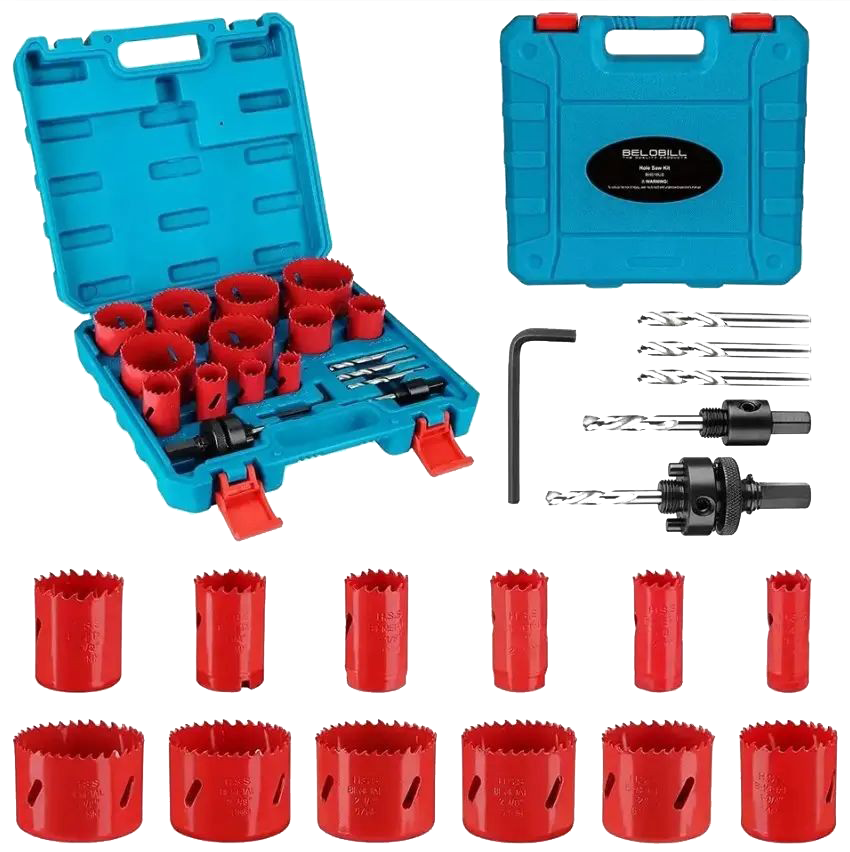
1. Our own copy: high carbon steel is not flexible
| What the source copy says | What is wrong | What we say instead |
|---|---|---|
| “Adopting high carbon steel body and high-speed steel teeth, flexible and durable” | A metallurgical contradiction. High carbon steel is hard and relatively brittle; it is not the flexible member. The flexible part of a hole saw body is low carbon spring steel | The welded construction stated accurately: HSS teeth on a spring-steel body. Section 4 |
| “HSS tool teeth are suitable for wood, particle board, plywood, gypsum board” | Not wrong, but it hides the reason. If HSS is only justified by those materials, the premium is unexplained — none of them needs red hardness | HSS in timber is justified by contamination, not by the timber. Section 3 |
| “can cut quickly and smoothly, with a long service life” | Long compared with what? The claim has no reference point, so it cannot be checked or defended | Service life stated against the alternative that matters: carbon steel teeth meeting a fixing |
| “The chip hole makes it easy to disassemble the plug” | Translation artefact. You do not disassemble a plug; you eject the core | Chip slots for ejection, cooling and sight of the kerf. Section 8 |
| No construction statement anywhere | The single most consequential fact about the tool — welded strip or solid cup — is absent | Stated explicitly, with what it means for regrinding. Section 4 |
2. What HSS buys, and why wood uses only half of it
High speed steel is specified for four properties. Only two of them are relevant to a saw cutting timber.
| Property | What it means | Does wood cutting use it? |
|---|---|---|
| Red hardness | Stays hard when the edge is hot | No. A hole saw in timber does not reach the temperature where it matters |
| Wear resistance at temperature | Resists abrasion while hot | Mostly no in solid timber; partly yes in resinous board |
| Edge toughness | Resists chipping rather than wearing | Yes — and this is the real reason |
| Abrasion resistance at ambient | Resists hard particles | Yes in MDF, particleboard and contaminated stock |
So the honest description of an HSS wood saw is not “a better cutting edge”. It is a tougher edge that survives bad conditions. In clean pine the difference between HSS and a decent carbon steel tooth is small and slow to appear. In a joist with a snap in it, the difference appears in one second.
3. The nail, and why it decides the purchase
This is the whole commercial argument, so it is worth being concrete about what actually happens at the tooth.
| Carbon steel tooth meets a nail | HSS tooth meets a nail | |
|---|---|---|
| Immediate result | Chip, crack or strip | Localised dulling, often a small nick |
| Neighbouring teeth | Usually damaged too, because the saw keeps rotating through the obstruction | Usually unaffected |
| Sound | Sharp change, then a scrape | Change in pitch, then a return to cutting |
| Can it continue? | Rarely — the saw is effectively finished | Usually yes, at reduced quality |
| Can it be recovered? | No. Chipped teeth cannot be ground back into a useful form | Sometimes, by dressing the tooth faces |
| Cost of the event | The price of a saw | A few minutes and some hole quality |
Where the risk actually lives
- Reclaimed and demolition timber — assume metal until proven otherwise
- Old flooring and joists — cut nails, lost screws, staples from carpet gripper
- Pallet and crate stock — staples and driven nails, often broken flush
- Formwork and shuttering ply — concrete nails, tie-wire, snapped fixings
- Any board that has been fixed before — the hole you are cutting may pass through an old fixing line
4. Two objects sold as HSS hole saws
The label describes the tooth material. It says nothing about how the tooth is attached, and that is the fact that determines the life of the tool.
| Welded HSS tooth strip | Solid HSS cup | |
|---|---|---|
| How it is made | A narrow HSS strip welded to a spring-steel body | Teeth ground out of the cup wall itself |
| Body | Spring steel — flexes and recovers | Harder, stiffer, less forgiving of a snag |
| Material available to regrind | The strip width, and no more | The full wall thickness |
| Regrinds possible | Few | Many |
| Unit cost | Lower | Higher |
| How common | The majority of what is sold as HSS | Uncommon outside specialist ranges |
| Best for | Site work, mixed stock, probable fixings | Shops with a sharpening route and repeatable work |
The regrinding boundary itself is set out on our bi-metal hole saw page and is not repeated here. What matters on this page is narrower: ask which construction you are being offered before you compare prices, because a cheap solid HSS saw and a cheap welded saw are not the same value.
5. MDF and particleboard: the abrasive case
There is a second reason HSS lasts longer in board work, and it is not the one usually given.
MDF and particleboard are bonded with resin and, in some products, contain mineral filler. That makes them more abrasive than solid timber, in the way that a filled plastic is more abrasive than a plain one. Abrasion is a wear mechanism rather than a heat mechanism, and it operates at ordinary temperatures.
So the benefit here is ordinary wear resistance rather than red hardness — which means the HSS argument in board work is real but modest, and a coated or harder tooth would do more. It also means that if your work is dominated by MDF, the more useful question is not HSS versus carbon steel but whether a harder tooth material is worth the step up.
6. When the premium pays and when it does not
| Your work | Does HSS pay? | Reasoning |
|---|---|---|
| Reclaimed timber, demolition, pallets, old flooring | Yes, clearly | The probability of a fixing is high enough that one event pays for the difference |
| Site work on unknown stock | Yes | You cannot inspect what you cannot see |
| Mixed work where the same saw meets board and timber | Yes | One saw that survives both is worth more than two that each do one |
| Clean new plywood and plasterboard | No | No fixings, no heat, no abrasion worth the premium |
| Production cutting of new board | No | Buy on cost per hole and edge consistency, not on toughness |
| MDF and particleboard at volume | Partly | Abrasion argues for a harder tooth, which is a different purchase |
7. Handling a fixing once you hit it
What you do in the next two seconds decides whether the saw is dulled or destroyed.
- Stop feeding immediately. The damage is done by continued rotation through the obstruction, not by the first contact
- Withdraw and look. Find the fixing. A magnet helps. Note where it is relative to the hole
- Do not reverse to clear. On large saws reverse can unscrew the cup from the arbor. This is a safety rule, not a preference
- Decide: move or cut it out. If the hole can shift by a few millimetres, move it. If it cannot, cut the fixing with a metal-capable tool and then resume
- Inspect the teeth before resuming. A nick is survivable; a missing tooth changes the cutting action and should be dressed or the saw retired
For the general rules on chip clearance, depth and arbor mounting, see our wood hole saw set page. This page deliberately stays on the material question.
9. Full specifications
| Parameter | Specification |
|---|---|
| Product | HSS hole saw sets: cup saws, arbors, pilot drills and case |
| Tooth material | High speed steel; cobalt grades to order |
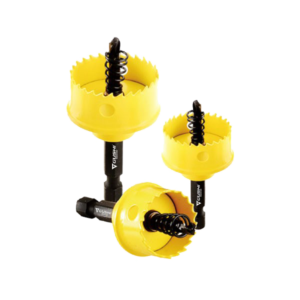
| Construction | Welded HSS tooth strip on a spring-steel body as standard. Solid HSS cup to order — state which on the order |
| Tooth pitch | Variable pitch, typically 4/6 TPI |
| Chip clearance | Side chip slots for ejection, cooling and sight of the kerf |
| Cutting depth | 38–44 mm typical single pass |
| Diameter range | 16–152 mm typical; other diameters to order |
| Arbor threads | 1/2″-20 UNF small saws, 5/8″-18 UNF large saws — see the wood hole saw page |
| Pilot drill | HSS, 135° split point, replaceable |
| Body finish | Powder coat or paint for corrosion protection. A finish, not a wear surface |
| Suitable materials | Softwood, hardwood, plywood, particleboard, MDF, plasterboard, plastics; reclaimed timber containing fixings |
| Not suitable for | Hardened steel, masonry, tile, glass; reverse rotation on large saws |
| Regrinding | Tooth faces only. Limit set by the construction, not by the material |
| Packaging | Moulded case as standard; colour box, blister or private label to order |
| MOQ | Indicative: from 500 sets for a stock configuration; from 1,000 sets for a private range, construction or label |
| Lead time | Indicative: 15–25 days for stock configurations; 30–45 days for OEM production |
10. How to specify an HSS set on an export order
- Construction, first. Welded HSS strip on a spring-steel body, or solid HSS cup. These are different products at different prices and the label “HSS” does not distinguish them
- Tooth material and grade. HSS is the family; name the grade and, if cobalt is present, the percentage
- Pitch, and the material it targets. 4/6 TPI variable as standard; state if the market is dominated by board or by reclaimed timber
- Diameter ladder. The diameters, not the piece count
- Cutting depth. State the cup depth, because it drives the price and the application
- Body steel, stated correctly. Spring steel for a welded construction. Do not accept “high carbon steel, flexible” on a specification sheet
- Arbor configuration and pilot supply. Both thread standards where the set spans 32 mm
- Case, finish and packaging. Moulded case, colour box, barcode, insert card, private label
11. Incoming inspection
- Confirm the construction against the order. Look at the tooth line: a welded strip shows a joint line at the base of the teeth; a solid cup does not
- Check the tooth line for continuity if it is welded — but note that weld quality is the bi-metal page’s subject, not repeated here
- Inspect tooth uniformity. Missing, hooked or unevenly set teeth will cut a polygonal hole from new
- Measure the cup depth on the smallest and largest saw
- Mount every saw on its intended arbor, by hand, checking thread engagement and flat seating
- Check the pilot drills roll straight and are long enough for their cup
- Cut a test hole in the material you sell into, at the largest and smallest diameter, and measure both
12. Troubleshooting
| Symptom | Most likely cause | What to change |
|---|---|---|
| Teeth chipped after one hole | Hit a fixing, or the stock is contaminated | Find the fixing; consider the solid construction if this is routine. Section 3 |
| Saw cuts slowly in hardwood | Dull tooth, or feed too light so it rubs | Dress the teeth; increase feed to a steady cut |
| Saw burns in MDF | Dust packing, dull edge, heat | Clear the gullets, fresh edge, steadier feed. Section 5 |
| Hole is polygonal | Uneven tooth set, or a bent tooth after an impact | Inspect and dress, or retire the saw |
| Saw jumps rather than labours | Snagging on a fixing or on a coarse pitch in thin stock | Stop, find the obstruction. Pressure makes it worse |
| Core will not come out | Left to cool and shrink in the cup | Eject while warm through a side slot |
| Cup distorted | Forced through an obstruction | Retire it. A distorted cup cannot cut a true circle |
| Saw spins on the arbor | Drive pins not engaged, or thread damaged | Reseat on the pins |
| Exit face torn | No backing board | Clamp a sacrificial board underneath |
| Teeth glaze instead of wearing | Too much pressure, too little speed, resinous stock | Reduce pressure, clear the gullets, clean with a wire brush |
13. Applications
Where this set earns its premium
- Reclaimed and demolition timber — the core case. Assume fixings
- Old flooring and joists — cut nails and carpet staples
- Pallet and crate work — broken staples flush with the surface
- Formwork and shuttering — concrete nails and tie-wire
- Site work on unknown stock, where inspection is impossible
- Mixed board and timber work, where one saw has to survive both
Where a cheaper saw does the same job
- Clean new plywood, MDF and plasterboard — no fixings, no heat, no case for the premium
- Production cutting of known material — buy on cost per hole and consistency instead
Where a different tool is the answer
- Metal as a regular material — a bi-metal saw specified for metal
- Hardened steel, cast iron, fibre cement — carbide-tipped, not HSS
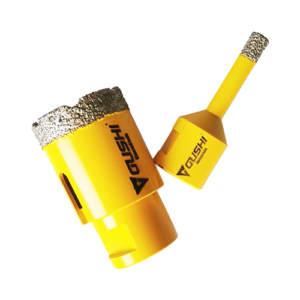
- Tile and stone — diamond grit with water
- Small holes below about 19 mm — a step drill is faster
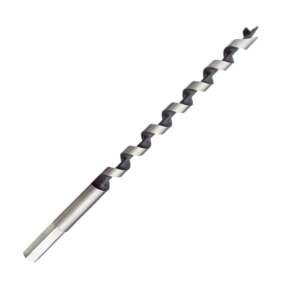
- Deep bores — an auger bit
- Flat-bottomed holes — a Forstner bit
14. Frequently asked questions
Does HSS make a hole saw cut wood better?
Not measurably, and the reason is temperature. HSS is bought for red hardness, the ability to stay hard when the edge is hot. Wood cutting does not generate that kind of heat at a hole saw’s speed, so the property you paid for is never called on. What HSS does give you in timber is edge toughness, and that pays off in one specific situation: when the tooth meets a nail, a screw, a staple or grit. A carbon steel tooth chips; an HSS tooth usually dulls and keeps cutting. That is the real case for HSS in a wood saw.
Is an HSS hole saw the same as a bi-metal hole saw?
Often yes in practice, which is the confusing part. The name HSS describes the tooth material; bi-metal describes the construction. A very large share of saws sold as HSS are an HSS tooth strip welded to a steel body, which is a bi-metal saw under a different label. A true solid HSS saw has the teeth ground out of the cup wall itself and is much less common and more expensive. Our own listing copy describes a high carbon steel body with HSS teeth, which is the welded construction. Ask which one you are being offered, because it decides how many regrinds the saw can take.
Why does the listing say high carbon steel body and flexible?
Because those two properties do not belong together, and the sentence reveals what the product really is. High carbon steel is hard and relatively brittle; it is not flexible. The flexible member in a hole saw body is low carbon spring steel. So the copy is describing, in slightly wrong words, the welded construction: hard HSS teeth on a spring-steel body. The intent is right and the metallurgy in the sentence is not. We have corrected it, because a buyer comparing products will read flexible high carbon steel as a contradiction and stop trusting the rest of the specification.
What happens if my hole saw hits a nail?
With a carbon steel tooth, usually a chipped or stripped tooth, and often more than one, because the saw keeps rotating through the obstruction. With an HSS tooth, usually localised dulling and a change in sound, but the saw keeps cutting. Either way the correct response is the same: stop, withdraw, find the fixing, and either move the hole or cut it out with a metal-capable tool. Forcing through a nail is how a saw that could have been sharpened becomes a saw that has to be replaced.
How do I know if there are nails in the timber before I cut?
You mostly cannot, which is why the HSS premium exists. You can improve the odds: a magnetic stud finder or a small magnet run over reclaimed stock will find steel fixings near the surface, and dark staining, filler patches, filled nail holes and re-used joist ends are all warnings. On demolition and reclaimed material, assume there is metal until you have proved otherwise. On clean new stock, there usually is not.
Should I pay for HSS if I only cut new plywood and plasterboard?
No. If the stock is clean and you are cutting plywood, MDF, particleboard or plasterboard, the HSS premium buys you a property you will not use. A standard toothed saw will do the same job for less, and the money is better spent on more diameters or a spare pilot drill. The HSS case is specifically about contaminated or reclaimed material, where a single nail would otherwise end the life of the tool.
Does HSS help with MDF and particleboard?
A little, for a different reason than most people assume. These boards contain resin and, in some products, mineral filler, so they are more abrasive than solid timber. That is a wear-resistance argument rather than a heat argument, and HSS does resist abrasion better than plain carbon steel. It is not the same as the nail case, but it is a real second reason why HSS lasts longer in board work.
Can I sharpen an HSS hole saw?
Yes, on the tooth faces, with a file or a small grinding point, following the existing tooth geometry. What you cannot do is change the pitch, and you should not try to reshape the tooth form freehand. The number of times it can be done depends on the construction: a welded tooth strip runs out of material when you reach the weld, while a solid HSS cup has the whole wall to give. Our bi-metal page sets out that boundary in detail.
Why does the saw cut slowly in hardwood?
Usually because the tooth is dull, the pitch is too fine for the chip volume, or the saw is being fed too lightly so it rubs instead of cutting. Hardwood also loads the tooth differently from softwood: the chip is firmer and takes more force to shear, so a light feed that works in pine will glaze in oak. Check the tooth first, then the feed, then the pitch.
What are the chip holes in the side of the saw for?
They let chips and heat out of the cup during the cut and give you a place to lever the core out afterwards. In wood the cup fills quickly, so the slots are doing real work rather than being a manufacturing convenience. On a deep cut they also let you see whether the tooth is still cutting or has started rubbing.
Will an HSS hole saw cut metal?
It will cut thin mild steel sheet, but that is not what this set is specified for and it is not a substitute for a bi-metal saw built for metal. The tooth geometry, the pitch and the body are aimed at timber and board. If metal is a regular part of the work, use a saw specified for it — our bi-metal hole saw page covers the tooth grades and the feed discipline that metal requires.
MOQ, lead time, OEM and samples?
HSS hole saw sets are specified by diameter range, tooth material, construction, pitch, cutting depth, arbor configuration and case rather than picked from a fixed list, so terms follow the configuration. Indicative minimum order quantity starts from 500 sets for a stock configuration and from 1,000 sets for a private range, a specified construction, a private case or private label packaging. Indicative lead time is 15 to 25 days for stock configurations and 30 to 45 days for OEM production. Samples are available for testing after terms are confirmed, with the sample cost credited against a subsequent order. Please confirm current figures with us before publishing them.
Related products
Other hole saws: 16 PCS Wood Hole Saw Sets, Bi-Metal Hole Saw Sets. Boring: Wood Step Drill Bits, Wood Step Drill Bits Set, Wood Forstner Drill Bits, Wood Forstner Drill Bits Set, Wood Flat Drill Bits Set, Wood Auger Core Drill Bits Set, Wood Auger Core Drill Bits, Wood Countersink Drill Bits, Wood Hex Shank Drill Bits. Substrates and finishes: HSS Twist Drill Bits Set, HSS Ti-coated Drill Bits Set, Ti-coated Drill Bits, Black Oxide Drill Bits, Amber Finished Drill Bits.
OEM & Wholesale
GUSHI has manufactured drilling and cutting tools in Huzhou, Zhejiang since 1998, and we supply HSS hole saw sets to importers, distributors and private label programmes. Because the label HSS does not distinguish a welded strip from a solid cup, most of what we ship in this category is configured and the construction is stated on the line item.
- Construction. Welded HSS tooth strip on spring-steel body as standard; solid HSS cup to order
- Tooth material. HSS as standard; cobalt grades with the percentage stated
- Pitch. Variable 4/6 TPI as standard; other pitches to order
- Diameter ladders. Standard ranges or built around the fittings your market installs
- Case and packaging. Moulded case, colour box, barcode, insert card, private label
- Terms. T/T, L/C, D/A, D/P and PayPal according to circumstance. Samples after terms are confirmed, credited against a subsequent order