Why a Sintered Panel Needs a Thin Rim
Dekton is not stone and it is not ordinary porcelain. A mix of glass, porcelain and quartz minerals is pressed under about 25,000 tonnes and fired until it reaches almost zero porosity. The upside is a surface that ignores stains, scratches, frost and UV. The catch arrives on the saw: the same density that makes the slab durable makes the cut edge brittle, and the material has almost no tolerance for heat or impact. A blade that works fine on granite will tear a sintered edge before the first cut is finished.
Two variables do the damage, and both are decided by blade geometry. Kerf width sets how much material is ground away per metre, which sets friction and heat. Rim continuity sets how the diamond meets the panel: an interrupted rim strikes the material thousands of times per minute, and each strike is a chance for a micro-fracture to open. Narrow the kerf and close the rim, and the cut becomes a continuous shave rather than a series of blows.
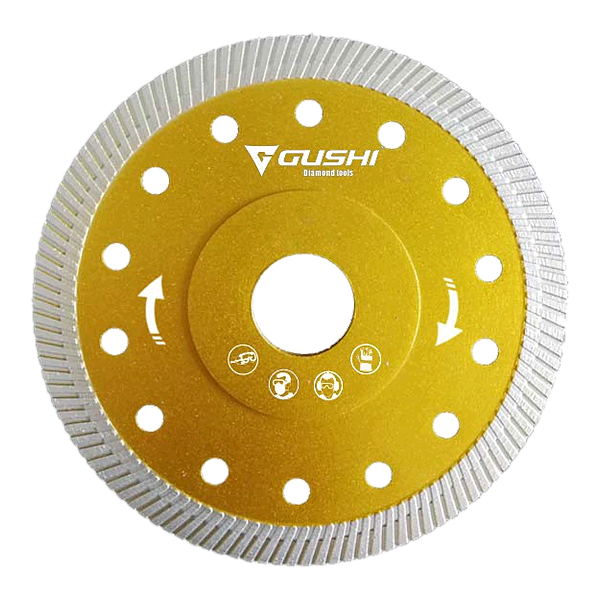
That is the whole design brief of this blade. Rim width runs from 1.0 mm at 4 inch to 1.6 mm at 9 inch, roughly a third narrower than a general masonry rim. The turbo pattern is a continuous ring with narrow coolant slots rather than deep gullets, so the diamond stays in contact while dust and water still escape. For a fabricator cutting 12 mm worktops all day, the difference shows up as fewer scrapped panels and less time spent dressing chipped edges.
Full Specifications
Seven diameters cover hand-held and fixed machines. Rim height, rim width and arbor are fixed at the factory per item number; custom combinations are available on OEM orders.
| Item No. | Diameter | Rim width | Rim height | Arbor hole | Max RPM (80 m/s) |
|---|---|---|---|---|---|
| 4THPST | 4 in / 100 mm | 1.0 mm | 5 / 7 / 8 / 10 mm | 16 / 20 / 22.23 mm | 15,200 |
| 4.5THPST | 4.5 in / 115 mm | 1.2 mm | 5 / 7 / 8 / 10 mm | 16 / 20 / 22.23 mm | 13,200 |
| 5THPST | 5 in / 125 mm | 1.4 mm | 5 / 7 / 8 / 10 mm | 20 / 22.23 mm | 12,200 |
| 6THPST | 6 in / 150 mm | 1.4 mm | 5 / 7 / 8 / 10 mm | 20 / 22.23 mm | 10,100 |
| 7THPST | 7 in / 180 mm | 1.4 mm | 5 / 7 / 8 / 10 mm | 22.23 / 25.4 mm | 8,400 |
| 8THPST | 8 in / 200 mm | 1.6 mm | 5 / 7 / 8 / 10 mm | 22.23 / 25.4 mm | 7,600 |
| 9THPST | 9 in / 230 mm | 1.6 mm | 5 / 7 / 8 / 10 mm | 22.23 / 25.4 mm | 6,600 |
| Rim type | Continuous turbo rim with narrow coolant slots, sintered diamond | ||||
| Core | Hardened steel, thin-gauge, laser-cut with expansion slots | ||||
| Diamond | High-concentration synthetic diamond, fine grit for hard dense material | ||||
| Cutting mode | Wet or dry | ||||
| Finish on cut | Clean to near-polished edge, suitable for visible joints | ||||
| Marking | EN13236, CE, direction arrow, max RPM | ||||
Max RPM is calculated from an 80 m/s rim-speed limit and is a safety ceiling, not a working speed. Always run the lower of the blade marking and the machine nameplate. For sintered panels use the reduced working speeds in the section below.
How the Thin Turbo Rim Cuts Sintered Stone
Diamond that shaves instead of striking
On a sintered panel the diamond does not need to be aggressive, it needs to be present. Fine-grit diamond held in a hard bond stays sharp across a dense, uniform material, and because the bond resists wear the rim keeps its profile instead of rounding over. A flat, true rim is what produces a straight edge; a rim that has worn into a curve starts steering and tearing.
Heat has nowhere to hide in a narrow kerf
A 1.0 mm kerf generates a fraction of the heat of a 2.4 mm rim, simply because less material is being destroyed per metre of travel. The narrow slots in the turbo pattern throw the fines clear rather than letting them pack into the groove and grind against the rim. In wet cutting the same slots carry water to the cutting face, which is why a thin blade on a wet saw runs noticeably cooler than a wide one on the same machine.
The core does the stabilising
Thin does not mean floppy. The core is hardened and laser-cut with expansion slots that let it grow as it warms without dishing, and it is tensioned so it stays flat at working speed. A flat core tracks a straight line, and a straight line is the single biggest factor in a chip-free exit edge: wander at the far side of a 3,200 mm slab is what usually breaks the corner out.
Key Features
| Feature | What it does on the job |
|---|---|
| 1.0 to 1.6 mm thin kerf | Cuts with less resistance and less heat, so sintered edges stay intact and the blade needs less push |
| Continuous turbo rim | Keeps diamond in constant contact instead of hammering the panel, which is what starts micro-fractures |
| High diamond concentration | More cutting points per revolution means a smoother cut and a rim that holds its shape on dense material |
| Rim height up to 10 mm | Enough diamond reserve for a full worktop fit-out, including sink and hob cut-outs, before replacement |
| Slotted hardened core | Stays flat as it heats, so long rips on a rail or bridge saw track straight |
| Wet or dry rated | Runs on a wet tile saw, a bridge saw with water, or dry on a grinder with dust extraction |
| Quiet, low-vibration body | Less tool shake at the cut line, easier control on a hand-held grinder, less operator fatigue |
Material and Thickness Guide
Choose the blade by panel thickness first, then by how the cut will be made. The table below gives a starting point for the materials this blade is built for.
| Material | Typical thickness | Suggested size | Cutting notes |
|---|---|---|---|
| Dekton, Dekton Slim | 4 mm, 8 mm, 12 mm, 20 mm, 30 mm | 4 to 5 in for 4-12 mm; 6 to 9 in for 20-30 mm | Score thin panels first. Wet preferred on visible edges. Two half-depth passes on 20 mm and above. |
| Lapitec | 12 mm, 20 mm | 4.5 to 5 in; 6 to 7 in for 20 mm | Very dense mineral body. Steady feed, no dwelling, water if the machine allows. |
| Neolith | 6 mm, 12 mm, 20 mm | 4 to 5 in; 6 to 9 in for 20 mm | Prone to edge chipping when fed fast. Keep the blade moving and support both sides. |
| Laminam and large-format porcelain | 3 mm, 6 mm, 12 mm | 4 in | Thin and flexible. Full support underneath is essential; score-cut 3 mm panels. |
| Porcelain tile and technical ceramic | 8 mm to 15 mm | 4 to 5 in | Dry or wet. Reduce speed on glazed faces to protect the finish. |
| Engineered quartz | 20 mm, 30 mm | 5 to 7 in | Wet cutting strongly preferred; resin content makes dry heat a problem. |
Speed Settings for Sintered Surfaces
This is the setting most operators get wrong. A thin turbo blade is rated to run fast, but sintered material wants it slow: heat is the enemy, and heat rises with speed. On a variable-speed grinder, start low and only increase if the blade stops cutting.
| Diameter | Max RPM (safety ceiling) | Working range on sintered | Typical machine |
|---|---|---|---|
| 4 in / 100 mm | 15,200 | 6,000 to 7,500 | 100 mm variable-speed grinder |
| 4.5 in / 115 mm | 13,200 | 6,000 to 7,500 | 115 mm variable-speed grinder |
| 5 in / 125 mm | 12,200 | 5,500 to 7,000 | 125 mm grinder, plunge saw |
| 6 in / 150 mm | 10,100 | 4,500 to 6,000 | Wet tile saw, rail saw |
| 7 in / 180 mm | 8,400 | 4,000 to 5,500 | Rail saw, bridge saw |
| 8 in / 200 mm | 7,600 | 3,500 to 5,000 | Bridge saw, masonry saw |
| 9 in / 230 mm | 6,600 | 3,500 to 4,500 | Bridge saw, large grinder |
Machine Fit
| Machine | Size to use | Setup notes |
|---|---|---|
| Angle grinder, 100 mm / 115 mm / 125 mm | 4, 4.5, 5 in | Most common setup for sink and hob cut-outs. Use a variable-speed model where possible, fit the guard, and clamp a straight edge for long cuts. |
| Wet tile saw | 4 to 7 in | The most forgiving option on visible worktops. Keep water flowing across the full kerf, not just the entry. |
| Rail saw or track saw | 5 to 7 in | Best choice for long rips on 3,200 mm slabs. Clamp the rail, support the whole panel, and cut in one continuous pass. |
| Bridge saw | 7 to 9 in | Production cutting of 20 mm and 30 mm. Set the feed rate low and constant rather than relying on hand pressure. |
| Plunge saw | 4 to 5 in | Useful for cut-outs in installed surfaces. Score first, then plunge in small increments. |
How to Cut Dekton Without Chipping It
- Support the whole panel. Every square centimetre on both sides of the cut line, including the offcut. A panel that flexes under load will chip on the exit edge no matter how good the blade is.
- Mark the cut on the back face. Sintered surfaces chip toward the face the blade exits. Cutting face-down on a wet saw puts any breakout on the hidden side.
- Check the arbor and guard. Slide the blade onto the spindle dry, confirm it seats flat with no rock, and refit the guard before starting.
- Run the blade free for a few seconds. Listen for vibration. A thin core that wobbles was fitted off-centre or has a damaged flange.
- Score thin panels. On 4 mm to 8 mm, take a first pass at 2 to 3 mm depth, then cut through on the second pass.
- Feed slowly and evenly. Enter at reduced speed, keep constant pressure through the middle, and do not decelerate at the exit. Most chipping happens at entry and exit, not mid-cut.
- Halve the depth on thick panels. On 20 mm, two passes at roughly half depth cut cleaner than one full pass.
- Keep water on the kerf. If the machine has water, use it. If not, cut in shorter runs and let the blade cool between them.
- Never dwell. A spinning blade held in one place builds heat in a spot the size of the rim and cracks the panel from underneath, where you will not see it until installation.
- Dress the rim if it glazes. If cutting slows and the rim looks polished, make a few passes through a soft abrasive block to expose fresh diamond.
Troubleshooting the Cut
| Symptom | Likely cause | Fix |
|---|---|---|
| Chipping on the exit edge | Panel unsupported, feed too fast, or single full-depth pass | Support both sides, slow the feed, score first or split into two passes |
| Blade cuts slowly and feels polished | Rim glazed from heat or from cutting a soft material | Dress on an abrasive block, reduce RPM, keep water on the kerf |
| Cut wanders off the line | Core dished from overheating, or blade not seated flat | Replace the blade, check the flange, and cut with water or shorter runs |
| Burning smell or blue discolouration on the core | Dry cutting at high RPM with a forced feed | Drop to the working range, take shallower passes, add water or dust extraction |
| Excessive dust, no visible sparks | Blade running too fast for the material, or worn rim | Slow down and check rim height against a new blade |
| Panel cracks after cutting | Heat built up in one spot, or the panel was flexed during the cut | Never dwell, keep the panel flat, allow the cut to cool before handling |
| Sink cut-out corner breaks out | Square internal corner cut in one plunge | Drill the corners first, then cut the sides in to meet them |
Where This Blade Is Used
Sintered surfaces turn up wherever a client wants stone looks without stone maintenance, and the cuts are almost always visible. That makes edge quality the whole job.
- Kitchen worktops – sink and hob cut-outs, upstands, waterfall ends and butt joints on 12 mm and 20 mm Dekton
- Bathroom vanities and shower panels – large-format Neolith and Laminam with exposed edges
- Facade and cladding panels – straight rips on 4 mm and 8 mm sheets, usually cut dry on site
- Flooring and stair treads – repeated dimensional cuts where a consistent edge matters
- Fireplace surrounds and furniture tops – visible mitres and curves on small, high-value pieces
- Shop fitting and reception counters – onsite adjustments to pre-fabricated panels
Frequently Asked Questions
- What makes a thin turbo blade suitable for Dekton?
- Dekton is an ultra-compact sintered surface pressed and fired to near zero porosity, so it is far harder than ordinary porcelain and far less forgiving at the cut edge. Heat and impact are what damage it. A thin turbo blade answers both: the 1.0 to 1.6 mm kerf removes very little material, so friction and heat stay low, and the continuous turbo rim keeps a near unbroken ring of diamond in the cut instead of striking the panel through deep gullets. The result is a steady, low-vibration cut that leaves a clean edge.
- Which materials can this turbo blade cut?
- It is built for ultra-compact and sintered surfaces: Dekton, Lapitec, Neolith, Laminam, sintered stone slabs and large-format porcelain. It also handles dense porcelain tile, technical ceramic, engineered quartz and glass-reinforced composite panels. It is not intended for concrete, asphalt, brick or metal; those materials need a blade with a bond and rim designed for abrasive mineral or steel cutting.
- Can the blade cut Dekton wet and dry?
- Yes, both. Wet cutting is the safer choice on visible worktops and on 12 mm and thicker slabs, because water cools the rim, flushes the kerf and removes the fine dust that sintered panels produce. Dry cutting works on an angle grinder when you keep the blade moving, take several shallow passes rather than one deep plunge, and use dust extraction. Never let the blade sit spinning in one spot, and never cut dry without respiratory protection.
- Why does Dekton chip and how does this blade reduce it?
- Sintered surfaces are brittle at the edge. Micro-fractures start when the blade slaps into the material, when the panel is unsupported and flexes, or when too much heat builds up in the kerf. The thin turbo rim limits all three: low kerf means low heat, the continuous rim means low impact, and a thin core tracks straighter so the blade does not wander and tear the exit edge. Support the panel on both sides of the cut and feed slowly, and chipping stays minimal.
- Which diameter should I choose for a Dekton worktop?
- For 4 mm to 12 mm panels, a 4 inch (100 mm) or 4.5 inch (115 mm) blade on a variable-speed angle grinder gives the best control and the least vibration. Step up to 5 inch (125 mm) when you need extra depth for sink and hob cut-outs. For 20 mm Dekton, or for straight production cuts on a bridge or rail saw, 6 inch to 9 inch blades give more rim in the cut and a straighter line on long rips.
- What arbor size does the blade use?
- Arbor options are 16 mm, 20 mm, 22.23 mm and 25.4 mm depending on diameter. The 4 inch and 4.5 inch blades are supplied with 16, 20 or 22.23 mm bores to suit European and Asian angle grinders; 5 inch and 6 inch use 20 or 22.23 mm; 7 inch to 9 inch use 22.23 or 25.4 mm. Tell us your machine spindle when ordering and we match the bore at the factory, so no reducer ring is needed.
- What RPM should I run on sintered stone?
- Run slower than you would on granite. On 4 inch to 5 inch blades, a working range of roughly 6,000 to 7,500 RPM on a variable-speed grinder is a sensible starting point, then adjust to what the panel tells you. Slower is cleaner. The maximum speed marked on the blade is a safety ceiling derived from rim speed, not a target: always run the lower of the blade marking and the machine nameplate, and reduce speed further for thick panels and visible edges.
- Will it fit a standard angle grinder or tile saw?
- Yes. The 4 inch to 5 inch sizes are made for 100 mm and 125 mm angle grinders, the most common tools on a stone fitting job. The 7 inch to 9 inch sizes suit large angle grinders, rail saws and bridge saws. The thin core also works on wet tile saws and plunge saws with a compatible arbor. Confirm the machine guard covers the blade diameter and that the spindle thread matches the arbor before mounting.
- How long does a thin turbo blade last on Dekton?
- Life is measured in linear metres of cut rather than hours. On 12 mm Dekton with water cooling and a steady feed, a 4 inch blade with a 10 mm rim typically covers a full kitchen fit-out, including sink and hob cut-outs, before the rim height drops noticeably. Dry cutting, forced feed and cutting over unsupported panel all shorten life. Track rim height: when the diamond section is worn close to the steel core, change the blade.
- Can it cut 20 mm or 30 mm Dekton?
- Yes, with the right size and technique. For 20 mm, use a 6 inch or larger blade so the rim is not fully buried, and cut in two passes at roughly half depth each rather than one full-depth pass; that alone removes most exit-edge chipping. For 30 mm, use 9 inch with water and expect a slower feed. Thin turbo blades are optimised for the 4 mm to 20 mm range that covers most worktops, splashbacks and cladding.
- Is the blade certified and safe to use?
- GUSHI blades are produced under ISO 9001 quality control and carry CE marking with EN13236 declaration. EN13236 is the European safety standard covering rim retention, markings and the technical file; GUSHI declares conformity in the technical file rather than through a third-party certificate unless one is specifically requested. Always fit the guard, wear eye, ear and respiratory protection, and never exceed the maximum RPM marked on the blade.
- What is the minimum order and can you OEM this blade?
- Standard MOQ is 20 pieces per size, and mixed-size orders are accepted for distributors and fabricators. Typical lead time is 25 to 30 days after confirmation, faster for stock sizes. GUSHI supports OEM and private label: laser marking, custom rim height and width, bespoke arbor, retail or bulk packaging. Exporting since 2004 to more than 20 countries, GUSHI supplies distributors, fabricators and brands worldwide.