Product Overview
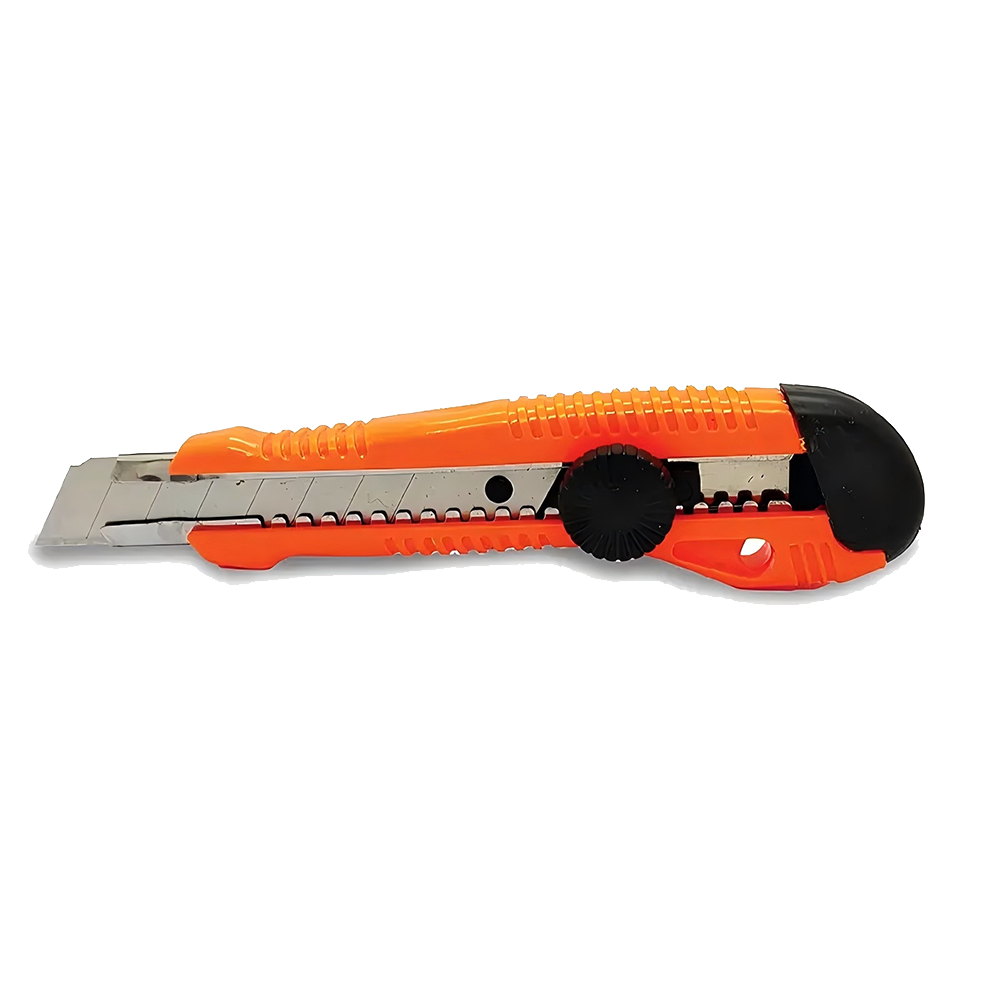
The GUSHI Regular Utility Knife is an everyday retractable snap-off knife built around an SK5 high-carbon steel blade in the standard 18 mm width. Each blade carries eight scored segments, so a dull edge is replaced by a factory-sharp one with a single snap instead of a blade change. The thickened hard plastic housing gives a comfortable, non-conductive grip with textured anti-slip sides, and the smooth slider with an automatic safety lock holds the blade firmly at the chosen extension. At 160 mm long and about 85 g, it is light enough to carry all day. It is made by Huzhou Gu’s Imp. & Exp. Co., Ltd., a Zhejiang manufacturer founded in 2004 that runs ISO 9001:2015 and exports to more than 20 countries.
The point of a snap-off blade is that you never sharpen it and rarely stop to reload. When the edge dulls, you extend the blade, snap the worn segment off in the tail cap, and keep cutting — eight times per blade. For warehouse, flooring and shop-fitting crews who cut packaging, carpet and sheet material all day, that is the difference between a tool that stays in the hand and one that keeps going back to the toolbox.
Two blade widths cover the work. The 18 mm blade is the general-purpose size with enough depth for cartons, carpet and underlay; the 9 mm version is for fine, controlled cuts on film, paper and light trim. Both use the universal industry format, so refills are available anywhere rather than locked to one supplier.
Full Specifications
| Parameter | Specification |
|---|---|
| Product name | Regular Utility Knife (snap-off box cutter) |
| Blade width — standard | 18 mm |
| Blade width — optional | 9 mm |
| Blade material | SK5 high-carbon steel |
| Blade hardness | HRC 58–62 |
| Blade thickness | 0.5 mm (18 mm) / 0.38 mm (9 mm) |
| Blade length | 100 mm |
| Snap segments per blade | 8 (18 mm) / 12 (9 mm) |
| Housing material | Thickened ABS hard plastic with anti-slip texture |
| Mechanism | Retractable slider with automatic safety lock |
| Blade operation | One-hand extension and retraction |
| Blade change | Removable tail cap; tool-free replacement |
| Blade snapper | Built into the tail cap |
| Spare blade storage | In-handle compartment on selected models |
| Lanyard hole | Yes |
| Overall length | 160 mm (6.3 in) |
| Net weight | ≈85 g |
| Colour options | Standard red/black; custom colours on OEM orders |
| Refill blades included | Selected packs; quantity set by OEM order |
| Replacement format | Universal 18 mm / 9 mm snap-off blades |
| Segment life (corrugated carton) | ≈3–8 m per segment |
| Cut materials | Carton, film, carpet, vinyl, drywall paper, leather, rope, foam |
| Packing | Blister card or bulk; 12 pcs/inner box, 240 pcs/carton |
| Quality system | ISO 9001:2015; 100% inspection before shipment |
| Material compliance | RoHS and REACH compliant plastics |
| MOQ | 500 pcs (9 mm and 18 mm mixable) |
| Lead time | 5–10 days stock; 15–30 days OEM |
| Payment terms | T/T, L/C, D/A, D/P, PayPal |
How a Snap-Off Utility Knife Works
Why SK5 holds an edge
SK5 is a high-carbon tool steel that takes a very fine edge and, heat-treated to roughly HRC 58–62, resists the rolling and dulling that softer blades suffer on abrasive material like carpet backing and drywall paper. The edge is thin enough to slice rather than tear, which is what makes a clean cut in corrugated board instead of a ragged one.
The scored segment system
The blade is manufactured with eight angled score lines. Those scores are stress concentrators: when you lever a projecting segment sideways in the tail-cap snapper, the steel breaks cleanly along the line instead of shattering. The result is a fresh, factory-ground edge — the full width of the blade, not a worn one — without handling a loose replacement blade.
The lock that makes one-hand use safe
Cutting pressure pushes a blade backwards into its housing, which is why a knife with a weak detent feels unsafe. The slider here carries an automatic lock plate that engages at each position, so the blade stays where you put it under load, and releases with thumb pressure when you want to retract. Fully retracted, the edge sits inside the housing for pocket or toolbox carry.
Why a plastic housing is often the right choice
Metal-bodied knives feel premium, but a thickened ABS shell is lighter, warmer to hold in cold stores, does not conduct electricity near live wiring, and will not scratch finished surfaces when set down. For a tool that gets handed to anyone on site and dropped regularly, that combination is usually worth more than the extra weight of alloy.
Key Features Explained
Eight fresh edges per blade
A snap-off blade is effectively eight blades in one. That removes the two things that stop work with a fixed-blade knife: carrying spares and handling loose blades. In a warehouse or on a flooring job, snapping takes two seconds and needs nothing else in your hand.
Thickened hard plastic housing
The shell is moulded thicker than a disposable knife, so it resists the cracking that cheap bodies suffer when dropped or stepped on, while the textured sides keep grip when hands are dusty or wet. It also keeps the tool at about 85 g, which matters when it is in a pocket all day.
Smooth slider with automatic lock
The slider travel is tuned so blade extension is controlled rather than jumpy, and the lock engages without needing to be set separately. Extension, cutting and retraction can all be done one-handed, leaving the other hand free to hold the material — which is both faster and safer.
Tail-cap blade snapper and lanyard hole
The removable tail cap doubles as the snapper, so the tool that dulls the edge also renews it. The same cap gives access for a full blade change without tools. A lanyard hole lets the knife hang on a rack, a belt or a display hook — useful in a workshop and useful on a retail peg.
Universal refill format
Because the housing takes the standard 18 mm and 9 mm snap-off format, end users are never locked into proprietary refills. For distributors that is a selling point rather than a threat: blades are the repeat-purchase item, and convenience drives the branded knife sale.
Blade Width and Segment Guide
Width decides how deep and how aggressive the cut is; segment count decides how many edges you get.
| Blade width | Segments | Typical use | Why choose it |
|---|---|---|---|
| 9 mm | 12 | Paper, film, light trim, craft work | Finest control, least material removal |
| 18 mm | 8 | Cartons, carpet, underlay, vinyl, drywall | ✓ General purpose — the default for most trades |
| 25 mm | 6–7 | Thick insulation, heavy board, roofing felt | Deepest cut, stiffest blade |
| Material being cut | Expected metres per segment | Notes |
|---|---|---|
| Single-wall carton | 8–15 m | Longest life; snap when it starts to drag |
| Double-wall carton | 3–8 m | The everyday benchmark |
| Carpet and underlay | 2–5 m | Abrasive backing dulls edges fast |
| Vinyl and linoleum | 4–10 m | Score and snap rather than cut through |
| Drywall paper | 3–6 m | Gypsum dust is highly abrasive |
| Foam board | 15–30 m | Least wear of common materials |
Applications & Suitable Materials
Applications
| Application | Why this knife fits | Blade |
|---|---|---|
| Warehouse and goods-in | Opens cartons and cuts strapping all day; snap keeps it sharp | 18 mm |
| Carpet and flooring installation | Trims carpet, underlay and vinyl with a fresh edge on demand | 18 mm |
| Drywall and plasterboard work | Cuts board paper and tape; light body suits overhead work | 18 mm |
| Shop fitting and signage | Trims foam board, film and display materials cleanly | 9 / 18 mm |
| Electrical and cable work | Non-conductive housing; strips insulation and cuts sleeving | 9 mm |
| Upholstery and leather | Thin edge slices hide and fabric without crushing | 9 mm |
| Packaging and dispatch | Cuts tape, stretch film and shrink wrap without snagging | 18 mm |
| General DIY and household | Cheap enough to own several; retracts for safe drawer storage | 18 mm |
Suitable Materials
| Cuts well | Do not attempt |
|---|---|
| Corrugated carton and paper board | Metal sheet, wire or cable cores |
| Carpet, underlay and felt | Glass (use a glass cutter) and tile |
| Vinyl, linoleum and rubber sheet | Stone, brick and concrete |
| Leather, fabric and rope | Hard plastics thicker than 3 mm |
| Foam board and insulation | Anything requiring prying or levering |
| Plastic strapping, film and tape | Use as a screwdriver, scraper or can opener |
Snap-Off vs. Fixed Blade vs. Folding Knife
Three common site knives. The right one depends on how often the edge dulls and how much force the job needs.
| Dimension | Snap-off (this model) | Fixed trapezoid blade | Folding lock knife |
|---|---|---|---|
| Edge renewal | ✓ Snap a segment, seconds | Carry and fit a new blade | Carry and fit a new blade |
| Edges per blade | ✓ 8 (18 mm) or 12 (9 mm) | 1 (often double-ended: 2) | 1 |
| Blade rigidity | Good for sheet and board | ✓ Stiffest — heavy pressure | Stiffest, thickest blade |
| Deep cutting | Controlled depth | ✓ Best for thick material | Best |
| One-hand operation | ✓ Slider extension | Some models | Two hands to open |
| Weight | ✓ ≈85 g | 100–200 g | 120–250 g |
| Blade storage on tool | Spares on selected models | Usually yes | No |
| Running cost | ✓ Lowest per edge | Higher per edge | Higher per edge |
| Safety when closed | ✓ Fully retracts into body | Retracts on most models | Folds, but blade exposed in pocket |
| Best for | Cartons, carpet, vinyl, film, board — high-volume slicing | Heavy scoring, thick board, construction | General site carry and utility prying |
Bottom line: When the job is slicing sheet material and the edge dulls often — warehouse, flooring, drywall, shop fitting — the snap-off knife wins on speed, running cost and safety. Choose a fixed-blade knife when you need maximum blade stiffness and depth, and a folder when one knife has to do everything on a tool belt.
How to Use: Step-by-Step Guide
- Check that the blade is secure and the slider lock engages before starting.
- Extend only as much blade as the material needs — one or two segments for carton, more for thick board.
- Hold the material firmly on a stable surface; never cut towards your supporting hand.
- Cut with a pulling motion using light, even pressure; let the edge do the work.
- Retract the blade fully the moment you stop cutting, especially before handing the knife over.
- When the edge drags instead of slicing, stop and renew it rather than pushing harder.
- To snap: remove the tail cap, insert the worn segment into the snapper slot, lever sideways.
- Collect the used segment immediately in a sharps container — never leave it on the floor.
- For a full blade change, remove the tail cap, slide the old blade out and insert a new one bevel-forward.
- Replace the cap firmly; a loose cap lets the blade shift during cutting.
- Wipe the housing and blade clean at the end of the day; keep the blade dry to prevent rust.
- Store retracted, out of reach of children, and never carry an extended knife in a pocket.
Complete the hand tool kit with the 6PCS Trowel Set, Tile Scraper, and Carpet Seam Roller.
Preguntas frecuentes
What blade sizes does the Regular Utility Knife use?
It is supplied with the standard 18 mm snap-off blade as the default, and a 9 mm variant is available for finer work. Both use industry-standard dimensions, so replacement blades from any major brand fit the housing. The 18 mm blade has eight snap segments and the 9 mm blade has twelve, giving eight or twelve fresh edges per blade respectively.
How do you snap off a used blade segment safely?
Retract the blade so only the worn segment projects, then use the snapper slot in the removable tail cap: insert the segment, lever sideways and it breaks cleanly along the scored line. Wear eye protection, never snap with your fingers, and collect used segments in a sharps container rather than throwing them loose into a bin.
How long does one segment last?
On double-wall corrugated carton a single 18 mm segment typically cuts about 3 to 8 metres before it starts dragging and tearing instead of slicing. Abrasive materials such as carpet backing, drywall paper and fibreglass dull a segment far faster. Snap to a fresh edge as soon as the knife needs pressure rather than glide, because a dull blade slips and causes more accidents than a sharp one.
Is the handle metal or plastic?
The Regular model uses a thickened hard plastic (ABS) housing with a textured anti-slip grip. Plastic keeps the knife light at about 85 g, stays comfortable in cold stores and outdoor work, and does not conduct electricity or mark finished surfaces. For heavy daily trade use where the body takes knocks, a metal-bodied knife is the alternative; GUSHI supplies both.
Does the blade lock during use?
Yes. The slider carries an automatic safety lock that holds the blade at the selected extension under cutting pressure, so it will not creep out or slide back mid-cut. The slider is shaped for thumb operation, allowing one-handed extension and retraction, and the blade retracts fully into the housing for pocket or toolbox carry.
What materials can it cut?
It handles corrugated carton, packaging tape, shrink and stretch film, carpet and underlay, vinyl and linoleum, drywall paper, leather, rope and cord, foam board, rubber sheet, plastic strapping and cable insulation. It is not intended for metal sheet, glass, tile or stone, which require a saw, a glass cutter or a scoring tool respectively.
Are spare blades included and are replacements a standard size?
Selected packs ship with spare blades in the handle or the retail card, and OEM orders can specify any quantity. Replacement blades use the universal 18 mm and 9 mm snap-off format, so end users can buy refills anywhere in the world rather than being tied to one brand. Blades are individually priced and are the natural repeat-purchase item for distributors.
What is the MOQ and what OEM options are available?
The OEM MOQ is 500 pieces, and 9 mm and 18 mm versions can be mixed in one order. Customisation covers housing colour, logo printing or moulding, blade count per pack, blister card and colour box artwork. Production runs under ISO 9001:2015 with 100% inspection before shipment; lead time is 5 to 10 days for stock items and 15 to 30 days for OEM.
OEM & Wholesale Information
| OEM / wholesale parameter | Details |
|---|---|
| MOQ | 500 pcs; 9 mm and 18 mm versions mixable |
| Customisation | Housing colour, pad-printed or moulded logo, blade count, retail artwork |
| Packaging options | Blister card, hanging card, colour box, counter display box, bulk carton |
| Blade programme | Refill blades supplied loose, in dispensers, or packed with the knife |
| Standard packing | 12 pcs/inner box, 240 pcs/outer carton |
| Sample policy | Samples at cost price plus freight; fee refunded on the official order |
| Payment terms | T/T, L/C, D/A, D/P, PayPal |
| Port of loading | Shanghai or Ningbo, China |
| Quality control | 100% inspection before shipment; ISO 9001:2015, SGS |
| Service languages | English, Spanish, Japanese, Russian, French, German |
Huzhou Gu’s Imp. & Exp. Co., Ltd. (brands GUSHI Tools and Roycel) has manufactured and exported hand tools, tile installation tools and diamond tools from Zhejiang since 2004, drawing on a supply chain active in this industry since 1998 and a production capacity of 100,000 sets per month. The company is ISO 9001:2015 certified, exports to more than 20 countries including the USA, Germany, the UK, the Netherlands, Brazil, Chile and Australia, and was one of 23 Chinese firms that won the US anti-dumping case on diamond blades at a 6.2% rate.
Continue through the hand tool range: 6PCS Trowel Set, Tile Scraper, and Carpet Seam Roller.