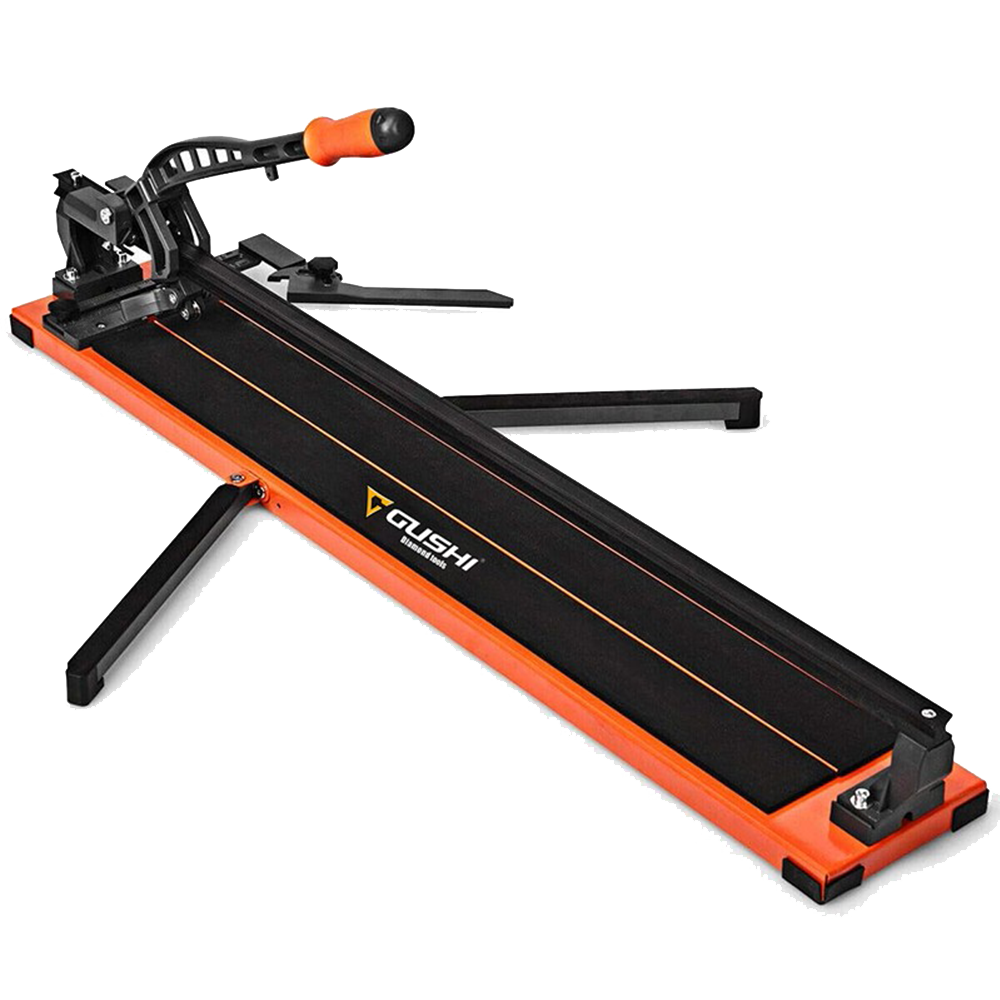
Product Overview
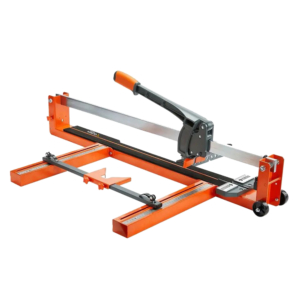
The GUSHI Upgraded Manual Tile Cutter keeps the proven GUSHI snap-cutter platform and adds the working configuration that large tile demands: folding side support legs that carry panel overhang, an extended aluminium fence with a true 45° scale, a smoother bearing slider, a wider anti-skid base foot and an optional laser guide that shows the break line before the wheel touches the tile. Offered in 800, 1000 and 1200 mm cutting lengths with diagonal capacities of 565, 705 and 860 mm, it cuts tile from 4 to 16 mm thick with a 900 kg breaker and straight-cut accuracy within 1.0 mm. It is built by Huzhou Gu’s Imp. & Exp. Co., Ltd., a Zhejiang manufacturer founded in 2004 that is ISO 9001:2015 and CE certified, inspects 100% before shipment and exports to more than 20 countries.
Capacity numbers alone rarely decide a cutter. What decides it is whether a 1200 mm panel is supported while it is being broken, whether the fence stays at a true 45° after a month of use, and whether the operator can see where the break will run before committing. Every upgrade on this model targets one of those three practical failures rather than adding capacity that sits unused.
It sits between two siblings in the range. The Standard model is the value choice for smaller tile and occasional work; the High-Grade model is the heavy-duty option for 18 mm material and daily professional use. This upgraded version is the middle path: full-size panel capability and the handling features that make large-format work predictable, at a price below the heavy-duty machine.
Full Specifications
| Parameter | Specification |
|---|---|
| Product name | GUSHI Upgraded Manual Tile Cutter |
| Series | GTC-U — 800 / 1000 / 1200 mm |
| Cutting method | Score and snap — fully mechanical |
| Cutting length — GTC-U800 | 800 mm (diagonal 565 mm) |
| Cutting length — GTC-U1000 | 1000 mm (diagonal 705 mm) |
| Cutting length — GTC-U1200 | 1200 mm (diagonal 860 mm) |
| Cutting thickness | 4–16 mm |
| Scoring wheel | Tungsten carbide, Ø22 × 6 × 6 mm, replaceable |
| Wheel life | ≈800–1,500 m ceramic; 300–600 m porcelain |
| Breaking force | 900 kg (≈8.8 kN) |
| Straight-cut accuracy | Within 1.0 mm over the full length |
| Cut types | Straight rip cut, 45° mitre, repeat cuts |
| Support legs | Folding side supports, both sides |
| Fence | Extended aluminium fence with 45° scale and side stop |
| Laser guide | Optional — button cell powered, switchable |
| Base plate material | Aluminum alloy plate with wide steel foot |
| Guide rails | Double chrome-plated solid steel rails, Ø20 mm |
| Sliding system | Upgraded bearing slider, low play |
| Handle | Anti-slip rubber grip with anti-pinch device |
| Base stability | Wider anti-skid rubber mat |
| Carry handle | Yes — integrated into the base |
| Net weight — GTC-U800 | ≈12 kg |
| Net weight — GTC-U1000 | ≈14 kg |
| Net weight — GTC-U1200 | ≈17 kg |
| Packed size (GTC-U1200) | ≈1450 × 260 × 250 mm (legs folded) |
| Packing | 1 pc carton; 2 pcs/outer carton (800 model) |
| Power requirement | None — dry cutting, no water needed |
| Certifications | ISO 9001:2015, CE, RoHS-compliant materials, SGS inspected |
| MOQ | 100 units (mixed cutting lengths in one order) |
| Lead time | 5–10 days standard; 15–30 days OEM |
| Payment terms | T/T, L/C, D/A, D/P, PayPal |
How the Upgrades Change the Result
Support legs remove panel flex
A 1200 mm panel on a machine whose base is shorter than the tile leaves a long unsupported overhang. When the breaker comes down, that overhang flexes, and the crack runs off the score line instead of along it. Folding legs extend the support surface so the panel rests along its length; the break then follows the groove because the tile is not bending while it breaks.
An extended fence holds a true 45°
Short fences make mitres a matter of judgement — a degree of error at the fence becomes several millimetres of gap at the far end of a tile. The extended fence on this model gives a longer reference face and a machined 45° scale, so the angle is set by the tool rather than estimated. The side stop then repeats identical rip cuts without re-measuring.
A lower-play slider keeps the wheel upright
Accuracy dies when the carriage can rock. The upgraded bearing slider reduces the clearance between carriage and rail, so the wheel stays perpendicular to the tile across the whole stroke. That is what turns the 1.0 mm tolerance from a specification into something the machine actually delivers on site.
The laser shows the break before the cut
On long panels, the expensive mistake is a score line in the wrong place. The optional laser projects the break line onto the tile while it is still lying flat, so alignment can be corrected before any metal touches the glaze. It is a correction tool rather than a precision instrument — but it prevents the one error that cannot be undone.
Key Features Explained
Folding support legs
The legs swing out to widen the working surface for 1000 and 1200 mm panels and fold back flat for transport and storage. On a machine that has to fit in a van alongside everything else, support that appears when needed and disappears when not is more useful than a permanently larger base.
Extended aluminium fence with mitre scale
Aluminium keeps the fence straight and light, and the machined 45° scale lets mitred corners be set repeatably. Paired with the side stop, it turns the cutter into a small production tool for plank tile, borders and repeated rip cuts.
Optional laser guide
Switchable and battery powered, the laser suits contractors working on expensive large-format material where a misplaced score is costly. It can be left off for everyday work, and OEM buyers can choose laser or non-laser versions across the range.
Wider anti-skid base
A broader foot and a larger rubber mat spread the machine’s weight and grip the bench or floor. Stability matters most at the moment of the break: if the machine shifts while the breaker is loading, the break follows the machine rather than the score.
Shared consumables across the range
The 22 × 6 × 6 mm tungsten carbide wheel, breaker foot and handle assemblies are shared with the Standard and High-Grade models, so distributors stock one set of spares and users can find replacements anywhere in the GUSHI cutter family.
Selection Guide: Which GUSHI Cutter?
Three machines, three workloads. Match the machine to the tile you actually cut, not the tile you might cut one day.
| Workload | Recommended model | Reason |
|---|---|---|
| Small rooms, wall tile, occasional jobs | Standard 600 / 800 | Lightest and lowest cost; up to 14 mm |
| 800–1200 mm floor tile, mixed site work | ✓ Upgraded 1000 / 1200 (this model) | Support legs, extended fence and optional laser at mid-range cost |
| Large-format panels with visible long cuts | ✓ Upgraded 1200 with laser | Confirms the break line before scoring |
| 18 mm porcelain, 20 mm paving, daily trade use | High-Grade 1200 | 1000 kg breaker and reinforced frame |
| Notches, L-shapes, curves, holes | Wet saw or diamond core bit | No snap cutter does these cleanly |
| Panel size | Diagonal cut needed | Model required |
|---|---|---|
| 600 × 600 mm | 425 mm | Any 600 mm machine |
| 800 × 800 mm | 565 mm | 800 mm machine |
| 1000 × 1000 mm | 705 mm | 1000 mm machine |
| 1200 × 1200 mm | 848 mm | 1200 mm machine (860 mm diagonal) |
Applications & Suitable Materials
Applications
| Application | Why the Upgraded model fits | Recommended size |
|---|---|---|
| Large-format porcelain floors | Legs support 1200 mm panels; laser confirms long cut lines | 1200 mm |
| Open-plan residential tiling | Repeat rip cuts with the fence and side stop | 1000 mm |
| Commercial fit-outs | Folds flat for transport between sites | 1000 / 1200 mm |
| Bathroom and wet rooms with large panels | Supported breaking reduces breakage on expensive tile | 800 mm |
| Terrace and outdoor tile to 16 mm | Wider base stays planted on uneven ground | 1000 mm |
| Mitred corners and borders | Extended fence with true 45° scale | 800 / 1000 mm |
| Contractor backup machine | Mid-price second cutter that still handles full-size tile | 1000 mm |
Suitable Materials
| Cuts well | Not suitable |
|---|---|
| Glazed ceramic wall and floor tile | Porcelain thicker than 16 mm |
| Porcelain floor tile up to 16 mm | 20 mm paving (use High-Grade) |
| Large-format thin panels (6–12 mm) | Granite, quartz and stone worktops |
| Unglazed quarry and terracotta to 16 mm | Tempered or laminated glass |
| Glass mosaic and small glass tile | Curved or internal-radius cuts |
| Cement and encaustic tile to 16 mm | Metal, wood and fibre-cement board |
Upgraded vs. Standard vs. High-Grade
The three GUSHI cutters share the same base design, rails, handle and consumables. These are the differences that matter.
| Dimension | Upgraded (this model) | Standard | High-Grade |
|---|---|---|---|
| Cutting lengths | 800 / 1000 / 1200 mm | 600 / 800 / 900 mm | ✓ 600–1200 mm |
| Max thickness | 16 mm | 14 mm | ✓ 18 mm |
| Breaking force | 900 kg | 800 kg | ✓ 1000 kg |
| Accuracy | ✓ ±1.0 mm | ±1.5 mm | ✓ ±1.0 mm |
| Support legs | ✓ Folding, both sides | Removable side supports | Reinforced frame and supports |
| Fence | ✓ Extended with 45° scale | Standard T-square | Heavy-duty fence |
| Laser guide | ✓ Optional | Not available | Optional |
| Slider | ✓ Upgraded low-play bearing | Standard bearing | Heavy-duty bearing |
| Weight (largest model) | ≈17 kg | ✓ ≈13 kg | ≈19 kg |
| Price | Mid | ✓ Lowest | Highest |
| Best for | Full-size panels with handling features at mid cost | Small-format and occasional work | Thick material and daily professional use |
Bottom line: Pick the Upgraded model when the tile is full size but not especially thick — 800 to 1200 mm panels up to 16 mm — and you want the legs, fence and optional laser that make those panels predictable. Choose Standard for small rooms and occasional jobs, and High-Grade when thickness and daily use are the real constraints.
How to Use: Step-by-Step Guide
- Set the machine on a firm, level surface and unfold both support legs.
- If fitted, switch on the laser and check the beam aligns with the wheel before cutting.
- Measure and mark the tile, then set the extended fence or side stop to the dimension.
- Check the wheel — it must spin freely with no flat spots; replace it if worn.
- Confirm capacity: no thicker than 16 mm, no longer than the machine’s cutting length.
- Wipe tile and base clean; grit deflects the wheel and marks the tile face.
- Seat the tile flat against the fence with the overhang resting on the support legs.
- Score in one smooth, continuous pass from the far edge, using even pressure.
- Do not score twice — a second pass widens the groove and causes chipping.
- Slide the breaker foot over the score line and press down firmly to snap.
- For 45° cuts, lock the fence at the mitre scale and check the diagonal capacity.
- Fold the legs, brush dust from the rails, and store the cutter dry with the handle released.
Complete the tile installation kit with the Almohadilla de pulido manual de diamante for edge finishing, 2-in-1 Tile Vibration Machine for setting tile, and the 6PCS Trowel Set.
Preguntas frecuentes
What is actually upgraded compared with the Standard GUSHI cutter?
Five things: folding side support legs that carry the overhang of large panels, an extended aluminium fence with a true 45 degree scale, a smoother bearing slider with less play, a wider anti-skid base foot, and an optional laser guide for long cuts. Cutting capacity also rises to 1200 mm lengths and 16 mm thickness with a 900 kg breaker.
Is the laser guide worth having?
It pays off on long or repetitive cuts, because the beam shows the break line before the wheel touches the tile, so panel alignment can be corrected while the tile is still flat on the base. It runs on standard button cells and can be switched off. For short one-off cuts on small tile, the fence alone is usually enough.
Can it handle large-format 1200 mm slabs?
Yes, up to 16 mm thick. Unfold the support legs so the panel overhang is carried rather than left hanging, score in one continuous pass, and break with the tile fully supported. At 1200 mm, diagonal capacity is 860 mm, so the machine covers corner-to-corner cuts on 1200 mm material. For 20 mm paving, use the High-Grade model instead.
What thickness can it cut?
The working range is 4 to 16 mm, which covers wall tile, standard porcelain floor tile and most large-format panels. That leaves 18 mm dense porcelain and 20 mm paving to the High-Grade model, and anything above 20 mm to a wet saw. Always check the actual tile thickness before assuming a snap cutter will break it cleanly.
How do the folding support legs help?
A 1200 mm panel leaves a long overhang past the base, and that unsupported length lets the tile flex during the break, which produces a ragged edge or a crack away from the score line. The legs extend the working surface so the panel is supported along its length, then fold away for transport and storage.
Is it portable, and does it need assembly?
The 800 mm model weighs about 12 kg and the 1200 mm model about 17 kg, with a carry handle in the base. The support legs fold and the fence lifts off, so the machine packs flat into a van. No assembly is needed on site beyond unfolding the legs and, on laser models, fitting the batteries.
How do I maintain the laser and the scoring wheel?
Keep the laser lens free of ceramic dust and replace the button cells when the beam dims; check beam alignment against the wheel before a critical cut. Replace the 22 x 6 x 6 mm wheel when the edge chips or a second pass is needed to break the tile, typically after 800 to 1,500 linear metres on ceramic or 300 to 600 metres on porcelain. Brush the rails clean after each job.
What is the MOQ, warranty and lead time?
The OEM MOQ is 100 units and mixed cutting lengths can be combined in one order. Every unit is inspected before shipment under ISO 9001:2015 with CE compliance, and we remain responsible for the supplied product throughout its service life. Delivery is 5 to 10 days for standard orders and 15 to 30 days for OEM, shipped from Shanghai or Ningbo.
OEM & Wholesale Information
| OEM / wholesale parameter | Details |
|---|---|
| MOQ | 100 units; mixed cutting lengths in one order |
| Model options | With or without laser guide; 800 / 1000 / 1200 mm |
| Customisation | Frame colour, logo printing, fence scale and language, packaging artwork |
| Packing | 1 pc carton; 2 pcs/outer carton for the 800 mm model |
| Spare parts programme | Wheels, breaker feet, fences, legs and handles supplied with OEM orders |
| Sample policy | Samples at cost price plus freight; fee refunded on the official order |
| Payment terms | T/T, L/C, D/A, D/P, PayPal |
| Port of loading | Shanghai or Ningbo, China |
| Quality control | 100% inspection before shipment; ISO 9001:2015, CE, SGS |
| Service languages | English, Spanish, Japanese, Russian, French, German |
Huzhou Gu’s Imp. & Exp. Co., Ltd. (brands GUSHI Tools and Roycel) has manufactured and exported tile installation tools from Zhejiang since 2004, drawing on a supply chain active in this industry since 1998 and a production capacity of 100,000 sets per month. The company is ISO 9001:2015 and CE certified, exports to more than 20 countries including the USA, Germany, the UK, the Netherlands, Brazil, Chile and Australia, and is one of the 23 Chinese exporters that won the US anti-dumping case on diamond blades at a 6.2% rate.
Compare the full cutter range: Standard Manual Tile Cutter, High-Grade Manual Tile Cutter, and Silent Diamond Cutting Blade for wet cutting.