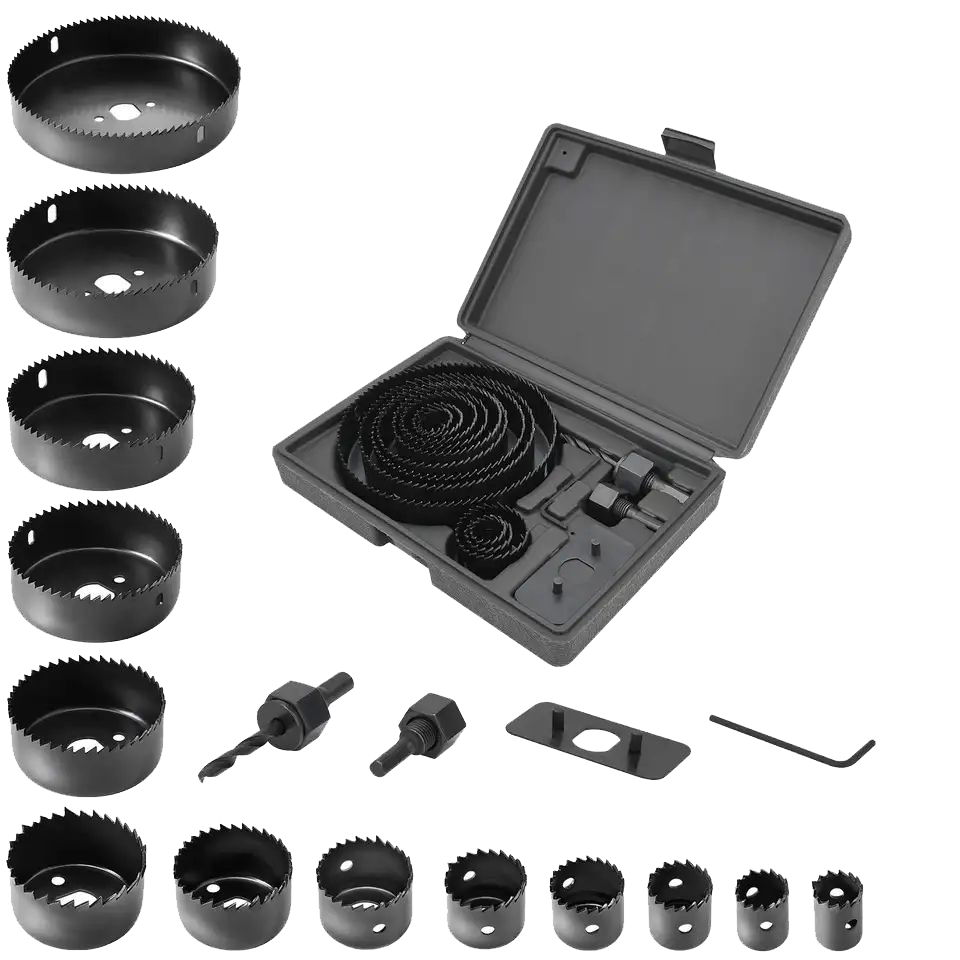
1. Our own copy: paint is not wear resistance, and wood is missing
| What the source copy says | What is wrong | What we say instead |
|---|---|---|
| “The black paint surface provides good rust prevention and wear resistance” | Paint does not resist wear. It is a film for appearance and limited corrosion protection, and it is gone from the tooth within the first few cuts because that is where abrasion happens. On the body it protects nothing that matters | The body finish is stated as a finish. Wear happens at the tooth, and the tooth is bare HSS. See our amber finish page for why surface treatments and wear resistance are separate questions |
| “Suitable for aluminum, cork, plastic board, gypsum board, composite materials, etc.” | Wood is absent from the list of materials for a product named Wood Hole Saw Sets. The one material the product is named after is the one the copy forgot | Wood first, then the panel products and plasterboard it also handles. See section 15 |
| “Made of high-quality high-speed steel, ensuring improved heat resistance of the hole teeth” | The claim is true of HSS and irrelevant to the listed applications. Cork, gypsum board and plastic do not generate the heat that HSS is for, so the copy is selling a property the buyer will never use | HSS buys edge life in hardwood and in the accidental nail. It is not a reason to choose this set for plasterboard |
| “Clean cutting: Use fast cleaning cutting.” / “extending the service life of drilling engineering” | Translation artefacts. Neither phrase is a term of art | Stated as what actually governs cut quality: tooth pitch, chip clearance, pilot condition and feed |
| “Choosing different diameters can greatly improve work efficiency” | True but empty. The reason diameter choice helps is that a saw cutting the right circle makes one cut instead of a chain of drilled holes | Said plainly in section 7, where the piece count is actually evaluated |
2. The depth number is the same for every diameter
Published data for production hole saws is unusually consistent on this point, and unusually blunt about it:
| Source | Stated cutting depth | Notes |
|---|---|---|
| One European bi-metal range, 25–114 mm | 35 mm (1-3/8″) | Same figure across ten diameters from 25 to 114 mm |
| A second European maker | 38 mm maximum, all sizes | Stated explicitly as a maximum for every size in the range |
| A third range, two depth classes | 38 mm and 47 mm | Two cup depths offered, not a depth that scales with diameter |
| Trade guidance for a 60 mm saw | 38 mm in one pass | Two-sided cutting quoted as roughly doubling the achievable thickness |
Read that as a rule rather than a set of coincidences. The depth limit is a property of the cup, and the cup is a pressed or drawn shell whose depth is chosen for the range, not calculated per diameter.
Three consequences that follow
- A bigger saw is not a stronger saw. It removes more material per revolution, needs more torque, and cuts exactly the same depth. The biggest saw in the set is the most demanding one to drive and the least able to go deep
- The depth-to-diameter ratio collapses as the saw grows. A 16 mm saw at 38 mm depth is a deep hole by any standard. A 152 mm saw at 38 mm depth is a shallow disc. The same cup depth means two completely different jobs
- “Will it cut 40 mm board?” has nothing to do with which saw you pick. The answer is no for every saw in the set, and the solution is a two-sided cut, not a bigger diameter
3. Why the saw fails by packing, not by dulling
A drill bit makes a hole and sends the chip up a helix. A hole saw makes a groove, and the groove is enclosed on three sides. The waste has one destination: the inside of the cup.
That changes the failure mode. A dull saw cuts slowly and hot; a packed saw stops cutting altogether and starts rubbing. The symptoms are different and so is the fix:
| Symptom | Dull tooth | Packed cup |
|---|---|---|
| Progress | Slow but continuous | Stops, then jumps, then stops |
| Sound | Steady, slightly higher pitch | Labouring, then a squeal |
| Heat | Gradual | Sudden, concentrated at the kerf |
| Chips at the kerf | Fine dust | None — they are inside the cup |
| Smell in wood | Mild | Sharp resin burn |
| What fixes it | Sharpen or replace | Withdraw fully, clear the cup, resume with pecking |
The reason this matters commercially is that buyers diagnose it as dullness. They press harder, which packs the cup further, which raises friction, which burns the work and glazes the tooth — and then they conclude the saw was poor quality. The saw may have been fine. It was never allowed to clear.
4. The chip-volume arithmetic
It is worth seeing how fast the cup fills, because the number explains why the depth limit feels so low in practice.
Where D is the saw diameter, d is the pilot diameter, and t is the depth cut. Worked for a mid-size saw:
| Saw | Pilot | Depth cut | Annular waste volume | What that means |
|---|---|---|---|---|
| 25 mm | 6 mm | 10 mm | About 4.6 cm³ | Small; clears easily |
| 60 mm | 6 mm | 10 mm | About 27.9 cm³ | Six times the volume for 2.4 times the diameter |
| 60 mm | 6 mm | 35 mm | About 97.7 cm³ | Most of a small cup, in one pass |
| 100 mm | 6 mm | 35 mm | About 272 cm³ | Beyond what most cups can hold |
Two things fall out of the table. First, waste scales with the square of diameter, so a saw that looks twice as big makes four times the debris. Second, at large diameters the arithmetic alone says the cup cannot hold a full-depth cut — which is the real reason big saws are used on thin material and why the two-sided cut exists.
The figures above are arithmetic, not measurement. They assume a clean annular cut with no compaction and no losses, which is optimistic: real chips do not pack perfectly, and wood dust compacts, so the practical limit is reached sooner than the volume suggests. Treat the numbers as an explanation of the trend rather than as capacity ratings.
5. Arbor: two thread standards, split by diameter
This is the part of the set that the piece count hides, and it is where a purchase goes wrong before the saw ever touches wood.
| Small saws | Large saws | |
|---|---|---|
| Typical upper limit | Up to about 30 mm | From about 32 mm |
| Mounting thread | 1/2″-20 UNF | 5/8″-18 UNF |
| Shank | 1/4″ (6.3 mm) hex, often quick-lock | 7/16″ (11 mm) hex |
| Drive | Thread plus a shoulder | Thread to hold, pins to drive |
| Pilot | HSS, 135° split point | HSS, 135° split point, often longer |
| Interchangeable? | No. The two threads are different diameters and different pitches. | |
So a set that covers both size bands needs two arbors, and the honest way to describe a set is by how many arbors it contains and which thread each one carries — not by the number of circles in the box.
What this means when you buy
- Count arbors first. A set with 16 saws and one arbor has roughly half its contents unmountable
- Check the thread is stated, not implied. “Fits standard arbors” is not a specification; 5/8″-18 UNF is
- Check the pilot length for the large sizes. A short pilot on a deep cup lets the teeth reach the work before the centre is established
- Extensions add run-out. Every adaptor between arbor and chuck is another interface, and an extension on a large saw is where wobble becomes an oversize hole. Our hex shank page quantifies that for the holding systems
6. Why the large saws must never run in reverse
On a large saw the thread does not drive the cup. It only holds it on. The torque is carried by drive pins that engage holes in the base of the cup, and those holes appear from about 32 mm upward for exactly this reason.
Two related habits worth keeping:
- Never use reverse to clear a packed cup. Stop, withdraw, clear by hand or with a brush
- Check the pins engage before starting. A cup seated on the thread but not on the pins will cut, then slip, then spin
- Keep the thread clean. Grit and resin in the thread let the cup seat at an angle, which produces an oversize, out-of-round hole
7. What 16 pieces actually buys you
The number on the box is a piece count, and a piece count is not a capability. Here is what the 16 actually contains, and how to judge whether it is the right 16.
| What is in the box | What it gives you | What to check |
|---|---|---|
| Cup saws, typically 16–76 mm | The diameter coverage. This is the part you are really buying | Does the ladder cover the fittings you install — downlights, cable glands, waste pipe, soil pipe, door hardware? |
| Arbors, usually one or two | The ability to mount what is in the box | Two is the minimum for a set spanning 32 mm. One means half the saws are ornaments |
| Pilot drills | The accuracy limit of every cut | Are they replaceable, and is a spare included? A worn pilot retires the whole set |
| Case | Storage and identification | Moulded slots prevent the teeth knocking each other, which is how saws lose teeth in a bag |
The question that beats the piece count
Do not ask “how many pieces”. Ask: which diameters, and how many arbors? A 10-piece set with both thread standards and a spare pilot is a better purchase than a 16-piece set with one arbor and a fixed pilot, and it will cost less.
8. Variable pitch and the vibration problem
Most production hole saws run a 4/6 TPI variable pitch: teeth alternate between four and six teeth per inch around the circumference.
Why alternating helps
With a constant pitch, every tooth enters the cut at the same phase relative to the previous one, and the reaction force arrives at a fixed frequency. That is a recipe for resonance: the saw, arbor and drill form a spring-mass system, and a periodic force at the right frequency makes it ring. The visible result is chatter and, in thin material, a polygonal hole.
Alternating the pitch breaks the phase relationship. Successive teeth hit the work at different intervals, the forcing frequency spreads, and the system cannot organise into a single mode. Two side benefits follow: wear spreads across a range of tooth geometries instead of concentrating on one, and the saw tolerates a wider range of material thickness without loading up.
What pitch does not fix
- A bent pilot. Variable pitch cannot centre a saw that is being steered off line
- A loose arbor. Wobble at the mount is not a tooth-phase problem
- A packed cup. Packing is a clearance problem; no tooth geometry clears a cup that is never withdrawn
9. The pilot drill is the accuracy limit
Everything about the cut is decided before the teeth touch anything. The pilot establishes the centre, sets the direction, and holds the saw while the first teeth enter. It is also the cheapest, most abused and most frequently replaced component in the set.
| Pilot condition | What happens | What it looks like |
|---|---|---|
| Sharp and straight | The saw starts where you aimed | Clean circular entry, no walk |
| Blunt | Needs pressure, heats, wanders | Oval entry, burn ring, smoke |
| Bent | The whole saw orbits | Hole oversize by roughly twice the bend, and out of round |
| Too short for the cup | Teeth contact before the centre is established | Walking start, chipped first teeth |
| Wrong diameter | Loose or binding fit for the fixing | A hole that is right but a pilot that is wrong for the screw |
Two practical rules. Keep spare pilots, because a set with a worn pilot is a set that is out of service. And check the pilot before diagnosing the saw, because a wander that looks like a bad tooth is usually a bent bit 30 mm ahead of it.
10. Break-out, and the two-sided cut
Two problems share one solution, which is why they are treated together.
The exit face
As the teeth break through, the unsupported fibre at the exit face lifts and tears. On veneered board, laminated panel or plywood with a thin face, this is the visible defect that ruins the job. Clamp a sacrificial board underneath so the teeth exit into something that holds the fibre down, and reduce feed as the pilot breaks through — that is the moment the saw grabs.
Board thicker than the cup
The cup bottoms out at 35 to 38 mm. For thicker material there is one correct method: cut from the first face until the pilot just breaks through, then finish from the opposite face.
- Mark the centre on both faces. Use the pilot hole itself as the transfer: once it breaks through, the hole in the far face is your centre
- Cut the first side until the pilot emerges, not until the cup bottoms out
- Turn the work and cut from the other side, aligning the pilot with the hole it made
- Accept the seam. The two cuts meet slightly imperfectly. That is inherent to the method and is why it is used where the bore is hidden, not where it is on show
11. Full specifications
| Parameter | Specification |
|---|---|
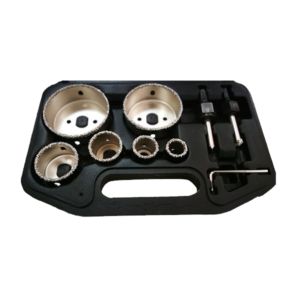
| Product | 16 piece wood hole saw set: cup saws, arbors, pilot drills and moulded case |
| Typical diameter coverage | 16–76 mm (5/8″–3″); other ranges to order |
| Cutting depth | 35–38 mm single pass, the same for every diameter. Two-sided cutting roughly doubles the achievable thickness |
| Tooth pitch | Variable 4/6 TPI as standard |
| Tooth material | HSS, welded or formed to the cup body |
| Body finish | Black oxide or painted. A finish, not a wear surface |
| Arbor, small saws | 1/2″-20 UNF thread, 1/4″ (6.3 mm) hex shank, often quick-lock |
| Arbor, large saws | 5/8″-18 UNF thread, 7/16″ (11 mm) hex shank, drive pins from about 32 mm |
| Pilot drill | HSS, 135° split point, replaceable |
| Drive | Thread to retain, pins to transmit torque on large sizes. Forward rotation only |
| Suitable materials | Softwood, hardwood, plywood, MDF, particleboard, plasterboard, plastics; aluminium and thin sheet with care |
| Not suitable for | Masonry, concrete, tile, hardened steel; reverse rotation on large saws |
| Case | Moulded case with dedicated slots per diameter |
| Packaging | Moulded case as standard; colour box, blister or private label to order |
| MOQ | Indicative: from 500 sets for a stock configuration; from 1,000 sets for a private range, case or label |
| Lead time | Indicative: 15–25 days for stock configurations; 30–45 days for OEM production |
12. How to specify a hole saw set on an export order
- Diameter ladder, listed explicitly. Not “16 pieces”. The diameters decide whether the set is useful in the destination market’s fittings
- Number of arbors and which thread each carries. A set spanning 32 mm needs both 1/2″-20 and 5/8″-18. Say so on the order
- Cup depth. 35 mm and 38 mm are both common and they are not interchangeable in a specification. State which
- Tooth pitch and tooth form. 4/6 TPI variable as standard; state if the market expects constant pitch
- Pilot drills: how many, what length, what point. And whether spares are included
- Body finish, named as a finish. Black oxide, paint, or none. Do not let “wear resistant” appear next to a paint
- Drive pin configuration. Confirm the pins are present and the cup is drilled to accept them above 32 mm
- Case and packaging. Moulded case, colour box, barcode, insert card, private label
13. Incoming inspection
Eight checks, in the order that catches the expensive problems first:
- Mount every saw. Not a sample. Every cup on its intended arbor, by hand, checking the thread engages fully and the cup seats flat. This single check catches the arbor coverage problem
- Count the arbors against the thread standards specified. Confirm both are present and correctly marked
- Check the drive pins engage on every saw above 32 mm, and that the corresponding holes are drilled in the cup base
- Measure the cup depth on the smallest and the largest saw. If they differ materially, the range is not built to a single cup depth and the depth claim needs rewriting
- Inspect teeth for uniformity. Missing, hooked or unevenly set teeth are a manufacturing defect and will produce a polygonal hole from new
- Check the pilot drills are straight by rolling them, and that each is long enough for the cup it ships with
- Check the case slots actually hold the saws without the teeth touching each other in transit
- Cut a test hole in the material you sell into, at the largest and smallest diameter, and measure both. The large saw is where run-out and packing show up first
14. Troubleshooting
| Symptom | Most likely cause | What to change |
|---|---|---|
| Saw stops progressing halfway | Cup packed, or cup bottomed out on a thick board | Withdraw fully and clear; if the board is thicker than the cup, cut from both sides. Section 3 |
| Burn ring and resin smell | Packed cup, or too much pressure on a dull tooth | Clear, then reassess the tooth. Pressure makes packing worse, not better |
| Hole is oversize and out of round | Run-out: bent pilot, worn arbor, cup not seated flat | Roll the pilot, clean the thread, reseat the cup. See section 9 |
| Saw walks at the start | Pilot too short, blunt, or no centre mark on a slick surface | Correct pilot length, sharp pilot, centre punch on laminates |
| Cup spins on the arbor | Drive pins not engaged, or thread damaged | Reseat on the pins. A damaged thread means a new arbor |
| Saw cannot be mounted | Wrong thread standard for the diameter | 1/2″-20 for small, 5/8″-18 for large. Section 5 |
| Exit face torn | No backing, or feed not eased at break-through | Sacrificial board underneath, ease the feed as the pilot exits |
| Teeth chip early | Hard material, or a saw run too fast and dry | Reduce speed, add lubricant in metal, and check the material against section 15 |
| Workpiece spins | Not clamped | Clamp it. A hole saw catches far more aggressively than a drill bit |
| Saw will not cut at all from new | Teeth set for a different material, or a badly formed tooth | Check the tooth form against the application; reject if malformed |
15. Applications
Where this set earns its place
- Downlights, speakers and extract fans in plasterboard and timber ceilings — the classic 60–100 mm range
- Cable and conduit penetrations through studs, plates and panel
- Waste and soil pipe through timber and panel, where the bore is hidden and a two-sided cut is acceptable
- Door hardware — latch and deadbolt bores in timber stiles
- General joinery and fit-out where several diameters are needed in one session and changing tools costs time
Where a different tool is better
- Below about 19 mm — a twist drill or step drill is faster; there is no cup to mount and clear. See our step drill page
- Flat-bottomed holes or clean rims — a Forstner bit
- Fast rough bores in timber — a spade bit
- Deep bores — an auger bit, which has a helix to clear chips instead of a cup to store them
- Metal and stainless at production volumes — a bi-metal saw rated for it, covered on our bi-metal hole saw page
- Masonry and concrete — a core drill, not a toothed cup
16. Frequently asked questions
How deep can a hole saw cut?
Whatever the depth of the cup is, typically 35 to 38 mm in a single pass. The important part is that this number is the same for every diameter in the set. A 152 mm saw and a 16 mm saw both stop at the same depth, because the depth limit is set by the cup wall and the arbor seat rather than by the diameter. That is the opposite of how a drill bit behaves, and it is why buying a bigger saw does not buy you a deeper hole.
Why does my hole saw stop cutting halfway through a thick board?
Two reasons, and they are usually confused. The first is that the cup has bottomed out: the arbor or the cup shoulder has reached the workpiece, so no more depth is available whatever the motor does. The second is that the cup has packed with chips, which raises friction until the saw stalls or burns. On wood the packing case is the common one, because the annular kerf produces a lot of waste and the cup is the only place for it to go. Withdraw fully and often, and if the board is thicker than the cup is deep, cut from both sides.
Why does a hole saw need two different arbors in one set?
Because the mounting thread changes standard with diameter. Small saws typically use a 1/2-20 UNF thread on a 1/4″ shank, and large saws typically use 5/8-18 UNF on a 7/16″ shank, with the changeover falling around 32 mm. The two threads are not interchangeable, so one arbor cannot carry the whole set. A 16-piece set with a single arbor is really a set where half the contents cannot be mounted. When you buy a set, count the arbors before you count the saws.
Can I use a hole saw in reverse?
Not on the large saws, and this is a safety point rather than a preference. Large hole saws are held to the arbor by a thread and driven by pins that engage holes in the cup base. The pins carry the torque; the thread only holds the cup on. Run the saw backwards and the torque reverses against the thread, which can unscrew the cup from the arbor while it is spinning. Small saws with a finer thread are less exposed but it is still a bad habit. Never reverse a hole saw to clear a jam.
Is this set suitable for wood if it says high speed steel?
Yes, and the material callout is not the problem. HSS teeth cut wood perfectly well; the issue with our own listing is that the materials list never mentions wood at all, on a product called a wood hole saw set. HSS buys you heat resistance and edge life when the tooth is working hard, which is useful in hardwood and in the accidental nail. What it does not buy you is a different tooth geometry, and tooth geometry is what decides how well a saw clears chips in softwood.
Does black paint make the saw more wear resistant?
No. Paint is a coating applied for appearance and limited corrosion protection. It contributes nothing to wear resistance at the tooth, and it is gone from the tooth within the first few cuts because that is where the abrasion happens. Our own listing says the black paint provides wear resistance, which is not true of paint on any tool. If a body needs corrosion protection there are conversion finishes and plated finishes for that job, and they are specified as such.
What does variable pitch actually do?
It breaks up the rhythm. With a constant pitch, every tooth enters the cut at the same phase and the vibration builds at a fixed frequency, which is what produces chatter and a polygonal hole. Alternating between a coarser and a finer pitch, typically 4 and 6 teeth per inch, means successive teeth hit the work at different intervals, so the vibration cannot organise itself. It also spreads wear across the tooth instead of concentrating it, and it handles a wider range of material thickness without loading up.
Why does the pilot drill decide where the hole goes?
Because the saw teeth do not touch the work until the pilot has already established the centre and the direction. The pilot is a small drill running inside a large cup, so it is the only component with a chance of starting accurately, and it is also the component most often worn, bent or replaced with the wrong size. Check it before blaming the saw: a dull or bent pilot makes the whole cut walk, and a pilot that is too short lets the teeth contact before the centre is established.
How do I stop break-out on the exit face?
Back the work. Clamp a sacrificial board under the workpiece so the teeth exit into something that supports the fibre, and reduce feed as the pilot breaks through, because that is the moment the saw wants to grab. Where the exit face is visible and the material is veneered or laminated, the reliable method is to cut from the face side until the pilot just breaks through, then finish from the other side. That also solves the depth problem on board thicker than the cup.
Why does my hole come out larger than the saw?
Usually run-out, and usually at the arbor rather than at the teeth. A worn arbor, a bent pilot, a chuck with play or a saw that is not seated flat on its arbor all let the cup orbit, and an orbiting cup cuts oversize by roughly twice the wobble. Check that the cup seats flat, that the arbor thread is clean and undamaged, and that the pilot runs true. Our hex shank page sets out the run-out figures for the holding systems that feed the arbor.
What is the difference between a wood hole saw and a bi-metal one?
Tooth material and tooth geometry, and they are usually sold for different jobs. A wood saw generally has a coarser, more open tooth that clears soft fibre quickly and is cheap to replace; a bi-metal saw welds an HSS tooth strip to a flexible spring-steel body, which survives harder and more abrasive material and heat. The bodies look similar and the arbors are often interchangeable, which is why people mix them. Our bi-metal hole saw page covers that side of the distinction in its own right.
MOQ, lead time, OEM and samples?
Hole saw sets are specified by diameter range, tooth form, arbor configuration, case and finish rather than picked from a fixed list, so terms follow the configuration. Indicative minimum order quantity starts from 500 sets for a stock configuration and from 1,000 sets for a private diameter range, a private case or private label packaging. Indicative lead time is 15 to 25 days for stock configurations and 30 to 45 days for OEM production. Samples are available for testing after terms are confirmed, with the sample cost credited against a subsequent order. Please confirm current figures with us before publishing them.
Related products
Other hole saws: Bi-Metal Hole Saw Sets, HSS Hole Saw Sets. Boring: Wood Step Drill Bits, Wood Step Drill Bits Set, Wood Forstner Drill Bits, Wood Forstner Drill Bits Set, Wood Flat Drill Bits Set, Wood Auger Core Drill Bits Set, Wood Auger Core Drill Bits, Wood Countersink Drill Bits. Shanks and finishes: Wood Hex Shank Drill Bits, HSS Twist Drill Bits Set, Amber Finished Drill Bits, Black Oxide Drill Bits.
OEM & Wholesale
GUSHI has manufactured drilling and cutting tools in Huzhou, Zhejiang since 1998, and we supply hole saw sets to importers, distributors and private label programmes. Because a set is defined by its diameter ladder and its arbor coverage rather than by a piece count, most of what we ship in this category is configured.
- Diameter ladder. Standard ranges to 76 mm; private ladders built around the fittings your market actually installs
- Arbor coverage. Both 1/2″-20 UNF and 5/8″-18 UNF, with drive pins from 32 mm
- Tooth form and pitch. Variable 4/6 TPI as standard
- Cup depth. 35 mm or 38 mm to your specification
- Case and packaging. Moulded case, colour box, barcode, insert card, private label
- Terms. T/T, L/C, D/A, D/P and PayPal according to circumstance. Samples after terms are confirmed, credited against a subsequent order