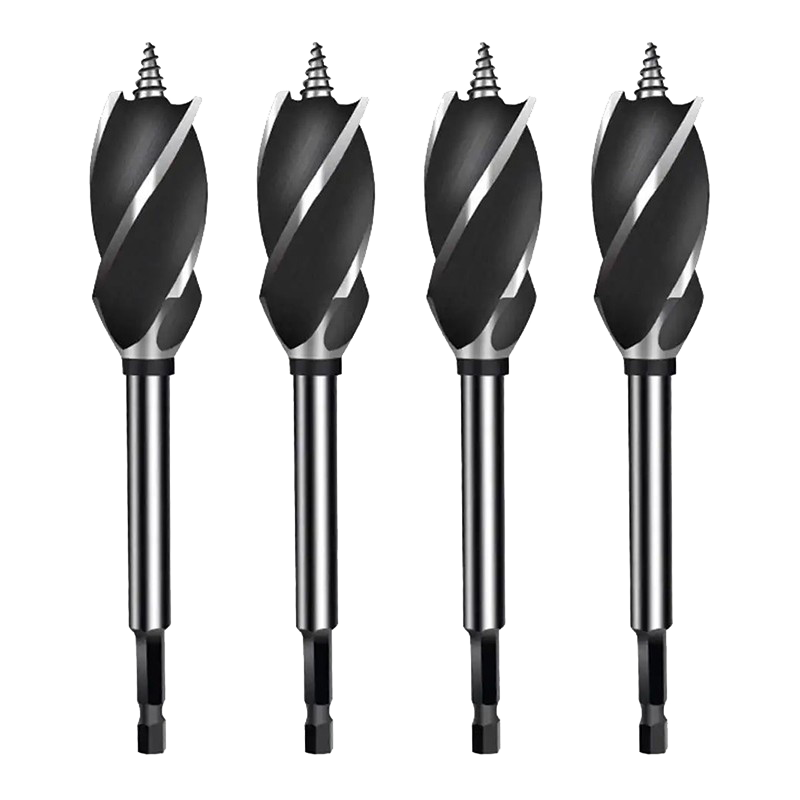
Specification
| Product | Wood auger core drill bit, supplied as single sizes |
|---|---|
| Body material | High-carbon steel, hardened and tempered. Typical as-quenched hardness for carbon tool steel is HRC 60–65; confirm the actual figure and the tempering temperature with the mill certificate |
| Patterns | Hollow-centre (Jennings type) · Solid-centre · Ship auger · Bell hanger · Adjustable / expansive |
| Point | Threaded lead screw, self-feeding |
| Cutting elements | Two scoring spurs, two cutting lips. Spurs must stand slightly proud of the lips — see the inspection section |
| Diameter range | 6–38 mm (1/4″–1-1/2″), single sizes |
| Flute | Single deep spiral (hollow centre) or twin spiral around a solid core, depending on pattern |
| Shank | Round or hex depending on pattern and length; confirm against your chuck and spindle |
| Primary materials | Hardwood, softwood, construction timber, green and resinous timber |
| Conditional materials | Cork and rigid plastics — both with restrictions, see below |
| Not suitable for | Metal, masonry, thin or flexible plastics, acrylic sheet, holes that will be seen |
| Red-hardness limit | Carbon tool steel loses hardness rapidly above roughly 200 °C. Blue or straw oxide on the steel means that limit has been passed |
| Re-sharpening | By hand file on the inside faces only. Never a bench grinder — see the set page for the full procedure |
| Packaging | Individual sleeve with tip cap, rigid tube for long bits, or hanging card for peg display |
| Brand | GUSHI — Huzhou Gu’s Imp. & Exp. Co., Ltd. |
| Service | OEM / ODM, private label, custom size ranges and packing |
Why a single bit instead of a set
The argument is not about price per piece. It is about the shape of the consumption curve, and the two curves do not match.
A set is an arithmetic progression. Consumption is not.
A six-piece set gives you something like 6, 10, 14, 18, 22 and 25 mm — evenly spaced, because that is what looks right on a shelf and what fits in a moulded case. But look at a month of holes on a real site and the distribution is nothing like flat. A first-fix electrician bores the two or three diameters that match the cable and conduit runs, over and over. A joiner bores the diameters that match the dowels and tenons in that shop’s standard work. A framer bores bolt diameters. The remaining sizes in the box get used a handful of times a year.
Now combine that with how an auger fails. It is not a tool that dulls politely. It is retired by discrete events — a hidden nail, a knot taken at full feed, a drop onto a hard floor, a spur chipped on a screw. Those events do not distribute evenly across the box either: they land on the bit you were using, which is the bit you always use. The first bit to die is the one with no spare.
Buying singly turns the stocking problem from “replace the box” into “hold three of the diameter you bore daily and none of the diameter you bore in March”. The occasional size gets bought when the job calls for it, which is cheaper than holding it as dead stock for eleven months.
| Diameter | In a typical 6-pc set | What it is for | Typical consumption | Sensible holding |
|---|---|---|---|---|
| 6–8 mm | Yes | Pilot holes, small dowels, screw clearances | Moderate, steady | 2–3 |
| 10 mm | Yes | General dowel work, small fixings | High in joinery | 3 in a joinery shop, 1 otherwise |
| 14 mm | Yes | Standard cable and small pipe runs | Very high in first fix | 3–4 in electrical work |
| 18–20 mm | Yes | Larger cable bundles, conduit, waste pipe | High in first fix | 2–3 |
| 22–25 mm | Yes | Large pipe runs, bolt holes in framing | Moderate | 2 |
| 28–32 mm | Rarely | Heavy framing bolts, large waste runs | Low but critical when needed | 1, or use an adjustable bit |
| 35–38 mm | Rarely | Large structural borings | Very low | 0 — use an adjustable bit instead |
The two right-hand columns are the point of the single format. A set forces the same holding on every diameter; a single programme lets the holding follow the work. Note that the last two rows are where an adjustable auger beats holding stock altogether.
Three other reasons the single format wins
- Length is a separate decision. A set fixes one length for every diameter. Bought singly you can hold a short bit for cabinet work and a long ship auger for the one wall cavity a year — without paying for long shanks on the diameters you use every day.
- Pattern is a separate decision. A hollow-centre bit clears green timber best; a solid-centre bit stays straight in dense hardwood. A set gives you one pattern across the whole range. Singly you can specify the pattern per diameter, which matters most at the large end.
- A failure is contained. One chipped bit is one line on an order. There is no minimum re-order that forces you back into a full box.
For the full comparison of how an auger stacks up against spade, Forstner, hole saw and brad-point bits, and the diameter-to-application map for electrical and plumbing work, see the wood auger bit set page.
The five patterns, and what really differs
Every auger shares the same three working parts: a threaded lead screw that pulls the bit into the timber, two spurs that score the circumference ahead of the cut, and two lips that lift the waste out. What varies between patterns is the centre of the flute, the number of spurs, and the overall length — and those three variables decide where each pattern is the right buy.
| Pattern | Flute centre | Spurs | Typical length | Where it wins | Where it loses |
|---|---|---|---|---|---|
| Hollow centre (Jennings type) |
Open spiral, no steel core | Two | 150–300 mm | Wet, green and resinous timber. The open channel is the largest of any pattern, so sticky chips clear instead of packing | Less rigid than a solid core. Can flex if it meets a dense knot in a very deep bore |
| Solid centre | Steel core up the middle, flutes wrap around it | Two | 150–460 mm | Deep straight holes in seasoned or knotty hardwood. The core resists bending, so the bore stays true | Smaller chip channel. Slower clearing in wet or green stock, where it can pack and bind |
| Ship auger | Single very wide spiral | One, aggressive | 300–600 mm and longer | Very deep holes through multiple studs, thick beams and stacked timber. Maximum chip clearance at maximum depth | Rough exit. Needs a high-torque, low-gear drill and a side handle. Overkill and hard to control on shallow work |
| Bell hanger | Short, often flexible shaft | One or two | Short to medium, flexible | Fishing wire through finished wall cavities. The tip often has an eye for pulling cable back through | Poor accuracy and poor hole wall. A navigation tool, not a boring tool |
| Adjustable / expansive | Flat bar with interchangeable cutters | One or two, on the cutter | Fixed bar, 200–400 mm | Covering a wide diameter range from one tool. A worn cutter is replaced cheaply instead of a forged bit | Rougher wall, diameter depends on setting the gauge right. Not for joinery you will see |
The short version of pattern selection
- Green, wet or resinous timber — hollow centre. Chip volume is the problem, and it has the biggest channel.
- Seasoned hardwood, knotty stock, deep straight holes — solid centre. Rigidity is the problem, and it has the most.
- Through multiple studs, thick beams, 300 mm+ — ship auger. Nothing else reaches and clears at that depth.
- Retrofit wiring in a finished wall — bell hanger. You are fishing, not boring.
- Large diameters you hit twice a year — adjustable. See the next section.
And one material caveat that belongs to the pattern decision rather than the diameter: a coarse-threaded lead screw in dense hardwood is a hazard. The screw grabs more than the lips can remove, the drill stalls, and the reaction twists the tool in your hands. Softwoods want a coarse screw; hardwoods want a fine one. If you only have a coarse screw and must bore hardwood, some tradesmen file part of the thread away to convert the bit from self-feeding to hand-feed — but specify the right screw pitch rather than modifying a new bit.
Why pattern names cannot be ordered on
This is the same class of problem as form-letter geometry codes on twist drills, where the letter does not map consistently between manufacturers. The fix is identical: specify what can be measured and photographed, and ask for a counter-sample against it.
| Name you might write | What supplier A means | What supplier B means | What to write instead |
|---|---|---|---|
| Jennings pattern | Hollow centre, two spurs | Any twin-spur bit, solid or hollow | “Hollow centre (no steel core between flutes), two spurs” + photo |
| Scotch pattern | Solid centre | Hollow centre | “Solid centre, steel core full length of flute” + photo |
| Irwin pattern | Solid centre, general purpose | Any modern machine auger | “Solid centre, two spurs, length … mm” + drawing |
| Ship auger | Extra long, single wide flute | Any long auger | “Overall length … mm, single wide spiral, one spur” |
| Machine auger | Hex shank for drill use | Any bit for a power drill | “Hex shank, … mm across flats, overall length … mm” |
A specification line that cannot be substituted
For an export order or a private-label programme, four items close the gap between what you meant and what arrives:
- The three measurable variables — centre solid or hollow, number of spurs, overall length in millimetres.
- A photograph or dimensioned drawing of the head, attached to the order, with the spur-to-lip relationship visible.
- A counter-sample held against that drawing before production runs. This costs one sample and saves a container.
- The steel and hardness stated numerically — grade and HRC range — rather than “hardened and tempered”, which is true of almost anything.
For buyers running a private-label programme, this is also the cheapest quality lever available: a written pattern specification with a counter-sample removes the single largest source of dispute in wood-bit orders.
One adjustable bit instead of a dozen
The strongest case for the single format is not buying single fixed sizes at all — it is the expansive (adjustable) auger: one lead screw on a graduated bar with one or two interchangeable cutters, typically covering roughly 7/8″ to 3″ or more from a single tool.
It matters because of where the dead stock sits. In every auger range, the bottom four or five diameters get used constantly and the top four or five get used twice a year. The bottom ones are worth owning properly. The top ones are worth covering, not owning.
| Factor | Fixed single bits, 26–38 mm | One adjustable bit + cutters |
|---|---|---|
| Capital to cover 26–38 mm | Several forged bits | One bar, a few flat cutters |
| Cost when the cutting edge is damaged | Replace a forged bit | Replace a flat cutter |
| Hole wall quality | Continuous rim, smooth wall | Flat blade, rougher wall |
| Diameter accuracy | Fixed by manufacture | Depends on setting the gauge correctly, every time |
| Set-up time | None | Measure and set the cutter each change |
| Deep-hole clearing | Spiral flute pumps chips out | Moderate; the flat cutter throws chips but there is no full helix |
| Best use | Diameters you bore every week | Large diameters you bore every few months |
The trade is honest: you give up wall quality and repeatable diameter accuracy, and in exchange you stop capital sitting in sizes that barely move. Use it for first fix and rough structural work, not for joinery anyone will look at. For a clean flat-bottomed hole at those diameters, a Forstner bit is the right tool; for a fast rough hole through a stud, a flat bit is cheaper still.
Carbon steel is correct, not cheap
The listing says “high-strength carbon steel, hardened and tempered”, and it is easy to read that as a cost-down decision. It is not. For a wood auger, carbon steel is the engineering answer and HSS would be money spent on a property timber never calls for.
The number that settles it: 200 °C
The difference between carbon tool steel and high-speed steel is not room-temperature hardness — carbon tool steel reaches HRC 60–65, which is plenty. The difference is red hardness: the ability to stay hard while the cutting edge is hot. Carbon tool steel loses hardness rapidly above roughly 200 °C. HSS holds to roughly 550–600 °C.
Now ask what temperature a wood cut actually reaches. When the bit is sharp, the chips are clearing and the feed is right, the cutting edge in timber stays far below 200 °C. The HSS advantage is never used. Spending on it buys nothing on a wood auger.
| Property | Carbon tool steel | HSS | What it means for an auger |
|---|---|---|---|
| Room-temperature hardness | HRC 60–65 | HRC 62–67 | Both more than adequate for timber. Not the deciding factor |
| Red hardness limit | ~200 °C | 550–600 °C | Timber cutting sits below the carbon limit, so HSS buys nothing |
| Toughness | Higher. A long slender shaft resists lateral bending and shock | Lower. Harder and more brittle | An auger shaft is long and thin. Toughness matters more than hardness |
| Can be touched up by hand file | Yes, on site, in minutes | Not practicable by hand | The only field-repairable wood-boring geometry |
| Consequence of hitting a hidden nail | Edge destroyed, usually beyond recovery | More likely to survive | The real cost of choosing carbon steel |
| Consequence of overheating | Blue or straw oxide means the temper is drawn and the edge will not hold | Survives far more heat | Burning a hole in hardwood retires the bit |
| Price | Lower | Higher | Not the reason, but a real benefit |
What this means in use
- Treat any blue or straw discolouration on the steel as retirement. That colour means the steel passed its tempering temperature and has lost hardness. It will not hold an edge again.
- Scan before you bore into old timber. A hidden nail or screw is the single most common way a carbon-steel auger dies, and it does so instantly.
- Keep the chips moving. Packed chips are what generate the heat that draws the temper. If the shavings turn to dust or the hole wall darkens, stop and clear.
- Do not buy HSS for a wood auger expecting longer life. You would be paying for red hardness the cut never reaches, while giving up toughness and field repairability.
For cutting metal, the calculation reverses completely and the grade ladder matters a great deal — see our HSS twist drill bit set for that argument, and the Ti-coated set for what a surface treatment can and cannot add.
Hardwood, cork and plastic
| Material | Verdict | What actually happens | If you must use it |
|---|---|---|---|
| Hardwood | Design case | The spurs sever the circumference and the lips lift clean waste. Slow, high torque, fine-thread screw. Dense species are where a solid-centre pattern earns its keep | Low gear, high torque, light steady feed. Watch for burning |
| Softwood and construction timber | Excellent | Fast and self-clearing. Coarse-thread screw is right here. Knots and hidden fixings are the risks | Standard practice. Still scan for nails |
| Green / resinous timber | Excellent with the right pattern | Sticky, stringy chips pack a solid-centre bit. A hollow-centre bit clears them | Specify hollow centre. Clear chips often |
| Cork | Not recommended | Cork is a closed-cell, brittle, highly compressible structure that crumbles rather than cuts and tears out at the exit face. The lead screw pulls aggressively, which breaks up the cellular material, and the spurs are shaped to sever fibres, not to part a foam | Only thick, dense cork board: brad-point or spur-point bit, 500–1000 rpm, very light feed, tight backer board, sharp edge. On cork rings and bottle corks, ream instead of drilling |
| Rigid plastics, PVC | Poor match | The screw point grabs and pulls itself through, chipping or splitting the exit side. Friction heat melts the wall and gums the flutes. Bits ground for plastics are deliberately made to scrape rather than self-feed | Thick block or pipe only: low speed, backer board, frequent withdrawal, accept a rougher wall. For sheet, use a step bit or brad point |
| Acrylic, polycarbonate sheet | Do not | Brittle, and softens with heat. Self-feeding action cracks the exit and can split the sheet outright, especially near an edge | Use a step bit or a plastics-ground bit, with a backer board |
| Metal, masonry | Do not | Carbon steel has neither the hardness nor the red hardness. Edge destroyed instantly | Use an HSS twist bit for metal, a masonry bit for masonry |
One sentence worth keeping: everything an auger does well in wood comes from a screw that pulls, and every material it fails on is a material that cannot be pulled through. That is the honest boundary of the tool, and it is a better selling line than a materials list the tool cannot live up to.
Seven-point inspection before you accept it
Single bits are bought one at a time, which means each one is worth inspecting — and it takes under a minute. These seven checks catch almost every defect that an auger can arrive with, and most of them are visible without a gauge.
| Check | Pass | Fail | Why it decides the tool |
|---|---|---|---|
| 1. Spurs stand proud of the lips | Looking at the head side-on, the two spurs sit slightly higher than the two cutting lips | Spurs level with, or below, the lips | The spurs must score the circumference before the lips lift the waste. Level spurs stop scoring and start tearing. This gap closes a little with every correct sharpening and can never be restored — so a new bit that fails this check has no service life to speak of |
| 2. Both spurs identical | Same height, same length, same sharpness, same angle | One shorter, lower, or rounder than the other | The bit drifts toward the side that cuts less, giving an oversize hole and tear-out on one edge |
| 3. Lead screw thread clean and centred | Sharp, even, full-depth thread, on the axis | Rounded crests, off-centre, or a bent tip | The screw is what advances the bit. A damaged thread means you end up pushing, which overheats the lips |
| 4. Shaft is straight | Rolls true across a flat surface with no wobble | Any visible bend or runout | A bent shaft makes the tip orbit: oversize hole, poor wall, and dangerous vibration at speed |
| 5. Flutes are smooth, not cast-rough | Cleanly milled or ground channel | Rough, sand-cast looking flute surface | Chips catch on a rough flute and pack. This is the most common difference between a bit worth sharpening and a bit worth binning |
| 6. Cutting edges sharp and undamaged | Crisp edge, no nicks, no rounded corners | Chipped or rounded | A chipped spur on a new bit is a manufacturing or handling defect, not wear. Reject it — it cannot be filed back to balance |
| 7. Hardness and size as stated | Marked diameter and stated grade match the order | Unmarked, or grade not stated numerically | “Hardened and tempered” is true of nearly everything. Ask for the grade and HRC range on the mill certificate |
On storage between jobs: keep each bit in its own sleeve or slot. Auger spurs chip against each other in a shared drawer or bucket, and a single chipped spur is the end of the bit. Carbon steel also rusts, so a light oil film in a humid climate is worth the thirty seconds.
Which sizes to actually hold
There is no universal answer, which is exactly the argument for the single format. The useful method is to look backwards rather than forwards: take last quarter’s holes, and weight the holding by what you actually bored.
| Trade | Diameters that dominate | Holding | Notes |
|---|---|---|---|
| First-fix electrical | The two or three diameters matching the cable and conduit runs in your market | 3–4 each | Add one bell hanger for retrofit fishing. Torque and length matter more than finish |
| Plumbing and heating | Pipe and waste-run diameters | 2–3 each | Long reach through studs and joists — this is where a ship auger earns its place |
| Joinery and furniture | Dowel and tenon diameters, typically the small end of the range | 3 each, short length | Short bits. Hole quality matters, so check the spurs often and consider a Forstner bit where the hole will be seen |
| Timber framing | Bolt diameters, large end of the range | 1–2 each, or one adjustable bit | Large diameters, deep holes, high torque. Solid-centre or ship pattern |
| Decking, fencing, outdoor | Mid range, plus clearance sizes | 2 each | Wet and resinous stock — hollow centre for clearing. Hidden fixings in reclaimed timber are the main killer |
| General maintenance | Broad but shallow | 1 each across the range + one adjustable | Buy the occasional size when the job calls for it rather than holding it |
A stocking rule that survives contact with reality
- Count last quarter’s holes by diameter. Not by feel — actually count.
- Hold three of each diameter in the top bracket. That bracket is usually two or three sizes, and it is usually not the middle of the range.
- Hold one of each diameter used monthly. No more.
- Hold none of the yearly sizes. Cover them with an adjustable bit, or buy when the job arrives.
- Re-check annually. The consumption curve moves when your work mix moves, and the whole point of the single format is that you can move with it.
Replace one bit, or replace the set
Since you are buying singly, this decision is mostly settled — but it is worth stating the rule, because the reflex to re-order the box is expensive.
| Situation | Replace | Reasoning |
|---|---|---|
| One bit chipped on a nail | That diameter, plus one spare | The failure is to one tool, not to the range. Buy two, because the second one will meet the next nail |
| Lead screw threads pulled out on one bit | That diameter | Self-feeding is gone and cannot be restored. Nothing else in the kit is affected |
| Spurs sharpened down level with the lips | That diameter | The bit has reached its service-life ceiling. Filing more makes it worse, not better |
| Shaft bent | That diameter | Runout makes every subsequent hole oversize. Not economically straightenable on a slender shaft |
| Three or more diameters retired in the same period | Reconsider the whole programme | That is not bad luck, it is a work-mix change or a specification problem. Re-run the consumption count before re-ordering |
| Moving into a new trade or material | Add diameters, do not replace | The point of the single format: the kit follows the work instead of the work following the kit |
The pattern to notice: in five of the six rows, the correct action is one line on an order. A set forces the same response to every one of them.
Packing and shipping single bits
A set has one box to solve. A single bit has three problems a set box never sees, and all three are cheap to fix at the factory and expensive to fix at the destination.
| Problem | What goes wrong | Format that solves it |
|---|---|---|
| The lead screw is a sharp point | It pierces the packaging, then pierces the parcel, then pierces whoever handles it. It also arrives damaged itself | Individual sleeve with a tip cap, or a rigid tube. The cap must not be pushable through by the point |
| Spurs chip against each other | Loose bits in one carton knock together in transit. A chipped spur is the end of the bit | One compartment per bit. Never bulk-pack loose augers |
| Carbon steel rusts | Sea freight and humid warehousing rust the flutes and the screw before the bit is ever used | Vapour-phase inhibitor or a rust-preventative film, plus a sealed sleeve |
| Diameter legibility | An unmarked bit in a van is a bit nobody uses | Diameter printed large on the sleeve and etched or stamped on the shank |
| Retail presentation | A loose bit cannot be pegged | Hanging card for peg display, or a labelled tube for trade counter |
For a wholesale programme the same checks that apply to any set still hold — drop test, moisture protection, barcode and label real estate, and compliance of the packaging materials. The difference here is that each single unit has to survive alone rather than inside a moulded case.
Troubleshooting
| Symptom | Most likely cause | What to do |
|---|---|---|
| Bit will not pull itself in; you are pushing | Lead screw threads rounded or pulled out; or the screw pitch is too fine for softwood | Retire the bit. Specify the correct thread pitch for the material next time — coarse for softwood, fine for hardwood |
| Drill stalls or twists violently in hardwood | Coarse screw grabbing more than the lips can clear | Use a fine-thread screw in hardwood, drop to low gear, ease the feed. Fit a side handle — the reaction is real |
| Hole wall torn or fuzzy, entry splintered | Spurs dull, uneven, or sharpened down level with the lips | Touch up the inside faces of both spurs equally. If they are already level with the lips, replace |
| Hole runs oversize | Unequal spur heights, or a bent shaft causing runout | Check straightness by rolling on a flat surface. Match the spurs. Replace if bent |
| Bit wanders off the marked centre | Lead screw tip damaged or off-centre; or starting too fast | Start at low speed and let the screw bite before applying feed. Replace if the tip is off-axis |
| Smoke, darkened hole wall, shavings turning to dust | Chips packing in the flutes — usually deep holes, or a solid-centre bit in green timber | Withdraw and clear more often. In green or resinous stock switch to a hollow-centre pattern |
| Steel turned blue or straw | Overheated past the tempering temperature | Retire it. Carbon steel above roughly 200 °C has lost hardness and will not hold an edge again |
| Bit suddenly stops dead and will not cut | A hidden nail, screw or other fixing | Withdraw and inspect. Carbon steel will not survive the contact — expect to replace |
| Exit side blows out | No support behind the last fibres | Stop when the screw point just appears, flip and finish from the other side. Or clamp a backer board tight to the exit face |
Frequently Asked Questions
Why buy a single auger bit instead of a set?
Because a set spreads its diameters evenly and real work does not. A six-piece set gives you 6, 10, 14, 18, 22 and 25 mm in equal measure, but a first-fix electrician drills two or three diameters almost exclusively and touches the rest once a year. The bit that wears out first is therefore the one that gets used most, and a set contains exactly one of it. A single-format programme lets you hold three of the diameter you use daily and none of the diameter you never touch, which costs less than replacing a whole set and never leaves you without the size you need.
What is the difference between a Jennings pattern and a solid-centre auger bit?
The centre of the flute. A hollow-centre bit has an open spiral with no steel core between the flutes, which gives the largest chip channel and the fastest clearing in wet, green or resinous timber, but slightly less rigidity. A solid-centre bit has a steel core running up the middle of the flutes, which resists bending and keeps a deep bore straight in dense or knotty stock, at the cost of a smaller chip channel. Both use a lead screw, two spurs and two cutting lips. In practice: hollow centre for green timber and fast clearing, solid centre for deep straight holes in hardwood.
Can I trust the pattern name when ordering?
No, and this is one of the most common causes of a disputed export order. The same catalogue will call a solid-core bit Scotch pattern in one place and Irwin pattern in another, and Jennings pattern is used for both a hollow-centre bit and any bit with two spurs depending on the supplier. Specify the three things you can actually measure instead: whether the centre is solid or hollow, how many spurs, and the overall length in millimetres. Attach a photograph or a dimensioned drawing and ask for a counter-sample against it.
Is carbon steel a downgrade compared with HSS on a wood auger?
No. It is the correct choice, and HSS would be money spent on a property wood does not need. Red hardness is the ability to stay hard when the cutting edge gets hot, and carbon tool steel loses hardness rapidly above roughly 200 °C while HSS holds to 550–600. Wood simply does not generate that temperature at the cutting edge when the bit is sharp and the chips are clearing, so the HSS advantage is never used. What carbon steel does give is more toughness across a long slender shaft, the ability to be touched up with a hand file on site, and a lower price. The trade-offs are real: carbon steel is destroyed by a hidden nail and loses its temper if it overheats to a blue oxide colour.
Can I use an auger bit on cork?
Only on thick, dense cork board, and only with restrictions. Natural cork is a closed-cell, brittle, highly compressible material that crumbles rather than cuts and tears out at the exit face. The auger’s lead screw pulls the bit in aggressively, which is exactly the action that breaks up a fragile cellular structure, and the spurs are designed to sever wood fibres, not to part a compressible foam. For cork use a brad-point or spur-point bit, a low speed in the region of 500–1000 rpm, very light feed, a tight backer board and a sharp edge. On thin cork, cork rings and bottle corks, ream or use a brad point instead.
Can I use an auger bit on plastic?
It is a poor match and we would not recommend it as a selling point. The self-feeding screw point that makes an auger fast in timber is precisely the mechanism that ruins thermoplastics: it grabs, pulls itself through the sheet, and chips or splits the exit side, while friction heat melts the wall and gums the flutes. Bits ground for plastics are deliberately made to scrape rather than to self-feed, with a steep point angle and near-zero rake. If you must bore a thick plastic block or PVC pipe with an auger, run at low speed, support the exit with a backer, withdraw often, and accept a rougher hole. For sheet acrylic, polycarbonate and thin PVC use a step bit or a brad point instead.
How do I know when a single auger bit is finished?
Four conditions, none of which filing will fix. If you have to lean on the drill to make the bit advance, the lead screw threads have pulled out and the self-feeding action is gone. If the spurs have been sharpened down level with the cutting lips, the bit no longer scores the perimeter before the lips lift the waste and it will tear rather than cut, permanently. If either spur has broken off, the balance is gone and the bore will run oversize. And if the shaft is bent, the tip orbits, the hole is oversize and the vibration is dangerous. Any one of these means replace that one diameter, not the whole set.
What size auger bits should I actually stock?
It depends entirely on the trade, which is the argument for buying singly. First-fix electrical and plumbing work concentrates on the diameters that match cable and pipe runs, furniture and joinery work concentrates on dowel and tenon diameters, timber framing concentrates on bolt diameters. A workable rule is to look at last quarter’s holes, take the two or three diameters that account for most of them, and hold three of each, then hold one of each diameter that comes up monthly and none of the diameters that come up yearly. Buy the occasional size when the job calls for it rather than holding it as dead stock.
What is an expansive or adjustable auger bit?
A single bit with a fixed lead screw and one or two interchangeable cutters that slide along a graduated bar, typically covering roughly 7/8″ to 3″ or more from one tool. It is the strongest argument for the single format: instead of holding ten large diameters you hold one bar and a set of small flat cutters, and a worn cutter is replaced for a fraction of the cost of a forged bit. The compromise is hole quality — the cutter is a flat blade without a continuous rim, so the wall is rougher and the diameter depends on setting the gauge accurately. Use it for rough first-fix work and for the sizes you hit twice a year, not for joinery you will see.
How should single auger bits be packed for export?
Three problems, none of which a set box has to solve. The lead screw is a sharp point that pierces packaging and injures anyone handling the parcel, so it needs a tip cap or a sleeve that cannot be pushed through. The cutting spurs chip against each other and against other tools, so bits must not travel loose. And carbon steel rusts, so any sea freight needs a vapour-phase inhibitor or a rust-preventative film on the steel. Practical formats are an individual plastic sleeve with a tip cap, a rigid tube for long ship augers, or a hanging card for retail peg display, with the diameter printed large enough to read in a van.
Do you supply matched sets as well as single bits?
Yes. If you would rather buy a fixed configuration, see our wood auger core drill bit set, which covers the full diameter-to-application map, together with Forstner, flat and step sets. Many importers run both: sets for the retail shelf and single sizes for the trade counter and replenishment.
OEM & Wholesale
Huzhou Gu’s Imp. & Exp. Co., Ltd. has supplied drilling and cutting tools since 1998, with our own factory and a long-standing partner network across Zhejiang. Single-format auger programmes are one of the most flexible things we run, because there is no fixed box to work around.
- Any diameter, any pattern — hollow-centre, solid-centre, ship auger, bell hanger or adjustable, in the sizes your market actually consumes.
- Pattern specified measurably — solid or hollow centre, spur count, overall length, plus a counter-sample against your drawing so there is no substitution.
- Steel and hardness stated numerically — grade and HRC range on request, rather than a generic “hardened and tempered”.
- Single-unit packaging — sleeve with tip cap, rigid tube, or hanging card, with VCI moisture protection for sea freight.
- Private label and mixed containers — mix diameters, patterns and lengths in one shipment, and consolidate with HSS twist, bi-metal hole saw and diamond core lines.
- QC and samples — 100% inspection before shipment; samples available for testing after price confirmation, with the sample cost refunded against a formal order.
- Prices and MOQ on this page are modelled figures, not current quotations. Replace with live terms before going live.
- “Hardened and tempered” has no numbers attached. Confirm the steel grade and the HRC range with the mill and state them — it is the single most checkable claim on the page.
- The cork and plastic claims in the original listing are qualified on this page, not repeated. If you would rather not make the claim at all, delete the two rows from the materials table; do not restore the unqualified original sentence.
- Hardness, red-hardness and temperature figures are typical values for carbon tool steel as a class, sourced from published tool-steel references, not from a test on this specific product.
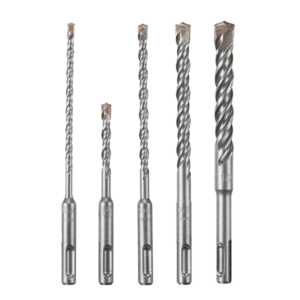
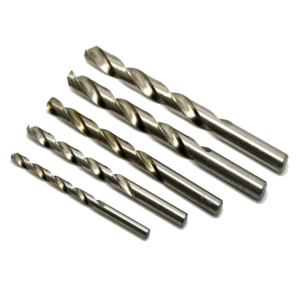
- Four product photographs were downloaded but could not be visually verified in this pass. Open them and confirm they show the screw point, the spurs and the flute before publishing the captions — in particular confirm whether the spurs visibly stand proud of the lips, since that claim is on the page.
- The stocking table is a method, not data. It shows how to weight holding by your own consumption; replace the example trades with your customers’ actual profiles if you have them.
- ISO 9001:2015 is stated as a quality-system claim only. Confirm scope and certificate number before publishing it as a product certification.