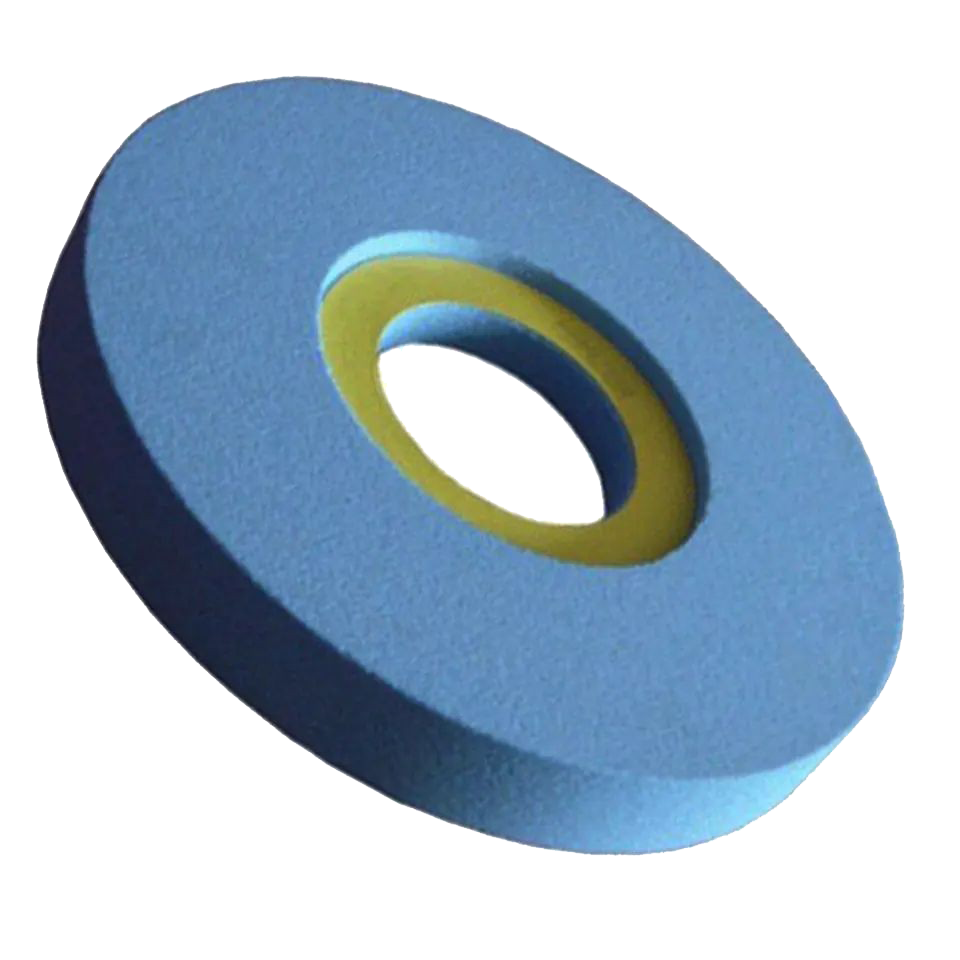
The Bond Is the Product: How a Resin Wheel Cuts
A bond designed to wear — self-sharpening, explained
Diamond does not stay sharp. Under grinding load a grain develops a wear flat, and a flat grain cannot cut — it rubs, and rubbing produces heat instead of chips. Every bonded wheel therefore has to answer one question: how do I get rid of a blunt grain?
Metal bond answers it by holding on. The grain stays in place until it is fully used up, which gives excellent wheel life and shape retention but means the wheel must be dressed regularly by a machine or an operator. Resin bond answers the opposite way. The phenolic resin, loaded with fillers that tune its wear rate, is formulated so that the bond retreats just behind the diamond. The grain is released before it becomes a fully worn flat. Cutting stays free, and the wheel runs cooler because it is no longer generating friction against a blunt grain.
The consequence for you is practical: you can dial the amount of self-sharpening with the bond grade. A soft grade releases grains quickly, runs coolest, and is the right choice for hard, brittle work like carbide and ceramics. A hard grade holds grains longer, keeps size better, and suits softer, more ductile work. Getting this grade right matters more than getting the grit right.
Elasticity is the finish
Resin is the only one of the three bonds that is genuinely elastic. A metal or vitrified bond is rigid, so a diamond grain in it behaves like a cutting point on a rigid tool: it bites, and the scratch it leaves is the scratch you keep.
A resin bond lets the grain micro-yield under load. It recedes slightly, takes a shallower bite, and recovers. The result is a shallower, more uniform scratch pattern, and that is what shows up as a lower Ra. In finishing conditions on tungsten carbide, resin bond 1A1 wheels routinely hold Ra 0.2–0.4 µm, and fine-grit grades in a controlled setup reach Ra ≤0.1 µm. Vitrified bond can approach this; metal bond generally cannot without a separate polishing stage.
Two secondary benefits fall out of the same property. Because grains are not rigidly held, they tend to ride over shock loads instead of shattering, so the wheel survives interrupted cuts and entry chatter better than a rigid bond. And because a dull grain is released rather than burnished against the work, the wheel generates less heat — which on carbide is the difference between a sharp edge and a micro-cracked one.
The 200 °C ceiling — the rule you cannot break
Phenolic resin begins to degrade well before it burns. Its continuous service temperature sits around 150–180 °C, and above roughly 200 °C the bond softens and then pyrolyses. When it softens it no longer grips the diamond, and grains come out in groups rather than one at a time. The symptoms are distinctive: the wheel sheds grit, loses diameter faster than the job justifies, smells of burning resin, and may lose whole patches of the rim.
This is not a wear process, it is a one-way failure. A resin wheel that has been cooked cannot be dressed back into service — the damaged layer has to be removed, and by then most of the wheel is gone. So the rule is absolute: resin bond diamond wheels are wet-grinding wheels. Flood coolant, aimed at the contact zone rather than splashed over the wheel guard, and clean filtered coolant so recirculated swarf does not polish the very finish you are grinding for.
Full Specifications
| Product | Flat Shape Resin Bond Diamond Grinding Wheels (Type 1 / 1A1 straight wheels) |
|---|---|
| Function | Precision surface, cylindrical and tool grinding of hard and brittle materials requiring a fine finish |
| Shape code | 1A1 (straight, parallel faces, single abrasive layer). 1V1, 3A1, 14A1 and 4A2 profiles also supplied to drawing. |
| Abrasive | Synthetic diamond, uncoated or nickel-coated. CBN available in the same geometry for steel and HSS. |
| Bond | Phenolic resin bond with metallic and oxide fillers, hot-pressed and cured |
| Outside diameter (D) | 75, 100, 125, 150, 175, 200, 250 mm standard · up to 500 mm on request |
| Wheel thickness (T) | 5, 6, 8, 10, 12, 15, 20, 25, 32, 40 mm |
| Bore (H) | 16, 20, 25.4, 32, 40 mm · 12.7 mm (1/2″), 31.75 mm (1-1/4″), 76.2 mm on request |
| Diamond layer width (X) | 3, 5, 6, 8, 10, 15, 20 mm depending on T |
| Abrasive layer depth | 3, 5, 10 mm (deeper layers reduce cost per ground part on repeat work) |
| Grit — D designation (FEPA, µm) | D251, D181, D151, D126, D107, D91, D76, D64, D46, D35, D20, D15, D9, D6 |
| Grit — mesh equivalent | #60, #80, #100, #120, #150, #180, #240, #320, #400, #600, #800, #1500 |
| Diamond concentration | 25 / 50 / 75 / 100 / 125 (≈1.1 – 5.5 ct/cm³) |
| Bond hardness grade | Soft (H–J) · Medium (K–L) · Medium-hard (M–N) · Hard (O–P) — see the selection guide below |
| Maximum line speed | 35 m/s standard · 40–50 m/s on request (resin bond runs slower than metal or vitrified) |
| Recommended working speed | 20–35 m/s · 25–30 m/s for most carbide tool grinding |
| Typical surface finish | Ra 0.2–0.4 µm general finishing · Ra ≤0.1 µm with fine grit and a rigid setup |
| Radial / face runout | ≤ 0.02 mm after truing on the machine |
| Balance grade | G2.5 |
| Wheel core | Aluminium alloy (standard) · bakelite · steel on request |
| Coolant | Required. Water-based emulsion or neat oil, filtered, flooded at the contact zone |
| Operating temperature limit | Bond degrades above ≈200 °C — dry grinding is not permitted |
| Mounting flange | Flange diameter ≥ 1/3 of wheel diameter, clean faces, evenly torqued |
| Storage | Dry, 5–35 °C, flat, away from direct heat and solvents; resin bonds absorb moisture in damp stores |
| Shelf life | 3 years from production date in sealed packaging |
| Applications | Carbide and PCD tool grinding · ceramic and glass · magnetic and silicon materials · thermal spray coatings |
| MOQ | 10 pcs standard · 30 pcs custom |
| Lead time | 5–10 days standard · 15–30 days custom |
Resin vs Metal vs Vitrified Bond — Choosing Your Bond Family
These three bonds are not grades of each other. They are three different engineering answers to the same problem, and the correct one follows from how you are grinding, not from how much you want to spend.
| Dimension | Resin bond (B) | Metal bond (M) | Vitrified bond (V) |
|---|---|---|---|
| Bond composition | Phenolic resin + metal and oxide fillers, hot-pressed | Sintered bronze or other metal powder | Clay, feldspar and glass frit, fired at high temperature |
| Grain retention | Lowest — grains release early | Highest — chemical-metallurgical grip | High |
| Self-sharpening | Best — cuts free with minimal dressing | Poorest — glazes and loads readily | Good |
| Surface finish (Ra) | Finest — 0.2–0.4 µm typical on carbide | Coarsest — needs a polishing stage | Fine, slightly coarser than resin |
| Heat generation | Lowest — least burn risk on carbide | High | Low, aided by high porosity |
| Edge quality on brittle work | Best — elastic bond avoids edge chipping | Most edge damage on PCD/PCBN | Good |
| Wheel life | Shortest — highest consumption | Longest — 5–10× conventional wheels | Long |
| Form / size retention | Poorest — not for form grinding | Best — holds profile and size | Good |
| Dressing | Easiest — SiC stick, alumina stick, copper or molybdenum rod | Difficult — needs specialised dressers, often on-machine | Moderate |
| Max line speed | 15–50 m/s (working band 20–35) | 35–80 m/s | 35–70 m/s |
| Heat tolerance | ≈200 °C ceiling — wet grinding only | Highest | High |
| Best for | Finish and semi-finish grinding, tool sharpening, PCD/PCBN finishing, glass and ceramics | Heavy stock removal, form grinding, long unattended production runs | Precision grinding of hard brittle materials, silicon wafers, engineering ceramics |
| Typical failure | Bond burnout from heat, or grain embedding on micro-powder grades | Glazing and loading | Occasional bond fracture under heavy load |
Read down the resin column and the pattern is clear: resin wins on everything the workpiece feels, and loses on everything the wheel experiences. If your problem is finish, edge quality or burning, use resin. If your problem is wheel cost per part, cycle time or holding a form, use metal — and consider roughing with metal bond and finishing with resin, which is what most serious tool rooms end up doing.
What a 1A1 Flat Wheel Is Good At
The 1A1 is a straight wheel with parallel sides and an abrasive layer on the outside diameter. Its working contact is the periphery, which makes it the shape for anything that is round or flat but not a tool face:
| Operation | How the 1A1 is presented | What it produces |
|---|---|---|
| Surface grinding | Periphery to a flat work surface | Flat, parallel faces on inserts, dies, plates and ceramic parts |
| Cylindrical / OD grinding | Periphery to a rotating workpiece | Outside diameters, shoulders and journals on carbide and ceramic shafts |
| Edge and slot grinding | Periphery into a narrow feature | Cutting edges, grooves and slots when thin T is selected |
| Face and rake-face grinding | Usually the wrong tool — see the cup wheel | Use a cup shape wheel instead, which grinds on its face |
| Floor and concrete grinding | Not applicable | Resin bond is too soft and too slow — see PCD grinding cup wheels and diamond grinding plates |
Selection Guide: Grit, Concentration, Bond Hardness and Speed
Grit — pick the finish you need, then work backwards
Grit is quoted two ways and they run in opposite directions, which is the number one ordering error. In the D designation (FEPA, micrometres) a bigger number is coarser. In mesh, a bigger number is finer. D126 and #120 are approximately the same grain.
| What you want | D designation | Mesh | Finish on carbide (wet) |
|---|---|---|---|
| Fast stock removal, re-profiling chipped edges | D251–D181 | #60–80 | Ra 1.6–3.2 µm |
| Rough sharpening | D151–D126 | #100–120 | Ra 0.8–1.6 µm |
| General tool room sharpening (the default) | D107–D91 | #150–180 | Ra 0.4–0.8 µm |
| Finish sharpening of carbide | D76–D64 | #240–320 | Ra 0.2–0.4 µm |
| Precision work, PCD and PCBN | D46–D35 | #400–600 | Ra 0.1–0.2 µm |
| Super-finishing, mirror work | D20–D6 | #800–1500+ | Ra ≤0.1 µm |
Concentration — how much diamond is in the bond
| Concentration | Diamond content | Use it for |
|---|---|---|
| 25 | ≈1.1 ct/cm³ | Light precision and form work, minimum cost |
| 50 | ≈2.2 ct/cm³ | General purpose, finishing |
| 75 | ≈3.3 ct/cm³ | The usual working grade for carbide tool grinding |
| 100 | ≈4.4 ct/cm³ | Heavier removal, better size retention, cooler grains |
| 125 | ≈5.5 ct/cm³ | Maximum removal and longest life, hardest work |
The practical reason to increase concentration on carbide is not wheel life, it is heat. More diamond per unit volume means the same grinding load is shared across more grains, so each grain carries less force and runs cooler. On a heat-sensitive material that effect is worth more than the extra cost.
Bond hardness — the counter-intuitive rule
Bond hardness is how strongly the resin holds each grain, and the selection rule runs opposite to what most people expect: hard workpiece, soft bond. Soft workpiece, hard bond.
| Grade | Behaviour | Choose it when |
|---|---|---|
| Soft (H–J) | Releases grains quickly, cuts coolest, wears fastest | Hard, brittle work that generates heat — carbide, ceramics, glass; heavy contact area |
| Medium (K–L) | Balanced release and life | General tool room and surface grinding — the safe default |
| Medium-hard (M–N) | Holds grains longer, keeps size better | Larger contact areas, better finish needed without losing form |
| Hard (O–P) | Long grain life, highest glazing risk | Softer, more ductile work; light finishing passes where wheel life dominates |
The logic: a hard workpiece dulls a grain quickly, so you want that grain gone quickly, which means a bond that lets go. A soft workpiece does not dull the grain much, so a hard bond holds it and you get life for free. Get this backwards — a hard bond on carbide — and the wheel glazes, the workpiece burns, and neither the grit nor the concentration will rescue you.
Speed — set it from the diameter, not from habit
Line speed is what matters, not spindle rpm, and the same rpm on two different wheel diameters gives you two completely different grinding conditions. Calculate it: rpm = (m/s × 60,000) ÷ (π × D mm), and keep a resin bond inside 20–35 m/s.
| Wheel diameter | @ 20 m/s | @ 30 m/s | @ 35 m/s |
|---|---|---|---|
| Ø100 mm | 3,820 rpm | 5,730 rpm | 6,690 rpm |
| Ø125 mm | 3,055 rpm | 4,585 rpm | 5,350 rpm |
| Ø150 mm | 2,545 rpm | 3,820 rpm | 4,460 rpm |
| Ø200 mm | 1,910 rpm | 2,865 rpm | 3,340 rpm |
| Ø250 mm | 1,530 rpm | 2,290 rpm | 2,675 rpm |
Two things follow. First, small wheels need very high spindle speeds — a 45 mm wheel needs roughly 12,700 rpm to reach 30 m/s, so check your machine can actually get there before you buy small. Second, running a resin wheel too slowly is a common hidden fault: the wheel rubs rather than cuts, the load goes into heat, and you get burning at 22 m/s that would not happen at 28 m/s.
Opening Up and Dressing a Resin Wheel
Opening up — the step everyone skips on a new wheel
A new resin bond wheel leaves the factory closed: a film of cured resin covers the diamond layer and only a small proportion of each grain is exposed. Used straight out of the box, it rubs. It feels hard, it does not cut, it generates heat, and on carbide it will burn the work long before the wheel starts behaving.
Opening up is quick, and it belongs in the installation procedure:
- Mount and true the wheel first, and check the runout with a dial indicator — target ≤0.02 mm.
- Open up with a silicon carbide or alumina dressing stick held against the face, with the wheel at working speed and coolant running.
- Use light passes and keep the stick moving across the face. You are removing a thin resin film, not shaping the wheel. Two to four passes is usually enough.
- Small wheels and narrow rims can be opened with a copper or molybdenum rod instead of a stick, which reaches into tight profiles.
- In a production shop with no dressing sticks to hand, grinding a short length of scrap mild steel works: the chip pulls the resin film away and exposes the diamond.
- Judgement call: the wheel is open when it cuts with light pressure and produces a fine even spark instead of a broad dull glow with heat building in the workpiece.
Truing and dressing during service
Truing and dressing are different jobs and worth keeping separate. Truing restores geometry — roundness, flatness, concentricity. Dressing restores cutting ability by removing the loaded or dulled outer layer. A wheel needs truing when it grinds a taper or the finish changes without warning, and dressing when it stops cutting freely.
| Practice | Recommendation |
|---|---|
| Dressing tool | Diamond pen or dressing roller; silicon carbide or alumina stick for manual work; copper or molybdenum rod for small wheels |
| Dressing depth | 0.002–0.008 mm per pass |
| Feed rate | 10–25 mm/min |
| Dressing interval — rough grinding | Every 2–5 hours of cutting time |
| Dressing interval — fine grinding | Every 1–3 hours of cutting time |
| After dressing | Re-open the wheel. Dressing leaves the bond slightly smeared over the grains, so a freshly dressed resin wheel cuts worse than a freshly opened one until you open it again. |
| Balance | Re-balance after substantial truing; a wheel that loses 5–10 mm of diameter changes its balance condition |
That last line is the one that catches people out. A shop dresses a glazed wheel, mounts it, and finds it cuts worse than before. The dressing was correct — they simply stopped one step short.
Which failure are you looking at?
Three different things end the life of a resin wheel, and they need three different responses. Applying the wrong fix wastes time, and in the case of a burnt wheel it wastes the rest of the wheel.
| Failure | What you see | Cause | What to do |
|---|---|---|---|
| Grain dulling (glazing) | Face goes glassy and reflective, sparks shrink and change colour, workpiece heats but nothing comes off | Bond too hard for the work, or speed too low, or feed too light | Dress back and re-open; then move to a softer bond grade |
| Bond burnout | Grit shedding, burnt resin smell, patches missing from the rim, rapid diameter loss | Bond temperature above ≈200 °C — dry grinding or coolant not reaching the contact zone | Not recoverable. Fix the coolant before the next wheel. |
| Loading | Metal smeared on the face, spindle power climbing, poor finish | Soft or sticky work material — high-cobalt carbide, cermets, sprayed coatings — filling the pores | More coolant pressure and flow at the contact zone; coarser grit, softer bond or a more open specification |
| Grain embedding | Fine scratches appearing in a later polishing or coating step | Micro-powder grades pressing grains into the workpiece instead of shearing them | Higher concentration, freshly dressed wheel, lighter passes |
Diamond or CBN? The One Rule You Cannot Break
Bond and grit are choices. Abrasive type is not, once you know the workpiece material: diamond for hard brittle materials, CBN for steel.
| Workpiece | Abrasive | Why |
|---|---|---|
| Tungsten carbide (K / P / M grades) | Diamond | Hardest abrasive available; carbide is hard but brittle and grinds cleanly with diamond |
| PCD, PCBN, CVD diamond | Diamond | The only abrasive harder than the workpiece |
| Engineering ceramics, glass, quartz | Diamond | No chemical reaction, clean brittle fracture |
| Magnetic materials, silicon | Diamond | Standard practice for wafer and magnet production |
| Thermal spray coatings (WC/Co, Cr₂O₃) | Diamond | Cuts the coating without pulling it off the substrate; expect loading |
| Steel, HSS, hardened steel, cast iron | CBN — never diamond | Carbon diffuses from diamond into iron at grinding temperature; the grain graphitises and breaks down within minutes |
The reason this is not negotiable is chemistry, not hardness. Diamond is carbon. At grinding temperature carbon is soluble in iron, so the diamond dissolves into the steel swarf and the grain collapses. Bond choice cannot prevent it, coolant cannot prevent it, and neither can a lower speed. If your workshop grinds both carbide and steel, keep the wheels physically separated and colour-coded, because the mistake is usually a mixed-up wheel rather than a decision. For the steel side of the shop, see our resin bonded CBN grinding wheels, which use the same bond technology with a CBN abrasive.
Applications & Materials
| Application | Typical specification | Notes |
|---|---|---|
| Carbide end mill, drill and reamer sharpening | D126–D91, concentration 75, medium bond, 25–30 m/s | Wet grinding; leave a spark-out allowance to remove the cobalt-leached layer |
| Carbide insert face and periphery grinding | D91–D64, concentration 75–100, medium-hard bond | Watch for edge chipping — a resin bond is gentler on the arris than metal |
| PCD and PCBN tool finishing | D46–D35, concentration 100, soft to medium bond | Finish only; rough the PCD with a vitrified or metal bond wheel first |
| Carbide dies, punches and wear parts | D91–D64, concentration 75–100 | Size retention matters — consider raising concentration before raising bond hardness |
| Engineering ceramics and ceramic sleeves | D76–D46, concentration 75, soft bond | Very heat-sensitive; the coolant must reach the contact zone, not the guard |
| Glass, quartz and optical blanks | D64–D35, concentration 50–75 | Fine grit for edge quality; avoid heavy passes to prevent subsurface damage |
| Magnetic materials and silicon | D46–D20, concentration 75–100 | Clean coolant filtration is essential to avoid scratching |
| Thermal spray coatings | D151–D107, concentration 75, soft bond | Expect loading; open the specification and increase coolant pressure |
| Deburring and edge preparation | D126–D76, concentration 50–75, hard bond | Light contact — a hard bond keeps size for long runs |
Suitable materials at a glance
| Material | Suitability | Key caution |
|---|---|---|
| Tungsten carbide (standard grades) | Primary use | Wet grinding, spark-out pass for the cobalt-leached layer |
| High-cobalt carbide | Suitable with adjustment | Sticky and prone to loading — coarser grit, softer bond, more coolant |
| Ceramics (alumina, zirconia, silicon nitride) | Excellent | Soft bond to control heat; avoid heavy passes |
| Glass and quartz | Excellent | Fine grit for edge quality |
| PCD / PCBN | Suitable for finishing | Rough with vitrified or metal bond first |
| Magnetic and silicon materials | Excellent | Filtered coolant, fine grit |
| Thermal spray coatings | Suitable | Loading risk; open specification |
| Steel, HSS, hardened steel | Not suitable | Chemical reaction destroys the diamond — use CBN |
How to Use a Flat Resin Bond Diamond Wheel
- Match the abrasive to the workpiece. Diamond for carbide, ceramics, glass and coatings; CBN for steel and HSS. Get this wrong and nothing downstream can save the job.
- Fix grit and concentration before you order. Work backwards from the finish you need, then add concentration for heat control on carbide rather than for wheel life.
- Pick the bond grade from the workpiece, not the wheel life you want. Hard work → soft bond. Soft work → hard bond.
- Mount on a clean flange of at least one third the wheel diameter and torque evenly in a cross pattern. A distorted wheel cannot be trued straight again.
- True and check runout. Target ≤0.02 mm radial and face runout before the wheel is trusted with any precision work.
- Open up the wheel. New wheels are closed. Dressing stick, light passes, coolant on. This step is part of installation.
- Set spindle speed from line speed. Aim for 25–30 m/s on carbide. Check the machine can reach the rpm a small wheel needs.
- Flood the contact zone with filtered coolant. Aimed at where the wheel meets the work, not at the wheel guard. Clear the filter — dirty coolant scratches finishes.
- Take a trial pass. Start with 0.02 mm depth for roughing and 0.005 mm for finishing, table feed 3–5 m/min. Listen and watch: a free-cutting resin wheel makes a light, even sound and produces fine sparks.
- Leave a finishing allowance on carbide. Grind the last few hundredths off in a light spark-out pass with fresh coolant so the cobalt-depleted layer comes off as chips.
- Monitor for the three failures. Glassy face → dress. Smell of burnt resin → stop immediately, the bond is going. Metal smeared on the face → loading, increase coolant. React to the symptom, not to the clock.
- Dress on a schedule, then re-open. Rough grinding every 2–5 hours, fine grinding every 1–3 hours. A dressed wheel that is not re-opened will cut worse than the glazed one you replaced.
- Store dry and flat. Resin bonds take up moisture in a damp store, which softens the bond and shortens life. Sealed packaging, 5–35 °C, three-year shelf life.
Frequently Asked Questions
Resin bond or metal bond diamond wheel — which should I choose?
Choose resin bond when surface finish, cutting freedom and a cool grind matter more than wheel life: carbide and PCD tool sharpening, fine grinding, polishing grades, ceramics and glass. Choose metal bond when you need form retention, heavy stock removal or a wheel that runs for months between dressings, such as profile grinding and production form grinding. A useful rule: resin bond cuts cooler and finishes finer, metal bond holds size and lasts longer. Many tool rooms keep both and use metal bond to rough and resin bond to finish. See our cup shape diamond grinding wheels for the metal and vitrified bond options.
What grit and concentration should I use for tungsten carbide tool grinding?
Start at D126 to D91 (#120 to #180) with concentration 75 for general sharpening. Move to D76 to D64 (#240 to #320) at concentration 50 to 75 for finish sharpening, which typically delivers Ra 0.2 to 0.4 µm on carbide. Use D251 to D181 (#60 to #80) only for roughing and re-profiling chipped edges, and D46 to D35 (#400 to #600) for PCD and PCBN. Higher concentration spreads the load over more grains so each grain runs cooler — that, not wear life, is the real reason to step up concentration on carbide.
Can I grind steel or HSS with a diamond wheel?
No. Diamond is chemically unsuitable for steel. At grinding temperature carbon diffuses out of the diamond into the iron, the grain graphitises and breaks down within minutes, and you ruin an expensive wheel. Use CBN for steel, HSS and hardened steel, and keep diamond for carbide, ceramics, glass, stone and other hard brittle materials. This is the most expensive mistake in a mixed tool room, and it is a material rule rather than a bond rule, so no resin or metal bond will save you. Our resin bonded CBN grinding wheels cover that side of the shop.
Do I have to open up a new resin bond wheel before use?
Yes. A new resin wheel leaves the factory closed, meaning the bond film still covers the diamond grains and only a fraction of each grain is exposed. Used straight out of the box it rubs, heats and glazes instead of cutting. Open it up with a silicon carbide or alumina dressing stick in several light passes at low speed with coolant on, or by grinding a scrap piece of mild steel. Small wheels can be opened with a copper or molybdenum rod. Treat opening up as part of installation, not an optional extra.
What is the maximum speed for a resin bond diamond wheel?
15 to 50 m/s, with 20 to 35 m/s as the practical working band for tool grinding. Resin runs slower than metal or vitrified bond, which reach 70 to 80 m/s, because resin has lower bond strength and lower heat resistance so the centrifugal and thermal limits arrive earlier. Always set the spindle from line speed and diameter rather than habit: rpm equals m/s times 60,000 divided by pi times D in mm. A 150 mm wheel at 30 m/s is 3,820 rpm; a 100 mm wheel at the same 30 m/s is 5,730 rpm.
My resin wheel has gone shiny and stopped cutting. What happened?
Diagnose before you dress, because there are three different failures. If the face is glassy and reflective with shrinking sparks, the grains have dulled but the bond is holding them — dress it back. If the wheel has lost chunks, smells burnt and is shedding grit, the bond has been overheated past roughly 200 °C and it cannot be recovered. If the face is smeared with metal and spindle power is climbing, the wheel is loading, and the fix is more coolant pressure at the contact zone plus a more open specification. Dressing an overheated wheel just wastes the rest of the wheel.
Wet or dry, and can I use water-based coolant on carbide?
Wet, always, and flood it. Resin softens above roughly 200 °C and then loses its grip on the diamond, so dry grinding a resin wheel is the fastest way to destroy it. On carbide there is a second consideration: water-based coolant leaches cobalt out of the cemented carbide surface layer, leaving a weak cobalt-poor zone. Leave a small finishing allowance and grind it off in a light spark-out pass with clean filtered coolant rather than taking all the stock in one heavy pass. Keep the filter clean, because recirculated swarf scratches the finish you are paying for.
MOQ, lead time, OEM and samples?
MOQ is 10 pieces for standard sizes; custom diameters, bores, widths, grits, concentrations and bond grades are made to order, typically 30 pieces when a new mould is required. Standard sizes ship in 5 to 10 days and custom sizes in 15 to 30 days after deposit. OEM and ODM are welcome with your own brand, packaging and specification sheet, and samples are available at cost with the sample fee returned against your first official order. Payment terms are T/T, L/C, D/A, D/P and PayPal.
OEM & Wholesale
Flat shape resin bond diamond grinding wheels are built to order as well as stocked in standard sizes. Because grit, concentration and bond grade decide whether a wheel suits your job, the fastest route to a correct quotation is to tell us the workpiece material, the machine, and the finish you are aiming for.
| Outside diameter (D) | 75–250 mm standard · up to 500 mm custom |
|---|---|
| Thickness (T) | 5–40 mm |
| Bore (H) | 16 / 20 / 25.4 / 32 / 40 mm · 12.7 mm, 31.75 mm, 76.2 mm on request |
| Abrasive | Diamond (standard) · CBN for steel and HSS |
| Grit | D251–D6 (#60–#1500) |
| Concentration | 25 / 50 / 75 / 100 / 125 |
| Bond grade | Soft (H–J) · Medium (K–L) · Medium-hard (M–N) · Hard (O–P) |
| Core material | Aluminium alloy · bakelite · steel |
| Private label | Neutral packing · GUSHI brand · your own brand and artwork |
| Packaging | Foam-lined carton · wooden case for large diameters |
| Certification | ISO 9001 quality system · CE · RoHS on request · SGS inspection available |
| MOQ | 10 pcs standard · 30 pcs custom (new mould) |
| Lead time | 5–10 days standard · 15–30 days custom, after deposit |
| Payment | T/T · L/C · D/A · D/P · PayPal |
| Port of loading | Shanghai or Ningbo, China |
Huzhou Gu’s Imp. & Exp. Co., Ltd. has manufactured diamond tools under the GUSHI and Roycel brands since 2004 from Huzhou, Zhejiang. Production capacity is around 100,000 sets per month, customers in more than 20 countries including the USA, Canada, Germany, the UK, Italy, Brazil, Chile, Australia and South Africa, and a good number of them have been buying from us for over ten years. One of only 23 Chinese companies to win the diamond blade anti-dumping case in the US market, we export with a 6.2% anti-dumping tariff rate.
Related products you may also need: Cup Shape Diamond Grinding Wheels for face grinding of cutter teeth · Resin Bonded CBN Grinding Wheels for steel and HSS · Diamond Grinding Plates and Concrete PCD Grinding Cup Wheels for floor work · Resin Fickerts for continuous edge polishing lines · Diamond Router Bits for CNC stone profiling.