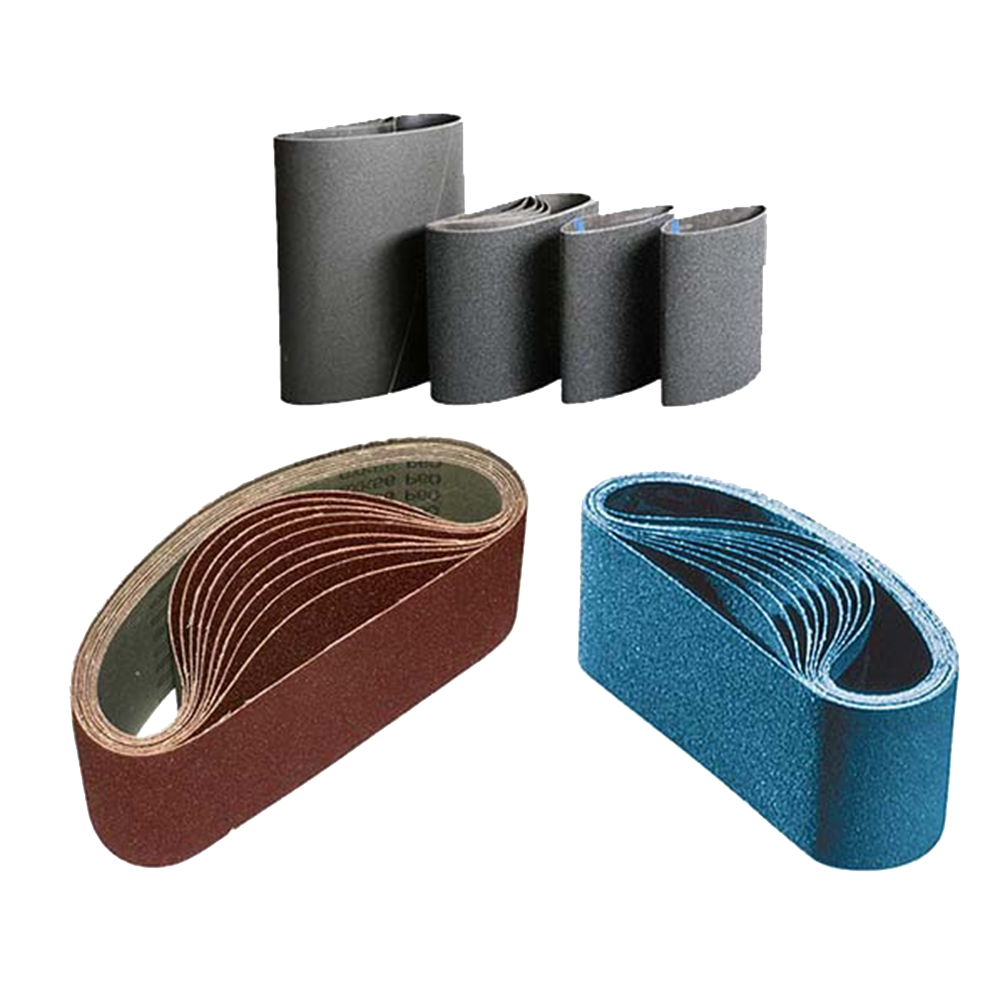
Product Overview
GUSHI Silicon Carbide Abrasive Belts use friable SiC grain bonded resin-over-resin to a waterproof X-weight cloth backing, giving a belt that cuts cooler and finer than aluminium oxide on stone, glass, aluminium and other non-ferrous materials. Grits run from P60 for shaping to P1000 for final finishing, in closed coat as standard with open coat and a stearate anti-clogging top coat available. A precision bi-directional tape joint means there is no thickened section at the splice, so the belt runs smoothly in either direction without seam chatter. Standard sizes include 100 × 915 mm and 100 × 610 mm, with custom belts from 10 mm to 1400 mm wide. They are made by Huzhou Gu’s Imp. & Exp. Co., Ltd., a Zhejiang abrasives and diamond tool manufacturer founded in 2004 that is ISO 9001:2015 certified and exports to more than 20 countries.
The reason to specify silicon carbide is the scratch pattern it leaves. Because the grain fractures rather than dulling, it keeps presenting fresh sharp points instead of rubbing, which produces a finer, more uniform finish at the same grit — the practical reason stone and glass finishers stay with SiC even when cheaper abrasives are available.
These belts run wet or dry. On stone, granite and glass, water controls heat and dust and extends belt life substantially; on wood, plastics and light metal, dry sanding avoids the mess and the swelling that water causes. The same belt does both, which is why many workshops standardise on a single waterproof product across materials.
Full Specifications
| Parameter | Specification |
|---|---|
| Product name | Silicon Carbide Abrasive Belts |
| Abrasive grain | Silicon carbide (SiC), Mohs ≈9.5 |
| Grain behaviour | Friable — self-sharpening fracture |
| Grit range | P60 – P1000 (FEPA P-grade) |
| Standard grits | P60 / P80 / P100 / P120 / P150 / P180 / P240 / P320 / P400 / P600 / P800 / P1000 |
| Backing — standard | X-weight waterproof polyester-cotton cloth |
| Backing — options | Y-weight heavy cloth; J-weight soft cloth for contours |
| Coating | Closed coat standard; open coat on request |
| Bond | Resin over resin |
| Anti-clogging | Stearate grinding-aid top coat available |
| Joint type | Bi-directional tape joint (runs either direction) |
| Joint options | Butt, lap, S-joint on request |
| Standard sizes | 100 × 915 mm (4 × 36 in), 100 × 610 mm, 75 × 610 mm, 75 × 533 mm |
| Long / wide sizes | 50 × 2100 mm; wide belts to 1400 mm |
| Width range | 10 mm – 1400 mm |
| Length range | 330 mm – 9000 mm (custom cut) |
| Waterproof | Yes — wet and dry use |
| Max operating speed | Up to 30 m/s (subject to machine rating) |
| Continuous temperature | Up to ≈200 °C (resin bond) |
| Suitable machines | Portable belt sanders, file belt sanders, stroke sanders, wide belt machines |
| Workpiece materials | Stone, granite, glass, porcelain, aluminium, non-ferrous metals, rubber, plastic, fibreglass, wood |
| Shelf life | ≈24 months stored 18–22 °C / 45–65% RH |
| Packing | 10 pcs/pack; 100 pcs/carton (size dependent) |
| Quality system | ISO 9001:2015; 100% inspection before shipment |
| Material compliance | RoHS-compliant materials |
| MOQ | 500 pcs (sizes, grits and backings mixable) |
| Lead time | 5–10 days standard; 15–30 days custom |
| Payment terms | T/T, L/C, D/A, D/P, PayPal |
Why Silicon Carbide Cuts the Way It Does
Friability is a feature, not a weakness
Silicon carbide grains are extremely hard but brittle. Under load they fracture rather than wear smooth, and each fracture exposes a new sharp edge. The belt therefore keeps cutting at close to its original rate for most of its life, instead of progressively rubbing and generating heat the way a dulling grain does. This is why SiC leaves a finer scratch pattern than a nominally identical grit in a tougher mineral.
Heat is what destroys a belt, not friction alone
A belt that stops cutting starts burning: the resin bond softens above roughly 200 °C, grain sheds prematurely, and the workpiece discolours. Sharp SiC grain, an open or stearate-coated surface, correct pressure and — on stone and glass — a little water all work to keep the cut cool. Most premature belt failure is a heat problem that looks like a wear problem.
Backing and bond determine where it fails
On a coated belt the grain rarely wears out first; the bond lets go or the backing tears. X-weight cloth carries the tension of a portable sander and resists edge fraying; Y-weight adds stiffness for heavy wide-belt work; J-weight flexes around profiles and contours. Matching backing weight to machine tension and belt speed is what converts a specification into belt life.
Why the joint matters more than people expect
Every belt has a splice, and a poorly made splice is a lump that hits the workpiece once per revolution, leaving a repeating mark and a vibration the operator feels through the machine. The bi-directional tape joint used here is made flush, so there is no chatter mark and no correct running direction — which also means a belt cannot be ruined by being fitted backwards.
Key Features Explained
Wear resistance beyond aluminium oxide
On the materials SiC is meant for — stone, glass, porcelain, non-ferrous metals — the grain’s combination of hardness and controlled fracture gives longer working life than an equivalent aluminium oxide belt, because it keeps cutting instead of glazing over. The practical result is fewer belt changes per shift and a more consistent finish between changes.
Anti-clogging options for soft materials
Aluminium, rubber, paint and resin tend to pack between the grains and stop the belt cutting. Open-coat construction increases grain spacing, and a stearate top coat acts as a dry lubricant so swarf releases instead of welding to the surface. Both are available, and both cost far less in wasted belts than they cost in specification.
Bi-directional joint
Beyond removing chatter, a direction-agnostic belt removes an entire class of workshop error. Fitting a single-direction belt backwards destroys it within seconds; these cannot be fitted wrongly, which matters in busy shops and on sites with high staff turnover.
Wet or dry on one product
The waterproof backing and resin system let the same belt run wet on granite or dry on timber. Workshops that handle both materials no longer need two inventories, and buyers can consolidate to a single line with fewer size and grit gaps.
Cut-to-size flexibility
Belts are cut from roll stock, so unusual machines are not an obstacle: widths from 10 mm file belts to 1400 mm wide belts, and lengths from 330 mm to 9000 mm. That makes the range viable for distributors serving woodworking, stone fabrication and metal finishing with one supplier.
Grit, Backing and Size Selection Guide
Choose in three steps: material, then grit sequence, then backing and size.
| Grit band | Stage | Typical use |
|---|---|---|
| P60 – P120 | Coarse | Shaping, levelling, removing tool marks and coatings |
| P150 – P240 | Medium | Removing P120 scratches, general surface preparation |
| P320 – P400 | Fine | Pre-polish smoothing before final grits |
| P600 – P1000 | Ultra-fine | Final finish, satin to near-polish on stone and metal |
| Material | Recommended sequence | Wet or dry |
|---|---|---|
| Granite / engineered stone | P60 → P120 → P220 → P400 → P600 → P1000 | Wet |
| Glass edge finishing | P80 → P180 → P320 → P600 | Wet |
| Aluminium / non-ferrous | P120 → P240 → P400 (open coat) | Dry, or with lubricant |
| Hardwood | P80 → P120 → P180 → P240 | Dry |
| Plastics / fibreglass | P120 → P240 → P400 (stearate coat) | Dry |
| Rubber | P60 → P120 (open coat, light pressure) | Dry |
Applications & Suitable Materials
Applications
| Application | Why SiC belts fit | Typical setup |
|---|---|---|
| Stone and granite finishing | Fine, uniform scratch pattern and wet operation | P60–P1000, wet, wide belt |
| Glass edge and surface work | Sharp grain cuts glass without excessive pressure | P80–P600, wet |
| Aluminium fabrication | Open coat and stearate resist loading | P120–P400, dry |
| Woodworking and furniture | Cool cutting avoids burn on hardwood | P80–P240, dry |
| Plastics and fibreglass trimming | Resists clogging on soft, heat-sensitive material | P120–P400, dry |
| Rubber and composites | Open coat keeps cutting on elastic swarf | P60–P120, light pressure |
| Stainless decorative finishing | Consistent linear finish at fine grits | P180–P600 |
Suitable Materials
| Ideal for | Consider another abrasive |
|---|---|
| Granite, marble, engineered stone, terrazzo | Carbon steel stock removal (use zirconia) |
| Glass, mirror and porcelain | Heavy stainless grinding (use ceramic alumina) |
| Aluminium, brass, copper, titanium | Concrete screed grinding (use diamond) |
| Rubber, leather, cork | Very high-pressure snagging |
| Plastics, acrylic, fibreglass, composites | Materials above the bond’s temperature limit |
| Hardwood, MDF, painted surfaces | Wet-only processes without waterproof bonding |
Silicon Carbide vs. Aluminium Oxide vs. Zirconia vs. Diamond
Four abrasives cover almost every job. The right one depends on the material’s hardness and toughness.
| Dimension | Silicon carbide (this product) | Aluminium oxide | Zirconia alumina | Diamond |
|---|---|---|---|---|
| Hardness (Mohs) | ≈9.5 | ≈9.0 | ≈9.0 | ✓ 10 |
| Grain behaviour | ✓ Friable, self-sharpening | Tougher, slower to fracture | Very tough, self-sharpening under pressure | Extreme wear resistance |
| Finish quality at same grit | ✓ Finest scratch pattern | Good | Coarser | Fine, on very hard materials |
| Cut rate on stone / glass | ✓ Fast and cool | Moderate | Slow | Fast but costly |
| Life on steel | Short | ✓ Good | ✓ Best | Not used on steel |
| Heat generation | ✓ Low | Moderate | Moderate, needs pressure | Low |
| Wet and dry use | ✓ Both | Mostly dry | Dry | Usually wet |
| Price per belt | Low–mid | ✓ Lowest | Mid | Highest |
| Best for | Stone, glass, non-ferrous, rubber, plastic, wood | General wood and steel work | Heavy stock removal on steel | Concrete, hard stone, ceramics |
Bottom line: Silicon carbide is the right default whenever the material is hard but not steel — stone, glass, porcelain, aluminium, rubber, plastic and wood. Move to aluminium oxide for general-purpose work, zirconia for heavy steel removal, and diamond for concrete and the hardest ceramics.
How to Use: Step-by-Step Guide
- Confirm the belt size matches the machine exactly — width and circumference, not just width.
- Pick the abrasive for the material: SiC for stone, glass, non-ferrous, rubber, plastic and wood.
- Choose the backing weight: X-weight for portable sanders, Y-weight for wide-belt, J-weight for contours.
- Select the starting grit from the selection table — coarse enough to cut, fine enough not to waste time.
- Fit the belt in the direction the machine specifies; these joints also run either way without damage.
- Set belt tracking and tension before the belt touches the workpiece.
- Start the machine and bring the work to the belt with light, even pressure — let the grain cut.
- Keep the belt moving; dwelling in one spot burns the resin bond and the workpiece.
- Run wet on stone and glass to control heat and dust, or use stearate-coated belts dry on soft metals.
- Progress through grits one step at a time, cleaning the surface between stages.
- Stop when the scratch pattern is uniform; a belt that glazes or loads should be replaced, not pressed harder.
- Store unused belts flat in their packaging at room temperature and moderate humidity.
Build a complete abrasives range: Aluminium Oxide Abrasive Sanding Rolls, Diamond Sanding Sheets, and Diamond Hand Polishing Pads.
Frequently Asked Questions
When should I choose silicon carbide over aluminium oxide belts?
Choose silicon carbide for low-tensile and heat-sensitive materials: stone, granite, glass, porcelain, aluminium and other non-ferrous metals, rubber, plastics, fibreglass and wood. Its grains are sharper and more friable, so they cut cooler and leave a finer scratch pattern. Choose aluminium oxide or zirconia for carbon steel, stainless stock removal and heavy grinding, where a tougher grain lasts longer.
What grit sequence should I use for a polished finish?
Never skip more than one grit step, because each stage only removes the scratches of the previous one. A practical sequence is P60 to P120 for shaping, P180 to P240 for scratch removal, P320 to P400 for pre-polish, and P600 to P1000 for final finishing. On stone and glass, extend to the finest grits and use water to control heat and dust.
Can these belts be used wet?
Yes. The backing and resin bond are waterproof, so the belts run wet or dry. Wet sanding reduces heat, suppresses dust and extends belt life on stone and glass, which is why most stone finishing is done wet. Dry sanding suits wood, plastics and light metal work where water would cause problems.
What does the bi-directional tape joint do?
The joint is precision-made so the belt has no step or thickened section at the splice. That removes seam chatter and the periodic mark it leaves on the workpiece, and it allows the belt to run in either direction, so fitment errors cannot ruin a belt. Butt, lap and S-joints are available where a machine requires them.
Why does my belt clog and how do I stop it?
Clogging, or loading, happens when soft material such as aluminium, rubber, paint or resin fills the gaps between grains. Fit an open-coat belt or one with a stearate anti-clogging top coat, reduce pressure, run wet where possible, and dress the belt with a cleaning block. A loaded belt stops cutting and starts burning the workpiece.
Which belt size fits my machine?
Match width and circumference exactly to the machine specification. Common sizes are 100 x 915 mm (4 x 36 in), 100 x 610 mm (4 x 24 in), 75 x 610 mm and 75 x 533 mm, with 50 x 2100 mm for long wide-belt machines and narrow file belts from 10 mm. GUSHI cuts custom sizes from 330 mm to 9000 mm in length, so non-standard machines are not a problem.
How should abrasive belts be stored?
Keep belts in their original packaging at 18 to 22 degrees Celsius and 45 to 65 percent relative humidity, laid flat and away from direct sunlight and moisture. Dry air makes the backing brittle, damp air softens the resin bond, and hanging a belt by one edge can crease it. Stored correctly, belts keep their performance for about 24 months.
What is the MOQ and what can be customised?
The OEM MOQ is 500 pieces, and sizes, grits and backings can be mixed in one order. Customisation covers belt dimensions, grit range, backing weight, open or closed coat, stearate top coat, joint type, private-label packaging and logo. Production runs under ISO 9001:2015; lead time is 5 to 10 days for standard sizes and 15 to 30 days for custom.
OEM & Wholesale Information
| OEM / wholesale parameter | Details |
|---|---|
| MOQ | 500 pcs; sizes, grits and backings mixable |
| Custom sizes | Width 10–1400 mm; length 330–9000 mm |
| Custom specification | Backing weight, closed or open coat, stearate top coat, joint type |
| Private label | Logo printing on belt backing, custom labels, sleeves and cartons |
| Standard packing | 10 pcs/pack; 100 pcs/carton (size dependent) |
| Sample policy | Samples at cost price plus freight; fee refunded on the official order |
| Payment terms | T/T, L/C, D/A, D/P, PayPal |
| Port of loading | Shanghai or Ningbo, China |
| Quality control | 100% inspection before shipment; ISO 9001:2015, SGS |
| Service languages | English, Spanish, Japanese, Russian, French, German |
Huzhou Gu’s Imp. & Exp. Co., Ltd. (brands GUSHI Tools and Roycel) has manufactured abrasives, tile installation tools and diamond tools from Zhejiang since 2004, drawing on a supply chain active in this industry since 1998 and a production capacity of 100,000 sets per month. The company is ISO 9001:2015 certified, exports to more than 20 countries including the USA, Germany, the UK, the Netherlands, Brazil, Chile and Australia, and was one of 23 Chinese firms that won the US anti-dumping case on diamond blades at a 6.2% rate.
Continue through the abrasives range: Aluminium Oxide Abrasive Sanding Rolls, Diamond Sanding Sheets, and Triangle Sanding Discs.