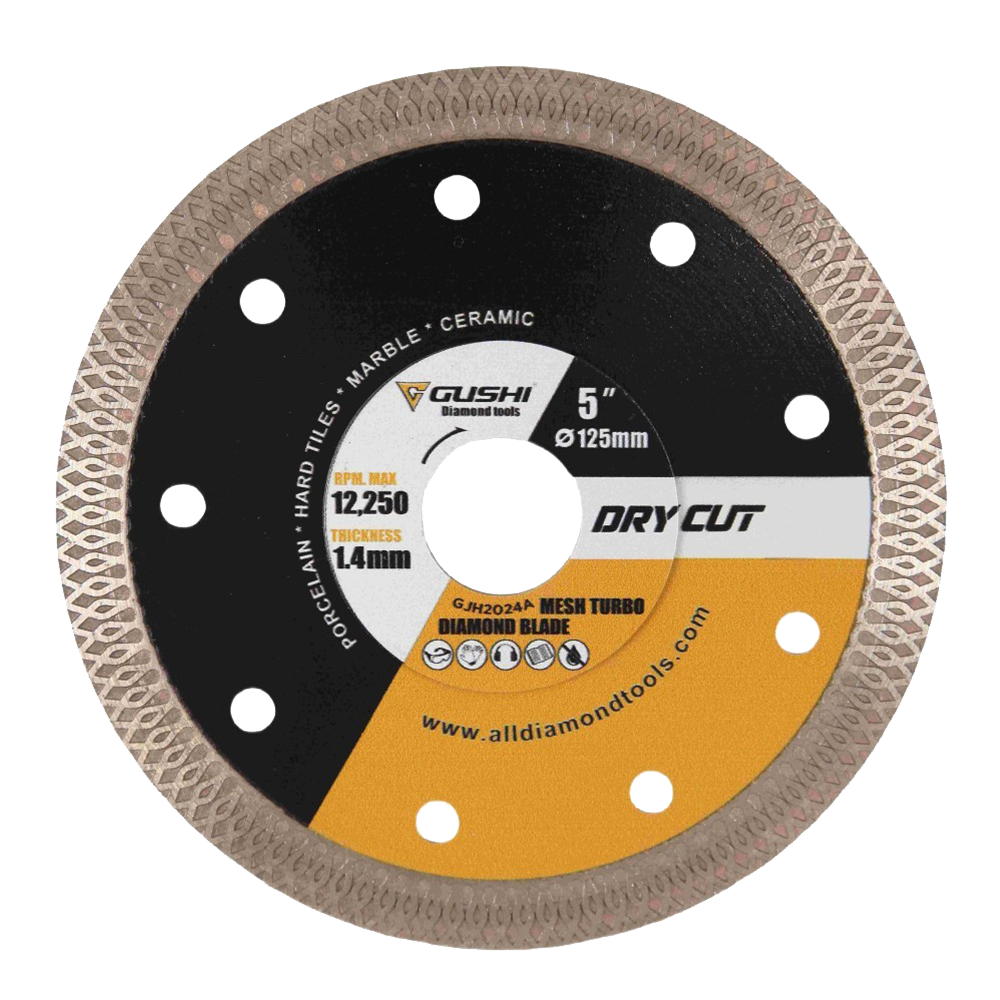
Product Overview
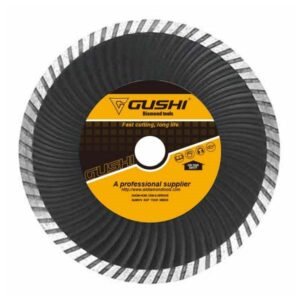
The GUSHI Roycel Mesh Turbo Diamond Saw Blade is a hot-pressed diamond blade with an X-mesh (mesh turbo) continuous rim that cools the cut, ejects dust and cuts chip-free on porcelain, ceramic, glazed tile, granite and marble. Manufactured by Huzhou Gu’s Imp. & Exp. Co., Ltd. — a diamond tool specialist founded in 2004 and ISO 9001, CE, EN13236 and RoHS certified — the mesh rim acts like a turbine, pulling air through the cut to keep the edge cool and clean during wet or dry use on angle grinders and tile saws. With a production capacity of 100,000 diamond-tool sets per month, GUSHI exports to 20+ countries including the USA, Germany, UK, Australia and Brazil.
The mesh turbo blade sits between a plain continuous-rim blade and a segmented blade. Where a plain continuous rim seals the cut and traps heat on hard tile, and a segmented blade can chip brittle edges, the mesh turbo rim opens a grid of vents that cool, extract dust and damp vibration while keeping the smooth, continuous-rim cut quality. Tile installers, stone workshops and renovation contractors choose it for porcelain and ceramic work where chip-free edges and dust control matter more than raw demolition speed.
GUSHI is one of only 23 Chinese manufacturers that won the anti-dumping case for diamond blades exported to the USA, holding a 6.2% tariff rate. That compliance heritage, plus in-house hot-pressing and per-lot rim and flatness inspection, makes the mesh turbo blade a dependable specification for distributors and OEM partners serving regulated and quality-sensitive markets.
Full Specifications
| Parameter | Specification |
|---|---|
| Product Name | GUSHI Roycel Mesh Turbo Diamond Saw Blade |
| Model Number | GSDB-MT Series |
| Blade Type | Mesh turbo-rim diamond blade (X-mesh pattern) |
| Diameter Range | 105 – 300 mm (4″ – 12″) |
| Arbor / Bore | 20 / 22.23 / 25.4 mm |
| Kerf (Segment) Thickness | 1.2 – 2.0 mm |
| Segment Height | 8 / 10 mm |
| Rim Type | Mesh turbo rim (X-mesh continuous rim) |
| Diamond Matrix | Hot-pressed synthetic diamond |
| Bond | Soft–medium, tile / stone optimized |
| Core | Reinforced steel body |
| Max RPM | 5,500 – 15,000 (by diameter) |
| Peripheral Speed | Up to 80 m/s |
| Cutting Mode | Wet and dry |
| Applications | Porcelain, ceramic, glazed tile, marble, granite, engineered stone |
| Machines | Angle grinder, tile saw, table saw |
| Certifications | ISO 9001, CE, EN13236, RoHS, SGS |
| Safety Standard | EN13236 (diamond tool safety) |
| Segment Process | Hot-pressed |
| Packaging | Skin card / blister / white box |
| HS Code | 8202.39 |
| MOQ | 500 pieces |
| Lead Time | 25 – 30 days |
| Port of Loading | Shanghai / Ningbo, China |
How the Mesh Turbo Blade Works
X-Mesh Rim Geometry
The mesh turbo rim is a continuous diamond rim patterned with an X-mesh grid instead of being plain. On a plain continuous rim, the cut line is sealed and heat and dust build up at the contact zone. The mesh openings break that seal: they act like a turbine, drawing cooling air through the cut and ejecting dust and slurry so the rim stays clean and cool. The result is fast cutting with the smooth, chip-free edge of a continuous rim.
Hot-Pressed Diamond Matrix
The diamond segments are formed by hot-pressing synthetic diamond grit into a metal bond under heat and pressure. Hot-pressing produces a denser, stronger segment than cold pressing, holding the diamond particles firmly so they wear evenly and stay sharp longer. A soft–medium bond is selected for hard, brittle tile so the matrix releases spent diamond at the right rate and maintains cutting speed.
Cooling Through Ventilation
Unlike a segmented blade that relies on deep gullets, the mesh turbo rim cools through many small vents distributed across the rim. These vents keep friction heat down during fast, continuous cuts and stop diamond paste from glazing the rim — the main cause of a blade “going slow” on porcelain. Cooler operation also protects the hot-pressed bond, extending service life.
Key Features Explained
X-Mesh Rim — Turbine Cooling
The X-mesh pattern opens vents across the rim that pull air through the cut and eject dust and slurry. This keeps the edge cooler and cleaner than a plain continuous rim, so the blade cuts faster and resists glazing on hard porcelain.
Chip-Free Edge on Hard Tile
The continuous mesh rim keeps full contact with brittle surfaces, producing clean, factory-like edges on porcelain, ceramic and glazed tile with minimal chipping. That means less rework and often no edge grinding after the cut.
Reduced Vibration
The vented rim and balanced reinforced steel core generate less vibration than a plain continuous or segmented rim at speed. Lower vibration improves operator comfort and helps hold tight, accurate cut lines on tile and stone.
Hot-Pressed Bond Longevity
Hot-pressed segments are denser and more wear-resistant than cold-pressed equivalents, holding diamond firmly for a stable, long service life. With water cooling, a 10 mm segment blade commonly reaches 800–1,500 linear meters on ceramic and porcelain.
Universal Arbor Fit
With 20, 22.23 and 25.4 mm arbor options across the size range, the blade fits most standard angle grinders, handheld tile saws and table saws without adapters — simplifying procurement for distributors.
EN13236 Compliance
Every blade is manufactured and tested to the EN13236 diamond-tool safety standard, the European benchmark for rotating diamond tools. QC includes blade-flatness, mesh-rim consistency and arbor inspection, with SGS inspection available on request.
Selection / Diameter Guide
Match diameter and arbor to your machine and the material thickness. Smaller sizes with 20/22.23 mm arbors fit angle grinders and handheld tile saws; larger 250–300 mm blades with 25.4 mm arbors suit table saws for slab work.
| Diameter | Arbor (mm) | Machine | Best For |
|---|---|---|---|
| 105 mm (4″) | 20 | 4″ angle grinder | Ceramic wall tile, indoor trim |
| 125 mm (5″) | 22.23 | Angle grinder, tile saw | Porcelain, floor tile |
| 150 mm (6″) | 22.23 | Tile saw, grinder | Marble, granite tile |
| 180 mm (7″) | 22.23 | Tile saw, grinder | Granite slab edge, stone |
| 230 mm (9″) | 22.23 | Tile / table saw | Thick porcelain, pavers |
| 250 mm (10″) | 25.4 | Table saw | Granite, marble slabs |
| 300 mm (12″) | 25.4 | Table / bridge saw | Stone fabrication |
Applications & Suitable Materials
Where the Mesh Turbo Blade Excels
| Application | Why the Mesh Turbo Blade Wins |
|---|---|
| Porcelain & ceramic tiling | Chip-free edges, low dust indoors |
| Glazed tile cutting | Cooled rim protects glaze from chipping |
| Granite / marble tile | Clean cut face, low vibration |
| Indoor renovation | Low dust, quiet, cool running |
| Stone workshop trimming | Smooth edge, little rework |
| Engineered stone panels | Stable cut, minimal edge breakout |
Suitable Materials
| Material | Bond Recommendation | Cutting Mode |
|---|---|---|
| Porcelain, ceramic | Soft bond, sharp grit | Wet / dry |
| Glazed tile | Soft bond | Wet preferred |
| Granite floor tile | Soft–medium bond | Wet preferred |
| Marble, limestone | Soft bond | Wet / dry |
| Engineered stone | Soft–medium bond | Wet |
| Hard decorative panels | Medium bond | Wet |
Mesh Turbo vs. Standard Continuous Rim Blade
The mesh turbo blade is an evolution of the plain continuous-rim (turbo-style) tile blade. The table compares the GUSHI mesh turbo blade with a conventional plain continuous-rim blade at a similar diameter.
| Dimension | Mesh Turbo (GUSHI) | Standard Continuous Rim |
|---|---|---|
| Rim design | X-mesh vents across rim | Plain sealed rim |
| Cutting temperature | Cooler (air turbine) | Runs hotter |
| Dust extraction | Vents eject slurry/dust | Trapped at cut line |
| Cutting speed | Faster, less glazing | Slower on hard tile |
| Edge finish | Chip-free, clean | Chip-free, clean |
| Vibration | Reduced | Moderate |
| Glazing resistance | High (stays sharp) | Can glaze on porcelain |
| Blade lifespan | Longer (cooled bond) | Shorter if overheated |
| Wet / dry use | Both (cools dry too) | Both |
| Best for | Porcelain, ceramic, indoor | Light, soft tile |
| Initial cost | Slightly higher | Lower |
Bottom line: Choose the mesh turbo blade for porcelain, ceramic, glazed tile and any indoor, dust-sensitive or continuous cut where cooling and chip-free edges decide job quality. Choose a plain continuous rim only for light, soft tile on a tight budget, and a segmented blade for heavy concrete or masonry.
How to Use: Step-by-Step Guide
- Confirm the blade arbor (20, 22.23 or 25.4 mm) matches your angle grinder, tile saw or table saw spindle.
- Inspect the rim and core for cracks, missing diamond or loose segments; never use a damaged blade.
- Mount the blade with the correct flange and tighten to spec; check the rotation arrow matches spin direction.
- Verify your machine’s maximum RPM exceeds the blade’s rated RPM for its diameter (105 mm up to 15,000 RPM).
- Mark the cut line on the tile; for plunge cuts, start from the edge rather than forcing into the face.
- For wet cutting, connect water to the cut zone before starting — it suppresses dust and maximizes edge quality.
- Begin with light feed pressure; let the mesh rim’s cooling do the work instead of pushing the blade.
- Keep a steady, even feed; the rim needs little force, so avoid leaning on the grinder.
- Use the mesh rim’s smooth profile for curved and notch cuts that a thick segmented blade cannot follow.
- If dry cutting, pause every 30–60 seconds to let the rim cool; never force a hot blade.
- After cutting, wipe the rim clean of slurry and diamond paste so the mesh vents stay open.
- Store the blade flat in its protective sleeve — never lean it where the core can warp.
For more guidance, see our related guides on Super Thin Turbo Diamond Blades, Diamond Core Drill Bits, and Diamond Polishing Pads.
Preguntas frecuentes
What is a mesh turbo diamond saw blade and how does the mesh rim work?
A mesh turbo blade is a diamond blade with an X-mesh (mesh turbo) continuous rim — a continuous diamond rim patterned with a mesh or cross-hatch grid rather than plain or segmented. The mesh openings act like a turbine: they pull cooling air across the rim, eject dust and slurry, and break up vibration, so the blade stays cool and cuts chip-free on hard, brittle tile. It keeps the smooth, continuous-rim cut quality while adding the cooling and speed of a vented design.
What materials can the mesh turbo diamond blade cut?
It is built for porcelain tile, ceramic tile, glazed tile, marble and granite, plus engineered stone and hard decorative panels. The hot-pressed soft-to-medium bond is tuned for hard, brittle surfaces to deliver clean, low-chipping edges. It is not intended for wood, metal, soft plastic or heavy reinforced concrete, where a thicker segmented blade is the right tool.
Can the mesh turbo blade be used wet and dry?
Yes. The blade is rated for both wet and dry cutting. Wet cutting suppresses dust and maximizes edge quality and life — preferred for glazed tile and continuous runs. Dry cutting works on angle grinders for fast on-site work; use moderate, steady feed and allow cool-down pauses every 30-60 seconds to protect the hot-pressed bond.
What diameters and arbor sizes are available?
Standard diameters are 105 mm (4″), 125 mm (5″), 150 mm (6″), 180 mm (7″) and 230 mm (9″), with 250-300 mm (10-12″) available on request. Small 105-230 mm blades use 20 or 22.23 mm (7/8″) arbors for angle grinders and handheld tile saws; 250-300 mm blades use a 25.4 mm (1″) arbor for table saws. Segment height is 8 or 10 mm, with kerf (segment thickness) 1.2-2.0 mm by diameter.
Why does the mesh rim cut cooler than a plain continuous rim?
A plain continuous rim seals the cut and traps heat and dust at the contact line. The X-mesh pattern opens vents across the rim that act as a turbine — pulling air through the cut, extracting dust and slurry, and dissipating friction heat. This lets the mesh turbo rim run cooler and faster than a plain continuous rim while keeping the chip-free edge finish.
How long does a mesh turbo diamond blade last?
Life depends on material hardness and cooling. The mesh rim’s cooling effect protects the hot-pressed bond, so with water cooling a 10 mm segment blade typically delivers 800-1,500 linear meters on ceramic and porcelain. Because the mesh design reduces heat and clogging, real-world life is often longer than an equivalent plain continuous-rim blade in the same duty.
What is the OEM minimum order quantity and lead time?
OEM and private-label MOQ is 500 pieces per specification. Standard production lead time is 25-30 days after artwork and sample confirmation. Custom branding (laser marking, silk screen or printed stickers), packaging and bond formulas are available. Samples are supplied at cost price with the buyer paying shipping. Payment via L/C, T/T, Western Union or PayPal. Port of loading: Shanghai or Ningbo.
Is the mesh turbo diamond blade certified for international markets?
Yes. GUSHI mesh turbo blades are manufactured under ISO 9001:2015, carry CE marking and RoHS compliance, and are tested to the EN13236 diamond-tool safety standard that governs European diamond-blade use. Each lot is QC-checked with blade-flatness, mesh-rim and arbor inspection, and SGS inspection is available on request.
OEM & Wholesale Information
| Parameter | Specification |
|---|---|
| Minimum Order Quantity | 500 pieces per specification |
| Production Lead Time | 25 – 30 days after sample & artwork confirmation |
| Custom Branding | Laser marking, silk screen, printed stickers |
| Custom Packaging | Skin card, blister, white box |
| Custom Specifications | Diameter, kerf, segment height, bond per RFQ |
| Sample Policy | Available at cost price; buyer pays shipping |
| Payment Terms | L/C, T/T, Western Union, PayPal |
| Port of Loading | Shanghai or Ningbo, China |
| QC Documentation | Flatness, mesh-rim, arbor inspection per lot, SGS on request |
| Production Capacity | 100,000 diamond-tool sets / month |
Huzhou Gu’s Imp. & Exp. Co., Ltd. (GUSHI Tools / Roycel) has manufactured and exported diamond tools since 2004, serving 20+ countries across North America, Europe, South America, Australia and Africa. As one of 23 Chinese companies that won the US anti-dumping case for diamond blades (6.2% tariff rate), GUSHI combines compliant export experience with ISO 9001, CE, EN13236 and RoHS certified production. Many distributor partners have collaborated with GUSHI for over 10 years.
Explore our complete diamond-tool range: Super Thin Turbo Diamond Blades, Diamond Core Drill Bits, and Diamond Polishing Pads.