Product Overview
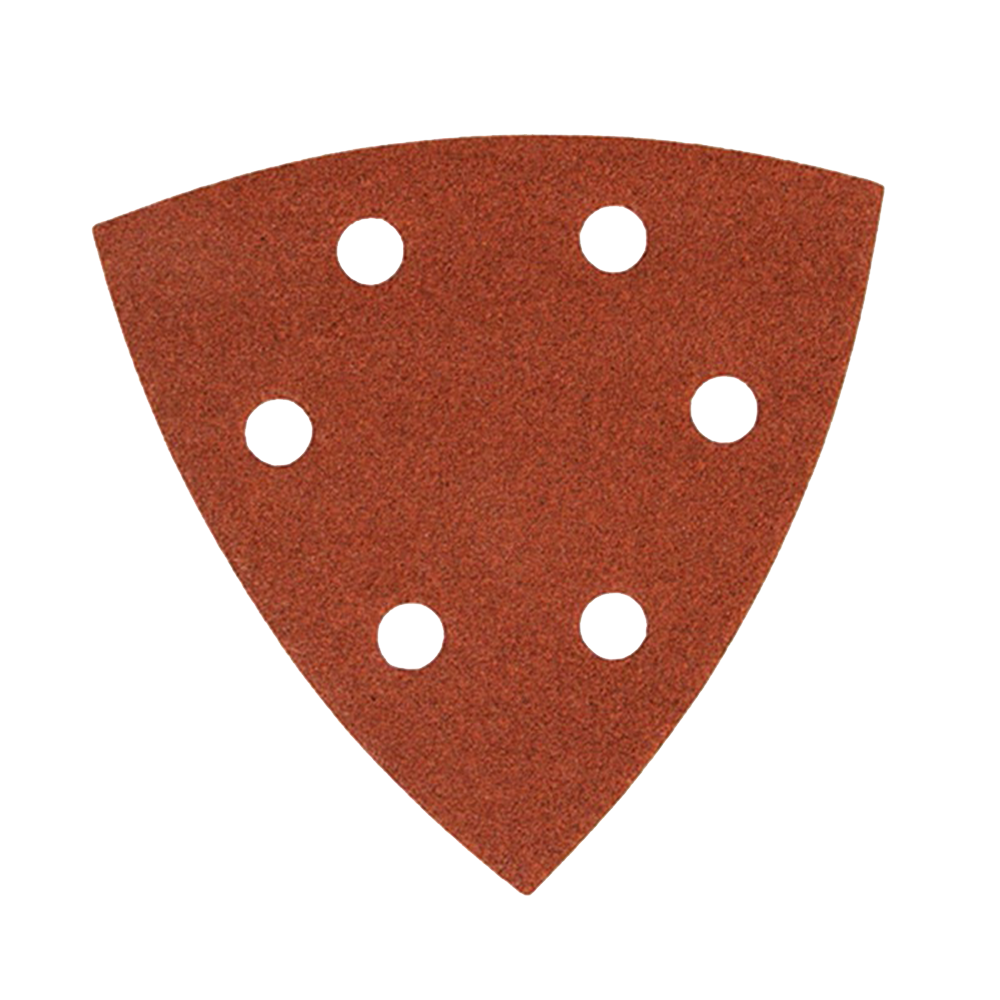
GUSHI Triangle Sanding Discs are hook and loop delta sheets built on durable aluminium oxide abrasive with an anti-static, anti-clogging coating. Supplied in coarse, medium and fine grades and in 80 mm, 93 mm and 100 mm side lengths, they fit oscillating multi-tools and delta or detail sanders, with no-hole, 6-hole, 8-hole and universal perforated patterns to suit different dust extraction systems. They are used for rust removal, paint removal, deburring, weld blending and finishing across metal, wood, rubber, leather, plastic, stone and glass. They are made by Huzhou Gu’s Imp. & Exp. Co., Ltd., a Zhejiang abrasives and diamond tool manufacturer founded in 2004 that is ISO 9001:2015 certified and exports to more than 20 countries.
The shape is the point. A round disc cannot reach into an internal corner, along a shutter board or behind a radiator bracket, and folding a rectangular sheet to fit rounds off the very edge you are trying to sand. A triangular sheet matches the geometry of a corner, so the abrasive reaches the junction instead of polishing the two faces either side of it.
The hook and loop backing turns the sheet into a quick-change consumable. There is no clamp, no alignment jig and no wasted time: press on, sand, peel off. Because the whole sheet is supported by the pad rather than gripped at two edges, it also stays flatter under load than a clamped sheet, which shows up as a more even scratch pattern.
Full Specifications
| Parameter | Specification |
|---|---|
| Product name | Triangle Sanding Discs (delta sanding sheets) |
| Shape | Equilateral triangle / delta |
| Abrasive grain | Aluminium oxide, Mohs ≈9.0 |
| Grades | Coarse / medium / fine |
| Grit range — coarse | P40 / P60 / P80 |
| Grit range — medium | P100 / P120 / P150 / P180 |
| Grit range — fine | P240 / P320 / P400 |
| Backing attachment | Hook and loop (velcro) |
| Backing material | Flexible paper or cloth, weight by grade |
| Side lengths | 80 mm / 93 mm / 100 mm |
| Hole patterns | No-hole, 6-hole, 8-hole, universal perforated |
| Anti-static coating | Yes — reduces dust cling and loading |
| Compatible machines | Oscillating multi-tools; delta and detail sanders |
| Pad requirement | Triangular hook and loop backing pad |
| Rotation for life | 3 usable tips — rotate 120° when worn |
| Typical operations | Rust removal, paint removal, deburring, weld blending, finishing |
| Workpiece materials | Metal, wood, rubber, leather, plastic, stone, glass |
| Use mode | Dry, with dust extraction |
| Sheet thickness | ≈0.4–0.6 mm (excluding hook backing) |
| Packing | 50 pcs/pack; 1000 pcs/carton (size dependent) |
| Shelf life | ≈24 months stored dry at room temperature |
| Quality system | ISO 9001:2015; 100% inspection before shipment |
| Material compliance | RoHS-compliant materials |
| MOQ | 500 pcs (sizes, grits and patterns mixable) |
| Lead time | 5–10 days standard; 15–30 days custom |
| Payment terms | T/T, L/C, D/A, D/P, PayPal |
Why the Triangle Shape Matters
Geometry decides what you can reach
Sanding an internal corner with a round disc leaves an unsanded wedge at the junction, because the disc’s radius cannot enter the angle. A triangle’s point does exactly what the corner needs — it reaches the apex, so the whole surface gets the same treatment instead of the two faces being finished and the corner being left.
Oscillation, not rotation
Multi-tools and delta sanders oscillate the pad through a few degrees at very high frequency rather than spinning it. That small-amplitude motion is what makes a pointed pad usable — the tip does not dig or grab the way a spinning edge would — and it is why these machines can work right into a corner without chattering or tearing the surface.
Dust extraction keeps the grain cutting
Fine dust packs between grains within seconds on paint, filler and resinous softwood, and a loaded sheet stops cutting and starts burning. Holes aligned with the pad and the machine’s extraction pull dust away at the point of contact, which is why matching the hole pattern is a performance issue and not just a fitting detail.
Anti-static coating and loading
Sanding generates static charge that holds dust against the abrasive even with extraction running. The anti-static treatment reduces that adhesion, so swarf releases instead of welding to the surface. The result is a sheet that stays sharp longer and a workpiece the operator can actually see while working.
Key Features Explained
Durable alumina abrasive
Aluminium oxide is tough rather than brittle, so it resists fracture and keeps abrading on metal, wood and painted surfaces. That toughness is what makes it the right general-purpose choice for a detail sander, which by definition meets a mix of materials on every job rather than one predictable surface.
Hook and loop quick change
Fitting takes seconds and needs no tools or clamps. More importantly, the sheet is supported across its whole area by the pad, so it stays flat and cuts evenly instead of fluttering at unsupported edges the way a clamped sheet does. Peel it off the moment the grit is spent and press on a fresh one.
Three grades for the whole sequence
Coarse grades strip rust, paint and old finish; medium grades remove those scratches and prepare the surface; fine grades finish before coating. Stocking all three means a repair can be taken from bare metal to ready-to-prime with one machine and one pad, without switching tools.
Sizes and hole patterns for most machines
With 80, 93 and 100 mm side lengths and four hole options, the range covers the common oscillating multi-tools and delta sanders in service. For distributors that means one product line serves a fragmented machine market rather than requiring separate stock for every brand.
Three tips per sheet
Corner work wears one point of the triangle, not the whole sheet. Rotating the sheet 120 degrees brings an unused tip into play, and rotating again before discarding it can triple usable life — the single most effective way to reduce consumable cost on detail sanding.
Size, Hole Pattern and Grit Guide
Match the machine first, then the material. Both matter before grit.
| Side length | Typical machine | Best for |
|---|---|---|
| 80 mm | Compact oscillating multi-tools | Tight access, detail work, small repairs |
| 93 mm | Standard oscillating multi-tools | Most common size — general site and workshop use |
| 100 mm | Delta and detail sanders | Larger triangular pads, furniture and joinery |
| Hole pattern | When to choose it |
|---|---|
| No-hole | Machines without extraction; general hand sanding |
| 6-hole | Pads with a six-hole layout |
| 8-hole | Pads with an eight-hole layout and good extraction |
| Universal perforated | Mixed machine fleets — fits most hole layouts |
| Task | Starting grit | Finishing grit |
|---|---|---|
| Rust removal on steel | P40–P60 | P120 |
| Paint and varnish stripping | P60–P80 | P120–P180 |
| Bare wood preparation | P80 | P180–P240 |
| Deburring and weld blending | P120 | P240 |
| Filler and primer flattening | P120 | P240–P320 |
| Stone and glass edge refinement | P180 | P400 |
Applications & Suitable Materials
Applications
| Application | Why the triangle fits | Grade |
|---|---|---|
| Internal corners on joinery | Point reaches the apex a round disc cannot | Medium → fine |
| Window shutter and slat sanding | Tip works between slats without dismantling | Medium → fine |
| Rust removal on steelwork | Aggressive coarse grain, small access footprint | Coarse |
| Paint stripping on profiles | Follows mouldings and edges | Coarse → medium |
| Weld blending on fabrications | Controlled removal in a small area | Medium |
| Deburring cut metal and plastic | Precise tip work on edges | Medium → fine |
| Leather, rubber and plastic trimming | Fine control on soft materials | Fine |
Suitable Materials
| Works well | Notes |
|---|---|
| Carbon steel, cast iron, weld seams | Keep separate sheets for stainless work |
| Hardwood, softwood, MDF, painted timber | Use extraction; resinous wood loads sheets quickly |
| Plastics, acrylic, GRP and composites | Light pressure to avoid heat build-up |
| Rubber and leather | Coarse grits only; fine grits load immediately |
| Stone, tile and glass | Diamond abrasives last longer on these |
| Filler, primer and old coatings | Anti-static coating helps resist loading |
Triangle vs. Round Disc vs. Rectangular Sheet
Same abrasive, three shapes. The shape decides where you can work, not how fast.
| Dimension | Triangle / delta (this product) | Round disc | Rectangular sheet |
|---|---|---|---|
| Internal corners | ✓ Reaches the apex | Cannot — leaves an unsanded wedge | Only if folded, which rounds the edge |
| Tight access between slats | ✓ Point enters narrow gaps | Poor | Poor unless cut down |
| Large flat areas | Slow — small contact area | ✓ Fast and even | Good by hand or on a block |
| Flatness under load | ✓ Fully supported by the pad | ✓ Fully supported | Edges unsupported, can flutter |
| Speed of change | ✓ Hook and loop, seconds | ✓ Hook and loop, seconds | Clamp or fold, slower |
| Material use efficiency | ✓ 3 tips, rotatable | Entire face, wears evenly | Can be cut and folded |
| Dust extraction | ✓ With matched holes | ✓ With matched holes | Usually none |
| Cost per piece | Low | Low | ✓ Lowest |
| Best for | Corners, edges, profiles, repairs | Flat panels and large surfaces | Hand finishing and custom shapes |
Bottom line: A round disc is the faster tool on open flat surfaces, and a hand-folded sheet still wins on odd shapes — but for corners, slats, profiles and anything a disc cannot enter, the triangle is the only shape that does the job properly. Most workshops keep all three and choose by geometry.
How to Use: Step-by-Step Guide
- Confirm the pad is triangular, hook and loop, and note its side length and hole pattern.
- Select the sheet size and hole pattern to match the pad exactly.
- Choose the grade: coarse for rust and paint, medium for preparation, fine for finishing.
- Clean the backing pad — packed hooks are the main reason sheets come off in use.
- Align the holes with the pad and press the sheet on firmly across its whole area.
- Connect dust extraction where the machine and sheet allow it.
- Hold the tool flat and let the abrasive cut; pressing hard only loads the sheet and heats the work.
- Work the corner or edge with the tip, keeping the machine moving in short overlapping strokes.
- When the tip dulls, rotate the sheet 120 degrees and continue with a fresh point.
- Step through grades in order, never skipping more than one grit.
- Clear a loaded sheet with a crepe cleaning block, or replace it rather than pressing harder.
- Peel the sheet off after use, clean the pad, and store sheets flat and dry.
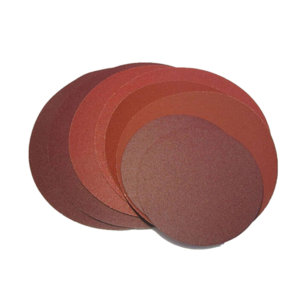
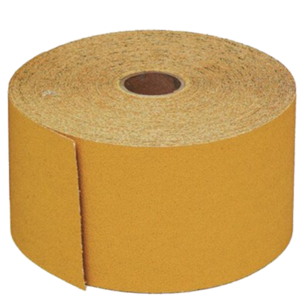
Complete the abrasive range: Abrasive Sanding Discs for flat work, Diamond Sanding Sheets for stone and glass, and Aluminium Oxide Sanding Rolls for hand work.
Preguntas frecuentes
Which tools do these triangle discs fit?
They fit oscillating multi-tools and delta or detail sanders whose backing pad is triangular and hook and loop. Check two things before ordering: the side length of your pad, typically 80, 93 or 100 mm, and the dust hole pattern, which may be no-hole, 6-hole, 8-hole or a universal perforation. The backing pad itself must be hook and loop, not a clamp-type fitting.
What size and hole pattern do I need?
Measure the side length of your existing pad: 80 mm suits compact multi-tools, 93 mm is the most common oscillating tool size, and 100 mm fits many delta detail sanders. Then match the hole pattern to the pad and to the machine’s extraction — a mismatched pattern blocks dust extraction and causes the sheet to load quickly. Universal perforated sheets fit most hole layouts.
Which grit should I use for rust, paint or wood?
For rust and paint removal start at P40 to P60, then refine with P80 to P120. For bare wood preparation use P80 then P120 and finish at P180 or P240. For deburring metal and blending welds use P120 to P240, and for fine finishing on stone or primer use P320 to P400. Never skip more than one grit step.
Will the hook and loop sheet come off during use?
Not when fitted correctly. Press the sheet firmly onto a clean pad so the hooks engage fully, align the holes, and keep the tool flat so the sheet is not peeled at an edge. Sheets usually detach because the pad hooks are worn or packed with dust, so clean the pad regularly and replace a backing pad whose hooks no longer grip.
Can they be used on metal, stone and glass?
Aluminium oxide works on all of them. On steel it removes rust and blends welds well; on stone and glass it cuts rather than glazes, though diamond abrasives last longer on those materials. Use separate sheets for different materials and never use a sheet that has been on steel for stainless work, since embedded iron particles can stain the surface.
What does the anti-static coating do?
The coating reduces the static charge that makes sanding dust cling to the abrasive surface and to the workpiece. Dust that would otherwise pack between the grains is released instead, so the sheet keeps cutting longer, extraction works better and the surface stays visible while you work. It matters most on paint, filler and resinous softwood.
How can I get more life from each disc?
A triangle has three tips, so when one wears, rotate the sheet 120 degrees to bring a fresh point into use, and rotate again before replacing it. Use dust extraction, avoid pressing hard — let the abrasive cut — and clear loaded sheets with a crepe cleaning block. Rotating alone can triple the usable life of a sheet on corner work.
What is the MOQ and what can be customised?
The OEM MOQ is 500 pieces, and sizes, grits and hole patterns can be mixed in one order. Customisation covers side length, hole pattern, grit range, abrasive type, backing colour, anti-static coating, pack quantity and private-label packaging. Production runs under ISO 9001:2015; lead time is 5 to 10 days for standard items and 15 to 30 days for custom.
OEM & Wholesale Information
| OEM / wholesale parameter | Details |
|---|---|
| MOQ | 500 pcs; sizes, grits and hole patterns mixable |
| Custom sizes | 80 / 93 / 100 mm standard; other side lengths to order |
| Hole patterns | No-hole, 6-hole, 8-hole, universal perforated, custom layouts |
| Custom specification | Abrasive type, grit range, backing weight, anti-static coating |
| Set options | Single-grit packs or mixed coarse/medium/fine assortments |
| Standard packing | 50 pcs/pack; 1000 pcs/carton (size dependent) |
| Sample policy | Samples at cost price plus freight; fee refunded on the official order |
| Payment terms | T/T, L/C, D/A, D/P, PayPal |
| Port of loading | Shanghai or Ningbo, China |
| Quality control | 100% inspection before shipment; ISO 9001:2015, SGS |
| Service languages | English, Spanish, Japanese, Russian, French, German |
Huzhou Gu’s Imp. & Exp. Co., Ltd. (brands GUSHI Tools and Roycel) has manufactured abrasives, tile installation tools and diamond tools from Zhejiang since 2004, drawing on a supply chain active in this industry since 1998 and a production capacity of 100,000 sets per month. The company is ISO 9001:2015 certified, exports to more than 20 countries including the USA, Germany, the UK, the Netherlands, Brazil, Chile and Australia, and was one of 23 Chinese firms that won the US anti-dumping case on diamond blades at a 6.2% rate.
Continue through the abrasives range: Abrasive Sanding Discs, Concrete Floor Polishing Pads, and Diamond Sanding Sheets.