Product Overview
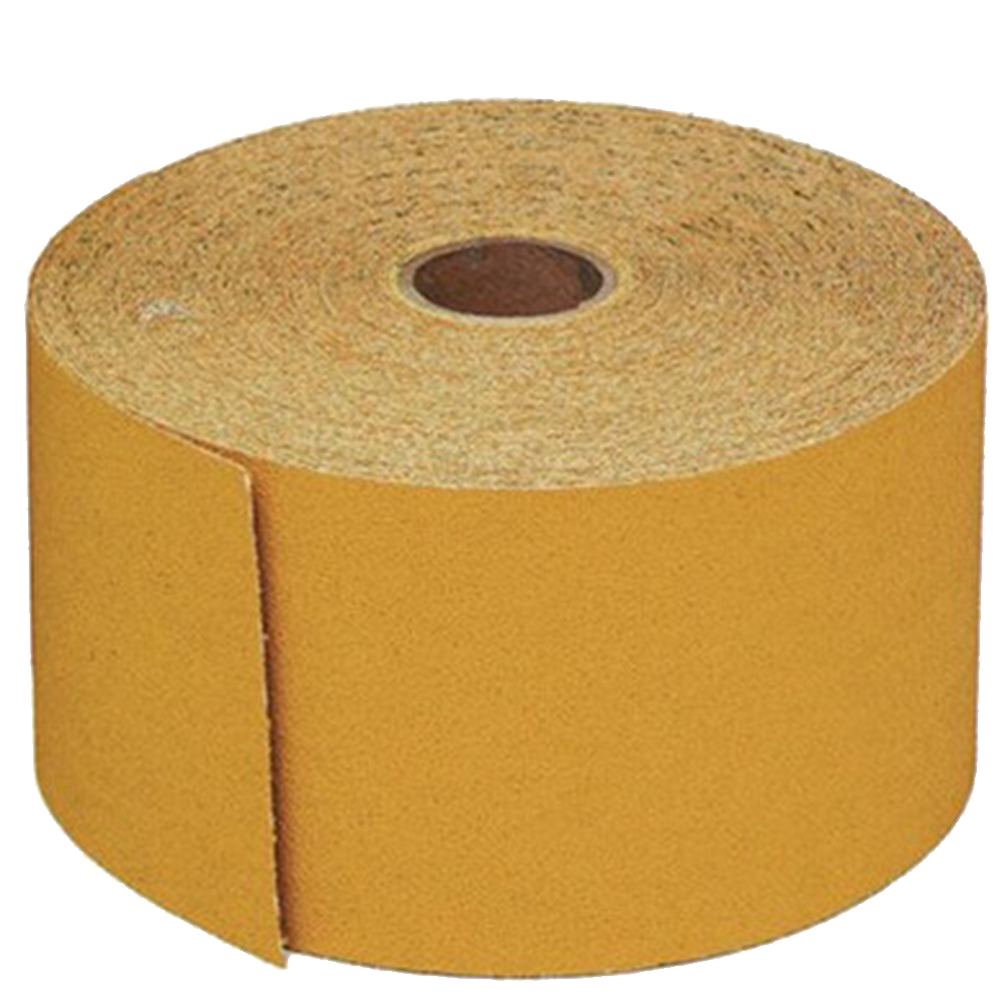
GUSHI Aluminium Oxide Abrasive Sanding Rolls combine tough alumina grain with a resin bond on a flexible J-weight cotton cloth, giving a consumable that resists edge tearing and outlasts silicon carbide on wood, steel and painted surfaces. Supplied as a continuous roll in a dispenser box, the material is torn off at whatever length the job needs — a strip for a sanding block, a short piece for a profile, or a long length wrapped around pipe. Grits run from P40 for stock removal to P600 for fine finishing, in widths from 25 mm to 200 mm and lengths of 25 m or 50 m. They are made by Huzhou Gu’s Imp. & Exp. Co., Ltd., a Zhejiang abrasives and diamond tool manufacturer founded in 2004 that is ISO 9001:2015 certified and exports to more than 20 countries.
Aluminium oxide is the general-purpose abrasive. It is slightly less hard than silicon carbide but considerably tougher, so instead of fracturing it keeps working — which translates into longer life on wood, carbon steel, paint and filler. That is why these rolls are specified for maintenance workshops, pipe and fitting work, joinery and metal fabrication rather than for stone or glass.
The roll format is the other half of the value. Pre-cut sheets force a choice between using a part-worn sheet or wasting a fresh one, and belts only fit one machine. A roll gives exactly the length required for the task, so a workshop can keep one dispenser box per grit and cut material to fit anything from a pipe bend to a wide panel.
Full Specifications
| Parameter | Specification |
|---|---|
| Product name | Aluminium Oxide Abrasive Sanding Rolls |
| Abrasive grain | Aluminium oxide (alumina), Mohs ≈9.0 |
| Grain behaviour | Tough, fracture-resistant, long life |
| Grit range | P40 – P600 (FEPA P-grade) |
| Standard grits | P40 / P60 / P80 / P100 / P120 / P150 / P180 / P240 / P320 / P400 / P600 |
| Backing — standard | J-weight flexible cotton cloth |
| Backing — options | X-weight heavy cloth; A/C-weight paper |
| Coating | Closed coat standard; open coat on request |
| Bond | Resin over resin |
| Anti-clogging | Stearate top coat available |
| Format | Continuous roll in dispenser box, tear to length |
| Standard widths | 25 / 50 / 75 / 100 / 115 mm |
| Wide rolls | Up to 200 mm |
| Roll lengths | 25 m / 50 m |
| Core | Coreless or 1-inch core, by width |
| Tear by hand | Yes — J-weight cloth tears across the weave |
| Wet use | Waterproof construction available on request |
| Max operating temperature | ≈200 °C (resin bond) |
| Typical applications | Hardwood, metal, pipe, weld blending, paint removal, deburring |
| Suitable machines | Hand sanding, sanding blocks, drum and roll sanders |
| Flexibility | High — conforms to edges, curves and profiles |
| Shelf life | ≈24 months stored 18–22 °C / 45–65% RH |
| Packing | 1 roll per dispenser box; 10 rolls per carton |
| Quality system | ISO 9001:2015; 100% inspection before shipment |
| Material compliance | RoHS-compliant materials |
| MOQ | 500 rolls (widths, lengths and grits mixable) |
| Lead time | 5–10 days standard; 15–30 days custom |
| Payment terms | T/T, L/C, D/A, D/P, PayPal |
Why the Roll Format Saves Material
Toughness over sharpness
Aluminium oxide grains are blocky and resist fracture. Where silicon carbide constantly breaks to expose new points — excellent on hard, brittle materials — alumina holds its shape and keeps abrading. On wood, paint and steel that means the same grit keeps cutting for longer, so the roll is consumed more slowly and the finish stays consistent for more of its life.
Cut length, not fixed length
A pre-cut sheet is a compromise: use it once and discard 70% of its life, or keep using it after it has loaded. A roll removes the compromise — tear 150 mm for a sanding block, 400 mm for a long profile, or a metre for wrapping pipe. Material use drops noticeably in workshops that sand a mix of large panels and small profiled parts.
Flexibility at the edge
Edges, corners and profiles are where coated abrasives fail, because the backing creases and the grain sheds. J-weight cloth is light enough to fold over an edge without cracking, which is why flexible cloth rolls are the standard for mouldings, turned parts, pipework and任何其他 curved work rather than stiffer paper-backed products.
Heat, loading and the real failure mode
Most rolls are thrown away not because the grain is worn but because the surface is loaded with paint, resin or metal swarf, or because heat has softened the bond. Open coat and stearate options, correct pressure and a cleaning block address all three, and together they extend usable life more than any change in grit.
Key Features Explained
High-quality alumina with resin bonding
The grain is bonded with a resin system that holds it firmly under the heat of dry sanding and resists the softening that causes premature grain loss. Because the grain is tough rather than friable, the roll keeps cutting through hardwood, primer and steel long after a more brittle abrasive would have glazed over.
Flexible cloth that survives edges
Sanding a sharp edge or a small radius creases stiff material and sheds the abrasive along the fold. The J-weight cotton cloth used here folds without cracking, so the same piece can be worked along a profile and back without falling apart — the practical reason cloth rolls are preferred for detail and maintenance work.
Tear-off convenience
Cloth rolls tear cleanly by hand across the weave, so no scissors, knife or dispenser blade is needed on site. The dispenser box keeps the remaining roll clean and dry between jobs, which matters because dust and humidity are what shorten the life of stored abrasive.
Width range for every task
Narrow 25 mm rolls suit slots, grooves and tight profiles; 50–75 mm covers general hand sanding and blocks; 100–115 mm handles wider flats and drum sanders; and rolls up to 200 mm serve wide sanding machines. One product family covers the whole workshop instead of several specialist formats.
Grain options for soft and loaded materials
Where paint, filler or softwood resin would load a standard closed coat, open-coat and stearate-coated versions keep cutting. Specifying the right coating at the ordering stage costs little and prevents the most common complaint about hand sanding: abrasive that stops working while it still looks new.
Grit, Width and Backing Selection Guide
Three choices decide the result: grit sequence, roll width and backing weight.
| Grit band | Stage | Typical use |
|---|---|---|
| P40 – P80 | Coarse | Paint and varnish removal, shaping, heavy stock removal |
| P100 – P150 | Medium | Removing coarse scratches, general wood and metal prep |
| P180 – P240 | Fine | Final sanding before finishing, hardwood preparation |
| P320 – P600 | Very fine | Between-coat sanding, fine metal finishing, denibbing |
| Job | Recommended sequence | Width |
|---|---|---|
| Hardwood furniture | P80 → P120 → P180 → P240 | 100 / 115 mm |
| Softwood joinery | P80 → P120 → P180 | 75 / 100 mm |
| Paint and varnish removal | P40 → P80 → P120 (open coat) | 75 / 100 mm |
| Carbon steel and welds | P60 → P120 → P240 | 50 / 75 mm |
| Pipe and tube polishing | P120 → P240 → P400 | 25 / 50 mm wrapped |
| Profiles, mouldings, slots | P120 → P180 → P240 | 25 / 50 mm |
Applications & Suitable Materials
Applications
| Application | Why rolls fit | Typical setup |
|---|---|---|
| Pipe and tube finishing | Long lengths wrapped around round stock | P120–P400, 25–50 mm |
| Precision machining support | Short pieces for localised fitting and adjustment | P180–P400 |
| Maintenance and repair | One roll covers many one-off jobs | P80–P240, mixed widths |
| Hardwood and joinery | Fine, consistent scratch before finishing | P80–P240, 100 mm |
| Paint, varnish and filler removal | Open coat resists loading | P40–P120 |
| Deburring and edge breaking | Flexible cloth follows the edge | P120–P240 |
| Metal fabrication and weld blending | Tough grain survives steel work | P60–P240, 50 mm |
Suitable Materials
| Ideal for | Consider another abrasive |
|---|---|
| Hardwood and softwood | Granite and engineered stone (use SiC) |
| Carbon steel, cast iron, weld seams | Glass and porcelain (use SiC) |
| Paint, varnish, primer, filler | Concrete screed (use diamond) |
| Plastics, GRP and composites | Aluminium, where SiC cuts cleaner |
| Copper, brass and bronze | Heavy stainless stock removal (use zirconia) |
| Leather and rubber at coarse grits | Polishing to a mirror finish (use SiC or film) |
Sanding Rolls vs. Belts vs. Sheets and Discs
Three formats of the same coated abrasive. The right one depends on how the work arrives.
| Dimension | Sanding rolls (this product) | Abrasive belts | Sheets and discs |
|---|---|---|---|
| Format | ✓ Continuous, cut to length | Closed loop, fixed size | Pre-cut shapes |
| Length flexibility | ✓ Any length, no waste | Fixed by machine | Fixed |
| Machine required | ✓ None for hand use | Belt sander | Sander or block |
| Contours and pipes | ✓ Excellent — wraps and folds | Poor on tight curves | Limited |
| Flat panel production | Slow, operator dependent | ✓ Fast and consistent | ✓ Good with a sander |
| Finish consistency | Operator dependent | ✓ Machine consistent | ✓ Machine consistent |
| Material waste | ✓ Lowest — cut what you need | Medium | Highest |
| Storage | ✓ Compact dispenser box | Belts need care | Flat packs |
| Cost per square metre | Mid | ✓ Lowest at volume | Low |
| Best for | Mixed work, maintenance, contours, pipe | Production flat and edge sanding | Machine finishing of panels |
Bottom line: Rolls win wherever work is varied, curved or one-off — pipe, profiles, edges, maintenance and repair. Belts and discs take over when the same flat part is being finished repeatedly and machine consistency matters more than flexibility. Most workshops stock both, and the roll is the one that gets used when nothing else fits.
How to Use: Step-by-Step Guide
- Choose the abrasive for the material — aluminium oxide for wood, steel, paint and filler.
- Select the width: narrow for profiles and slots, wide for flats and blocks.
- Pick the starting grit from the selection table, coarse enough to cut but not to gouge.
- Pull the required length from the dispenser box and tear it across the weave.
- Wrap the piece around a sanding block, pad or your hand with a flat backing.
- Sand with the grain on wood, using light, even pressure and overlapping strokes.
- Keep the abrasive moving; dwelling in one spot builds heat and loads the surface.
- Check progress often, and clean or replace the abrasive once it stops cutting.
- Progress one grit step at a time, removing the previous scratches each time.
- For pipe, wrap a long strip around the tube and work it back and forth for an even finish.
- Clean loaded abrasive with a crepe rubber block, or replace it rather than pressing harder.
- Return the roll to its box and store flat at room temperature and moderate humidity.
Build a complete abrasives range: Silicon Carbide Abrasive Belts for stone and non-ferrous work, Diamond Sanding Sheets, and Diamond Hand Polishing Pads.
Preguntas frecuentes
Aluminium oxide or silicon carbide — which roll should I buy?
Buy aluminium oxide for wood, hardwood, steel, paint, filler and general maintenance, where a tough grain that resists fracture lasts longest. Buy silicon carbide for stone, glass, porcelain, aluminium and other non-ferrous metals, rubber and plastics, where a sharper, more friable grain cuts cooler and leaves a finer scratch pattern. Both are stocked by GUSHI in roll form.
Can the roll be torn by hand or does it need cutting?
J-weight cotton cloth rolls tear cleanly across the weave by hand, which is why they are the standard choice for hand sanding and site work — no scissors or dispenser blade needed. Heavier X-weight cloth and paper-backed rolls are better cut with a blade or a dispenser cutter for a straight, fray-free edge.
What widths, lengths and grits are available?
Standard widths are 25, 50, 75, 100 and 115 mm, with wider rolls to 200 mm for drum and wide sanding, supplied in 25 m or 50 m lengths. Grits run from P40 through P600, with P40 to P120 for stock removal, P150 to P240 for preparation and P320 to P600 for fine finishing. Custom widths, lengths and grit mixes are available on OEM orders.
What grit sequence should I use on wood and on metal?
On hardwood, work P80 then P120 then P180 and finish at P240; on softwood stop at P180 to avoid burnishing. On bare steel, use P60 then P120 then P240, extending to P400 where a finer finish is needed. Never skip more than one grit step, because each stage only removes the scratches left by the previous one.
Can these rolls be used on metal, and will they contaminate stainless steel?
Aluminium oxide is the standard abrasive for carbon steel, cast iron and general metal work and performs well there. On stainless steel it also cuts well, but you should keep separate rolls for stainless and never use a roll that has previously been on carbon steel, because embedded iron particles can rust and stain the stainless surface.
Can they be used wet?
Standard rolls are resin-bonded for dry use, which suits wood, metal and paint work. A waterproof cloth and resin system is available for wet sanding where heat and dust need to be controlled, for example on filler, primers and some stone work. Specify wet or dry when ordering so the correct bond is supplied.
How do I stop the roll clogging on paint and filler?
Paint, varnish and body filler soften with heat and pack between the grains. Use an open-coat or stearate-coated roll, sand with light pressure and a block rather than bare fingers, keep the surface moving, and clean a loaded sheet with a crepe rubber cleaning block. If the abrasive stops cutting, replace it rather than pressing harder.
What is the MOQ and what can be customised?
The OEM MOQ is 500 rolls, and widths, lengths and grits can be mixed in one order. Customisation covers roll width and length, grit range, backing weight and colour, open or closed coat, stearate top coat, core size, private-label dispenser boxes and cartons. Production runs under ISO 9001:2015; lead time is 5 to 10 days standard and 15 to 30 days for custom.
OEM & Wholesale Information
| OEM / wholesale parameter | Details |
|---|---|
| MOQ | 500 rolls; widths, lengths and grits mixable |
| Custom sizes | Width 25–200 mm; length 25 m or 50 m, other lengths on request |
| Custom specification | Backing weight and colour, closed or open coat, stearate top coat, core type |
| Private label | Custom dispenser box print, labels, shrink sleeves and cartons |
| Standard packing | 1 roll per dispenser box; 10 rolls per carton |
| Sample policy | Samples at cost price plus freight; fee refunded on the official order |
| Payment terms | T/T, L/C, D/A, D/P, PayPal |
| Port of loading | Shanghai or Ningbo, China |
| Quality control | 100% inspection before shipment; ISO 9001:2015, SGS |
| Service languages | English, Spanish, Japanese, Russian, French, German |
Huzhou Gu’s Imp. & Exp. Co., Ltd. (brands GUSHI Tools and Roycel) has manufactured abrasives, tile installation tools and diamond tools from Zhejiang since 2004, drawing on a supply chain active in this industry since 1998 and a production capacity of 100,000 sets per month. The company is ISO 9001:2015 certified, exports to more than 20 countries including the USA, Germany, the UK, the Netherlands, Brazil, Chile and Australia, and was one of 23 Chinese firms that won the US anti-dumping case on diamond blades at a 6.2% rate.
Continue through the abrasives range: Silicon Carbide Abrasive Belts, Diamond Sanding Sheets, and Abrasive Sanding Discs.