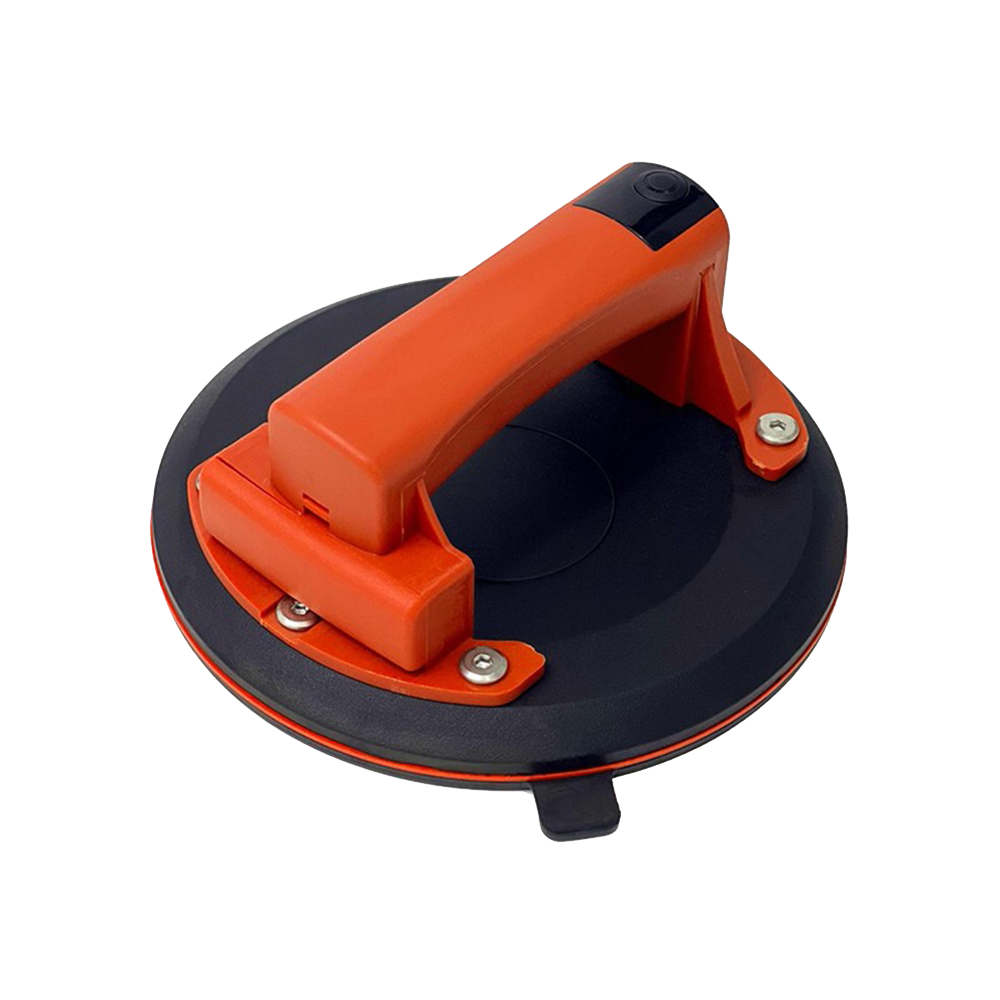
Product Overview

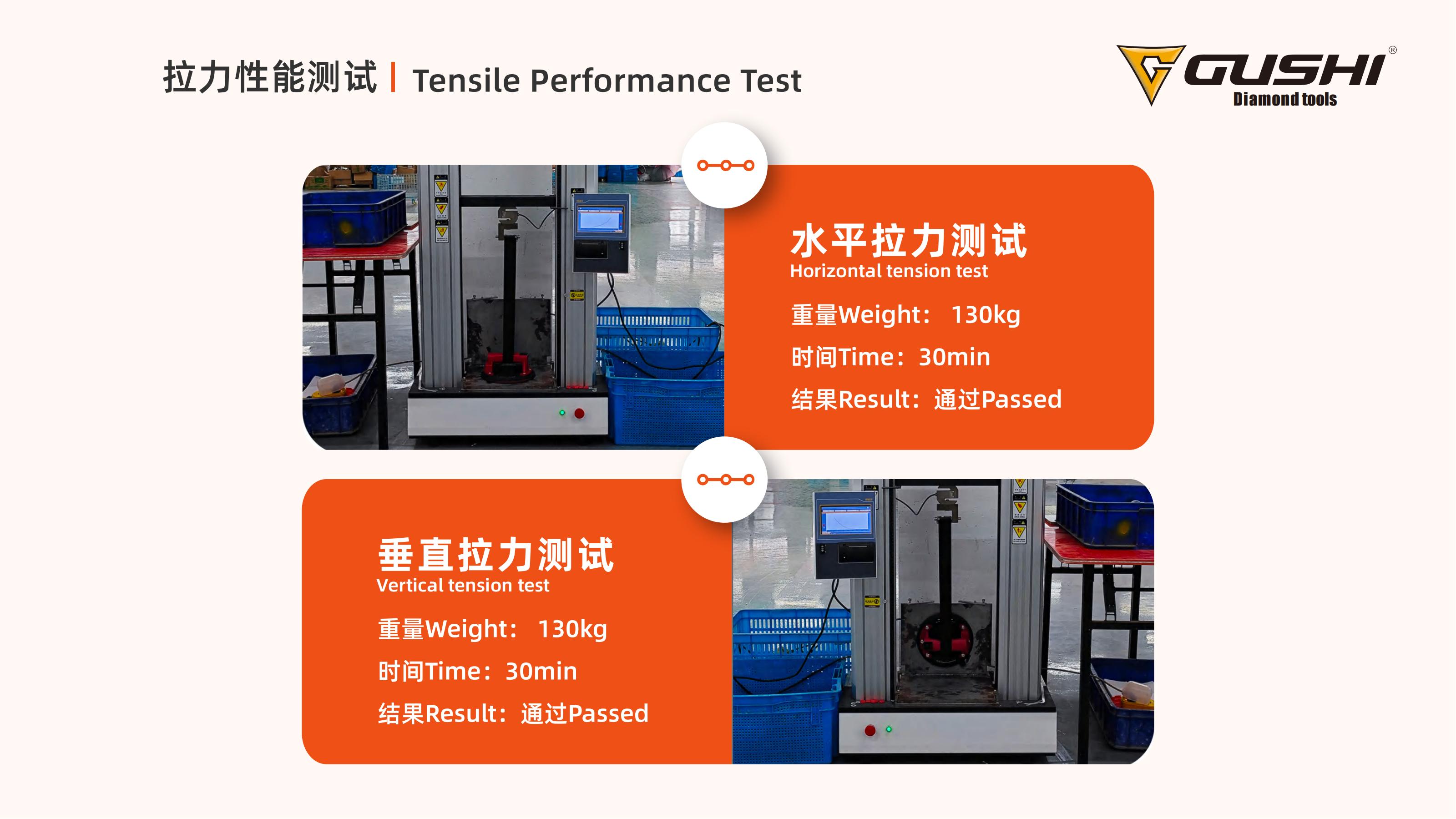

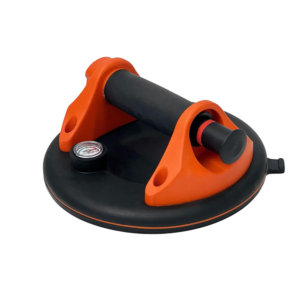
The GUSHI Digital Electric Vacuum Suction Cup (SC-B001) is a battery-powered lifter with a 200 mm rubber pad, a 150 kg (330 lb) safe vertical working load and an integrated digital display that reports live vacuum pressure in kPa. One short press takes the pump to about -75 kPa in 4–6 seconds; when pressure later falls below -60 kPa, the pump restarts automatically for 1–2 seconds and the display updates in real time. The external 7.4 V 2000 mAh battery is hot-swappable and runs 5–7 days per charge. It is manufactured by Huzhou Gu’s Imp. & Exp. Co., Ltd., a Zhejiang factory founded in 2004 that is ISO 9001:2015 and CE certified, inspects 100% before shipment and exports to more than 20 countries.
The display is the reason to buy this model rather than a simpler electric cup. An LED bar tells you the vacuum is “probably fine”; a numeric reading tells you it is -73 kPa, which is a number you can set a rule against — lift above -60 kPa, reposition below -50 kPa. On a 1200 × 600 mm porcelain slab worth US$50–200, turning a guess into a one-second verified check is the cheapest insurance on the job site.
Within the GUSHI range this is the digital standard model. It sits above the SC-B002 electric cup with its LED indicator and 120 kg rating, and below the two double-layer flagships: the GSH-DSC210 (210 mm round, 220 kg) and the GSH-DISC167 (167 × 247 mm rectangular, 260 kg). Those add a double-layer seal for matte and lightly textured surfaces plus an automatic cleaning cycle. If your material is smooth and your panels are under 150 kg, this model does the job for less money.
Full Specifications
| Parameter | Specification |
|---|---|
| Product name | Digital Electric Vacuum Suction Cup |
| Model | SC-B001 |
| Type | Battery-powered vacuum lifter with digital pressure readout |
| Suction pad diameter | 200 mm (8 in) |
| Pad construction | Single-layer high-elastic rubber, non-marking |
| Safe vertical working load | 150 kg (330 lb) |
| Maximum horizontal (shear) load | 200 kg |
| Working vacuum level | ≈-75 kPa reached in 4–6 seconds |
| Auto re-pump threshold | Restarts for 1–2 s when pressure falls below -60 kPa |
| Theoretical pull-off force | ≈2,350 N at -75 kPa (≈240 kgf) |
| Safety factor (rated vs theoretical) | ≈1.6:1 |
| Display | Integrated digital LCD: vacuum (kPa/bar), battery %, mode icon |
| Low-pressure warning | Yes — display alert below the safe threshold |
| Control scheme | Long press on/off · short press start · double click release |
| Battery type | External, replaceable lithium-ion, tool-free hot-swap |
| Battery capacity | 2000 mAh |
| Output voltage | 7.4 V DC |
| Power consumption | 3.5 W |
| Charging time | ≈3 hours |
| Battery life | 5–7 days at 2–4 hours of daily use |
| Automatic pressure maintenance | Yes — continuous sensor-controlled air supply |
| Release mechanism | Electric release valve plus manual override |
| Check valve | Holds vacuum with the pump off or battery removed |
| Housing material | PA6 engineering plastic with rubber over-grip |
| Operating temperature | -10 °C to +50 °C |
| Surface compatibility | Flat, smooth, clean, non-porous |
| Net weight (with battery) | ≈1.3 kg |
| Packing | 1 pc colour box; 8 pcs/outer carton |
| Compliance | CE, RoHS, UN38.3 (battery transport) |
| Certifications | ISO 9001:2015, CE, SGS inspected | Warranty 12 months |
| MOQ | 100 units |
| Lead time | 7–15 days stock; 20–30 days OEM |
How the Digital Vacuum System Works
Evacuation and the number on the screen
A short press starts the pump, which evacuates the chamber between the rubber pad and the panel. On clean, flat glass or glazed tile it reaches roughly -75 kPa in 4 to 6 seconds and then stops by itself. That pressure is measured, not assumed: a sensor inside the chamber feeds the display, so the operator sees the actual value rather than an indicator light that only means “pump ran”.
What -75 kPa actually buys you
Holding force is pad area times pressure difference. A 200 mm pad has about 314 cm² of contact area, so at -75 kPa it develops roughly 2,350 N — the equivalent of about 240 kg of pull-off force under ideal static conditions. The published rating is 150 kg, which keeps a safety factor near 1.6 for the vibration, tilting and imperfect surfaces of real work. The gap between those two numbers is deliberate, not保守 padding: it is what stops a slab from falling when someone walks over an uneven floor.
Closed-loop maintenance at -60 kPa
Air always seeps back under the seal, and faster on matte or slightly textured material. When the sensor sees pressure rise past -60 kPa, the pump restarts for 1 to 2 seconds and the display climbs back to the working band. You can watch that happen, which tells you two useful things: how often it is happening, and whether repositioning would fix it. Frequent top-ups mean the surface is leaking, not that the tool is failing.
Gesture control and safe release
One button runs everything: long press powers on and off, a short press starts the pump, and a double click opens the release valve. There is no menu to navigate with gloves on, and because a check valve holds the vacuum, power loss does not release the load. The manual override valve works even with a flat battery, so a panel is never stuck to a dead tool.
Key Features Explained
Numeric pressure readout
This is the feature that separates the digital model from an LED electric cup. A numeric value lets a supervisor set a rule — “no lift below -60 kPa” — and lets an operator follow it without judgement calls. It also makes handover between crews consistent, because the number means the same thing to everyone on site.
150 kg capacity from a 200 mm pad
The pad is sized to spread 150 kg across about 314 cm² so the load does not stress or crack large-format porcelain. The high-elastic rubber conforms to minor flatness variation in the tile, and the non-marking compound leaves no residue on glass, polished stone or painted panels.
Automatic pressure maintenance
Continuous sensor-controlled vacuum is what makes long positioning jobs safe. Instead of remembering to re-pump every 30 minutes, the tool does it the moment pressure drops — so a slab being aligned, shimmed and pressed home stays gripped the whole time.
External 2000 mAh battery with 5–7 day life
The pack mounts outside the housing and comes off without tools in under 10 seconds, so a spare on the charger removes downtime entirely. Five to seven days of typical use per charge and a 3 hour recharge mean the tool is charged overnight rather than managed during the shift, and the battery percentage on screen makes swaps plannable.
Built for the GUSHI ecosystem
The same battery platform, gesture language and pad thread are used across the digital range, so crews moving between this model and the 220 kg GSH-DSC210 need no retraining, and distributors can stock one family of spares. That commonality is why many customers buy across the range rather than model by model.
Reading the Display: Safe Pressure Zones
The display is only useful if the number means something. Use these zones as the standard rule on site.
| Display reading | Zone | What to do |
|---|---|---|
| -75 to -80 kPa | Excellent | Full vacuum on a smooth surface — safe for the rated 150 kg |
| -65 to -75 kPa | Safe working band | Lift normally; pump will top up automatically |
| -60 kPa | Auto-pump threshold | Pump restarts for 1–2 s — normal, no action needed |
| -50 to -60 kPa | Caution | Reduce the load; check pad and surface for dust or damage |
| Above -50 kPa | Unsafe | Set the panel down, reposition or move to a double-layer model |
| Surface | Typical stable reading | Recommended max load |
|---|---|---|
| Glass, mirror, glazed ceramic | -75 to -80 kPa | 150 kg (full rating) |
| Polished porcelain | -70 to -78 kPa | 150 kg |
| Polished marble and granite | -68 to -75 kPa | 140 kg |
| Matte porcelain | -60 to -70 kPa | 100 kg (reduce ~35%) |
| Lightly textured tile | -55 to -65 kPa | Use GSH-DSC210 / GSH-DISC167 instead |
Applications & Suitable Materials
Applications
| Application | Why the digital model fits | Setup |
|---|---|---|
| Large-format porcelain panel installation | Verified pressure before lifting expensive slabs; auto-hold during alignment | 1 cup ≤150 kg; 2 cups over 1.5 m |
| Glass and window panel handling | Numeric check before each lift; non-marking pad | 1–2 cups, vertical carry |
| Marble and granite countertop setting | Steady hold while scribing and levelling | 2 cups for slabs over 1.5 m |
| Wall tile and backsplash work | Hands-free hold lets one installer position precisely | 1 cup |
| Commercial tiling contracts | Consistent, trainable safety rule across crews | 1 cup per installer + spare battery |
| Mirror, shower screen and glass door fitting | Confirmed grip in tight, finished spaces | 1 cup |
| Factory and warehouse panel transfer | Battery swap supports continuous shifts | 1–2 cups, spare battery on charge |
Suitable Materials
| Holds at full rating | Reduce load / use another model |
|---|---|
| Float, tempered and laminated glass | Matte porcelain — reduce load to ~100 kg |
| Glazed ceramic and polished porcelain tile | Lightly textured tile — use double-layer models |
| Polished marble, granite and engineered quartz | Honed or flamed stone — use a mechanical clamp |
| Stainless steel and painted sheet metal | Raw concrete, brick and open-porous stone — no seal possible |
| Acrylic and finished composite panels | Wet, oily or dusty surfaces of any material |
Digital vs. LED Electric vs. Manual Cup
Three levels of feedback, three price points. Pick the one that matches how much verification your crews need.
| Dimension | Digital SC-B001 (this model) | Electric SC-B002 (LED) | Manual SC-A001 |
|---|---|---|---|
| Grip feedback | ✓ Numeric vacuum in kPa + battery % | LED indicator bar | Red-line indicator |
| Safe load | ✓ 150 kg | 120 kg | 60–150 kg by pad size |
| Rule you can enforce | ✓ “No lift below -60 kPa” | Light colour only | Visual line position |
| Vacuum maintenance | ✓ Automatic, sensor-controlled | ✓ Automatic | Manual re-pump |
| Pad | 200 mm single-layer rubber | 200 mm single-layer rubber | 120/160/200 mm rubber |
| Battery | 2000 mAh, 5–7 days | 1500 mAh, 3–5 days | ✓ None required |
| Charging time | ≈3 h | ≈2.5 h | ✓ n/a |
| Net weight | 1.3 kg | 1.1 kg | ✓ 0.9–1.5 kg |
| Power dependency | Battery, hot-swappable | Battery, hot-swappable | ✓ None |
| Price per unit | US$48–110 | ✓ US$35–90 | US$3–18 |
| Best for | Crews who must verify pressure before each lift | Everyday electric lifting at the lowest electric price | Intermittent work, no-power sites, backup tool |
Above this range: the GSH-DSC210 (210 mm double-layer, 220 kg, automatic cleaning) and the GSH-DISC167 (167 × 247 mm rectangular double-layer, 260 kg, dual motor) take over when panels get heavier or surfaces get rougher.
Bottom line: Buy the digital model when the cost of a dropped panel exceeds the price difference — which, on large-format porcelain, it does after the first slab. Buy the LED electric model for lighter everyday work, and keep a manual cup in every van as the tool that never needs charging.
How to Use: Step-by-Step Guide
- Charge the battery before the shift (≈3 h) and confirm the display shows full percentage.
- Inspect the rubber pad and sealing lip — no cuts, no embedded grit, no permanent flat spots.
- Clean and dry the panel surface; the pad needs a smooth, non-porous, dust-free contact area.
- Confirm the load: ≤150 kg vertical, ≤200 kg horizontal, less on matte or imperfect surfaces.
- Place the cup flat on the panel, at the centre of gravity or the quarter points with two cups.
- Long press to power on, then short press to start the pump; it stops by itself at full vacuum.
- Read the display: lift only at -60 kPa or deeper, with -75 kPa as the normal target.
- Do a 5 cm test lift and hold; if the reading falls quickly or the pump fires repeatedly, reposition.
- Carry smoothly with the panel vertical where possible, keeping the load close to the body.
- Watch the display during positioning — brief 1–2 second pump bursts are normal and expected.
- Double click to release the vacuum and set the panel down; long press to power off.
- Swap in the spare battery when percentage runs low; wipe the pad and store the tool dry.
Complete the handling kit with the Electric Vacuum Suction Cup SC-B002, the Manual Vacuum Suction Cup SC-A001, and the G-Ultra Lifter.
Preguntas frecuentes
What does the digital display show and how do I read it?
The integrated LCD reports live vacuum pressure as a numeric value in kPa or bar, battery charge as a percentage, and the active mode icon. Read it as a traffic light: -75 to -60 kPa is the safe working band, -60 kPa is the threshold where the pump restarts automatically, and anything above -50 kPa means the seal is leaking and you should set the panel down and reposition. Checking that number takes one second and replaces the guesswork of a manual cup.
What vacuum reading is safe before lifting?
Lift only when the display reads -60 kPa or deeper, with -75 kPa as the normal target after 4 to 6 seconds of pumping. At -75 kPa a 200 mm pad develops about 2,350 N, roughly 240 kgf of theoretical pull-off force, and the 150 kg rating keeps a safety factor near 1.6. If the reading will not reach -60 kPa, the surface or the pad is the problem, not the pump.
How is this different from the SC-B002 electric suction cup?
SC-B001 is the digital model: 150 kg safe load, a numeric LCD showing actual vacuum in kPa, a 2000 mAh battery rated for 5 to 7 days, and a 200 mm pad. SC-B002 is the simpler electric model: 120 kg load, an LED indicator bar rather than a numeric readout, and a 1500 mAh battery rated for 3 to 5 days. Choose the digital model when operators need to verify the pressure value, not just see a light.
Should I step up to the 220 kg or 260 kg digital models instead?
Step up to the GSH-DSC210 (210 mm double-layer, 220 kg) or the GSH-DISC167 (167 x 247 mm rectangular double-layer, 260 kg) when panels exceed 150 kg, when material is matte or slightly textured, or when you want the automatic cleaning cycle. The double-layer seal bridges surface irregularities that a single-layer pad cannot, and the rectangular footprint grips long narrow slabs where a round cup would overhang.
How long does the battery last and can it be swapped?
The external 7.4 V 2000 mAh lithium pack delivers 5 to 7 days of typical use at 2-4 hours per day and recharges in about 3 hours at 3.5 W. It is mounted externally and can be replaced without tools in under 10 seconds, so a spare pack on the charger eliminates downtime. The display shows battery percentage, so swaps can be planned rather than discovered.
Does the pump keep working while I am carrying a panel, and what if the battery dies?
Yes. The pressure sensor monitors the chamber continuously and the pump restarts for 1 to 2 seconds whenever vacuum drops below -60 kPa, so grip is maintained while you carry and position. If the battery fails completely, a check valve holds the vacuum and the load stays attached; you can still release with the manual override valve. Never leave a panel suspended unattended.
Can it be used on matte or slightly textured tiles?
The single-layer pad is designed for smooth, sealed, non-porous surfaces: glass, glazed ceramic, polished porcelain, polished stone and metal. On matte or lightly textured material it will hold but leaks faster, so reduce the load by 30 to 50 percent and watch the display. For daily work on textured surfaces, the double-layer GSH-DSC210 or GSH-DISC167 is the correct tool.
What certifications does it hold and how is the battery shipped?
The product is manufactured under ISO 9001:2015 and carries CE and RoHS certification, with the lithium pack certified to UN38.3 for transport. We supply MSDS and battery documentation for air and sea freight, and orders can also ship battery-free with packs packed separately if your market prefers. Warranty is 12 months and OEM MOQ is 100 units.
OEM & Wholesale Information
| OEM / wholesale parameter | Details |
|---|---|
| MOQ | 100 units; digital, electric and manual models can be mixed |
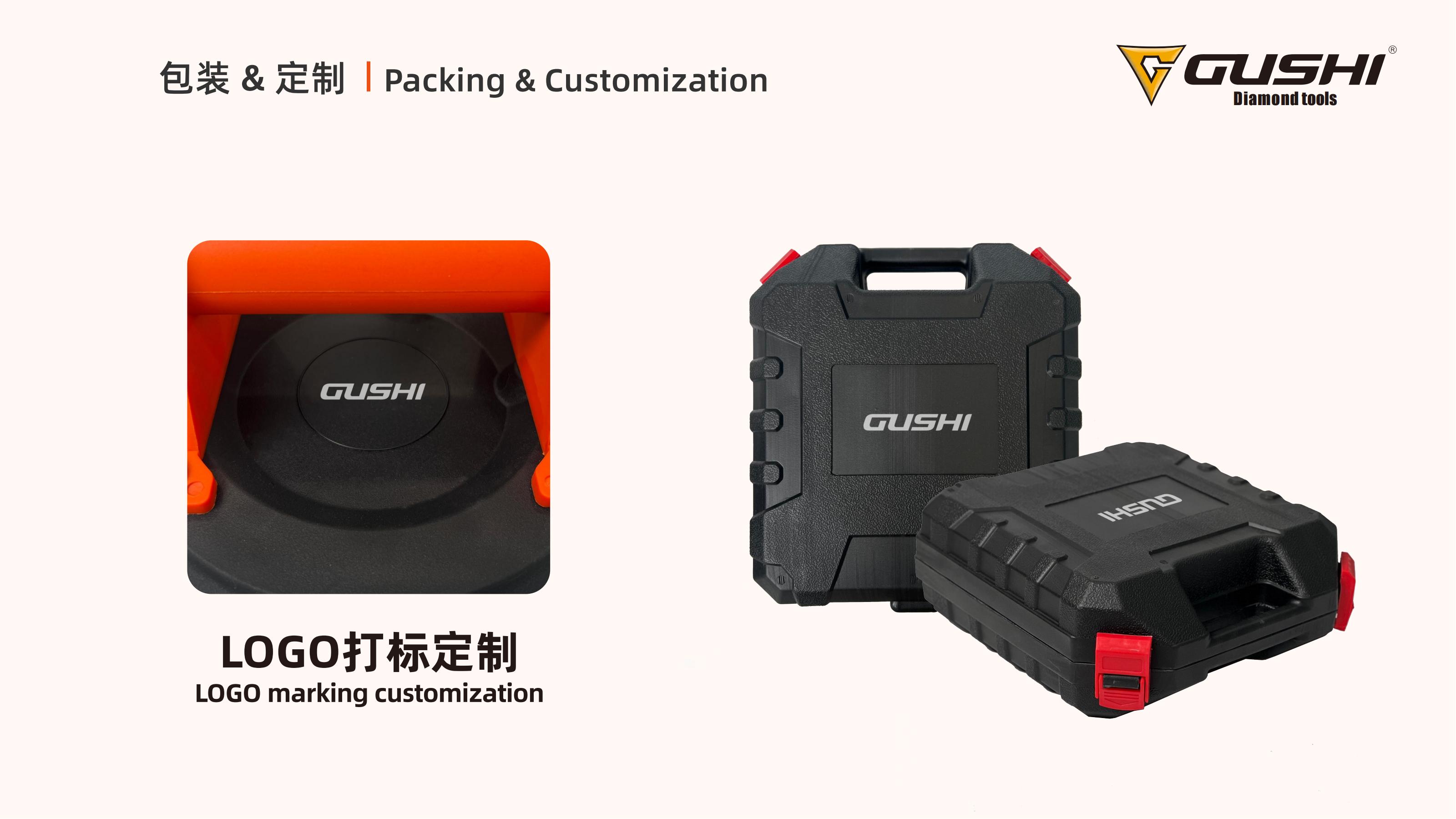
| Customisation | Housing colour, logo printing, pad compound, display language, packaging artwork |
| Colour options | Black / Red / custom Pantone on request |
| Battery options | Ship with battery, battery-free, or separate spare packs; UN38.3 and MSDS provided |
| Charger options | EU, US, UK and AU plugs; connector type on request |
| Packing | 1 pc colour box, 8 pcs/outer carton; private-label artwork supported |
| Sample policy | Samples at cost price plus freight; fee refunded on the official order |
| Payment terms | L/C, T/T, Western Union, PayPal |
| Port of loading | Shanghai or Ningbo, China |
| Quality control | 100% inspection before shipment; ISO 9001:2015, CE, RoHS, SGS |
| Warranty | 12 months |
Huzhou Gu’s Imp. & Exp. Co., Ltd. (brands GUSHI Tools and Roycel) has manufactured and exported tile installation and material handling tools from Zhejiang since 2004, backed by a supply chain active in this industry since 1998 and a production capacity of 100,000 sets per month. The company is ISO 9001:2015 and CE certified, exports to more than 20 countries including the USA, Germany, the UK, the Netherlands, Italy, Brazil, Australia and South Africa, and was one of 23 Chinese firms that won the US anti-dumping case on diamond blades at a 6.2% rate. Many distribution partners have worked with us for over a decade.
Continue through the suction cup range: 8-Inch Digital Suction Cup (210 mm), Double Layer Integrated Digital Suction Cup (167 × 247 mm), and Electric Vacuum Suction Cup SC-B002.