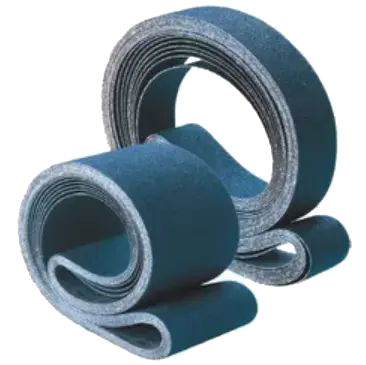
1. Our own copy: “stronger” is the wrong word
The listing is four sentences long and three of them contain a technical error. None of the errors is cosmetic: each one points the buyer at the wrong product for their material.
| What the source copy says | What is wrong | What we say instead |
|---|---|---|
| “silicon carbide particles are stronger than alumina particles” | Wrong property. Silicon carbide is harder (roughly 2,500–2,800 Knoop against about 2,000) but less tough; it is more friable and fractures more readily. Strength is not the axis | Harder and sharper, but more brittle. That distinction decides where it works — section 5 |
| “good wear resistance” | Inverted. Silicon carbide stays sharp by fracturing, so the grain is consumed. On most work it wears faster than aluminium oxide, not slower | It maintains a sharp edge by controlled fracture. That is a different virtue from wear resistance — section 6 |
| “suitable for light metal finishes, as well as wood, aluminum, fiberglass, rubber, and plastics” | Wood is the wrong headline. General wood stock removal is aluminium oxide work. Silicon carbide is used on lacquers, paints and finishes, and it is specifically poor on softwood because the grain microfractures instead of sharpening | Glass, stone, ceramic, cast iron, non-ferrous metal, paint and lacquer, plastics, rubber. Wood only as a finish, not as stock removal |
| “bidirectional adhesive tape joint … can be driven in any direction” | Correct, but only because it is a butt splice. On a lap splice the same sentence would be dangerous: run backwards, the work catches the exposed edge and peels the joint open | Bidirectional is a property of the butt splice, not of belts in general — section 3 |
| No grit, width, length, backing or coat | These five fields decide whether the belt fits the machine and the job. A belt order without them is not an order | P or CAMI grit, width × length, joint type, coat, backing — section 12 |
The first two errors are the expensive ones, because they both point the same way: towards “harder is better”. A buyer who believes that will put a silicon carbide belt on steel, watch it load and dull, and conclude that the belt is poor. It is not poor; it is the wrong mineral for that workpiece, and the listing told them to expect otherwise.
2. A belt is the only abrasive that must be cut and rejoined
This sounds like a manufacturing detail. It is actually the organising fact of the product, and it explains most of what follows.
| Form | Continuous surface? | Runs under tension? | Joint? | What fails first |
|---|---|---|---|---|
| Sheet | Yes | No | None | Grain wear or loading; the sheet is simply replaced |
| Disc | Yes | No — held on a backing pad | None | Edge wear, or the backing pad rather than the abrasive |
| Detail disc | Yes | No | None | Corner wear; the tips do the work and go first |
| Belt | No — one interruption | Yes | Yes | The joint, before the grain is spent |
| Roll | Yes | No | None | Loading or grain wear; torn off and discarded |
So the belt is the only coated abrasive whose performance is limited by a bond that is not the abrasive bond. Everything else — grain, coat, backing — is continuous. The joint is a discontinuity, and the whole product is an exercise in making that discontinuity behave as if it were not there.
What the loop changes about the physics
Three consequences follow directly, and they are worth separating because they are often confused:
- Tension. The belt is stretched around two or more rollers. The tape in a butt splice carries that tension continuously, which is why the tape is specified in kilograms per centimetre rather than in adhesive strength.
- Cyclic bending. Every revolution, the joint bends over the contact wheel and straightens again. That is a fatigue cycle on a polymer bond, and it is the reason belt joints fail progressively rather than instantly.
- A repeating interruption. The joint passes the work once per revolution. Any difference in thickness there is pressed into the surface once per revolution, which is exactly the frequency of the mark a belt leaves when the splice is proud.
This is also why the belt is the one coated abrasive where the backing has to be strong rather than merely flexible. Paper is fine for a sheet or a disc that is never tensioned; a belt under load generally wants cloth, because the backing has to survive the same tension and bending as the joint.
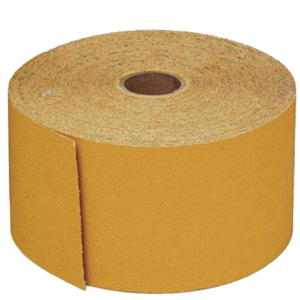
And it explains why the family splits by form rather than by grit: the aluminium oxide abrasive sanding roll is a continuous strip torn off by hand, so it has no joint and no tension, and its whole set of trade-offs is different. That is the correct place to look if the job is hand work rather than machine work.
3. The joint decides direction, mark and failure
Joint type is not a purchasing detail. It decides whether the belt can be reversed, whether it leaves a mark on the work, and how it will eventually fail. There are five forms in common industrial use.
| Joint | How it is made | Directional? | Mark on work | Where it belongs |
|---|---|---|---|---|
| Butt splice | Ends cut at an angle, butted edge to edge, reinforced tape on the back | No — bidirectional | None on most work | The standard. Almost everything, and the strongest of the non-specialty joints |
| Lap splice | One end skived thin and overlapped over the other, bonded | Yes — arrow on the back | Possible, because the overlap is thicker | Paper and thin flexible backings, some older machines, where heat flexibility matters |
| Sine-lock / wave | Butt joint cut in a wave or zig-zag rather than a straight line | No | Very low | Wide belts, glass, machines that dislike a straight joint passing in one instant |
| Top skive | Grain shaved along the joint so it sits below the surface | No | None | X-weight cloth wide belts that were marking furniture parts |
| Tape on top | Joint tape applied on the abrasive side instead of the back | No | None | Wide belts in woodworking where a mark-free joint is required |
The arrow is not decoration
A lap splice must run so that the overlap trails. Run it the other way and the workpiece meets the exposed leading edge of the joint, lifts it, and peels the splice open. The failure is fast and loud, and it is almost always reported as a bad belt rather than as a belt installed backwards.
A butt splice has no such constraint, because there is no overlap to catch. That is the real content of the listing’s “can be driven in any direction”: it is a statement about the splice, and it would be false on a lap belt.
Bidirectional is a working tool, not just a convenience
Because a butt-spliced belt can run either way, a partly loaded or glazed belt can be taken off and put back on the other way round. The grain that was doing the least work is now in the cut, and some cutting performance comes back for free. This is a genuine field technique, and it only exists because of the joint type.
4. Why the joint is the weakest part
Belt manufacturers describe the joint as the weakest part of the belt, and the description is not modesty. It is a consequence of the geometry, and it can be traced through three separate load paths.
The tape is the load path
In a butt splice the two ends do not overlap — they meet. The only thing holding the loop closed is a tape on the back: typically about 19 mm wide, between 75 and 160 microns thick, rated to carry more than 60 kg per centimetre of width. The entire tension of a running belt passes through that tape, in shear, continuously.
That is why the tape is specified by tensile rating rather than by adhesive strength, and why a cheap belt fails at the joint rather than in the grain. The abrasive is not the limiting component.
The joint is the only thickness step
A belt is a continuous surface except at one line. In a wide belt sander the belt is pressed between the contact drum and the work over a very short arc — roughly 3 mm on many machines. Anything thicker than the belt at that point is pressed harder into the surface, once per revolution. That is the mechanism behind a mark that repeats at exactly the joint spacing.
It bends every revolution
The joint passes over the contact wheel and the idler every revolution, so the tape and the bond line are in cyclic shear and cyclic bending at the same time. Polymers do not fail from a single overload in this situation; they fail from accumulated cycles, usually starting at an edge or a void in the bond line.
The diagnostic that separates joint from everything else
Draw a crayon or pencil line across the abrasive at the splice. Sand a scrap piece lightly. Look at where the crayon has transferred and compare the spacing of those marks with the spacing of the defect you are chasing. If the two match, the joint is the cause. If they do not, the problem is tracking, tension, feed or the contact wheel.
5. Grain selection: hardness matched to tensile strength
This is the part of the page where the listing’s logic has to be inverted. The question is not “which grain is harder”, it is “which grain survives the workpiece”. Those give opposite answers on steel.
| Property | Silicon carbide | Aluminium oxide |
|---|---|---|
| Knoop hardness | Roughly 2,500–2,800 | About 2,000 |
| Character | Harder and sharper, but friable — it fractures readily | Softer, but much tougher — it resists fracture |
| How it stays sharp | Microfracture exposes new edges — self-sharpening, at the cost of grain life | Grain dulls, then the bond releases it and exposes the next layer |
| Best workpiece | Low tensile strength and hard-brittle: grey cast iron, glass, stone, ceramic, brass, copper, aluminium, carbide | High tensile strength: carbon and alloy steel, hardened steel, annealed malleable iron, wood |
| On the wrong material | Steel: the grain fractures before it cuts, and silicon has an affinity for iron, so the belt loads and wears | Glass and stone: the tough grain glazes and cuts slowly instead of fracturing to a fresh edge |
The rule, stated properly
Match the grain to the tensile strength of the workpiece, and pick the grain one step tougher than the material demands. Ductile, high-tensile work needs a grain that can survive being dragged through a chip without shattering; hard, brittle work needs a grain that stays sharp by breaking.
That is why the selection guides put cast iron and aluminium on silicon carbide and steel on aluminium oxide, even though silicon carbide is the harder of the two. The harder grain loses on the tougher material, because it never gets the chance to do useful work.
Where the listing’s material list goes wrong
The copy lists wood first among the materials. For coated abrasives, general wood stock removal is aluminium oxide work: the grain is tough, the loading is heavy, and the cost matters. Silicon carbide does have a wood role — sanding between coats of lacquer, and finishing MDF and painted surfaces — but that is a finishing role, not a stock-removal one.
On softwood specifically, silicon carbide is a poor choice: the grain microfractures under the light loads that softwood allows, and the result is burnishing rather than cutting. This is exactly the kind of sentence that belongs on a product page and never appears on a listing.
For the harder end of the same logic, stone and ceramic work usually belongs with diamond rather than with either conventional grain: a resin bond grinding disc for stone or a T segment grinding cup wheel removes stone by a different mechanism entirely.
6. Why silicon carbide is fast but not long-wearing
The two claims in the listing — “fast” and “good wear resistance” — are in tension, and only one of them is true. Understanding why resolves the confusion.
Friability is the mechanism
Silicon carbide grains are sharp and angular, and they are brittle. Under load, the corners fracture off. Each fracture exposes a new sharp edge, so the belt keeps cutting even as the grain gets smaller. This is self-sharpening, and it is genuinely valuable: it is why a silicon carbide belt cuts fast on glass and stone without glazing.
But the same property means the grain is being consumed. A self-sharpening grain has a finite number of fractures in it, and once the grain is too small to cut, the belt is finished. Aluminium oxide, being tougher, holds its shape longer and typically lasts longer on work it is suited to.
The steel problem is chemical as well as mechanical
On steel, two effects combine. Mechanically, the friable grain fractures before it has removed much material, because the workpiece is tough enough to break it rather than be cut by it. Chemically, silicon and carbon have an affinity for iron at the grinding interface, which accelerates attrition and encourages the swarf to stick.
The result is a belt that loads, dulls and heats — all the symptoms a buyer would read as “poor quality”. They are not quality symptoms. They are a mineral choice that contradicts the workpiece.
What to say instead of “wear resistance”
The honest claim is about edge maintenance: silicon carbide keeps presenting sharp edges to hard, brittle materials, which is why it cuts them quickly and with a good finish. That is a different and more defensible statement than “long life”, and it is also the one that helps a buyer choose correctly.
The same distinction appears elsewhere in the catalogue: a tungsten carbide grit hole saw is an abrasive-edge tool chosen for abrasive sheet goods, not because the grit is the hardest thing available, but because the edge type suits the material. Matching the edge to the work is the whole skill.
7. Coat, backing and grit
Grain family is only the first decision. Three more fields determine whether the belt behaves as expected.
Coat: closed or open
A closed coat covers the backing almost completely with grain; an open coat leaves deliberate gaps, typically 30 to 45 percent of the surface. Closed coat gives more cutting points and a finer finish, and is the common choice for silicon carbide on hard materials. Open coat resists loading, because the swarf has somewhere to go, and is the right choice for soft, resinous or sticky materials.
The failure mode to remember: a closed-coat belt on soft material loads rather than wears. It looks intact and cuts nothing, which is why loading is so often misdiagnosed as a worn-out belt.
Backing: paper, cloth or film
| Backing | Character | Used for |
|---|---|---|
| Paper (A or C weight) | Flexible, cheap, not waterproof | Fine finishing, sheets and discs; light belts where tension is low |
| Cloth, X weight | Strong, moderately flexible, takes tension | The general belt backing; wide belts, jointed loops |
| Cloth, Y weight | Heavier and stiffer, very strong | Heavy stock removal, high tension, coarse grits |
| Polyester film | Dimensionally stable, waterproof, precise | Fine and precision work, wet applications |
For a jointed belt, the backing and the joint are chosen together. Paper belts commonly take a lap splice; cloth belts commonly take a butt splice, because cloth survives the tension and the tape can be bonded reliably to it. A paper belt run wet will delaminate at the joint, which is a backing problem that presents as a joint failure.
Grit: always name the standard
Two scales are in use: FEPA “P” and CAMI. They do not align, and a P120 is not a CAMI 120. Every order and every label should say which one is meant. For silicon carbide belts the working range is commonly P60 to P400, with coarser grits for stone and cast iron and finer ones for paint and lacquer.
| Stage | Typical grit (FEPA P) | What the belt is actually doing |
|---|---|---|
| Coarse stock removal | P40–P80 | Removing material and leaving deep scratches that later grits must erase |
| Shaping and flattening | P80–P120 | Levelling the surface and removing the previous grit’s scratch pattern |
| General finishing | P120–P180 | Preparing a surface for a finish rather than removing shape |
| Paint and lacquer preparation | P180–P240 | Keying the surface and removing raised grain |
| Between coats | P320–P400 | Cutting the finish, not the substrate — the role silicon carbide is genuinely good at on wood |
8. Heat, loading and wet running
A belt sander runs the abrasive at a surface speed far above anything achieved by hand, and that changes the balance between cutting, heat and loading.
Heat
The belt is in contact briefly but repeatedly, and the same patch of work is traversed many times. Heat builds in the workpiece and in the belt. Silicon carbide tolerates heat reasonably well, but the resin bond does not tolerate it indefinitely, and the backing is the component that suffers first. A belt that has been run hot will show a glazed, shiny surface and a stiff, curled backing.
Loading
Loading is swarf packed into the spaces between grains. It is a function of the material, not the belt: soft metals, resinous woods, paint and rubber all load. The countermeasures are an open coat, a coarser grit, lower pressure and, on aluminium, a lubricant or a stearate-coated product.
Wet running
Silicon carbide performs well wet, and for glass, stone and ceramic the water does three jobs at once: it cools, it controls the fine dust, and it flushes the swarf out of the grain so the belt does not load. The constraint is the backing — paper is not waterproof, and a paper belt run wet will fail at the joint.
Wet working also changes the consumable logic: the belt is doing the cutting, and the water is doing the clearing, so the choice of belt becomes less about heat resistance and more about grain and coat. The same principle runs through the wet polishing pads used for stone, where the water is not optional either.
9. Length, width and tracking
Before any of the abrasive questions matter, the belt has to fit the machine. Three dimensions decide that, and one of them is routinely measured wrong.
Length is nominal, measured under tension
Belt length is a nominal figure measured on a calibrated fixture with the belt tensioned. A loose belt measured with a tape reads short, because it does not hold a true circle. The reliable method is to read the size on the old belt, or to lay it flat, measure from fold to fold and double the result.
The tolerance is small: the length has to match within the travel of the tension arm, which on most hand-held machines is well under 25 mm. A belt that is close but not right will either not tension or will not track.
| Machine type | Common belt size | Note |
|---|---|---|
| Hand-held belt sander | 75 × 533 mm (3 × 21 in) | The most common hand-held format in the North American market |
| Compact hand-held | 75 × 457 mm (3 × 18 in) | Shorter bed; the width is the same but the belt is not interchangeable |
| Larger hand-held | 100 × 610 mm (4 × 24 in) | More surface, more load on the joint |
| Benchtop combination sander | 100 × 915 mm (4 × 36 in) | Belt plus disc on one machine |
| Benchtop wide belt | 150 × 1220 mm (6 × 48 in) | Where joint marks and top-skive joints matter most |
| Belt grinder / knife making | 50 × 1829 mm (2 × 72 in) | The standard format for free-running belt grinders |
Width cannot be adjusted
The belt width has to match the machine. Trimming a wide belt is not an option, for the reason in section 4: the cut edge is unsealed and will fray and catch.
Tracking is usually not the joint
A belt that thumps, snakes or walks off the rollers is normally a tracking or tension problem. Check that the belt is seated square, that the tension is even, and that the tracking adjustment has not drifted. A joint produces a rhythmic sound once per revolution, but it does not make a belt leave the rollers. The exception is a directional lap splice installed backwards, which can fail at the joint very quickly.
Storage matters more than it sounds
Belts are affected by humidity because the backing and the bond both absorb moisture. Published storage guidance is around 18 to 22 degrees Celsius at 45 to 65 percent relative humidity, away from sunlight and heat. Wide belts are often hung on a rod of at least 50 mm diameter and allowed to stabilise to ambient conditions for about 48 hours before mounting, because a belt that has taken a set in storage will not track until it relaxes.
10. Failure modes and diagnosis
| Symptom | Most likely cause | What to change |
|---|---|---|
| Mark once per revolution | Joint thicker than the belt, pressed into the work at the contact point | Top-skived or tape-on-top belt; confirm with the crayon test in section 4 |
| Joint peels open or snaps | Lap splice run backwards, or a paper belt run wet and delaminated | Run with the arrow; use a waterproof backing for wet work |
| Belt walks off the rollers | Tracking or tension, not the joint | Reseat square, even tension, check the tracking adjustment |
| Belt thumps rhythmically | Joint passing the contact wheel, often a lap splice with a proud edge | Check joint type; a butt or sine-lock splice runs smoother |
| Cuts slowly with a shiny surface | Glazing: grain too fine or too tough for the material, or pressure too high | Coarser grit, lower pressure, or the correct grain family |
| Belt looks intact but cuts nothing | Loading: swarf packed between the grains | Open coat, coarser grit, lower pressure, lubricant on aluminium |
| Burns or discolours the work | Too much pressure, too fine a grit, or a loaded belt | Reduce pressure, clear the belt, step down through grits |
| Edge frays and catches | Belt trimmed narrower, or damaged in storage | Replace with the correct width; do not trim |
11. Full specifications
| Abrasive | Silicon carbide, black (general) or green (harder and sharper, for carbide and precision work) |
|---|---|
| Hardness | Roughly 2,500–2,800 Knoop; harder than aluminium oxide but more friable |
| Bond | Resin over resin |
| Backing | Paper (A or C weight), X or Y weight cloth, or polyester film |
| Coat | Closed coat as standard; open coat for loading-prone materials |
| Grit range | Commonly P60 to P400; state FEPA P or CAMI on every order |
| Joint | Taped butt splice as standard; lap, sine-lock, top skive and tape-on-top on request |
| Joint angle | Typically 45–70 degrees; 55 and 67 degrees most common |
| Joint tape | About 19 mm wide, 75–160 microns thick, rated above 60 kg/cm |
| Direction | Bidirectional on a butt splice; directional on a lap splice, marked with an arrow |
| Width and length | To the machine; length is nominal under tension |
| Suitable materials | Glass, stone, ceramic, grey cast iron, brass, copper, aluminium, paint and lacquer, plastics, rubber, fibreglass, composite |
| Marginal | Wood, as a finishing step between coats rather than for stock removal |
| Not recommended for | Carbon steel, alloy steel and stainless steel as a primary material; softwood stock removal |
| Coolant | Water is suitable and often preferred; backing must be waterproof |
| Storage | About 18–22 degrees Celsius and 45–65 percent relative humidity; wide belts hung on a rod of at least 50 mm |
| OEM / ODM | Width, length, grit, joint, backing, printing and packaging to order |
12. What to put on the purchase order
A belt order needs seven fields. The listing provides none of them, and a belt that is wrong in any one of the first four is unusable rather than merely suboptimal.
| Field | What to state | Why it matters |
|---|---|---|
| Width × length | Exact figures, with the length confirmed against the old belt | Length tolerance is the tension-arm travel, often under 25 mm |
| Grit and standard | For example P120 FEPA, not just “120” | P and CAMI do not align; an unnamed number is ambiguous |
| Abrasive | Silicon carbide, and black or green | Green is harder and sharper, for carbide and precision work |
| Joint | Butt, lap, sine-lock, top skive or tape on top | Decides direction, mark on the work and failure mode |
| Backing | Paper weight, cloth X or Y, or film | Determines whether the belt can take tension and whether it can run wet |
| Coat | Closed or open | Open coat is the fix for loading on soft or sticky material |
| Marking | Grit and standard printed on the back of every belt | A belt without a legible grit is a belt that gets used for the wrong job |
Two additions are worth making for a distributor. First, state the joint direction convention if you supply lap splices, because a customer who installs one backwards will report a failed belt. Second, stock the two or three grits that wear out first as separate SKUs: a belt range sells once, but the coarse grits are replaced many times.
13. Incoming inspection
| Check | Method | Accept / reject |
|---|---|---|
| Width and length | Measure the flat belt fold to fold and double; check width at both ends | Reject anything outside the tension-arm tolerance; a short belt will not track |
| Joint type and direction | Inspect the splice; confirm the arrow if it is a lap splice | Reject a lap splice with no arrow or an arrow that contradicts the overlap |
| Joint quality | Look for voids, lifted edges, tape wrinkles and a proud step | Reject visible voids or a step you can feel; both are fatigue initiation points |
| Grain coverage | Visual across the width, closed or open coat as specified | Reject bald patches and streaks; they cut slowly and mark the work |
| Backing | Flex a sample; check for cracks, delamination or a set from storage | Reject cracked or delaminated backing; it will fail at the joint |
| Marking | Grit and standard legible on the back | Reject unmarked belts; they cannot be identified once out of the box |
| Trial run | Mount a sample, tension it, run briefly and watch tracking | Reject a batch that will not track on a known-good machine |
14. Applications
- Glass edge and surface work: silicon carbide wet, with the water doing the cooling and the dust control.
- Stone and marble finishing: silicon carbide for the finer stages; for heavier removal, diamond tooling is the better family.
- Grey cast iron and chilled iron: the classic silicon carbide application, where a tough grain would glaze.
- Non-ferrous metal: aluminium, brass, copper and bronze, where a sharp friable grain cuts without loading as badly as a tough one.
- Paint, lacquer and between-coat work: the finishing role where silicon carbide’s fast, cool cut is worth the shorter life.
- Plastics, rubber and fibreglass: soft materials that respond to a sharp grain and a light pressure.
- Ceramic and carbide finishing: green silicon carbide, the harder and sharper variant.
For hand work on the same materials, the continuous forms are usually the better fit: a abrasive sanding disc on a backing pad, a diamond hand polishing pad for stone edges, or a finger resin diamond polishing pad for profiles and inside curves. Where the material is tile or cement board and the job is a cut-out rather than a sand, a carbide grit jigsaw blade is the abrasive-edge equivalent of this belt.
15. Frequently asked questions
Should I use silicon carbide or aluminium oxide?
Match the grain to the tensile strength of the workpiece, not to a hardness ranking. Silicon carbide is harder and sharper but more friable, and it suits low-tensile and hard-brittle materials: grey cast iron, glass, stone, ceramics, brass, copper and aluminium. Aluminium oxide is softer but much tougher, and it suits high-tensile materials: carbon and alloy steel, hardened steel and wood. A sharp brittle grain on ductile steel fractures before it does useful work, which is why the harder abrasive is the wrong choice there.
Is silicon carbide stronger than aluminium oxide?
No, and our own listing uses the wrong word. Silicon carbide is harder, roughly 2,500 to 2,800 Knoop against about 2,000 for aluminium oxide, but it is less tough: it is more friable and fractures more readily. Hardness is the ability to penetrate; toughness is the ability to survive the force while doing it. Calling it stronger confuses the two, and it leads buyers to expect a longer life when the opposite is usually true.
Why does a silicon carbide belt wear out quickly on steel?
Two reasons that reinforce each other. First, silicon carbide grains are friable, so on a tough ductile material they fracture before they have removed much material. Second, silicon and carbon have a chemical affinity for iron at the grinding interface, which accelerates attrition and promotes loading. The belt does not fail because it is not hard enough; it fails because it is too brittle and chemically mismatched for the workpiece. Aluminium oxide, or a ceramic or zirconia grain, is the right family for steel.
Can an abrasive belt run in either direction?
It depends entirely on the splice. A butt splice, where the ends are cut at an angle and joined with tape on the back, is bidirectional and can be run either way. A lap splice, where one end overlaps the other, is directional and is marked with an arrow on the back: run it backwards and the workpiece catches the exposed leading edge and peels the joint open. If a belt has an arrow, the arrow is not decoration.
Why does my belt leave a mark once per revolution?
Because the joint is thicker than the rest of the belt, and it passes the contact point once per revolution. At the contact point the belt is pressed between the drum and the work, so anything thicker there digs in slightly deeper and leaves a line at exactly the joint spacing. The standard test is to draw a crayon line across the abrasive at the splice, sand a scrap, and compare the spacing of the crayon marks with the spacing of the defect. If they match, it is the joint; a top-skived or tape-on-top belt is the fix.
My belt thumps or walks off the machine. Is the joint to blame?
Usually not. A belt that thumps, snakes or walks off is normally a tracking or tension problem: the belt is not sitting square on the rollers, the tension is uneven, or the machine’s tracking adjustment has drifted. A joint does cause a rhythmic sound once per revolution, but if the belt is leaving the rollers the joint is a symptom rather than the cause. Check tracking and tension first, and check that the belt is seated the right way round if it is a directional lap splice.
How do I measure the belt length I need?
Read the size on the old belt first, because belt length is a nominal dimension measured under tension and a tape measure inside a loose belt reads short. If there is no marking, lay the old belt flat, measure it from fold to fold and double that figure. The length has to match within the travel of the tension arm, which on most hand-held machines is well under 25 mm, so an approximate measurement is not good enough.
Can I cut a wide belt down to a narrower one?
No. Cutting a wide belt narrower leaves an unsupported, unsealed edge that frays, and a frayed edge can catch and throw the belt. It is also unsafe, because the belt is under tension and the cut edge is the part that fails. Order the width you need; converting a belt is a splicing operation, not a trimming one.
Can I use a silicon carbide belt wet?
Yes, and it is often the better way to run it. Silicon carbide performs well wet: the water cools the cut, controls the fine dust that these materials produce, and helps clear the swarf so the grain does not load. Glass, stone and ceramic work are commonly run wet. Check that the backing is waterproof first, because paper backings are not, and a paper belt run wet will delaminate at the joint.
Why does my belt clog on wood or aluminium?
Because the material is soft and the swarf is sticky, so it fills the space between the grains instead of leaving the belt. The fixes are mechanical rather than abrasive: use an open coat rather than a closed coat, use a coarser grit so the gaps are bigger, reduce pressure so the belt does not heat the swarf, and on aluminium use a lubricant or a stearate-coated product. A loaded belt looks intact and cuts nothing, which is why it is often mistaken for a worn-out belt.
What grit should I start with?
Start coarser than the finish you want and work down, because a fine grit on a rough surface does very little. For stock removal on stone or cast iron, start around P60 to P80; for general finishing, P100 to P120; for paint and lacquer preparation, P180 to P240; for between-coat work, P320 or finer. Do not skip more than one step at a time, and always state whether the number is FEPA P or CAMI, because the two scales do not align.
Why is the joint the weakest part of the belt?
Because it is the only place where the belt is not continuous. In a butt splice the entire tension of the loop is carried by a tape on the back, roughly 19 mm wide and 75 to 160 microns thick. That tape is a polymer in cyclic shear, bending over the contact wheel once per revolution, and it is bonded to a backing that is itself being flexed. Everything about belt design is an attempt to make that one interruption behave like the rest of the belt.
OEM & Wholesale
GUSHI supplies silicon carbide abrasive belts in custom widths and lengths, with the grit and standard, joint type, backing, coat and printing specified per market. Because the joint and the belt length are functional rather than cosmetic, both are treated as specification fields: tell us the machine, the material and the finish, and the belt follows.