
Why Segmented Beats Continuous on Concrete
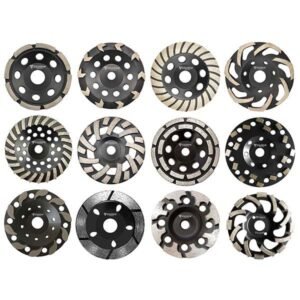
Diamond cup wheels are sold in three rim families, and they are not interchangeable. The rim decides how fast the wheel removes material, how the surface looks afterwards, and how the wheel behaves when it gets hot — which on concrete floors it always does.
| Dimension | Segmented rim | Continuous rim | Turbo rim |
|---|---|---|---|
| Structure | Separate diamond segments with open gullets between them | One unbroken diamond band round the full circumference | Angled slots cut into a near-continuous band |
| Stock removal rate | Highest — small contact area, high pressure per segment | Lowest | High, just below segmented |
| Dust and slurry clearing | Best — gullets throw material clear | Poorest — dust packs under the rim | Good |
| Heat dissipation | Best — air or water reaches the segment roots | Worst — heat has nowhere to go | Good |
| Overheating and glazing risk | Lowest | Highest — can polish the surface instead of cutting it | Moderate |
| Surface finish | Coarser scratch pattern, some visible tracking | Smoothest, most uniform scratch pattern | Relatively smooth for its speed |
| Edge chipping on brittle material | Can catch and chip an edge | Cannot catch — safest finish on brittle work | Moderate |
| Best wet or dry | Both, and the gullets help either way | Prefers wet to control heat | Both |
| Materials it is right for | Concrete, screed, terrazzo, asphalt, masonry, granite and hard stone levelling | Tile, marble, granite and engineered stone where the edge must stay clean | General concrete grinding where you want speed with a better finish |
| Typical use | Floor levelling, coating removal prep, trowel mark removal, high spot grinding, joint feathering | Cutting and finishing brittle surfaces, stock removal on the face of stone slabs and tiles | All-round concrete surface preparation |
| Do not use for | Finishing work where a visible scratch pattern is unacceptable | Concrete floors — it will glaze, overheat and slow down | Heavy coating removal |
The trade-off is straightforward: segmented buys speed and durability on hard mineral surfaces by giving up finish quality. That is why the standard concrete workflow is a segmented wheel first and a finer wheel second, rather than one wheel trying to do both jobs.
Full Specifications
| Product | T Segment Grinding Cup Wheels (segmented diamond cup wheels) |
|---|---|
| Function | Aggressive surface grinding, levelling and coating preparation on concrete, screed, terrazzo, masonry and stone |
| Segment type | T-shaped cross-section — wide grinding face on a narrow root for wider gullets and better clearance |
| Abrasive | Synthetic diamond, high concentration, in a metal matrix |
| Segment count | 8 (100 mm) · 9 (115 mm) · 10 (125 mm) · 11 (150 mm) · 12–14 (180 mm) · custom counts on request |
| Segment thickness | 5.5 mm standard · 8 mm heavy-duty on 130 mm and above |
| Outside diameter | 100, 105, 115, 125, 150, 180 mm (4″–7″) · 230 mm on request |
| Arbor / bore | 22.23 mm (7/8″) · M14 thread · 5/8″-11 thread · 20 mm on request |
| Diamond grit | #16/20 · #30/40 · #60/80 · #100/120 · #120/150 · #200 and finer |
| Bond hardness | Extremely soft · very soft · soft · medium-soft · medium · hard · very hard |
| Bond type | Metal matrix, soft to hard — matched to the concrete, not to the wheel life you would prefer |
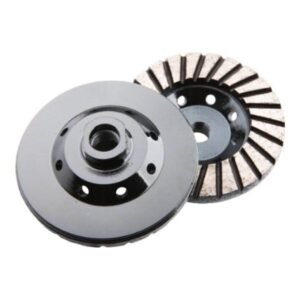
| Body | Pressed steel core with cooling, slurry-clearing and weight-saving holes |
| Attachment method | High-frequency silver brazing (standard) · laser welding (heavy-duty) · hot-press sintering |
| Coating | Powder coated in standard colours, or to your brand colour |
| Maximum speed — Ø100 mm | 15,300 rpm |
| Maximum speed — Ø115 mm | 13,300 rpm |
| Maximum speed — Ø125 mm | 12,200 rpm |
| Maximum speed — Ø150 mm | 10,200 rpm |
| Maximum speed — Ø180 mm | 8,500 rpm |
| Grinding mode | Dry with dust extraction, or wet with water suppression |
| Machines | Angle grinders (handheld) · floor grinders and single-disc machines · edge grinders · walk-behind planetary grinders |
| Applications | Concrete · screed and levelling layers · terrazzo · masonry and brick · asphalt · granite and hard stone · coatings removal preparation |
| Certification | ISO 9001 quality system · CE · EN 13236 safety standard for diamond tools · RoHS on request |
| Packaging | Neutral white box · blister or paper insert · branded carton with artwork |
| MOQ | 100 pcs standard · 500 pcs custom and OEM |
| Lead time | 5–10 days standard · 15–30 days custom |
| Payment | T/T · L/C · D/A · D/P · PayPal |
| Port of loading | Shanghai or Ningbo, China |
What the T Segment Actually Does
The difference between a single-row segment and a T segment is not cosmetic. It changes the contact pressure, the clearance around each segment and the way the segment wears.
A wide face on a narrow root
A T-shaped segment is wider across its grinding face than across its root, so instead of a rectangular block sitting on the body you get a flared post. Three things follow.
- The gullets get wider. Two neighbouring T segments open a broader, deeper channel between them than two single-row segments would. That channel is where the dust, the slurry and the water go — and it is the single biggest reason a T segment wheel stays free-cutting on an abrasive floor.
- Contact pressure goes up at the same machine weight. Grinding rate follows pressure per unit area, not total load. Narrower roots and a smaller total contact area mean the same angle grinder presses harder where it counts. That is why an operator feels a segmented wheel bite where a continuous one slides.
- The segment stays sharp as it wears back. As the segment shortens, the flare keeps presenting a relatively narrow leading edge to the work, so the wheel does not go blunt in the way a plain block does once its face has flattened.
Segment count against diameter
Segment count is a balance between speed and finish, and it scales with diameter so that the gap between segments stays roughly constant.
| Diameter | T-segment count | Segment thickness | Character |
|---|---|---|---|
| 100 mm (4″) | 8 | 5.5 mm | Edge work, light levelling, tight corners |
| 115 mm (4½”) | 9 | 5.5 mm | The everyday angle-grinder size |
| 125 mm (5″) | 10 | 5.5 mm | Most popular for concrete and screed grinding |
| 150 mm (6″) | 11 | 5.5 mm | Faster coverage on open floors |
| 180 mm (7″) | 12–14 | 5.5 or 8 mm | Large areas, walk-behind machines, heavy removal |
Why the body has holes in it
The two rings of holes in the steel body are doing three separate jobs, and all three matter on a long shift:
- Cooling. The steel body is the heat sink for the segments. Open holes let air move through the disc, so the body sheds heat instead of conducting it into the spindle and the operator’s hands.
- Slurry and dust clearing. On wet work the holes let water and slurry pass through the wheel rather than being trapped and re-ground. On dry work they reduce the amount of dust that recirculates under the wheel.
- Weight. A lighter wheel loads the grinder less, spins up faster and is easier to control at the end of a pass — and it costs less to ship, which is why the holes appear on almost every concrete cup wheel sold today.
Silver brazed or laser welded
The segments have to stay on the body under a load that is constantly trying to tear them off sideways, so the joint matters as much as the diamond.
| Joint | Strength | When it is the right choice |
|---|---|---|
| High-frequency silver brazing | High, with a controlled heat-affected zone | Standard production — the default for concrete and masonry cup wheels |
| Laser welding | Highest — a deep metallurgical bond, best impact resistance | Heavy-duty and walk-behind machines, high-feed grinding, brick and asphalt |
| Hot-press sintering | Moderate | Where a specific segment density or a one-piece body is required |
Bond Hardness: Match the Concrete, Not the Wheel Life You Want
This is where most concrete grinding goes wrong, and the rule runs opposite to intuition. Hard concrete needs a soft bond. Soft, abrasive concrete needs a hard bond.
The reason is that the bond has two jobs, and the balance between them depends on the material. A diamond only cuts while it is sharp. On hard, dense, high-strength concrete a diamond grain dulls quickly, so it has to be released and replaced quickly — you want a bond that lets go. On soft or abrasive concrete the opposite happens: the aggregate is full of hard mineral particles that do not dull the diamond much but do sand away the metal matrix, so a soft bond simply disappears. There you want a hard bond that holds the diamonds for as long as possible.
| Bond grade | Behaviour | Choose it for |
|---|---|---|
| Extremely soft / very soft | Diamonds release almost immediately, very free cutting | Hardest, densest concrete; high-strength and low-water-cement floors; hard granite |
| Soft | Fast release, cool cutting | Hard concrete and hard natural stone aggregate |
| Medium-soft / medium | Balanced release and life | The safe default when you do not know the slab — general concrete grinding |
| Hard | Holds diamonds longer, higher glazing risk | Soft, abrasive concrete; green or new concrete; light finishing passes on hard concrete |
| Very hard | Maximum diamond retention | Highly abrasive aggregate, asphalt, and surfaces where the matrix wears faster than the diamond |
How to read the symptoms on site:
| What you see | What it means | Change |
|---|---|---|
| The wheel stops cutting and the surface goes shiny and polished | Bond is too hard for this concrete — the diamonds have dulled but are still held | Move to a softer bond; if you are mid-job, open the wheel by dressing it briefly on a piece of abrasive block |
| The wheel wears away fast and the segments vanish | Bond is too soft for this concrete — the matrix is being eroded by the aggregate | Move to a harder bond |
| Sparks are bright and the wheel glows | Too much pressure, too little speed or no coolant | Reduce pressure, raise speed to the machine’s rating, add water |
| Steady fine dust, moderate spark, wheel holds its size | Correctly matched | Nothing — this is the setup you are looking for |
Grit Selection for Concrete
Grit is the second decision after bond hardness, and it is decided by what you are trying to remove and what the surface has to be ready for next.
| Grit | Removal rate | Finish | Use it for |
|---|---|---|---|
| #16/20 | Highest | Very coarse scratching | Thick coating removal, heavy levelling, bulk removal on big floors |
| #30/40 | Very high | Coarse | The standard first cut — levelling high spots, removing trowel marks, feathering joints |
| #60/80 | High | Medium | General grinding, coating and adhesive removal once the floor is flat |
| #100/120 | Moderate | Fine | Second cut — preparing for coatings, sealers, overlays and adhesive |
| #120/150 | Moderate | Very fine | Fine surface preparation before a thin coating or a polish |
| #200 and finer | Low | Polishing preparation | Dense hard surfaces, the first step before resin polishing pads |
A practical floor procedure is two grits, not one: a #30/40 T segment wheel for the first cut to get the floor flat and remove the surface layer, then a #100/120 or #120/150 wheel for the second cut to produce the surface the coating or sealer needs. Trying to take a floor flat with a fine grit takes several times as long, and trying to prepare a coating surface with a coarse grit leaves scratches that show through the coating.
Dry or Wet Grinding?
The wheel will do both. The decision is about dust, heat and cleanup, not about the wheel.
| Factor | Dry grinding | Wet grinding |
|---|---|---|
| Dust | Crystalline silica dust — a regulated respiratory hazard. Requires a shroud and a rated extractor, plus a respirator. | Almost none — dust becomes slurry |
| Heat in the segment | Higher; the gullets and air do the cooling | Lowest — water carries heat away at the source |
| Wheel life | Shorter on hard floors | Longer, because the bond runs cooler |
| Surface visibility | Poor — you are working blind into dust | Good — you can see the cut as it happens |
| Cleanup | Dry vacuum and go, if the extractor is working | Slurry has to be contained, pumped or squeegeed and disposed of |
| Speed of the job | Faster on small areas and outdoors, because there is no water handling | Usually faster overall indoors, because you avoid dust containment and see what you are doing |
| Best for | Outdoor work, small areas, jobs where water is not available or not permitted | Indoor floors, large areas, coating removal prep, fine second cuts |
Coatings, Adhesive and the PCD Question
A diamond grinding wheel removes concrete. It does not remove coatings, and reaching for one when there is a coating on the floor is the most common source of wasted time and burnt-out wheels.
Diamond segments grind: they abrade a hard brittle material into dust. Epoxy, polyurethane, mastic, adhesive, rubberised membranes and paint are none of those things — they are tough, flexible and often slightly sticky. A diamond segment pushed against them does not cut, it heats them. The coating softens, smears across the segment face, fills the pores and glazes the wheel. From that point on the wheel is polishing a rubber mat.
The tool for that job is a PCD wheel — polycrystalline diamond cutters mounted on the same kind of steel body. PCD works by shearing rather than grinding, slicing under the coating and lifting it off the slab. That is a different mechanism, a different tool and a different page: see our Concrete PCD Grinding Cup Wheels for coating, adhesive and membrane removal.
The two tools are meant to be used in sequence on a typical renovation:
| Surface on the slab | Right tool | Why |
|---|---|---|
| Thick epoxy, resin or membrane coating | PCD wheel | Shears the coating off instead of heating it |
| Adhesive, mastic, glue residue | PCD wheel | Grinding a tacky layer loads the segments instantly |
| Thin paint, sealer or curing compound | Coarse diamond wheel, #16/20 or #30/40 | Thin enough to grind, and the coarse grit clears it |
| Levelling compound and screed | T segment diamond wheel | Mineral and hard — exactly what the wheel is for |
| Bare concrete, high spots, trowel marks | T segment diamond wheel | The core application |
| Concrete flat, preparing for coating | Finer diamond wheel, #100/120 | Produces the profile the coating needs |
The practical rule: if the material bends or peels instead of turning to dust, it wants PCD. If it turns to dust, it wants diamond.
Machine Set-Up and Technique
The same wheel behaves completely differently on a handheld angle grinder and on a walk-behind floor grinder, because the two machines apply pressure in completely different ways.
| Machine | How it loads the wheel | What that means for you |
|---|---|---|
| Handheld angle grinder | Operator pressure — variable, and easy to overdo | Let the wheel do the work. Pressing harder does not remove more concrete, it flattens the diamonds and builds heat. Use the grinder’s own weight plus light guidance. |
| Walk-behind floor grinder | Machine weight plus added ballast | Pressure is set by the ballast, so the operator’s job is depth of cut and travel speed, not downward force. Add ballast for hard floors, take it off for soft or delicate work. |
| Single-disc machine | Machine weight, one head | Good for edges and small areas; expect more tracking marks than a planetary machine. |
| Planetary grinder | Weight distributed across multiple counter-rotating heads | Flattest results, no directional scratch pattern, best for floors that will be coated or polished. |
| Edge grinder | Small diameter, operator guided | Use a 100 or 115 mm wheel to get into corners the main machine cannot reach. |
Technique on the floor follows from the same logic:
- Overlap each pass by about a third to a half of the wheel width. Less overlap leaves visible track lines that no coating will hide.
- Keep moving. Stopping in one place is how you burn a floor and glaze a wheel. A steady walking pace gives even removal; standing still gives a hollow.
- Two directions for the first cut. Run the first pass one way, then cross it at roughly 90°. This flattens high spots a single-direction pass would leave behind.
- Let the machine’s weight work. On a walk-behind, if you are leaning on the handle you are not removing more material, you are loading the machine and wearing the wheel.
- Watch the dust or the slurry, not the wheel. A consistent plume of fine dust means the wheel is cutting correctly. A trickle of dust with sparks means pressure without cutting.
- Check the floor with a straightedge as you go. Grinding is a measuring job as much as a cutting job; sample the surface every few square metres rather than at the end.
Applications & Materials
| Application | Typical specification | Notes |
|---|---|---|
| Concrete floor levelling and high spot removal | #30/40, soft to medium bond, 125 mm | First cut, two directions, check with a straightedge |
| Trowel mark and surface laitance removal | #30/40 or #60/80, medium bond | Do not over-grind — the aim is to expose a clean surface, not to remove depth |
| Joint and patch feathering | #30/40 to #60/80, medium-soft bond | Small diameter wheel gives better control at the transition |
| Coating removal preparation | #16/20 or #30/40, soft bond | Take the coating off with PCD first, then profile the concrete |
| Coating and sealer profiling (second cut) | #100/120 or #120/150, medium bond | Produces the anchor profile the coating needs |
| Screed and levelling compound grinding | #30/40, medium bond | Softer than structural concrete — a harder bond often lasts better |
| Terrazzo grinding | #30/40 coarse stage, moving to finer grits | Follow with finer diamond wheels and then resin polishing pads |
| Masonry, brick and block | #16/20 or #30/40, hard bond, laser welded | Abrasive material — expect matrix wear and choose a hard bond |
| Asphalt and abrasive surfaces | #16/20, very hard bond | Matrix erosion dominates; hardness matters more than grit |
| Granite and hard stone levelling | #30/40, soft to medium-soft bond | Hard mineral, so release the diamonds quickly |
| Step, threshold and edge work | #30/40, 100 or 115 mm | Small diameter for access; keep the guard fitted |
Suitable materials at a glance
| Material | Suitability | Bond to choose |
|---|---|---|
| Standard concrete | Primary use | Medium-soft to medium |
| Hard, dense, high-strength concrete | Excellent | Soft or very soft |
| Green or new concrete | Suitable | Hard — soft bonds vanish in green concrete |
| Screed and self-levelling compound | Excellent | Medium to hard |
| Terrazzo | Excellent | Medium, with finer grits as you progress |
| Masonry, brick, block | Excellent | Hard to very hard |
| Asphalt | Suitable | Very hard |
| Granite and hard stone | Excellent | Soft to medium-soft |
| Marble, tile, engineered stone | Possible with care | Use a continuous rim wheel where the edge must stay clean |
| Thick epoxy, adhesive, membranes | Wrong tool | Use PCD cutters instead |
How to Use a T Segment Diamond Cup Wheel
- Identify what is on the floor. Bare concrete, screed or a coating. If the surface peels or is flexible, you need a PCD wheel first, not this one.
- Test the concrete hardness. A scratch test with a screwdriver or a small trial grind in a corner tells you whether you need a soft or a hard bond. On an unknown slab, start with a medium-soft bond.
- Choose the grit for the stage. #30/40 for the first cut, #100/120 or finer for the second. Do not try to do a whole floor with one grit.
- Match the wheel to the machine. Check the arbor — 22.23 mm, M14 or 5/8″-11 — and confirm the grinder’s rated speed does not exceed the maximum rpm marked on the wheel for that diameter.
- Fit the guard and the dust shroud. Fit the guard before the wheel, keep it fitted, and never remove it because it is inconvenient in a corner.
- Set up dust or water control before you start. Dry: extractor rated for silica dust plus a respirator. Wet: a steady water feed at the cut, contained so the slurry can be collected.
- Run the wheel up to speed off the floor for 30 seconds. Listen for any change in note and watch for vibration. If a segment is loose, this is where you find out, with the wheel not touching anything.
- Start with a light pass. Bring the wheel onto the surface gradually, then let the machine’s weight and a steady walking pace do the work.
- Grind the first cut in two directions. One pass forward, one pass crossed at 90 degrees, overlapping each pass by a third to a half of the wheel width.
- Check flatness with a straightedge as you go. Mark the high spots and take them down rather than grinding the whole floor deeper.
- Switch to the finer grit for the finishing cut. Once the floor is flat, a #100/120 wheel produces the profile a coating or sealer will bond to.
- Watch for the glazing signal. If the wheel stops cutting and the surface begins to look polished, the bond is too hard for this concrete. Stop, change to a softer bond, and open the glazed wheel by dressing it briefly on an abrasive block.
- Retire the wheel at the right time. When the segments wear down to within 2 to 3 mm of the steel body, stop. Grinding the body damages the floor and the machine, and a worn-out wheel no longer cuts efficiently anyway.
Frequently Asked Questions
What is a T segment diamond cup wheel used for?
It is a heavy-duty grinding wheel for concrete and stone, used on angle grinders and floor grinders to level uneven slabs, remove high spots and trowel marks, feather patch repairs and joints, and prepare a surface for coatings, sealers or overlays. The T-shaped segments make it more open than a single row wheel, so it stays free-cutting on abrasive concrete and clears dust and slurry out of the cut. It is the right wheel for grinding the concrete itself, not for stripping thick coatings — that is a job for PCD.
Segmented or continuous rim diamond cup wheel — which one do I need?
Segmented for concrete, screed and masonry, where you need material removal rate and the gullets allow dust and heat to escape. Continuous rim for stone, tile and hard dense material where a clean edge and a smooth scratch pattern matter more than speed, because the unbroken rim cannot catch or chip an edge. Turbo sits between the two: angled slots give near-continuous cutting with better clearance than a continuous rim. If you are preparing a concrete floor, buy segmented; if you are finishing a granite edge, buy continuous.
Should I choose a soft or hard bond for concrete grinding?
Match the bond to the concrete, and the rule runs opposite to intuition. Hard, dense, high-strength concrete dulls the diamonds quickly, so you want them released quickly and you choose a soft bond. Soft or abrasive concrete, green and new concrete, and asphalt do not dull the diamonds much but they do erode the matrix, so you choose a hard bond to slow the wear. A hard bond on hard concrete glazes and polishes the surface instead of cutting; a soft bond on abrasive concrete disappears in a few square metres.
What grit do I need for concrete grinding?
Use #16/20 or #30/40 for aggressive stock removal: levelling high spots, removing thick coatings, grinding down trowel marks. Use #60/80 for general grinding and coating removal once the surface is flat. Use #100/120 for fine grinding and preparing a surface for a coating or a sealer. Use #200 and finer for polishing preparation and dense hard surfaces. Most contractors keep two wheels — a #30/40 for the first cut and a #100/120 for the second — rather than trying to do everything with one grit.
Can I grind concrete dry with this cup wheel?
Yes, the wheel is rated for both dry and wet use, but dry grinding concrete means crystalline silica dust, which is a serious respiratory hazard and a regulated exposure in most markets. Dry grinding requires a properly rated dust extractor connected to a shroud on the grinder, plus a respirator — never a household vacuum. Wet grinding removes the dust problem, keeps the wheel and the surface cool and lets you see the surface while you work, at the cost of slurry handling and cleanup. On indoor work, wet is usually the faster decision overall.
What is the maximum speed for a 125 mm diamond cup wheel?
It depends on the diameter, and the marking on the wheel is set to keep the rim within its safe peripheral speed. As a working guide: 100 mm 15,300 rpm, 115 mm 13,300 rpm, 125 mm 12,200 rpm, 150 mm 10,200 rpm and 180 mm 8,500 rpm. Never fit a large diameter wheel to a grinder rated for a smaller one, and never remove the guard. Always check that the spindle speed on the grinder does not exceed the maximum rpm marked on the wheel.
When should I use a PCD wheel instead of a diamond grinding wheel?
When the material on top of the concrete is the problem rather than the concrete itself. Thick epoxy, polyurethane and resin coatings, adhesive, mastic, paint, screed and trowel-applied levelling compounds should be sheared off with PCD segments, which cut rather than grind and do not load or clog. Diamond grinding segments are for removing concrete. Trying to grind away a thick epoxy coating with a diamond cup wheel just loads the wheel, generates heat and glazes the segments. Once the coating is off, switch to a diamond cup wheel.
MOQ, lead time, OEM and samples?
MOQ is 100 pieces for standard sizes and bonds; custom diameters, segment counts, grits, bond hardness, arbor threads and branded packaging are made to order with an MOQ of 500 pieces. Standard sizes ship in 5 to 10 days and custom production in 15 to 30 days after deposit. OEM and ODM are welcome with your own brand, colour, artwork and packaging, and samples are available at cost with the sample fee returned against your first official order. Payment terms are T/T, L/C, D/A, D/P and PayPal.
OEM & Wholesale
Concrete cup wheels are a specification-plus-branding product: the same 125 mm body can be built with very different segment counts, grits and bond hardness, and two contractors will disagree about which is best on their local aggregate. Tell us the floor you are grinding and the machine you are running, and we will build to that rather than to a catalogue number.
| Outside diameter | 100 / 105 / 115 / 125 / 150 / 180 mm · 230 mm on request |
|---|---|
| Arbor / bore | 22.23 mm (7/8″) · M14 · 5/8″-11 · 20 mm on request |
| Segment count | 8 / 9 / 10 / 11 / 12 / 14 per diameter, or to your specification |
| Segment thickness | 5.5 mm standard · 8 mm heavy-duty |
| Diamond grit | #16/20 · #30/40 · #60/80 · #100/120 · #120/150 · finer on request |
| Bond hardness | Extremely soft · very soft · soft · medium-soft · medium · hard · very hard |
| Attachment | High-frequency silver brazing · laser welding · hot-press sintering |
| Body finish | Powder coated to standard colours or to your brand colour |
| Private label | Neutral white box · blister and paper insert · full colour branded carton · artwork design support |
| Certification | ISO 9001 quality system · CE · EN 13236 · RoHS on request · SGS inspection available |
| MOQ | 100 pcs standard · 500 pcs custom and OEM |
| Lead time | 5–10 days standard · 15–30 days custom, after deposit |
| Payment | T/T · L/C · D/A · D/P · PayPal |
| Port of loading | Shanghai or Ningbo, China |
Huzhou Gu’s Imp. & Exp. Co., Ltd. has manufactured diamond tools under the GUSHI and Roycel brands since 2004 from Huzhou, Zhejiang, with a production capacity of around 100,000 sets a month and customers in more than 20 countries including the USA, Canada, Germany, the UK, Italy, Brazil, Chile, Australia and South Africa. One of only 23 Chinese companies to win the diamond blade anti-dumping case in the US market, we export at a 6.2% anti-dumping tariff rate. A good number of our customers have been buying from us for more than ten years.
Related products: Concrete PCD Grinding Cup Wheels for coating and adhesive removal · Diamond Grinding Plates for floor grinding systems · L Shape Grinding Cup Wheels and Fan Shape Grinding Cup Wheels for other segment layouts · Concrete Floor Polishing Pads for the polishing stage · Cup Shape Diamond Grinding Wheels for metal-bond tool grinding.