
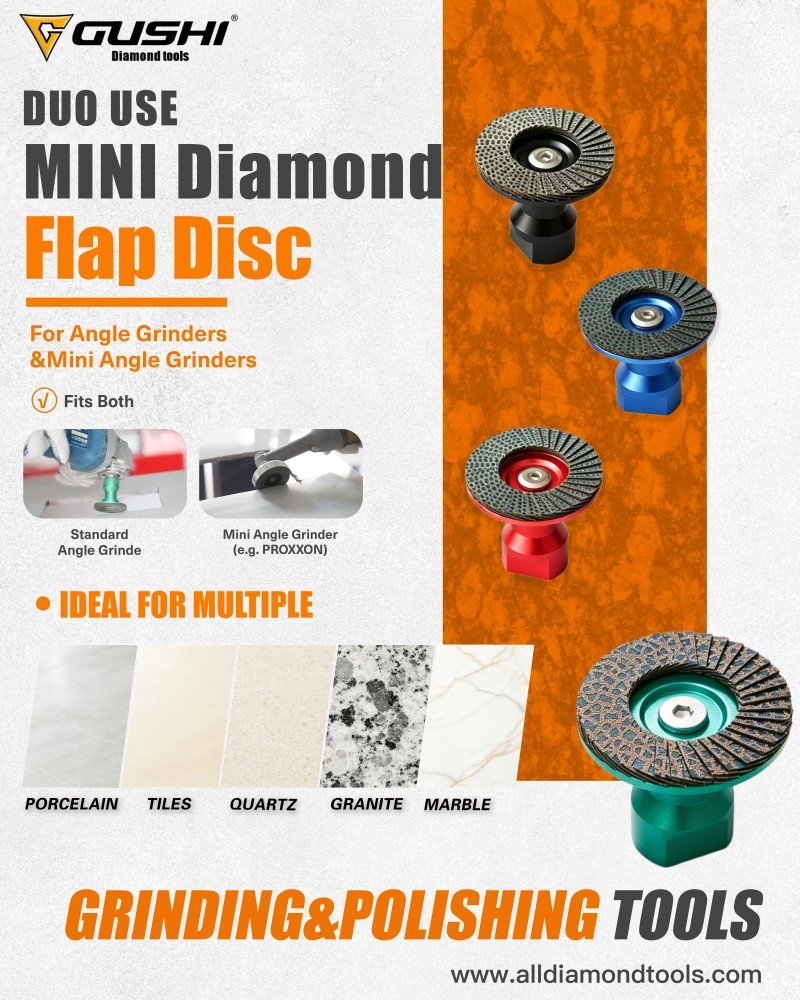
1. The poster, decoded: what “duo use” actually claims
The exhibition poster makes five statements about this product, and it is worth separating what each one commits to from what it leaves open — because on this page, as on every product page we write, the difference matters more than the adjectives.
| What the poster says | What it specifies | What it commits to | What is still open |
|---|---|---|---|
| MINI Diamond Flap Disc | A flap disc in the mini format — small diameter, detail work, low power draw | A disc sized for precision work and mini tools | The exact diameter — the poster prints none (section 7) |
| DUO USE / Fits Both | The same disc fits a standard angle grinder and a mini angle grinder | One consumable serving the workshop’s two most common machines | How the two mountings are achieved — hub variants or adapters (section 4) |
| For Angle Grinders & Mini Angle Grinders | The two machine families, photographed and labelled | Compatibility with both classes of tool | Thread or bore for each variant — M14 / 5/8-11 versus the mini mounting |
| IDEAL FOR MULTIPLE: porcelain, tiles, quartz, granite, marble | The material list, shown as swatches | A bond and grit ladder tuned for hard stone and tile | Grit availability per material |
| GRINDING & POLISHING TOOLS | The process range: material removal through to polish preparation | A multi-grit product family, not a single-grit disc | The exact grits stocked |
What the poster does not print is a diameter, a grit, an arbor size or a speed rating — and that restraint is honest, because those figures belong on a datasheet and a spec table, not on a wall graphic. Everything numeric on this page is therefore marked as class convention or indicative until the datasheet confirms it, and section 14 lists exactly which values must be replaced before publishing. What the poster does establish, and what this page is built on, is the product’s identity: a mini, electroplated, duo-use diamond flap disc for grinding and polishing hard stone and tile.
2. What electroplated buys — and what it costs
Everything about how this disc behaves follows from one manufacturing fact: the diamond is held by electroplating, not by sintering or brazing. In electroplating, a steel hub is placed in a nickel bath charged with suspended diamond grit, and an electric current deposits nickel that mechanically traps a single layer of fully exposed grains. There is no chemical bond between diamond and nickel, and no second layer behind the first. That single sentence explains every advantage and every limitation.
What the single layer buys
| Advantage | The mechanism | What it means at the bench |
|---|---|---|
| Fastest cut from first contact | 100% of the diamond is exposed on the surface — no bond covering the grains, nothing to wear down before the disc works properly | The disc is at its sharpest when new, which is when detail work needs it most |
| Sharpest, most precise profile | The hub is machined before plating, so the geometry is exact and the layer is thin and uniform | Clean chamfers and crisp edges without the shaping a sintered disc needs |
| Clog-free on hard materials | Exposed grains plus the gaps between flaps give swarf somewhere to go; diamond does not load the way conventional abrasives do | It keeps cutting on glazed ceramic and glass instead of glazing over |
| No dressing, no break-in | There is no matrix to expose — the working diamond is already at the surface | Ready to use out of the pack; no wasted passes seasoning the disc |
| Lowest price per disc | Simple process, single layer, less diamond than a multi-layer segment | Cheap enough to use as a true consumable — change grits and discs freely |
| Low heat and light cutting force | Sharp grains cut with low resistance rather than rubbing | Usable on heat-sensitive glass and glazed tile without burning the surface |
What the single layer costs
| Limitation | The mechanism | What it means in use |
|---|---|---|
| Shortest life of the diamond processes | One layer of diamond; when it is worn or shed, there is nothing behind it | Treat the disc as a consumable — budget replacements, not reconditioning |
| Cannot be dressed or renewed | There is no multi-layer matrix to erode and expose fresh grit | A dull electroplated disc is finished; do not try to clean or true it back to life |
| Performance declines with wear | Grains dull and shed; the cutting rate drops through the disc’s life | The first third of the life is the fastest; judge the disc by how it cuts, not how it looks |
| Mechanical bond only | Nickel holds the grains mechanically; heavy load can shed them early | Light pressure is not a nicety — it is what keeps the grains in the bond |
The three diamond processes, side by side
| Property | Electroplated (this disc) | Hot-pressed / sintered | Vacuum brazed |
|---|---|---|---|
| Diamond layers | Single, fully exposed | Multi-layer in a metal matrix | Single, chemically bonded |
| Initial sharpness and speed | Fastest from first contact | Slower — matrix must wear to expose grit | Very aggressive |
| Tool life | Shortest | Longest — self-sharpening as layers erode | Medium — typically two to four times electroplated |
| Precision and profile | Highest — machined before plating | Good, may need dressing | Good |
| Clog resistance | Excellent | Moderate — matrix friction is higher | Good |
| Dressing required | None | Yes, typically | Rarely |
| Upfront cost per disc | Lowest | Highest | Medium |
| Best for | Detail work, short runs, glass and ceramic, precision edges | Production volumes, heavy grinding, long life | Aggressive roughing, refractory materials |
3. The grit ladder: from #60 to polish preparation
One flap disc is one rung. The product’s value is the ladder: a set of discs from coarse to fine that takes an edge from raw cut to polish-ready in sequence. Electroplated diamond discs in this class are conventionally offered across the range below; the exact grits stocked for this product are a datasheet item (section 14).
| Grit | Stage | What it does | Typical use |
|---|---|---|---|
| Coarse, around #60 | Rough grinding and stock removal | Removes material fast; levels high spots; cuts the first chamfer | Raw cut edges, lippage removal, shaping the bulk of a recess |
| Medium, around #120 | Shaping and beveling | Defines the chamfer angle and removes the coarse-grit scratch pattern | Edge profiles, bevels, removing saw marks |
| Fine, around #200–#400 | Surface preparation | Leaves a uniform, semi-smooth surface ready for polishing | Final finishing before a polish pad, deburring, edge blending |
| Very fine, #600 and up | Polish preparation | Refines the surface so a polishing pad has fine work left to do | Pre-polish on porcelain and marble; scratch repair on glass |
The three rules that make the ladder work
- Work in sequence, coarse to fine. Skipping a rung does not save time: a fine grit cannot remove coarse-grit scratches efficiently, and you will spend longer getting a worse result.
- Clean between grits. Coarse diamond particles left on the surface will be picked up by the finer disc and scratch the work — undoing the previous stage. A wipe and a rinse between grits costs seconds and saves the finish.
- Match the grit to the material’s hardness.Quartz and granite are hard and abrasive; they consume coarse grits fastest and reward a medium start. Porcelain and ceramic are brittle; they want sharp grains and light pressure, and they chip if you push a coarse disc where a medium one would do.
For most tile edge work the practical set is three discs — a coarse for shaping, a medium for the profile, a fine for the finish — with a very fine added where the edge will be polished rather than left matte. Buying a single mid grit and trying to do all four stages with it is the most common way to end up with a scratched edge and three worn discs.
4. Two machines, one disc: what actually changes
“Duo use” is a mounting claim, and the mounting is the part to confirm on the variant you order. What this section covers is the half that does not need confirming: what changes in technique when the same disc moves between a standard angle grinder and a mini one, because the two machines deliver the same disc at completely different working conditions.
The physics: same disc, different rim speed
A grinder’s RPM is not the working variable — the rim speed is, and rim speed scales with diameter at the same RPM. A mini disc turns at the same RPM as a full-size one but covers far less ground per revolution:
Ø100 mm disc at 10,000 RPM → 52.4 m/s (standard angle grinder)
Ø50 mm disc at 10,000 RPM → 26.2 m/s (mini angle grinder, same RPM)
Half the rim speed at the same RPM means the mini disc cuts more gently per revolution, removes less material per pass, and generates less heat at the contact point. That is why the mini machine is the right one for detail work and heat-sensitive edges, and the wrong one for heavy stock removal — and why the technique, not just the hub, has to change with the machine.
What changes between the two machines
| Factor | Standard angle grinder | Mini angle grinder (e.g. PROXXON) |
|---|---|---|
| Rim speed at equal RPM | Higher — full-size disc | Lower — small disc; gentler cut, less heat |
| Power and torque | High — sustains heavy stock removal | Low — the tool’s own weight is usually enough pressure |
| Control | Coarser control; momentum carries the cut | Fine control — detail work, recesses, small parts |
| Best operations | Levelling flats, long edges, heavy chamfering | Short chamfers, internal corners, tile cut-outs, scratch repair |
| Heat management | More material removed per pass — watch for heat build-up | Lower heat at the contact — safer on glazed and thin material |
| Typical mistake | Leaning on the tool; dwelling in one spot | Pressing to compensate for low power — which sheds the single-layer diamond |
The mounting question, stated honestly
The two machine families take different mountings, and this is the part of “duo use” to verify before ordering. Standard angle grinders use the conventional hub thread — M14 female in European markets, 5/8″-11 in North America. Mini angle grinders of the PROXXON class take a small-bore or shank mounting, and the mini diamond flap discs common in that class are specified with a 10 mm bore held by flange and screw. How this product delivers both mountings — hub variants, an included adapter, or a bolt-on flap design — is a datasheet item, and a disc supplied with the wrong mounting is unusable on either machine. The four hub colours shown on the poster may encode the mounting, the grit, or nothing at all; confirm before publishing any colour coding (section 14).
5. How the flap disc works at the edge
The flap format is not a shape chosen for looks. Three mechanisms work together, and together they are what let a single-layer disc finish a brittle surface cleanly.
Many small edges, engaging in sequence
A flap disc carries dozens of small diamond flaps around the hub rather than one continuous rim. As the disc turns, the flaps engage the surface in sequence, so the cutting load is spread across many small edges instead of concentrated on one rim. Two consequences matter. The disc wears evenly instead of developing a single worn track, and each individual flap presents a fresh cutting edge as it enters the work — a continuous self-renewal at the scale of the flap, even though the diamond layer itself is single-layer and finite.
Compliance: the flap bends, the edge survives
Each flap is thin and mounted flexibly, so the working surface conforms slightly to the material instead of riding rigidly over it. On a slightly uneven tile edge or a curved profile, that compliance keeps more of the diamonds in contact at a uniform depth, which is what prevents the single high spot that gouges. It also absorbs vibration: a mini grinder at high RPM transmits every imbalance to the edge, and a rigid disc turns that vibration into chatter marks. A flap disc rides over it.
Heat and swarf: why it does not clog or burn
Electroplated diamond is fully exposed, so the grains cut with low resistance instead of rubbing — and friction is what generates the heat that glazes conventional abrasives and burns glazed ceramic. The gaps between the flaps give swarf a route out of the contact, so the disc keeps cutting on glazed and glassy surfaces where a continuous rim would load up. Diamond also conducts heat away from the contact far better than aluminium oxide or silicon carbide. Add water and the heat problem largely disappears; run dry and the disc still cuts, but hotter, with more dust and a shorter life (section 10).
6. Applications and materials
The operations this disc does
| Operation | What it involves | Grit to start |
|---|---|---|
| Rough grinding and levelling | Removing material fast; flattening a high spot; taking a raw cut edge down to size | Coarse |
| Chamfering and beveling | Cutting a consistent angle along a tile or stone edge | Coarse, then medium |
| Edge rounding and arrising | Softening a sharp factory edge without changing the profile | Medium |
| Deburring | Removing the sharp swarf left by a cut on porcelain or quartz | Medium to fine |
| Surface preparation | Producing a uniform matte surface ready for a polishing pad | Fine |
| Detail and recess work | Shaping cut-outs, internal corners and small parts — the mini machine’s territory | Medium |
The materials it cuts
| Material | Performance | Notes |
|---|---|---|
| Porcelain and porcelain stoneware | Core case — chip-free edges | Light pressure; the hardest common tile rewards sharp grains |
| Ceramic tile | Core case | Watch the glaze: keep moving, avoid dwelling |
| Quartz and engineered stone | Good | Abrasive — consumes the single layer fastest; wet preferred |
| Granite | Good | Wet preferred for life and dust |
| Marble and natural stone | Good | Soft for diamond — cuts easily; finish with fine grits |
| Glass | Good with care | Light pressure, keep moving, water if possible |
| Ferrous metals, wood, plastics | Not suitable | Steel gums the disc; wood and plastics are not diamond’s economics |
The material list on the poster — porcelain, tiles, quartz, granite, marble — is the design brief, and the electroplated process is the right answer to it: hard, brittle, abrasive materials are exactly where fully exposed sharp diamond outperforms both conventional abrasives and multi-layer bonds. What the disc is not for is steel, wood or plastic; those belong to different abrasives, and a diamond disc used on them wears out for no return.
A worked example: chamfering a run of porcelain tiles
The job: 100 rectified porcelain tiles, 600 × 600 × 10 mm, factory edges softened with a 1 mm chamfer, finished matte, no chips. This is the sequence the duo-use format is built for.
| Stage | Machine and disc | What happens | Time reality |
|---|---|---|---|
| 1. Cut the tiles | Standard grinder with a thin turbo blade | Straight cuts to size; the cut edge is sharp and slightly ragged | Not this product’s job — the flap disc follows the blade |
| 2. Rough the chamfer | Standard grinder, coarse grit | One pass per edge at 15–20° takes the sharpness off and sets the chamfer width | Fast — coarse grit removes porcelain quickly; the disc earns its keep here |
| 3. Refine the chamfer | Standard grinder, medium grit | Second pass removes the coarse-grit scratch pattern and makes the chamfer uniform along its length | The stage most people skip — and the reason edges look scratched at the end |
| 4. Finish the edge | Mini grinder, fine grit | Short controlled passes leave a uniform matte finish; the mini machine’s lower rim speed keeps the glaze and edge cool | Slower per edge, but this is where chips are prevented, not created |
| 5. Detail and clean-up | Mini grinder, fine grit | Internal corners, cut-outs and any spot the big grinder could not reach | The duo-use point: no second consumable line for the detail machine |
Read the economics honestly. One coarse disc handles the roughing of the whole run; the medium disc does the refinement; the fine disc on the mini machine finishes. That is three single-layer discs consumed — which is exactly what the electroplated trade is for: each disc is spent at the stage where its sharpness matters, and none is asked to do a stage it is wrong for. A hot-pressed disc would outlast all three, but it would cost more than the three combined and would need dressing before it cut cleanly — the wrong trade for a 100-tile job, and the right one for a thousand.
7. Full specifications
| Product name | Mini Diamond Flap Disc (duo use, electroplated) |
|---|---|
| Brand / manufacturer | GUSHI — Huzhou Gu’s Imp. & Exp. Co., Ltd., Huzhou, Zhejiang, China |
| Product type | Electroplated diamond flap disc, mini format |
| Abrasive | Industrial-grade synthetic diamond, single layer, fully exposed |
| Bond | Nickel electroplate (mechanical retention; no chemical bond) |
| Hub / backing | Hardened steel hub; flexible flap substrate |
| Machine fit | Duo use — standard angle grinders (M14 / 5/8″-11 class) and mini angle grinders (e.g. PROXXON); confirm mounting per variant |
| Diameter | Mini format; class convention for mini electroplated flap discs is 50–100 mm — confirm stocked diameters against the datasheet |
| Grit range | Coarse to fine diamond grits, conventionally #60 to #800 for this class — confirm stocked grits against the datasheet |
| Hub colours | Multiple colours shown on the poster — confirm whether they encode grit, mounting or are cosmetic before publishing any coding |
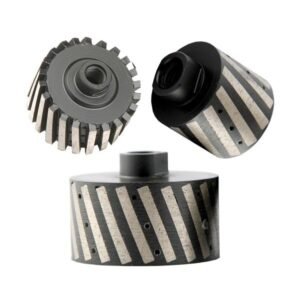
| Centre fastener | Central bolt visible on the discs shown — consistent with a replaceable-flap construction; confirm mechanism (see FAQ 9) |
| Cutting mode | Dry and wet; wet extends life and controls dust |
| Dressing | None required — single-layer disc, replaced when exhausted |
| Operations | Grinding, chamfering, beveling, edge rounding, deburring, surface preparation |
| Applications | Porcelain, ceramic, tile, quartz, granite, marble; natural stone and glass |
| Not suitable for | Ferrous metals, wood, plastics |
| Machines | Standard angle grinders and mini angle grinders with the matching mounting |
| Safety standard | EN 13236 practice for superabrasive products applies to the disc class; confirm which variants are marked and to what scope |
| Quality system | ISO 9001:2015; 100% inspection before shipment; SGS inspection on request |
| Packing | Skin card / blister / colour box; bulk for wholesale |
| HS code | 6804.22 (diamond abrasive tools) — confirm against your customs broker |
| MOQ | 500 pieces (indicative) |
| Lead time | 25–30 days after advance payment |
| Payment terms | T/T, L/C, D/A, D/P, PayPal |
| Port of loading | Shanghai or Ningbo, China |
8. Mini duo-use electroplated against the alternatives
Three ways to buy a diamond flap disc, side by side: this mini duo-use electroplated disc, a standard-size electroplated flap disc, and a hot-pressed multi-layer disc. The comparison explains where each one wins, and why the answer is usually “both, for different jobs” rather than one product.
| Dimension | This disc: mini, duo use, electroplated | Standard-size electroplated flap disc | Hot-pressed multi-layer flap disc |
|---|---|---|---|
| Format | Mini diameter; standard and mini machine mountings | Full diameter, grinder thread | Full diameter, grinder thread |
| Machine fit | Both machine families — one consumable line | Standard grinders only | Standard grinders only |
| Initial sharpness | Fastest from first contact | Fastest from first contact | Slower — matrix must wear to expose grit |
| Tool life | Shortest — single layer, not reconditionable | Short — same single-layer limit | Longest — self-sharpening, multi-layer |
| Precision and detail | Highest — small format, crisp profile | High | Good; may need dressing |
| Cost per disc | Low | Low | Higher |
| Cost per hour of work | Low for short detail work; high in volume | Low for short work | Lowest in sustained production |
| Heat at the edge | Lowest rim speed at equal RPM — gentlest on glazed and thin material | Moderate | Highest — matrix friction; water usually needed |
| Clog resistance | Excellent | Excellent | Moderate |
| Best for | Detail work, short runs, two-machine workshops, glass and ceramic | Full-size edge work where life is short anyway | Production grinding where life dominates the economics |
The honest summary: this disc wins on versatility, sharpness, precision and price per disc; the hot-pressed disc wins on life and cost per hour in volume; the standard-size electroplated disc is the same trade at a bigger diameter. A workshop that buys all three is not indecisive — it is matching the process to the job, which is the only way consumables pay for themselves.
9. Buying checks: what to verify before the box ships
An electroplated flap disc is a consumable with no dressing and no second chance, which makes the receiving inspection the only quality gate there is. The checks below take minutes, need no laboratory, and catch the failures that actually occur in this product class — because a single-layer disc with a plating defect or an unbalanced hub is not merely disappointing, it sheds diamond on the first pass.
What to look for on the disc itself
| Check | What good looks like | What a failure looks like |
|---|---|---|
| Flap coverage | All flaps present, evenly spaced, uniform height around the hub | Missing flaps (imbalance and vibration), uneven flap heights (the disc will chatter and gouge) |
| Plating quality | Continuous nickel bond; diamond exposed and evenly distributed; no bare patches | Bare patches, dull zones, or clusters where the plating has not taken — the disc will cut unevenly and shed grains |
| Flap-to-hub joint | Flaps firmly attached; no lifting at the edges; no separation line visible | Lifting or delamination — the flap will tear off at speed |
| Hub condition | No cracks, no rust, no distortion; thread or bore clean and undamaged | A cracked or bent hub is scrap at any price — it fails centrifugally, not gracefully |
| Runout | Spun by hand on its own arbor, the rim runs true with no visible wobble | Visible wobble means the disc is out of balance; it will vibrate, over-cut and wear unevenly |
| Centre fastener | Present, tight, correct type — if the design is bolt-on | A loose or missing bolt is an immediate reject, and a stripped one is a design fault |
| Marking | Size, grit, brand and any safety marking legible on the hub or card | Missing or illegible marking — an untraceable consumable is a process failure, not a cosmetic one |
The ten-second test run
Visual checks catch the obvious failures; a short run on scrap catches the rest. Bring the disc to speed on a piece of offcut porcelain or tile, make three or four light passes, and watch three things: the swarf should be even and consistent, the disc should track without pulling to one side, and there should be no shower of loose diamond coming off the surface. A disc that immediately glazes, chatters, pulls, or sheds grains has a defect that no amount of technique will compensate for — reject it and ask for the batch to be checked, because a plating or balancing problem is a batch problem, not a bad-luck disc.
What to ask the supplier for
- Batch or traceability code on the disc or the smallest packaging unit, linking the disc to a production lot — the mechanism by which a complaint becomes a correction rather than a credit note
- The plating process statement — diamond grit size and concentration, bond thickness convention, and the substrate specification
- The safety standard position — which variants carry EN 13236 marking and to what scope (section 14 lists the confirmation needed before this is published)
- Sample-first ordering — samples at cost plus freight, credited against the first order, which is the cheapest inspection of all
These checks cost an importer almost nothing and protect the one thing a consumable programme cannot afford: a batch of discs that fails in the customer’s hands, where the cost is not the disc but the rework, the tile and the reputation.
10. How to use: step by step
- Confirm the mounting before power. Check that the disc’s hub matches the machine — thread, bore or shank, per section 4. A disc on the wrong mounting is not a field fix.
- Inspect the disc. No missing or lifted flaps, no delamination between flap and hub, no cracks in the hub, no play in the centre fastener. A damaged single-layer disc sheds grains and is scrap.
- Fit the guard and your protection. Eye protection always; hearing protection on the standard grinder; respiratory protection rated for fine silica dust whenever cutting dry.
- Secure the workpiece. Clamp tile and stone; never hold small pieces by hand. The mini machine’s high RPM plus a grabbed workpiece is how fingers are lost.
- Bring the disc to speed before contact. Start the tool, let it reach working speed away from the work, then bring it in gently. Contact at part speed loads the single layer and can shed grains immediately.
- Use light, steady pressure. The weight of the tool is usually enough, and on the mini machine it is always enough. Pressure does not speed up diamond; it sheds grains and generates heat. If material is not coming off, change grit, not force.
- Keep it moving. Sweep the disc across the work rather than dwelling in one spot. Dwelling is what causes local heat, glazing and gouges — especially on glazed ceramic and glass.
- Hold the working angle deliberately. Roughly 15–30° for chamfering and edge work; flat for surface levelling. A consistent angle is what produces a consistent chamfer.
- Work the grit ladder and clean between stages. Coarse to fine, wipe or rinse the surface between grits so coarse diamond cannot scratch in the finer stage.
- Retire on performance, not appearance. When cutting slows and the disc starts to glaze, the single layer is exhausted — replace it. Electroplated discs are consumables; there is no dressing or renewal. Store them dry, flat, flaps protected from impact.
Working parameters by machine
| Machine | Rim speed at equal RPM | Pressure | Mode |
|---|---|---|---|
| Standard angle grinder | Higher — more material per pass | Light; let the disc float over the surface | Dry for short passes; wet for volume, dust control and life |
| Mini angle grinder (e.g. PROXXON) | Lower — about half at equal RPM | Tool weight only; never lean | Dry for detail passes; wet whenever heat or dust is a concern |
These are starting points for porcelain, tile and stone. Glass and glazed ceramic want the lightest pressure and constant movement; quartz and granite want wet cutting and an acceptance that the single layer will be consumed faster. If the disc leaves a smeared or glazed track, the pressure is too high or the speed too low — back off before changing anything else.
11. Frequently asked questions
What is a diamond flap disc used for?
Grinding, shaping and finishing hard, brittle materials. On porcelain, tile, quartz, granite and marble it does rough grinding and levelling, chamfering and beveling, edge rounding, deburring, and surface preparation before polishing. Because the abrasive is diamond rather than aluminium oxide or silicon carbide, it removes hard-stone material quickly without glazing, and the flap format conforms slightly to the surface so it finishes evenly instead of gouging.
What does “duo use” mean — does one disc really fit both machines?
It means the same flap disc geometry is offered for both mounting families: the standard angle grinder and the mini angle grinder such as PROXXON. What changes between them is the hub and the working parameters, not the flap itself — the standard-grinder version uses the conventional grinder thread, while the mini version uses the small-bore or shank mounting that mini tools take. Confirm the exact mounting on the variant you are ordering, because a disc with the wrong hub is not usable on either machine. Section 4 sets out what changes in technique between the two.
Why is this disc electroplated rather than hot-pressed?
Because electroplating holds a single layer of fully exposed diamond in a nickel bond, which makes it the sharpest and fastest-cutting diamond bonding process from the first contact — ideal for the detail work mini discs do. The trade is life: a single-layer disc cannot be dressed or reconditioned and is replaced when the layer is exhausted, where a hot-pressed multi-layer disc keeps exposing fresh diamond and lasts longer at a higher price. For short, precise work the electroplated disc is the right default; for production volumes on a standard grinder, the hot-pressed disc usually pays back.
How long does an electroplated diamond flap disc last?
Shorter than a hot-pressed or vacuum-brazed disc of the same diameter, and there is no way to extend that by dressing — once the single diamond layer is worn or shed, the disc is a consumable that is finished. Actual life depends on the material, the pressure and whether you run wet: hard, abrasive materials such as quartz and granite consume it fastest, and heavy pressure accelerates wear by shedding grains before they are dull. Judge it by performance, not by appearance — when cutting slows and the disc starts to glaze, it is finished.
Which grit should I start with?
Match the grit to the operation, and work in sequence. Coarse grits, around #60, remove material fast and are for rough grinding, levelling and the first chamfer. Medium grits, around #120 to #200, shape the edge and remove the coarse-grit marks. Fine grits, from #400 up, prepare the surface for polishing. Clean the workpiece between grits — coarse diamond particles left behind will scratch in the finer stages and undo the work. Starting too fine wastes the disc and takes longer; starting too coarse leaves more stages to complete.
Can I use it dry?
Yes — electroplated diamond discs work well dry because the fully exposed grains dissipate heat and the flap format clears swarf without clogging, which is why they are common on site where there is no water. Two cautions. Dry cutting of stone and porcelain produces fine silica dust, so respiratory protection and ventilation are required, and a dry disc runs hotter than a wet one, which shortens its life and risks thermal damage on glass and glazed ceramic. Where the job allows water, wet cutting cools the rim, controls the dust and extends the disc’s life.
Will it work on glass and ceramic?
Yes — hard, brittle materials are exactly where electroplated diamond is strongest, because the sharp exposed grains cut rather than fracture the surface, and the low cutting force keeps chipping under control. On glass and glazed ceramic use light pressure, keep the disc moving and avoid dwelling, since localised heat is what causes chips and cracks. If the workpiece shows any crazing or the disc starts to glaze, stop: reduce pressure or add water rather than pressing harder.
What machines does it fit?
Both families the poster names. Standard angle grinders take the conventional threaded hub — M14 in European markets, 5/8-11 inch in North America — and deliver the power for larger flats, edges and heavier stock removal. Mini angle grinders, with PROXXON long-neck models the named example, take the small-bore or shank mounting used by that class of tool and trade power for control, which is what detail work, recesses and small parts need. The duo-use product covers both; confirm the mounting on the variant you order.
Can the flaps be replaced when they wear out?
On some mini flap disc designs the diamond flaps are retained by a central bolt so a worn flap set can be unbolted and replaced while the hub is kept — a design that changes the running cost substantially, because the hub stops being a consumable. The discs shown on our poster carry a central bolt, which is consistent with that construction, but confirm the mechanism on the actual product before relying on it: if the flaps are bonded rather than bolted, the whole disc is replaced. Ask us which construction your order is built on.
What is the MOQ, lead time and OEM support?
The indicative MOQ is 500 pieces with a lead time of 25 to 30 days after receipt of advance payment; loading ports are Shanghai and Ningbo. OEM and private-label programmes run on the same specification, including hub colour, laser marking, skin card, blister and colour-box packing, and your own barcode. Samples are available at cost price plus freight, credited against a subsequent order. Payment terms are T/T, L/C, D/A, D/P and PayPal. All figures are indicative and should be confirmed against current production terms.
OEM & wholesale
Huzhou Gu’s Imp. & Exp. Co., Ltd. has manufactured and exported diamond tools from Huzhou, Zhejiang since 2004, working with partner factories in the region for more than twenty years, and supplies this mini flap disc as single discs and in retail packing to importers, distributors and private-label programmes. GUSHI is one of the 23 Chinese manufacturers that won the anti-dumping case for diamond blades exported to the USA, holding a 6.2% tariff rate — a compliance heritage that matters to distributors serving regulated markets. Production capacity is 100,000 diamond-tool sets per month.
| Parameter | Standard | To order |
|---|---|---|
| Format | Mini flap disc, duo use | Diameters across the mini range; hub colours per programme |
| Abrasive and bond | Electroplated single-layer industrial diamond in nickel bond | Grit selection and concentration per material mix |
| Grit ladder | Coarse to fine, conventionally #60 to #800 | Sets and ladders built to your process sequence |
| Mounting | Standard and mini angle grinder variants | Hub, thread or shank per your market’s machine population |
| Marking | Laser marking on hub; size and grit on card | Logo, brand and barcode |
| Packing | Skin card / blister / colour box | Bulk, private-label artwork, your own barcode |
| Quality | 100% inspection before shipment under ISO 9001:2015 | SGS inspection |
| Terms | T/T, L/C, D/A, D/P, PayPal; MOQ 500 pieces; lead 25–30 days | Samples at cost plus freight, credited against the first order |
| Port of loading | Shanghai or Ningbo, China |
For private-label programmes the two items worth settling early are the grit ladder — because your customers will judge the set by whether the sequence works, not by any single disc — and the mounting variants, because a duo-use programme that ships the wrong hub for a market generates returns no packing specification can fix.